Mix Picks Chicks Flix, by John Ostrander
 Generally speaking, I’m a guy. When I get dressed, I’m usually not worried about the ensemble, just about whether it’s relatively clean. I’m not concerned about my “looks,” considering that at my age I haven’t got many looks left to consider. My sweetie Mary likes how I look and that’s good enough for me.
Thing is – I’m not really a “guy’s guy.” I don’t follow sports all that closely but that’s because I’m mostly interested in my home teams. Because I’m at heart a Chicago boy, that means that – with the exception of certain comparatively rare periods of time – following sports is an exercise in masochism, especially as I am a Northsider, which makes me a Cubs’ fan.
I’m not into the whole “alpha male” thing, either. Never was, never will be. If “winning” is that big a deal to the other guy and it’s not over anything important to me – fine, I don’t care. He wins. If the jerk in the other car HAS to zoom around me, cut me off, and gain 2.5 seconds – okay. I continue on, generally catch up at the next stoplight, pull in behind him and then mime laughing at him, pointing at his car, so he can see me in the rear view mirror. I never said I wasn’t petty.
I also don’t always give in. People who assume that get a surprise when it’s on something that matters to me – or I’m just feeling contrary and cranky.
What I’ve discovered lately, however, is that I’m into certain films that are sometimes called “chick flicks,” in which producers target the female demographic. Sometimes they’re called “date films,” which means the girl may be able to get the guy to go see them with her and he won’t feel threatened or get too bored. Generally speaking, they are notable for a lack of explosions and testosterone based swaggering, and goes for dialogue rather than catch phrases. Generally, the characters move the plot rather than the plot moving the characters. (There’s nothing inherently wrong or better in either approach; just in how it’s done.) And I tear up at the appropriate moments towards the end, my emotions just as skillfully played upon as any woman’s.
Stella Dallas doesn’t do it for me, neither does An Affair To Remember and, sorry, but I watched Gone With the Wind all the way through exactly once and that was enough. Scarlett is a magnificent bore, I couldn’t care less about Tara, and the plot becomes one calamity after the other piled up until, like Rhett Butler, I just don’t give a damn.
Here’s some movies about which I do give a damn. In fact, if I happen across any of them while I’m channel surfing, I’ll probably stop and watch through the end.
When Harry Met Sally – the first of three Nora Ephron films, although she only wrote this one; Rob Reiner (who has directed a slew of my favorite films) directed. It stars Meg Ryan with Billy Crystal (she would team up with Tom Hanks in the latter two films) and has a terrific supporting cast including Carrie Fischer, Bruno Kirby and, in a key cameo, the director’s mother in the orgasmic Katz’s Deli scene.
In all three films, Meg Ryan is in full America’s sweetheart mode, which means she’s cute and funny. In this film, Billy Crystal plays the part that Tom Hanks would later take and he’s fine. The story documents Harry and Sally’s relationship from acquaintances through friends through lovers that then break up and, finally, in a New Year’s Eve scene, find they really are meant for each other. I suppose I respond to it in part because I’ve experienced something like it twice – When Johnny Met Kimmie and the sequel When Johnny Met Mary. In both cases, I was acquaintance, friend, and finally found love with someone. The first time was with the late Kim Yale and now with my sweetie, Mary Mitchell. Oddly enough, both were met at Comic book Conventions. Hmmm. I wonder if I should talk with Nora Ephron. A great romantic comedy.
Sleepless in Seattle – this time, Nora Ephron writes and directs although Rob Reiner plays one of the supporting roles, somewhat analogous to the part Bruno Kirby played in When Harry Met Sally. This time, Tom Hanks plays the romantic lead and, while Meg and Billy Crystal were terrific, Meg and Tom Hanks are incredible – even though they spend almost no time together on the screen.
Hanks in the film plays a widower, Sam, with an eight year old son, Jonah, and they both live on a houseboat in Seattle. Ryan plays Annie, a magazine writer who is engaged to a prosaic fellow and they are on the East Coast. Jonah goes on a therapist’s talk show on the radio one Christmas Eve talking about how his Dad needs a new wife; said therapist eventually not only entices Sam on the phone but gets him to talk as well. Annie, listening on the car radio while she’s driving towards a family gathering, is drawn to him. It takes the rest of the film until she, Sam, and Jonah all meet on top of the Empire State Building on Valentine’s Day and Sam and Annie instantly fall in love.
In many ways, the film is dated. Jonah has to travel cross-country by himself and take a cab in NYC to the Empire State Building solo. These days that scares the life out of me; part of me thinks “Jonah is so dead.” Annie also comes across as a stalker. Post 9/11, I’m not sure you can get to the top of the Empire State Building much anymore and a child’s backpack left behind would be a cause for the bomb squad – not the final plot twist the movie anticipates.
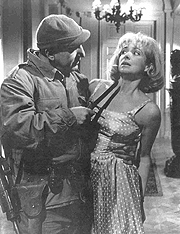 That all said, there is once again a terrific supporting cast (something that is noticeable in all these movies) – Rosie O’Donnell and Bill Pullman stand out, Pullman especially as Annie’s fiancée, Walter, who could have been made into a jerk but is a nice guy who just isn’t Tom Hanks. Who is? Pullman has great warmth, which will also serve in the next film I’ll discuss. Odd note in a fine performance – Rita Wilson, Hank’s real life wife, plays his sister in the film. Really nice job as well and is part of a hysterical scene where her real life husband and her film husband, Victor Garber, get into weepy hysterics over the ending of The Dirty Dozen.
I’m fully sensible why this film works for me as it does. Although it came out in 1993, I didn’t see it until after Kim died, which would have been at least four or five years later. It’s Hank’s performance as the widower, speaking about his late wife and how much he misses her that feels so real and forms the honest emotional center of the film. He doesn’t expect to find that again – but he does. So did I and, yes, the ending moves me to tears.
While You Were Sleeping – this is sort of faux Nora Ephron/Meg Ryan/Tom Hanks and the plot is pretty ridiculous but it just works for me all the same. Sandra Bullock made her run on Meg Ryan as America’s sweetheart with this one and Bill Pullman is more or less the Tom Hanks character. Supporting cast includes Peter Gallagher, Peter Boyle, Jack Warden, and Glynis Johns and they’re all pretty cool. It’s set in Chicago which, of course, makes me forgive a lot in it and the film makes good use of Chicago locations.
Bullock is Lucy who works the entrance booth on one of the elevated train stations in the Loop, which is Chicago’s downtown. She has a crush on Peter Gallagher’s character, Peter – a shallow and vain stockbroker type – and, when he slips and falls on the tracks, saves him. Through a mix-up when she takes him to the hospital, they think she is his fiancée. He’s in a coma and, while he is sleeping, she meets his family – who all think she is Peter’s fiancée – and falls in love with Peter’s brother, Jack, played by Bill Pullman. Peter eventually awakes, becomes convinced he has amnesia and that he really is engaged to Lucy and Lucy, because she is in love with Peter’s family, agrees to go through with the wedding. Relax – she winds up marrying the right brother because that’s what happens in films like this.
Like I said, the plot strains but Bullock manages to sell it and Bill Pullman has a warm side to him and makes a very good romantic lead – one that hasn’t been used much. There’s some weird touches in the film – the super in Lucy’s building seems right out of Noo Yawk rather than Chicaguh but overall the film works for me.
You’ve Got Mail – another classic Ephron/Ryan/Hanks team-up – why aren’t there more? The film is a remake/update of The Little Shop Around the Corner although the update itself now seems dated. Basic story is the same – two people, man and woman, who can’t get along in real life fall in love with each other as pen pals or, in this case, e-mail buddies. This time Meg is Kathleen Kelly who runs a small children’s bookstore in an upscale NYC setting, The Little Shop Around the Corner. Hanks plays Joe Fox, part of a family that runs a chain of big book stores that is about to open a new outlet near the aforementioned Little Shop. And he drives her out of business. Great premise for a romantic comedy, eh?
Again, a great gaggle of supporting actors in this – Greg Kinnear who starts as Meg’s boyfriend, Frank, and Parker Posey as Hank’s girlfriend, Patricia. Add in Jean Stapledon, whose Birdie once had a fling with Spain’s dictator, Franco, and Dabney Coleman as Hank’s father, famous for running off with his son’s nannies, and Dave Chappelle, who is a bit wasted here.
Hanks discovers that the woman he has been anonymously chatting to via the Internet and with whom he seems to have so much in common is the woman he can’t stand in real life, who he has just put out of business, and who hates his guts. He courts her anyway. I guess the comic book geek in me likes the idea that he has an alter ego. Like the ending of Sleepless in Seattle, this is also a visual valentine to New York City.
The Upside of Anger – I’ve written about this one before but it really belongs in this discussion. Joan Allen is incendiary (and damned funny) in the central role of a woman whose believes her husband has left her. She gets into drinking and turns an acid tongue on all those around her. Allen doesn’t ask for our sympathy and doesn’t pull punches. At heart is the relationship that she has with her vanished husband, with her daughters, and with her new relationship, the boozy former baseball player Denny, played by Kevin Costner. This film is what Stella Dallas looks like for our times. More so than the others, I think of this as a “chick flic” in that it focuses on women’s relationships and feelings. The ending narration is a little overwritten, trying to be profound when it should just let the movie stand as it is, but Allen’s performance wins over everything. Costner, by the way, gives a fine supporting performance but it’s Allen’s rage, her bitterness, that makes the film work in what is, essentially, a comedy. There’s a humanity here that draws me in every time.
In Her Shoes – okay, no bones about it, this is a “chick flic.” It’s also a comedy but the central relationship is between two sisters and the major secondary relationships are with their grandmother and their mother. The relationships with men, father, son-in-law, fiancées, friends, they all come after that. Oh, and shoes are definitely a big factor in the story. And shopping. What I’m saying is that I’m probably not the target demographic. I love it anyway.
Basic storyline: Cameron Diaz and Toni Collette play Maggie and Rose, the two sisters mentioned above. Maggie is a Wild Child and Rose is down to earth. Maggie winds up living with (and off) Rose and winds up ‘accidentally” sleeping with Rose’s lover – which gets her banished from her sister’s apartment (not unreasonably). Maggie winds up crashing at her long vanished grandmother’s apartment in a retirement home in Florida. After the breach of trust, can these two sisters ever be close again?
This film also has some wonderful supporting actors, starting with Shirley MacLaine who is just about reason enough to watch it right there. Throw in Ken Howard, Francine Beers, and Jerry Adler among others and you got a terrific cast.
I have sisters and I know what a complicated relationship that can be – far more, in my opinion, than brothers or even brother and sister. The film is laugh out loud funny at times but it speaks directly to that relationship, for good and bad. It opts for growth, understanding, change, and reconcilement. What’s not to love?
In calling a film “chick flic,” I want to stress it’s not a put down. It simply acknowledges that the film was made with a certain audience in mind and that falls along gender lines. In fact, it’s a crime that more films aren’t made to primarily appeal to women – but that’s another column. I also know that gender targeting is not universal. I know women who don’t have a “romantic” bone in their body and would be bored to tears by most of these films. My sweetie Mary gets into westerns and war films and she’s as into the Bourne films as I am, which has plenty of action. So I’m not advocating gender stereotypes.
However, all our psyches have both male and female sides. As a writer, I need to have access to both and have a dialogue going between the two sides. The films I’ve mentioned above play on and to the emotions and, despite the crap we’ve been told, real men feel emotions. Real men aren’t afraid of them. There’s nothing unmanly about crying at the end of a film.
Especially The Dirty Dozen. Every time I watch, I think that Jim Brown is going to make it and then. . .and then. . .
Oh gawd, where’s my Kleenex?
John Ostrander writes GrimJack: The Manx Cat, new installments of which appear every Tuesday here on ComicMix, and much of Munden’s Bar, new installments of which will reappear anon here on ComicMix. Both for free. Can’t beat that. His new Suicide Squad mini-series is out there from DC Comics, and his Star Wars: Legacy is out there from Dark Horse, both at finer comics shops across the galaxy.
Kleenex is a registered trademark of the Kimberley-Clark Corporation. Makers of fine products. So watch your ass, pal.