Power!, by Dennis O’Neil
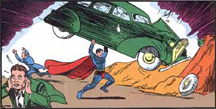 So you wanna be a superhero. Okay, where are your powers going to come from?
For years – nay, hundreds of years; nay, thousands of years – the brief answer was: From out there. Somewhere. The first superbeings in popular culture (the only kind there was, back then) were either gods, or pals of gods, or imbued with magical abilities, the origins of which weren’t necessarily clear or important. What was important was…wow! – look at what he/she/it can do! And so much the better if it, whatever spectacular thing it is, is being done for reasons I approve of.
That’s still what’s important. But our minds seem to be wired to want reasons for what we see, which is certainly why there’s science and may be why there’s art and civilization. But, oddly, once a reason is supplied, many of seem to be satisfied and require nothing further. The great cosmic snortlefish created the oceans? Swell, now I know why there’s all that water and what’s for dinner?
By the time Jerry Siegel got around to thinking up Superman in the summer of 1934, magic wasn’t terribly fashionable and it had long since become divorced from religion. But science…ah, science was going to deliver us and besides, it was real. And Jerry was a reader of science fiction, which, in those happy days, at least claimed to be rooted in physics and chemistry and astronomy and stuff like that. So it was natural, maybe inevitable, that he would give his übermensch a science rationale. Guy comes from another planet, sure – that’d be why he could be so powerful. Makes sense. Made sense to Jerry in 1934, probably would have made sense to me when I was the age Jerry was when he created Superman, if I’d thought about it.
Superman was the first in a long line of costumed superfolk whose abilities were explained by a nod to science. Among them: the Flash, who happened to be standing near some chemicals that were struck by lightning and the resulting whatever-it-was splashed on him and voila! – the world’s fastest man, and no carb loading needed; the second version of Green Lantern, whose mojo was an artifact from a vastly advanced civilization; the X-Men, whose gifts were explained by mutation; the late Captain America, who was enhanced by being injected with a drug; and my favorite, Spider-Man, who was bitten by a radioactive spider and…you know the rest.
Of course, this list is the merest sampling of science-derived explanations for superpowers; anyone whose done even a little comic book reading, or summer movie-going, can add to it.
Science was the favored gimmick, here, but that doesn’t mean there was no magic in comics. The most popular superhero of the 40s, in fact, was Captain Marvel and he got his muscle by uttering a magic word, Shazam. (Anybody out there familiar with Cap who hasn’t, at some time, said “Shazam” and waited for results? I mean, it can’t hurt to try…) There were a handful of good guys in comics who actually called themselves “magicians” and a few more whose powers came from magic, most notably the original, 1940s, Green Lantern, whose ring and lantern were…you know, magic.
There’s one other notable source of superpowers but that’ll have to wait until next week, as will my perhaps lame attempt to tie all this into the topic we are merrily beating to death, the evolution of superheroes.
RECOMMENDED READING: Spy vs Spy: The Complete Casebook, by Antonio Prohias.
Dennis O’Neil is an award-winning editor and writer of comic books like Batman, The Question, Iron Man, Green Lantern and/or Green Arrow, and The Shadow, as well as all kinds of novels, stories and articles. The Question: Zen and Violence is on sale right now in trade paperback