Author: Robert Greenberger

Robert Greenberger is best known to comics fans as the editor of Who's Who In The DC Universe, Suicide Squad, and Doom Patrol. He's written and edited several Star Trek novels and is the author of The Essential Batman Encyclopedia. He's known for his work as an editor for Comics Scene, Starlog, and Weekly World News, as well as holding executive positions at both Marvel Comics and DC Comics.
0

REVIEW: Beam Me Up Sulu

It is likely that many Star Trek fans since the 1960s have shot home movies, recreating Gene Roddenberry’s television in their basements and backyards. I know I was part of one in sixth or seventh grade. So, it’s little surprise that film students in California in 1985 wanted to take their turn at making one such film.

Yorktown: A Time to Heal was the brainchild of college student Stan Woo, who worked with friends and fellow students to make this tribute to the series. Funded largely by Woo’s father, the production cost about $10,000 and was shot in and around the area between 1985 and 1987. Surprisingly, he coaxed George Takei to reprise the role of Hikaru Sulu in this fan film while awaiting work on Star Trek IV: The Voyage Home. Perhaps even more surprising, Woo found and convinced veteran character actor James Shigeta (Die Hard) to join the production in the role of “revered” Admiral Nogura.

Star Trek production designer Joe Jennings and special effects artist Andrew Probert even contributed to the production. Both were easily located through the phone book (trust me, these were simpler days).

And then the film disappeared. Woo admitted in the 90-minute documentary Beam Me Up Sulu that the Paramount Pictures canvas bag containing the film reels was misplaced in his family home, where it remained undiscovered for years.

Meantime, John Atkin read about the production in Starlog #119 in 2010 and wanted to watch the film. He found Woo, learned the film was never quite finished, and offered to help. Between 2010 and 2022, Atkin worked sporadically on digital effects while additional scenes were filmed to complete the story.

The 23-minute fan production debuted on April 2, 2022, and is available on YouTube. This documentary, produced by Timour Gregory and Sasha Schneider, recounts how this remarkable production came to be and places it in context within the world of Star Trek.

Eugene Roddenberry recounts his father’s pre-television career, while copious film clips depict the social issues consuming the 1960s, with science fiction author Robert J. Sawyer noting that the series was a beacon of hope amid the chaos. Takei himself discusses his upbringing, including the now well-told story of his time in the Japanese internment camps. There’s a digression on how Asians were depicted in film and television until Takei helped break stereotypes with Sulu. Several other actors from across the sprawling franchise—Garrett Wang, Christina Chong, Alexander Siddig, and Ian Alexander—all chime in about how the original series paved the way for diversity to flourish (perhaps Roddenberry’s greatest legacy).

There’s even a section covering diversity and acceptance within the fan community and at conventions (although the scenes are all from pro events like Creation rather than fan-run shows).

As a result, we get a lot of digressions to pad out the film, each element deserving its own examination. The real joy is watching the young cast and crew in behind-the-scenes footage from the original production, along with recollections from several participants. James Sheigeta’s widow was totally unaware of his participation, and there’s genuine delight on her face as she sees his scenes for the first time. To bridge some of the stories, the producers brought in Gazelle Automations to produce Filmation-style animated bits, which provide a nice touch.

This is a mostly engaging documentary, available on disc from Tribeca Films, and a true Valentine to Star Trek and the generations of fans who were in some way inspired by its promises.

0

REVIEW: Soviet Land

Soviet Land
By Pierre-Henry Gomont
320 pages/Abrams ComicArts/$34.99

Those of us of a certain age recall when the Berlin Wall was breached and the USSR, the evil empire that was our Cold War enemy, was shattered. We knew of détente, perestroika, Mikhail Gorbachev, and the other big players of the time.

But, as I recall, the Western press didn’t spend a lot of time talking about what this meant to the citizens of the former organization who were now merely Russians. We heard about the rush of capitalism and the arrival of America’s biggest brands, but also about supply shortages and long lines for meager offerings. But the full picture of daily life remained elusive.

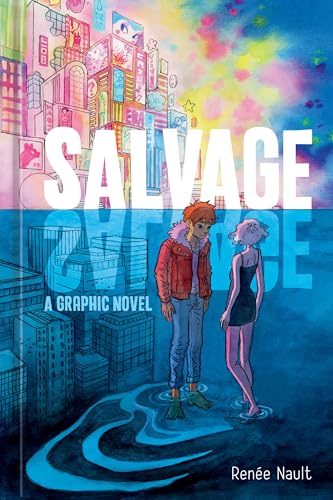
French creator Pierre-Henry Gomont invites us along for a glimpse into what that world must have been like for people living there. We open a few years into the new era and follow the efforts of the young, disillusioned artist Slava and the con man Dmitiri Lavrin as they scavenge and sell remnants of the old regime amid the country’s collapse. We watch as they, like so many others, loot abandoned Soviet sites for valuables to sell to collectors and to put food on the table. They’re an odd couple, but their friendship is genuine as they look after one another throughout the story.

At one stop along their nomadic path, they encounter Volodya and his daughter Nina, who are squatters in their latest target. The older man physically is the old Russian bear, menacing to those who threaten him or his daughter, who, of course, has caught Salva’s eye.

We follow their travails as Lavrin breaks away to use his skills to parlay his way out of poverty and become a major wheeler-dealer. Volodya and Nina get involved in an abandoned mining operation, trying to repair its equipment and put people to work, but find themselves embroiled in a new form of corruption, embodied by Morkhov, one of the oligarchs who cares about money rather than Communist ideals.

Gomont, a former sociologist, has been producing acclaimed graphic novels since 2011, and this appeared as a three-album series between 2022 and 2024, making its English-language debut in this collection. His energetic art is expressive, with kinetic, layered pages and loose, flowing linework. It’s an appealing style and makes the complicated interrelations between characters and story arcs easy to follow.

He explores the erosion of ideals, the struggle for survival, profiteering, and the search for purpose in a disorienting new world. Being Russian, it has its share of humorous moments and keen tragedy. 

1

REVIEW: Moneyball

Geeks come in all shapes, sizes, and flavors. Among the earliest might be Henry James, who developed the box score for baseball, which evolved under Bill James into the field of Sabermetrics. An entire generation of people scoured box scores and then followed James, who dug deeper and came up with entire categories Major League Baseball had never considered. After all, to them, the Save and the Hold were still newfangled concepts in the 1980s. 

In 2001, though, those stats and their analysis broke through to the professional ranks. After losing the World Series to the Yankees, in a true David and Goliath matchup, the Oakland Athletics were about to lose first baseman Jason Giambi, outfielder Johnny Damon, and pitcher Jason Isringhausen to free agency, and there just weren’t the financial resources to match what other Big Market teams were willing to pay. General Manager Billy Beane, a young but open-minded executive, lost out on a trade with Cleveland but met a Yale economics graduate named Peter Brand, who had theories about player value that ignored the handful of stats MLB typically used. Intrigued, Beane hired Brand, and together, they built a stronger A’s for 2002, and after convincing old-school manager Art Howe to try it, they found success.

Business writer Michael Lewis covered this transformation in the best-selling book Moneyball: The Art of Winning an Unfair Game, which became the hit film Moneyball in 2011, and has just arrived on 4K disc from Sony Home Entertainment.

Director Bennett Miller (Capote) faced the challenge of presenting statistics in a compelling way to keep audiences riveted in their seats. It helped that he had Steven Zaillian’s help, who wrote the original script for Steven Soderbergh. When he left the project in 2009, Miller was hired, and he had Aaron Sorkin revise the script so that the two had clearly delineated personalities and matching dialogue.  Miller was fortunate to assemble a stellar cast, led by Brad Pitt, Jonah Hill, and Philip Seymour Hoffman as this triumvirate of executives. The tension comes from Brand convincing Beane, then executing the plan until they hit the stone wall of Howe, chipping away at him, until finally the plan is executed to smashing success. They are three very different personalities, each with vastly different experiences, and they find common ground thanks to the singular goal of winning.

Anyone who knows baseball knows this was a turning point in analytics, and suddenly, one team after another hired their version of Peter Brand, including Bill James himself, which lends importance to this story, since it worked outside expectations and delivered, and could be replicated.

The film comes with 4K Digital HD and a Digital Code. The 2160 transfer is very good, though not as sharp as one might hope, given the quality of the 1080 edition from 2013. The video is supported with an excellent DTS-HD 5.1 Master Audio mix, ported over from the Blu-ray, so you can enjoy the game without leaving your home.

This 15th anniversary edition eschews major new supplemental features but uses the ones from the original 2013 Blu-ray release:

Deleted Scenes (3 clips, 12:05); Brad Loses It (3:11); Billy Beane: Re-Inventing the Game (16:02); Drafting the Team (20:51); Moneyball: Playing the Game (19:28) Adapting Moneyball (16:33); Theatrical Trailer (new to the collection, 2:33)

0

REVIEW: Human Nature: Book 1

Human Nature: Book 1
By Darren Aronofsky, Ari Handel, and Jeff Welch
208 pages/Abrams ComicArts/$29.99

When an inventive filmmaker like Darren Aronofsky produces a graphic novel, it warrants attention. His work on Black Swan, The Wrestler, and Requiem for a Dream, among other movies, shows an inventive director but also an inquisitive storyteller, examining different aspects of the human condition. Here, without budgetary limitations, he tackles the biggest issue of them all: life after death.

Here, he partners with his frequent screenwriting collaborator Ari Handel, along with screenwriter Jeff Welch (Bet Your Life), who first conceived the idea in 2011, although none of them could craft a script that secured studio funding. (George Clooney was considered for Duke, which would have been an interesting approach.) This is a first for them all, which may be why the story takes so long to ramp up.

We are introduced to Duke, a self-made success who leverages his poultry business to become one of the world’s richest men. He seeks a way to cheat death, taking the Walt Disney route of cryogenics, hoping that the brain tumor slowly killing him can be cured at some future date. He finds such a company but decides it costs too much, so he buys it out and grows it into profitability through scale by offering to freeze the near-dead for a mere $99.99.

Duke is not a pleasant person, letting the bottom line dictate his choices, refusing to acknowledge people’s frailties. The only glimmer of kindness emerges when he discovers the existence of Pembroke, an adult daughter he never knew. He’s frozen before he can search, thanks to the unscrupulous actions of his number two.

His search for her drives some of the story. When he awakes, Duke discovers an unrecognizable world, one where aliens have invaded and remain unknown, their motivations and actions unexplained. We see him slowly learning to please his captors by singing whatever songs he can recall, and trying to engage with his neighboring captives.

We learn all of this as an elderly Duke tells a group of initiates his story sitting around a campfire. Most of the book is then an extended flashback.

It’s billed as a satire, and it’s a very subtle satire, more about the human failings and corporate greed – so far. We’ll have to wait and see. It’s also billed as Book 1 of a trilogy and utterly fails the reader by ending on a cliffhanger. For $30, I would think the reader deserves enough story to feel satisfied, welcome to return for the next installment. Here, we are forced to buy Book 2 to continue the story.

Martin Morazzo is best known for Ice Cream Man, a title I am unfamiliar with, but I really enjoyed his work on 2018’s She Could Fly. But his art is richly textured, and the writers give him plenty of space for vast vistas or thousands of chicks. He doesn’t skimp on detail and invites us to immerse ourselves in this new reality. He is ably supported by the subtle colors from Chris O’Halloran and Aditya Bidkar’s lettering.

Overall, it’s a breezy read with plenty to look at and enjoy. As for giving us much to consider, well, that will just have to wait.

0

REVIEW: The Undertaker Volume One

The Undertaker Volume One
By Xavier Dorison and Ralph Meyer
112 pages/Abrams ComicArts/$25.99

While the Western has risen and fallen in favor here in America, it has continued to fascinate European creators, who have produced works set in an era they know only from history and movies. Among the more interesting offerings has been the Undertaker series from French-born Xavier Dorison and Ralph Meyer. They have been producing multiple story cycles since 2015, and last week their English-translated stories (by Tom Imber) finally reached us.

“The Gold Eater” cycle introduces us to Jonas Crow, who is, in 1868, an itinerant undertaker, arriving in Anoki City to collect the body of mining tycoon and grade-A asshole Joe Cusco. Rather than bequeath his wealth, he has decided to take it with him, swallowing gold nuggets. He has contracted with Crow to bring his corpse to the spot of his first gold strike and bury him there. His faithful assistant, Rose Prairie, is blackmailed into assisting him because if she doesn’t, some unknown innocent will be killed in three days’ time.

As they set out, they collect the Chinese governess Miss Lin, and the three are beset by Cusco’s former employees, led by McKullen, the town’s sheriff,  who learn of the gold and want it. Add in American soldiers seeking Crow, wanted for murder and known as the Butcher of Skullhill, and we’re off to the races.

Meyer wanted to write a Western, and Meyer conceived of the Crow to subvert the traditional notion of the Western hero. Here, he’s closer to Jonah Hex than John Wayne, cynical and solitary, uncomfortable with sharing the hearse wagon with the women. He is accompanied by the injured vulture Jed, whom he speaks to more than the women.

Once we’re off, the action is fast-paced as Crow and company have to contend with a harsh environment and with men willing to risk everything to get the gold their families need. There’s desperation to spread around, along with violence.

Working within the tried-and-true Western conventions, the story also addresses universal themes of loyalty, responsibility, and, of course, greed. Justice and morality are examined in the actions the Undertaker takes to protect the women and fend off the men, as he tries to honor his obligation.

Meyer’s Franco-Belgian art is rich in period detail and paces the action sequences quite well. He colored the work with Caroline Delabie in subtle tones, subduing the harsh glare of the sun and desert.

Each cycle is in two parts, so we can hope this does well enough for the remainder of the series to come to the States.

0

REVIEW: Looney Tunes Collector’s Vault Vol. 2

Since the first animated short in 1929, the Looney Tunes brand has signified creative genius and unusual freedom for its animators, who were not required to follow the vision of one man: Walt Disney. Instead, producer Leon Schlesinger oversaw a long run of entertaining eight-minute cartoons that introduced a stressed nation to live-wire characters, beginning with Porky Pig, Daffy Duck, and, of course, Bugs Bunny.

As a child of the 1960s, I was raised with the Looney Tunes and Merrie Melodies cartoons on constant rotation, mainly on WNEW. They ran at all hours, it seemed, and then even more could be found on Saturday morning cartoons. By the time I was old enough to go to the movies, animated short features had mostly been discontinued, so I never got to see them in their intended environment.

When I was raising my children, there was a movement against violence and chaos in animated fare, with some worried about imitative behavior. I saw nothing wrong with exposing my kids to the shorts I grew up on, and they turned out just fine. But they have practically disappeared from cable and are relegated to various streaming services. One would think Max would celebrate hosting these cultural treasures, but that doesn’t seem to be the case.

As a video collector, few things have irked me more than the lack of a definitive collection of Looney Tunes and Merry Melodies, either by character, director, or era. As a result, they have been packaged and repackaged in numerous ways, none of which has them all. So, the best thing about the newly begun Looney Tunes Collector’s Vault is that dozens of these cartoons are coming to Blu-ray for the first time.

“A-Lad-In His Lamp”

Volume One was released last year with 50 shorts, 24 of which had never been remastered for DVD or Blu-ray. Volume Two was delayed as Warner Archive focused instead on Tom and Jerry: The Golden Era Anthology, but it is finally being released on March 24. Disc one offers up 26 never-before-remastered on DVD or Blu-ray, and the second disc has 25 making their Blu-ray debut. All of this is cause for celebration.

Each disc is a hodgepodge of characters and eras, organized alphabetically. Neither disc offers a single Special Feature, which is a disappointment. It does offer audio commentaries, from previous editions, on selected shorts.

What you do get, though, are shorts directed by Chuck Jones, Friz Freleng, Robert McKimson, Tex Avery, Maurice Noble, Norman McCabe, Phil Monroe, Hawley Pratt, Frank Tashlin, and Richard Thompson, with Mel Blanc’s vocalizations, and music from Norman Spencer, Carl Stalling, Milt Franklyn, and William Lava.

“I Taw a Putty Tat”

The packaging warns us that the content is “intended for the Adult Collector and May Not Be Suitable for Children.” The discs remind us that they represent attitudes and stereotypes specific to their time and do not reflect contemporary attitudes.

With the ass covering out of the way, you can settle back to healthy doses of Bugs, Daffy, Porky, Sylvester, Foghorn Leghorn, Tweety, Ralph & Sam, Coyote & Road Runner, Speedy Gonzales, and Pepe Le Pew. There is a sprinkling of shorts with unique characters such as “Bone Sweet Bone” featuring the dog Shep (not the same Shep as seen in other cartoons), Conrad Cat, Spike and Chester, and several Goofy Gophers.

Rewatching these was an interesting experience because some evoked memories, assuring me I had seen them before, while others felt brand new to me. The earliest is from 1935, and the latest is 1963, so you can see characters evolve along with art direction, and the ever-limited animation to fight the budget. I remain a fan of the earlier works, thinking the 50s and 60s shorts get overly stylized, looking locked in a time and place, rather than the more universal look of the first decade or so.

“Boulevardier from the Bronx”

The all-new-to-Blu-ray disc opens with 1948’s “A-Lad-In His Lamp,” a Bugs Bunny feature from McKimson, and features a funny take on the genie.

You can see those changes as you move into the 1950s, such as the spy caper “Boston Quackie” (1957), a Daffy and Porky satire reflecting Cold War tensions. Most definitely recall their era, sometimes requiring footnotes for context, such as “Boulevardier from the Bronx” (1936), which parodies baseball’s Dizzy Dean and Babe Ruth. (The cartoon is noteworthy as being the first to use “Merrily We Roll Along”, as well as the blue color rings and a blue WB Shield in the opening titles.)

“Little Blabbermouse”

Conrad the Cat arrives in “The Bird Came C.O.D.” (1942), the first of the three shorts to use the short-lived character. Another first is “Dr. Jekyll’s Hide” (1954), the first of three that Frend borrowed from Dr. Jekyll and Mr. Hyde. And we get to hear Sylvester speak for the first time in “I Taw a Putty Tat” (1948), using Tweety’s well-known phrase (also a remake of 1943’s ”Puss n’ Booty”.) We also get the first “Little Blabbermouse” cartoon, the last one written by Ben Hardaway, who left to write for Walter Latz. The character was another short-lived creation, although this one featured caricatures of popular celebrities W.C. Fields, Jerry Colonna, Marian Jordan, and even George Washington.

“Bone Seeet Bone”

Another departure seen here is that of Milt Franklyn, who died shortly after completing “Mother was a Rooster” in 1962. He began with Stalling and then succeeded him as music director in 1954. He was scoring a Tweety cartoon at the time of his death, so this is his final full score.

It’s also clear that gags get repeated, as do some of the backgrounds, and they don’t always stick the landing, but more or less end after the antagonist has received their comeuppance. That said, incredible visual inventiveness is required for the mostly silent Ralph, Sam, and Road Runner cartoons. You know what’s coming, but laugh anyway because the setups and payoffs are just so funny. You also see inventive pairings such as the Gophers vs. Elmer Fudd, which creatively challenge the animators and refresh the characters.

Having these restorations almost makes up for the lack of a complete library, and they are well worth repeat viewing.

0

REVIEW: Star Trek Deep Space Nine Omnibus

Star Trek: Deep Space Nine Omnibus
By Various
384 pages/IDW Publishing/$24.99

While Star Trek: Deep Space Nine may never achieve the commercial success of Star Trek and Star Trek: The Next Generation, it is, for many, the best of the many series. Produced while the focus was on TNG and the development of Voyager, it allowed the series to delve deeper into characters and themes that its predecessors had not explored. It really found its point of view once the Dominion was introduced, followed by the multi-season war, which led to some of the franchise’s strongest writing. 

It’s little surprise then that IDW waited three years after acquiring the license from Paramount Pictures before publishing any DS9 material. There have been miniseries and one-shots, which are now nicely collected into this omnibus.

Collected are Fool’s Gold, Too Long a Sacrifice, and The Dog of War, along with five short stories. These have been written by Scott Tipton, David Tipton, Mike Chen, Cecil Castellucci, Cavan Scott, Dave Baker, and Thom Zahler, with artists Fabio Mantovani, Emanuela Lapacchino, Francesco Lo Start, Greg Scott, Ángel Hernández, Megan Levens, Josh Hood, Nicole Goux, and Andy Price.

Fool’s Gold (clearly set between seasons three and four) focuses on the space station being a gathering spot for thieves and bounty hunters, testing Constable Odo and Colonel Kira, and delighting Quark. Too Long a Sacrifice (set late sixth season) is an Odo murder mystery, while The Dog of War (a 30th anniversary tribute) is a delightful romp as Quark brings a corgi aboard the station. What no one noticed is that the dog has some Borg components wreaking havoc in its wake.

While this provides entertaining stories, they all lack the real feel of the series, its busy population and numerous subplots dealing with nearby Bajor, the wormhole, the mysterious Founders who dwell within it, or Sisko’s spiritual journey.

These are serviceable and respect the characters and their actors; they don’t really explore anything new or delve deeper. Certainly, the short stories work well given their length, with “The First Year” being the best of the bunch.

Much of the writing is solid and serviceable; the art captures the look and feel of the station and its varied population, along with some nice cameos from races from other corners of the franchise.

Since we’re not getting a movie or even new novels, we have these to provide us with some reading comfort, and if these are new to you, this volume does a good job packaging them together, although there are just a few bonus pages.

0

REVIEW: Broadway on the Big Screen 6-Film Collection

You gotta love Warner Archive. They find interesting, thematically linked titles and place them together on an affordable Blu-ray for fans and collectors alike. Among the February releases was this one, an assortment of film adaptations of1950s Broadway smashes, each with their pluses and minuses. Collected on Broadway on the Big Screen are Brigadoon (1954), Guys and Dolls (1955), The Pajama Game (1957), Damn Yankees (1958), Gypsy (1962), and the outlier The Boyfriend (1971). The latter alone makes this an intriguing set to own and watch.

For the record, the other sets now available feature Fred Astaire and Spencer Tracy.

Interestingly, two of these qualify as fantasies, as Brigadoon and Damn Yankees feature magical places and the devil himself. In the former, game hunters Tommy Albright (Gene Kelly) and Jeff Douglas (Van Johnson) encounter the magical town, which exists on our plane of existence once a century for just a day. It is also a wedding day, and the hunters are invited to the party where Tommy falls for the bride’s older sister, Fiona Campbell (Cyd Charisse).

In the latter, middle-aged Joe Boyd makes a deal with the devil, Applegate (Ray Walston), and is transformed into Joe Hardy (Tab Hunter), who joins the Yankees roster but is seduced by Lola (Gwen Verdon), forced to choose between his old life and a soulless one. The original production hasn’t aged particularly well, but Washington D.C.’s Arena theatre produced an updated revival that received terrific notices.

Brigadoon

Richard Bissell’s 1953 novel 7½ Cents was turned into The Pajama Game a year later, which was quickly adapted for screens. Here, workers at the Sleeptite Pajama Factory unionize, led by Doris Day. She is confronted by the new superintendent, John Raitt, and of course, they fall in love. The workplace drama goes as one would expect.

Another prose adaptation is Guys and Dolls, turning Damon Runyon’s stories and colorful characters with their unique phraseology into a fun story, Here, cash-strapped gambler Nathan Detroit (Frank Sinatra) best big time gambler Sky Masterson (Marlon Brando) that he could not romance the woman of his choice: the Save-a-Soul Mission’s Sarah Brown (Jean Simmons) while Nathan’s seven-year fiancée (Vivian Blaine) pines.

The real-life Gypsy Rose Lee wrote a memoir of her life that became a best-seller, a smash Broadway show, and then a movie, starring the ultimate stage mother, Rosalind Russell, who badgers her daughter, Natalie Wood, into performing as a stripper back in the glory days of burlesque.

Guys and Dolls

The outré director Ken Russell spanned the genres as he experimented with filmmaking and storytelling. Among his lesser-remembered works is The Boy Friend, a movie centered around the world’s most famous model of the day, Twiggy (these days perhaps best remembered only for a small role in The Blues Brothers). He chose a relatively obscure 1953 British musical (instrumental in introducing the world to Julie Andrews) about an understudy (Twiggy) thrust into the spotlight just when a Hollywood director was coming to see about adapting the musical into film. MGM cut 25 minutes from Russell’s finished film, and it went on to receive good notices and profitable box office receipts. Thankfully, the cut material was restored for the disc.

You see some wonderful performances and actors, like Walston, in their prime. You can see casting misfires (Brando, Twiggy) and errors (Russell is good but the part is owned by Ethel Merman). You also see musicals as sheer entertainment, mostly lacking the heavy themes from the Oscar & Hammerstein musicals from this era. There are strong themes, to be sure, but the strongest one here, nascent female empowerment, dissolves when the romance takes center stage. At worst, they are weaker than their stage versions and at their best, can transport you to other times and places.

The Pajama Game

The discs included here are all previous Blu-ray iterations, with excellent transfers that retain the bright colors of the day. The Boyfriend is the best of the lot. Warner thankfully remastered Brigadoon in 2005, with a new soundtrack and new extras.

Equally strong is the audio quality on each disc, which is particularly important for musicals.

Here is a breakdown of the special features per film:

Brigadoon

  • Deleted Scenes: Four musical numbers—“Come to Me, Bend to Me,” “From This Day On,” Sword Dance,” and “There for You Go I!”—that were cut prior to theatrical release.
  • Trailer (3:45)

Guys and Dolls

Damn Yankees
  • The Goldwyn Touch (23:54), focusing on the Sam Goldwyn approach to filmmaking
  • From Stage to Screen (26:41) explores the adaptation process, justifying the exclusion of some Broadway songs (which I miss)
  • Adelaide (00:51)
  • Brando Dance Lesson (1:34)
  • Goldwyn’s Career (2:38)
  • On the Set (1:12) Tom Mankiewicz discusses being a kid on the set as a kid
  • Rehearsing Adelaide (1:29)
  • Theatrical Trailer (SD; 4:53)

The Pajama Game

Gypsy
  • Song Selection – Jump
  • Deleted Musical Sequence (3:02) “The Man Who Invented Love”,
  • Theatrical Trailer (3:17)

Damn Yankees

  • Song Selection – Jump
  • US Theatrical Trailer (2:31)
  • UK Theatrical Trailer (2:32)
The Boy Friend

Gypsy

  • Songs: Thought lost, these cut songs were found via a private collector and restored: “Wherever We Go” (2:39) and “You Couldn’t Get Away From Me (3:37)
  • Trailer (3:36)

The Boy Friend

  • All Talking . . . All Singing . . . All Dancing (8:40): An archival featurette
  • Trailer (2:47)
0

REVIEW: Godzilla Rulers of Earth

Godzilla Rulers of Earth
By Chris Mowry, Matt Frank, and Jeff Zornow
592 Pages/IDW Publishing/$13.99

I grew up in the 1960s when the first Godzilla movies became part of the monster movies frequently found on television at all hours of the day or night. I recall being thrilled to be taken to see Destroy All Monsters because it was the monster team-up I always imagined.

But I never thought Godzilla lent itself to comic books, no matter who tried their hands at it, beginning with Marvel in the 1970s. So much depended on the iconic roar and the man in the suit. Company after company has tried, and it appears IDW found a winning formula with this particular series. It ran for 25 issues, the longest run for any Godzilla title, and remains fondly recalled by fans of the character. If you, like me, skipped this, you can now get a nicely priced omnibus of the complete series at the 6’ x 9” size.

The stories here pick up after the ongoing Godzilla as the kaiju begin appearing around the world. This typical problem is enhanced by the arrival of shapeshifting Cryogs, aliens bent on conquering the world. They form an alliance with the undersea Devonians, an ancient civilization new to the reader. 

This alliance appears to spell the end to humanity, with Destoroyah and Biollante dispatched to destroy Godzilla (as if). Meanwhile, the Counter-Kaiju Reaction Forces (CKR), led by Commander Steven Woods and a team of Kaiju Watchers, fronted by Lucy Casprell, represent the main humans involved in the story.

Across the first dozen issues. We watch battle after battle, as buildings are toppled, people flee in panic, and the CKR try to hold things together. Things look pretty bleak for mankind until the Devonians betray their alien partners, resulting in the CKR and Godzilla turning the tide.

Undaunted by their seeming defeat, the Cryogs unleashed the Trilopods, parasitic aliens that absorb the DNA and powers of any kaiju they bite, creating hybrid clones of Earth’s monsters. Now we have something new to worry about, but it sure gives artists Matt Frank and Jeff Zornow something fun to draw, and they make it work, issue after issue. Their humans are never quite right, but their kaiju and aliens are lovely.

Things are looking pretty bleak as one by one, the kaiju are defeated and trussed up in Los Angeles hives. This, of course, puts all the creatures in one place for the climactic battle in the final issue.

Chris Mowry paces things nicely, making certain his humans have things to do and feel even though it’s clear he, like the artists, does better with the kaiju and aliens. Mowry certainly has been steeped in the Toho lore, and there are some nice deep cuts for long-time fans.

If you want monsters, you get them all: Godzilla, Gigan, Rodan, Mothra, Zilla, Kumonga, Gorosaurus, Anguirus, Titanosaurus, Battra Hedorah, and Mechagodzilla. Even SpaceGodzilla gets some screen time.

Reading this took me back to the first battle royale with the monsters, and it felt nostalgic in a good way.

1

REVIEW: Lucifer: The Complete Series

Prime Time Television all too often reduces great ideas to easily digestible concepts, often resulting in police procedurals of one sort or another. As a result, when the Vertigo Comics interpretation of Lucifer Morningstar was optioned by Fox in 2014, they quickly announced that the devil would be running a piano bar, like in the comics, but also partner with a policeman. I was initially turned off to the notion and was slow to sample Lucifer when it finally debuted in 2016.

A funny thing happened: the buzz was surprisingly good. The ratings were solid, and it kept getting renewed. Thanks to the miracle of On Demand, my wife and I were able to go back to the beginning and play catch-up.

For those who missed out on the initial run, can now find the entire 93 episodes spread across six seasons collected from Warner Archive as Lucifer: The Complete Series. Essentially, the individual seasons have been packaged together, unfortunately, with no new Special Features. So, if you already possess these, you can skip them. To the uninitiated, this is for you.

Neil Gaiman, Sam Kieth, and Mike Dringenberg created Lucifer Morningstar as supporting players in the acclaimed Sandman comic, and then Vertigo gave him his own series (2000-2006), written by novelist Mike Carey. The fallen angel was cast from Heaven to rule over Hell and was accompanied by one of Lilith’s offspring, Mazikeen, whose first act as his companion was to cut off his wings.

The season six cast.

On the Fox version, Lucifer (Tom Ellis) has left ruling Hell out of boredom (you’d be bored too after 10 billion years) and now runs Lux, a piano bar in Los Angeles. Throughout the series, the tension between acting on one’s desires and fate versus free will is a recurring theme explored through the regular cast and the story du jour. As devils, demons, and angels spend more time on this mortal coil and interact with mankind, those interactions force them to reexamine their core beliefs.

Fascinated after an encounter with police detective Chloe Decker (Lauren German), Lucifer pulls strings to get named a consultant and becomes Decker’s partner. The slow-burning romance between the two carries us pretty much through the first five seasons until they finally become the couple we knew they would be, but unlike many such couplings, this one burns brighter when they’re together, resulting in a very satisfying conclusion. Mazikeen (Leslie-Ann Brandt) initially objects strenuously to this diversion until she leaves Lux and becomes a bounty hunter and ultimately shares Decker’s home, leading to some enchanting exchanges between the demon and Decker’s daughter Trixie (Scarlet Estevez).

With every passing season, the cast grows and becomes more varied, enriching the interactions, especially as Lucifer seeks out Dr. Linda Martin (Rachel Harris) to process his evolving emotions and as his brother angel Amenadiel (D.B. Woodside) spends more time among mortals. Add in the eternal optimist police scientist Ella Lopez (Aimee Garcia), other angles, cops, exes, and more, and the ensemble became richer. One after the other learned Lucifer’s secret, spoiling some of the mystique, but it seemed inevitable.

Ellis is just wonderful as the title character, deliciously reveling in being the devil while letting himself become vulnerable and even fall in love. The remainder of the cast is solid, with nice chemistry among them. Their work made the series tremendous fun to watch.

The series struggled in the ratings, despite positive reviews, so Fox canceled it, and the fans were loud enough to attract Netflix’s attention. They acquired it and ordered its final three seasons, which managed consistency despite the production pause during the pandemic. After meeting the angels’ mother, Charlotte (Tricia Helfer), we finally got around to meeting dad (Dennis Haysbert in the thankless role of God). This set up the final storyline as Mother and Father decided it was time to move on, and the fight for the Silvery City’s throne was on.

The discs come neatly packed in a plastic shell case and a cardboard slipcase. They are the original Blu-ray presses, with varying degrees of quality, ranging from good to very good. The 1080p, AVC-encoded BD-50s nicely reproduce the rich colors and preserve the shadows required for many of the storylines. The lossless DTS-HD MA is more consistent season to season and up to the task for comfortable home viewing.

Each season includes deleted scenes and gag reels. The first season includes four brief character profiles and the cast appearing at the 2015 San Diego Comic-Con. Season two’s discs have the 2016 Comic-Con panel and a look at the show’s move from Vancouver to Los Angeles in Reinventing Lucifer in the City of Angels (14:42).