
Every Man a King, by Martha Thomases
 In the kind of coincidence that seems manufactured for this campaign season, Dr. Martin Luther King is in the news during the same week that we celebrate his birth and life. In a speech last week, Senator Hillary Clinton said (among other things), “Dr. King’s dream began to be realized when President Johnson passed the Civil Rights Act… It took a president to get it done.” The media pounced on this as an attack on Senator Barack Obama and his alleged lack of experience in politics.
They got it wrong.
Oh, sure, that may be what she meant to imply. And it’s certainly easier to cover a news story that’s nothing more than a war of words, a clash of personalities, a spat among gladiators in the electoral arena. It’s an easy narrative, one that pundits can discuss without having to do much actual studying or other work.
It is true that Lyndon Johnson signed the Civil Rights Act. It’s true that he, and the liberal wing of the Democratic Party at the time, along with liberal Republicans (yes, there were such people), were the parts of the government that worked towards this end.
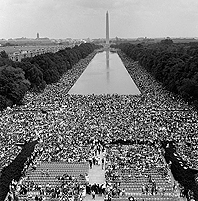
Admirable, sure. But it’s not the whole story. None of this would have happened if Dr. King, and hundreds of thousands of others, had not marched in the streets to change the law. Hundreds of busloads of people went into Southern towns to help desegregate schools, encourage voter registration, and generally improve the democracy for which Americans are known. Some of these people died, murdered by local bigots. Others were injured in confrontations with police. Hundreds went to jail. Because of their commitment and sacrifice, the world is a better place.
When I was in elementary school, I often saw these events on the evening news. Even though I didn’t live in the South, I lived in a community that was largely segregated. Seeing the demonstrators marching for equality opened my mind to the possibilities of a richer, more diverse community.
Dr. King was a magnificent speaker, and his eloquence stirred the hopes and imagination of this particular young girl. And he was more than a speaker. He was an organizer of the first order. Through his efforts and those of others, the civil rights movement found common ground with the anti-war movement, the labor movement, and other groups devoted to social justice.
Notice how I keep including others when I talk about Dr. King. He was not the only one on the stage. He was not the only one in the movement. He was not the only one who started the movement.
It serves the people in power to perpetuate the myth that movements are created by a single, charismatic person. It serves these same people to create dissension among those not in power, to distract us from the real issues. In this year’s campaign, the media asks if African-Americans and Latinos hate each other, if blacks and women are on opposite sides. In past elections, there was allegedly strife between Jews and blacks. Somehow, no one questions that straight white men retain their control. No one is ever opposed to them.
In comics recently, we see the same kind of crisis mentality. They’re killing our favorite characters! They’re un-marrying Peter Parker! And there’s nothing we can do about it! Sure, there is. Don’t buy comics you don’t like. Try something else. Write fan-fiction that continues the stories the way you’d like to see them. Life is too short to knit with crummy yarn, and it’s too short to read comics that don’t give you pleasure.
Don’t be passive. Don’t accept the narrative of convenience. Go out and do something. I don’t really care what you do. Vote. Register other voters. Find a group that’s doing something you like, and spend an hour or two a week working with them as a volunteer. Take to the streets and put your body on the line for an issue. There’s a war on, and every day you do nothing, it gets worse. Every day you do something, it gets better.
Have a dream.
Martha Thomases, Media Goddess and nagging mother-figure of ComicMix, suggests that readers who want to know more read Dr. King’s writings.