
Sex, by Mike Gold
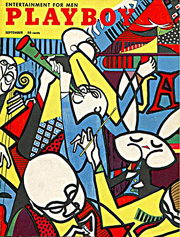 I’ve been gallivanting across this fine country again like the high society bon vivant that I am, so I was a little late in scoring my family’s big box o’ comics. It was even heavier than usual, despite the fact that my wife and daughter are both big-time comics fans. I figure it was about four and one-half pounds heavier. That’s because Playboy Cover to Cover – The 50s, finally arrived. It was released as a Christmas item last November, no doubt under the belief that it would make for an excellent stocking stuffer should King Kong become a cross-dresser.
If you ask founder / publisher / editor Hugh Hefner, he’ll give you the impression he single-handedly invented the sexual revolution back in 1954. That’s okay; he’ll also give you the impression he has foursomes with The Girls Next Door. Whereas I think the creation of the birth control pill and the resultant sexual empowerment of women had a lot more to do with it than Hugh, he did take a lot of risk and paid some heavy dues. Remember, until 1965 laws prohibiting the distribution of information about contraception, and in some cases even the possession of contraception, were still on the books – and not just in the bible belt states. Connecticut was the last to fall. People still went to jail for publishing, owning or mailing stuff about sex.
From a sexual perspective, all Playboy’s success did was put some of the under-the-counter content out on the newsstand racks. By the time Penthouse and, later, Hustler came out Playboy was irrelevant from a pictorial point of view. Of course, later the Internets completely rendered Playboy magazine sexually impotent, as they supplied men the one thing any magazine could not: freedom from your own fist. No, sex is not the reason Playboy was hip.
Playboy brought cool to the masses.
During the extremely conformist, ultra-uptight and massively stone conservative 1950s, Playboy published Jack Kerouc, Nelson Algren, Ray Bradbury (Fahrenheit 451, no less), and Lenny Bruce. They covered, promoted and interviewed Miles Davis, John Coltrane, and Dizzy Gillespie. Himself a cartoonist, Hefner published the works of Shel Silverstein, Harvey Kurtzman and Will Elder, and Jack Cole. Its design and illustration approach was nothing short of astonishing, and it remains a bastion of fine magazine illustration art to this day. In the days of demonstration and racial strife, Playboy actively promoted equality and gave black artists (writers, performers, cartoonists) a fair shake.
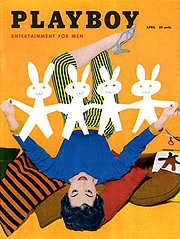 In the 1950s Playboy was just about the only outlet for this kind of material. Oh, sure, Mort Sahl and Shelly Berman and Irwin Corey were burning people’s ears on the nightclub circuit, and the original Madwas corrupting our nation’s youth. Television was not a mass force back then – most markets only had one or two stations, if any, back in 1954 – and the medium was so conservative Lucy couldn’t tell Desi she was “pregnant.” Heck, they couldn’t even use the word pregnant in the episode title, lest TV Guidepick up the word inadvertently. Maybe Steve Allen could get away with some of the musical acts, but that was after 11:15 PM.
Sure, sex sells. Lenny Bruce defined the difference between dirty screwing and fancy screwing; the latter is art and it’s okay. Pictures of Marilyn Monroe and Brigitte Bardot defined fancy screwing. Playboy has come under some criticism for promoting an environment of sexual harassment and there’s some truth to that, but Playboy hasn’t done half as much damage to women’s self-image as the ads in the fashion magazines.
They were among the first magazines to employ women in critical roles, and Playboy Enterprises’ current CEO, Christie Hefner (yeah, well), brought the operation into modern times by focusing on cable, pay-per-view, home video and Internet ventures. I worked with Ms. Hefner when she was running the Playboy Foundation – several social service programs I was working on received the benefits of their largesse. Less known is the fact that both the Playboy Foundation and the Hugh M. Hefner Foundation have quietly financed a lot of feminist causes, including some of the first-class documentaries on the critical role of women as writers and directors in the early days of the motion picture industry.
Playboy Cover to Cover – The 50s contains a DVD-ROM of all the issues of the magazine published in the 1950s. It also contains an excellent trade paperback chronicling its history, a reprint of the first issue, and an awesome index. As such, it is an important addition to our cultural history.
And, at long last, it frees men from their fist.
Mike Gold is ComicMix’s editor-in-chief.