Comic Book Market Farces, by John Ostrander
 How’s this for a concept of a superhero? A guy who is strong, can leap maybe a mile but doesn’t fly, and only a bursting cannon shell can puncture his skin. He is on the outs with the government, the local representatives of whom may be corrupt. He’s on the side of the “little guy” who otherwise may not have a chance against the Big Interests. He dangles neer-do-wells by one foot high in the air and threatens to drop them unless they co-operate – and he laughs while he’s doing it. The guy may be more than a little crazy.
Like the sound of this guy? Readers during the Depression did when they first started reading Superman. You ever go back and read those initial stories? In one, Superman decides that one slum area of the city needs urban renewal, which, of course, the city is disinclined to do. Superman then provokes the army who tries to drop bombs on him. He rushes in and out of abandoned tenements and the bombs level those buildings instead. The army fails to capture Superman and the tenements are leveled. The city now has to rebuild public housing, given the attention on the area.
That Superman today would be labeled a terrorist.
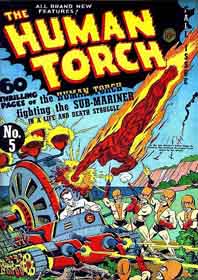
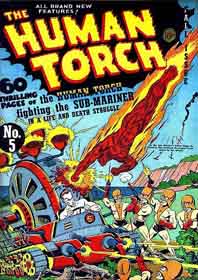
Or how about Prince Namor, the Sub-Mariner over at Marvel when it was called Timely Comics. He was at war with the surface dwellers – us – and, in one story, deliberately flooded the Hudson Tunnel into New York. The tunnel is shown full of cars and there is no doubt in my mind everyone in them drowned.
That Sub-Mariner was a terrorist in his own day.
Both also were very primal and very much a part of the era in which they were created and reflected that time in ways that our modern superheroes do not. Superman is now a Boy Scout and Namor is all regal. And the companies that they work for are hooked into event programming. The big difference between DC and Marvel these days is that DC has a “Crisis” while Marvel has a “Secret.” DC has been noted forCrisis On Infinite Earths and now is embroiled in its Final Crisis while Marvel started with its Secret War(s)and is now embroiled in its Secret Invasion. Both will be knee deep in hype and selling their events this weekend at Wizard World Chi-town.
That there is the problem in a nutshell. Both companies are essentially trying to sell the same product over and over again to the same but dwindling audience via an archaic distribution system. They say things are going to change forever but nothing really does. Some characters will live, some characters will die… and then some characters will live again. I’ve done it myself.
Every twenty years, comics needs to re-invent itself and that includes the existing characters. The Superman that I cited was not the Superman they needed in the Forties when World War 2 was on or necessarily the one we need today. Re-invention can strengthen a series. Take a look at the Bond franchise; in Casino Royale they stripped the character back closer to basics, showed how he first became 007 and reinvigorated Bond for today’s market. They had a big success with a character that a lot of people felt no longer mattered.
So I offer, free of charge, a plan to either DC or Marvel, whoever takes it. Have one more Event and, in this event, your world/universe gets blown apart but a new one is started at the end, bringing with it hope and the promise of heroes re-invigorated. Since this is the end, the writers of your regular series can do all the stuff that they can’t currently do to the heroes because those heroes and their supporting casts have had to return month after month.
Kill off characters by the bushel – Lois Lane, dead. Aunt May, cremated. Alfred, dead and gone. The Punisher goes down in a hail of bullets. Do other fun stuff – Bruce Wayne is revealed in public as Batman, Spider-Man is so broke he is forced to live on the street. Whatever. Go ahead and do it because the world as the readers know it is about to end.
The month following the end of the big Event, your respective world/universe is reborn and superheroes appear on it for the first time. At DC, Superman makes his first appearance. Don’t worry about getting all his back-story out there; in the first issue he makes his first appearance in costume. Superman is first because that’s your DC mythology; Superman was first.
At Marvel, maybe start with the Fantastic Four. First issue again. Update the characters and concepts. Don’t worry about Captain America, Namor, and other 40s characters; Stan Lee didn’t. They found their way back in and they’ll do it again.
The key in both cases is that you get together all your editors and your best talent and you figure out what your world is going to be. No one is bound by past continuity but they will be bound by the new one. Re-imagine and re-define your world/universe. Decide what are the mythic elements that define each character. Make the world they operate in as close as reasonably possible to our own; let it reflect who we are. Let the characters be who we need them to be for our time. Before you start the end, know what’s going to replace it.
Make use of the Internet to have additional content not found in the books. Maybe some characters initially only appear on the Internet. Supply bios of the characters.
Oh, and another thing: announce that dead is dead, that when characters are killed off, they’re not coming back. And then make it stick. Let death have meaning other than as a sales gimmick. (Does anyone truly believe, in a year that has an important Batman movie coming out, that DC has really killed off Bruce Wayne?) Death in comics has become a shell game using tombstones.
If either company was to announce that they were wiping everything out and, for real, starting over again, do you think that would attract some attention, not just among comics fans but in what we laughingly refer to as the “real world.” Oh, you bet. Would fans be outraged? Probably – but I’m willing to bet most would buy it just to see how it was handled. More importantly, it would have the potential to draw new people into the mix. Comics desperately needs new readers. As comics movies get more popular, we should see them coming in droves. They don’t because they don’t know where to find them and they find the continuity impenetrable. That needs to be fixed.
Put books out aimed at the kids market; they read Harry Potter so they’re not going to find anything in comics too difficult. Not every comic has to be for kids but some sure should be. Take a note from manga and try all different styles and genres.
Last of all, stop with the events and the multiple covers. Stop thinking of it as product and start sellingstories. That’s what comics are about. Revson and his cronies who took Marvel from a powerhouse down to a bankrupt mess, nearly taking the entire comic market with it, had to learn that. Comics aren’t widgets. All the stunting – events, special covers, and so on – are not about stories. They’re about marketing. Getting back to basic means getting back to story. There are plenty of folks in the biz who know how to do that.
Those of us telling the stories also need to get back to basics. Readers don’t need to be told via comics that these are tough times; they know that. The Depression was bleaker but it spawned the heroes that we still write about today. The characters became popular because they spoke to a need in the reader – for justice, for equality, for hope. Those are the stories that we need.
I made this offer free of charge because I know that, even if it’s read, it won’t be believed, let alone acted upon. The Big Two are not where innovation begins. They’ll follow a trend but there’s too much to risk tostart one. If such a change is going to happen – a new paradigm for superheroes – it’ll happen at a smaller company or online.
Once upon a time there was a good business to be had in buggy whips. Time and technology changed. Comics, as an industry, does not have to survive. If it does it will only be because it remembers its past – telling stories – and looks to the future – ways of getting those stories to where the readers can see them. Doing the same old, same old, will ultimately fail because it will mark a failure of imagination in an industry that should run, at least partially, on it.
Meanwhile, the clock keeps ticking and the market keeps getting smaller and smaller and smaller and smaller…
John Ostrander’s play Bloody Bess (co-written with William J. Norris) is currently in revival by the BackStage Theater Company through July 20. It’s up on Thursdays, Fridays and Saturdays at 7:30 PM and Sundays at 3 PM, at The Storefront Theater Gallery 37, 66 East Randolph Street, in downtown Chicago.