
Comical Lives: A Paired Review of ‘Little Nothings 2’ and ‘Giraffes in My Hair’
 The impulse to anecdote is ubiquitous in mankind; we all want to tell our own stories. Since those stories happened to us, we naturally think that they’re fascinating…and sometime are surprised when the rest of the world doesn’t agree with us. Comics creators have been spilling out their lives onto their pages for a few decades now – since the undergrounds, if not before that – and the autobiographical comic is now its own cliché. But there’s still room to do interesting things with autobiographical materials – at least, I hope
there is, since it seems that we’re destined to be deluged with books of true stories…
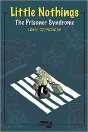
Little Nothings, Vol. 2: The Prisoner Syndrome
Lewis Trondheim
NBM/ComicsLit, March 2009, $14.95
Trondheim mostly makes fictional comics – Dungeon and Kaput and Zosky and Mister O and many more – but he also has kept a comics blog in French, mostly focused on the small moments of his life. Three collections from the blog have been published in his native France; the first two have been translated so far for the English-speaking world. (I reviewed the first one here back in March of last year.)
For the “Little Nothings” blog, Trondheim works in watercolor, mostly in single pages – each one the record of a single event, or a short conversation. The emphasis is on observation – each strip is a crystallized instant, and clearly the blog as a whole is not intended to seriously chronicle Trondheim’s life. As with the Dungeon
books, all of the people are drawn anthropomorphically – Trondheim and his family are various kinds of bird, and most of the others look like different kinds of mammals – rats and dogs and cats. (In the usual unsettling way of anthropomorphic comics, Trondheim’s family also has a pair of real cats, Orly and Roissy, and other actual animals show up from time to time.)
Either Trondheim travels an awful lot or travel is more conducive to diary comics than his regular life, since a clear majority of the comics here are about trips – to the Angouleme comics festival (a year when he was the Guest of Honor), several other comics events, and vacation in Greece, Guadeloupe, and Corsica. That does keep Prisoner Syndrome from being a succession of Trondheim-sitting-at-his-desk pages – there are a number of those, of course, since that’s where a cartoonist spends most of his time – and ties nicely into the title. In one of the early strips in this book, Trondheim learns about “Prisoner Syndrome,” in which people who spend all of their time in the same place gradually get more and more tired from doing less and less – and so he decides to go to more comics festivals, to keep himself healthy.
There are no grand gestures in Prisoner
Syndrome, no deep thoughts or big
moments – the series is called Little
Nothings for a reason. But there
are many thoughtful little moments, of the kind that make up all of our lives, and Trondheim is an artful and nuanced portrayer of his own internal life. It’s a lovely book of the small things that go together to make up an everyday life.
<
p style=”text-align: right;”>
Giraffes in my Hair: A Rock ‘N’ Roll Life
Written by Bruce Paley; Art by Carol Swain
Fantagraphics, October 2009, $19.99
Giraffes in My Hair
is a very different kind of autobiography – a collection of stories written by Paley (who the press release says hasn’t written professionally before, which I assume means he isn’t the Bruce Paley who wrote Jack the Ripper: The
Simple Truth) and illustrated by Swain (who has previously written and illustrated her own stories), about Paley’s various misadventures from 1967 to 1979 as a young ne’er-do-well. Paley and Swain are now a couple – and have been for some time – but these stories take place long before that, when Paley was young and aimless.
So what we have here, I think, is a comics professional turning her partner’s anecdotes – of bumming around for a decade, basically, in search of drugs and women and good times – into comics. I can only imagine the conversations they had, as Swain tried to work out how to draw the prostitute on p.130 (for example). I envy the strength their relationship must have, if they can take on a project like this.
Paley’s stories are all at least mildly depressing, and not just because so much time has passed since the days he’s writing about. They’re about drinking, and doing drugs (and selling drugs, or trying to find drugs), and wandering around the country, and that sort of youthful exuberance. But there’s no joy in any of them – maybe because this is how Paley views his past now, or maybe because it’s being filtered through Swain. There’s no explicit condemnation of the young Paley, but he never seems to be having any fun, no matter what he’s doing. Surely in a decade of being young and energetic and fancy-free, he had some happier stories than these?
Giraffes in My Hair
then has to be seen as the way Paley wants to remember these years – essentially his twenties – and it’s not a positive light. There’s some muted moments of happiness here, but no triumphs and a lot of misery. These are mostly “let me tell you about that crazy thing I did once…” stories, ones that couldn’t have been pleasant when they happened but which work well as retellings.
The title comes from a T. Rex song – it’s a line that Paley never understood until one day when he took acid, and suddenly got it. He doesn’t share that realization with the reader, and that’s emblematic of Giraffes in My Hair: it’s all clear and connected in Bruce Paley’s head, but that doesn’t all make it out onto the page. On the other hand, the old saying was that if you could remember those days, then you clearly weren’t there. So maybe this is all that Paley can remember…which proves he was really there.
Andrew Wheeler has been a publishing professional for nearly twenty years, with a long stint as a Senior Editor at the Science
Fiction Book Club and a current position at John Wiley & Sons. He’s been reading comics for longer than he cares to mention, and maintains a personal, mostly book-oriented blog at antickmusings.blogspot.com.
Publishers who would like their books to
be reviewed at ComicMix should contact ComicMix through the usual channels or email Andrew Wheeler directly at acwheele (at) optonline (dot) net.