REVIEW: X-Men Elsewhen
X-Men Elsewhen
By John Byrne
232 pages/Abrams ComicArts/$39.99 (hc)
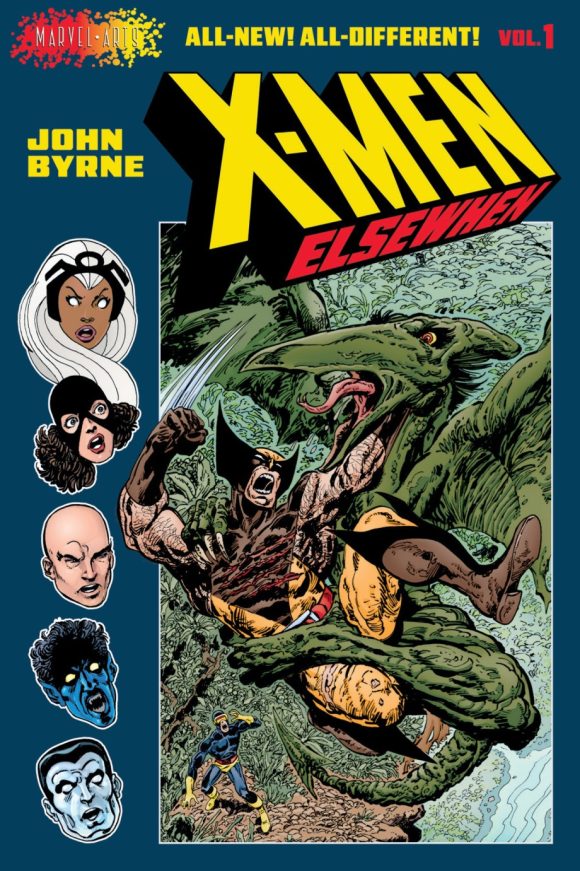
 It’s clear that, among Marvel’s pantheon of heroes, John Byrne prefers the X-Men. After leaving the series in 1980 with Uncanny X-Men #137, he has returned to it now and then, notably with The Hidden Years limited series. And when he was largely out of the public eye and entertaining himself at home, he picked up his pencil and drew Wolverine fighting Sauron.
According to his introduction, he kept penciling page after page and went on to produce 30 issues of essentially fan fiction. After a while, he posted the pages, one at a time, on his website for the faithful’s approval. How could they not? It was new X-Men material, picking up where Byrne left off, but charting their stories on his own.
Finally, editor Chris Ryall brokered a deal between Byrne and Abrams ComicArts to bring these stories to print. Byrne recruited newcomer Paul Walls to ink and got help with lettering and coloring from Pat Brosseau, Lovern Kindzierski, Carlos Lopez, and Leonard O’Grady. and Ruth Redmond. The first of the three projected volumes arrived with such a splash that it sold out quickly, and a second printing has arrived.
So, is it any good?
It’s certainly action-packed, trading deep characterization for breathless pacing. Byrne juggles many subplots (I miss good subplots in today’s comics), possibly one too many since characters vanish for long stretches. It’s also a greatest hits as we see Sauron, the Savage Land, Magneto, the Shi’ar, and the main threat: Sebastian Shaw (teamed with Henry Peter Gyrich) and a new generation of Sentinels. To balance the scales, Byrne also works in the Avengers and Fantastic Four (teams she had also had long runs with), so they’re nice to see.
A character introduced in Fantastic Four #203 makes an appearance, resolving a dangling thread.
Kitty Pryde was introduced not long before he left, and here she’s the skinny, eager newbie, but very little is done with her, while Jean Grey survived being executed only to emerge as an adult with a five-year-old’s mental state and an adult’s emotional state. I hope both get more screen time in volume two.
If you grew up reading this era of comics, this is for you. To everyone else, it’s an interesting reading experience, but it requires prior knowledge and offers little context or footnotes, so you may be a tad confused. It’s fun reading a nostalgia-fueled story that makes you want to see what’s coming next, but the paper-thin characterization is a detriment.