Yearly Archive: 2016

Joe Corallo: Caitlin R. Kiernan and the Rising Stars

img_0082-8216342

img_0085-6603152Last week I interviewed Rachel Pollack in this space. In my introduction I mentioned that only two trans women have written for DC before. That’s somewhat true, and somewhat not true. It would be true to say that only one trans woman had written for DC, and it would also be true to say that number is three. Rachel Pollack is the only one who has written for DC proper. The late Maddie Blaustein wrote for Milestone Comics, for which DC had (and has) the publishing and distribution rights. Rachel had created a trans character for comics. Today, I’d like to talk about Caitlin R. Kiernan.

In 1996, prior to becoming an accomplished and award-winning author, Caitlin R. Kiernan was an award-nominated author of short stories shopping around a novel. She was fronting a band called Death’s Little Sister, in reference to the character Delirium from Neil Gaiman’s Sandman. In that year of 1996 she would be approached by the very same Neil Gaiman to write for The Dreaming, a Sandman spinoff, for DC’s Vertigo imprint. Caitlin R. Kiernan would go on to say yes, becoming the second and last trans woman to write for the Vertigo imprint.

For those of you keeping track at home, that means Neil Gaiman has played a crucial role in hiring 100% of the trans writing talent that has freelanced at Vertigo. If we add Maddie Blaustein to the mix, that’s still a sizeable 66.6%. Either way, not too shabby.

caitlin_r-_kiernan_by_kyle_cassidy2I don’t mean any of that to sound like a knock against Neil either. Quite the opposite. It’s great knowing that trans and queer representation was important to Neil at a time where the majority of Americans felt that it wasn’t even okay that we exist at all. It makes me more sympathetic towards his handling of the character of Wanda in Sandman as well considering the time that story had come out. You can see some of what Neil has to say on Wanda towards the end of this fairly recent article here.

Now back to Caitlin R. Kiernan, she would go on to write thirty-five issues, over half of The Dreaming. Working with people at Vertigo including Neil himself, she crafted stories in the dreaming with many characters we already know, like the Corinthian, as well as her own creations like Echo.

On earth Echo had been a male transvestite, but upon entering the dreaming she became a woman. Unlike Rachel Pollack’s Coagula and Maddie Blaustein’s Marisa Rahm, Echo isn’t trans in the same way. It’s through a sort of magic that Echo goes from being a male transvestite to becoming a woman in The Dreaming. That’s not to diminish the importance of Caitlin R. Kiernan’s contributions to comics or to imply that it makes Echo’s stories inherently less important than Coagula’s or Marisa Rahm’s, but Echo’s story and her journey as a character is certainly different, and it’s a story that does fit well into The Dreaming.

img_0084-4723148After The Dreaming ended with issue #60, Caitlin R. Kiernan would leave comics for the next decade before returning to the medium at Dark Horse, most notably with Alabaster: Wolves. Unlike Kiernan’s peers at DC Comics, she’s had six of her issues of The Dreaming collected in The Dreaming: Through The Gates of Horn & Ivory. This of course is just a fraction of her work on the title, and three of the issues in the collection are written by other writers. Any readers getting a chance to meet Echo in this collection will be disappointed to find that the rest of her journey remains uncollected.

While yes, many other comics at DC have not been collected (I’m still waiting for volume three of John Ostrander and Tom Mandrake’s The Spectre) the fact that the only three trans women that have written at one DC imprint or another have had nearly zero success at getting their comics collected and in print beyond their initial release is troubling.

If DC Comics is going to talk about the importance of diversity, push characters like Supergirl, Cyborg, Wonder Woman, Midnighter, and the new Superman, then I see no reason why they wouldn’t want to celebrate how they were ahead of the curve decades ago. They’ve solely been working up to this by reprinting Tony Isabella’s Black Lightning, but reprinting the works of Rachel Pollack, Maddie Blaustein, and Caitlin R. Kiernan is an important part of that. Reprinting Milestone Comics instead of sitting on them is important.

img_0083-959710620That’s not to say this is just a DC Comics problem. Trans representation at other comics publishers is lacking as well. We’ve seen Sophie Campbell and Tamra Bonvillain getting more recognition for their contributions to comics, and that’s a step in the right direction. We’re seeing Mags Visaggio becoming a rising star with her comic Kim and Kim over at Black Mask Studios. However, we are not seeing enough trans and queer representation overall.

Hopefully we’ll see more trans writers telling their stories in comics. Not only people like Caitlin R. Kiernan or Rachel Pollack, but people like Sophie Campbell who have gotten greater name recognition as of late, rising stars like Mags Visaggio, Lawrence Gullo and Fyodor Pavlov, and the countless others out there around the world. Some of whom I’ve heard of and some I haven’t had the pleasure of seeing their work yet.

And maybe Marvel could hire one of them to write a story… as they’ve yet to do.

REVIEW: Red Sonja: Queen of Plagues

red-sonja-dvd-e1468425005766-3775203Gail Simone is an adept writer who brings a unique voice to her projects and when she took over Dynamite’s Red Sonja, it was no different. Her initial foray, Queen of Plagues, saw the she-devil with a sword lead an army as payback for a man who spared her life. Not only did she display a good handle on Sonja but gave us the arresting figure of Dark Annisia, a unique antagonist.

Coupled with fie art from Walter Geovanni, it was a strong story and remain available in trade. For some reason, Shout! Factory chose this story as their next motion comic, out now on Blu-ray and DVD combo pack.

As nice as Geovani’s art is, some of it proved difficult for the limited animation of motion comics and pales in comparison with the more detailed art found in some of Shout!’s Marvel offerings, such as Wolverine: Origins.

Misty Lee does a nice job as Red Sonja and Rebecca Strom is fine as Dark Annisia. The sound effects are okay and it’s pleasurable enough to watch. The question remains why these exist, since the interest in the format waned long ago and the adaptation adds nothing to our enjoyment of the story.

The disc comes with an interview with Simone, which is worth a watch; less interesting are what the cast and crew have to say.

Ed Catto: Fiction with Purpose

comic-book-review-dc-the-new-frontier-5137671

On the way to RocCon, the Rochester Comic Convention, my cousin John gave me a comics-related clipping that his mom, my Aunt Carolyn, asked him to pass along. It was from the Catholic Courier and it was a positive review of Darwyn Cooke’s graphic novel The New Frontier.

This week’s column was supposed to be about RocCon, but the clipping about The New Frontier sent me in another direction. So instead let’s focus on purpose, Geek Culture and the Catholic Courier clipping.

But first a little background on Darwyn Cooke’s The New Frontier. This graphic novel was originally released as a six-issue miniseries in 2004. The Catholic News Service review describes it this way:

rochester-catholic-courier-2063049Set in the 1950s and early 1960s, the novel…examines issues of racism, immigration, the blacklisting of accused subversives and the morality of the Vietnam War.

More important, in The New Frontier creator Darwyn Cooke firmly established the DC Universe as a place where focused individuals work hard to create positive change that benefit everyone.

Still, it was strange to reed about this graphic novel in a Catholic newspaper. Back in the day, I don’t recall a whole lot of support from the Catholic Church for comics. More recently, I’m always surprised when some organized religions protest against fiction like Harry Potter stories for promoting the devil or other rotten things.

This review was different. It was very positive. In fact, they awarded The New Frontier an A-III rating. I never would have imagined that the Catholic Church would formally approve of the Justice League. But you know what? They should have.

Maybe I should have seen the church’s embrace of heroic fiction coming. My Aunt Carolyn, a devout Catholic, has always been pro-comics. She’s retired now, but she enjoyed a long career as a middle school/high school English teacher.

In the 60s, my Aunt Carolyn famously took the initiative to purchase a stack of comics to share with her class. This was in Auburn, NY, a town that back in 1948 had one of those ridiculous comic book burnings to stamp out juvenile delinquency. Despite the fact that she used her own money to buy the comics, the school administration frowned on classroom distribution of “funny books.” They demanded she get those comics out of the school.

So I’m happy that “we” in general, and the Catholic News Service’s reviewer in particular, value positive stories about individuals who routinely engage in self-sacrifice and contribute to the greater good.

I contrast that with current political discussions. It’s astounding to me that so many conversations about the Presidential race don’t value a lifetime of public service.

I’m proud of the fact that often in Geek Culture, there tends to be a value assigned to characters that do positive things.

And taking it a step further, in Geek Culture the real heroes are the creators who got off the couch and created something positive.

None of our fictional heroes are perfect. Certainly few of Geek Culture’s real-life hero-creators are perfect. In fact, one Golden Age artist I constantly put on a pedestal struggled throughout his life. Consequently he was, at times, mean and cruel and disappointed many people.

But it’s not about perfection. It’s about trying to do something positive and succeeding once in a while.

I’m thrilled that the Catholic News Service embraces the message of hope and optimism in that the brilliant Darywn Cooke story, The New Frontier. It’s a fantastic read. However, at the core of that story and so many stories in Geek Culture, there are a lot of positive, hopeful messages. And even the Catholic Church can get behind that.

Oh, that review from the Catholic News Service is here http://catholicphilly.com/2016/07/us-world-news/culture/darwyn-cookes-final-frontier/ if you’d like to read it.

John Ostrander: Writing Rules

ostrander-close-wasteland-3-d

Recently on Facebook, a father asked me what advice I could give his 13-year old daughter who wanted to be a writer. I had to be succinct but I think my reply was moderately useful and I thought I’d repeat it here.

As I’ve done columns about writing before, some of this may be familiar but this time it will be the short form.

  1. Read. If you want to be a writer, you need to be a reader. Fiction, non-fiction, newspaper (or online news feeds). Read outside your narrow interests. You draw from yourself so you need to feed yourself. My late wife Kim Yale called it “re-stocking the pond.”
  2. Write. Seems obvious but it’s not. Write every day even if it’s only for five minutes. Get into the habit of writing. We all have a certain amount of crap we need to write out of our systems before we can do real work. A writer writes. Get to it.
  3. Live. Again, seems obvious but in writing we draw upon our own experiences. Live life. Learn from those experiences. It’s all grist for your writing mill, the good and the bad. If you don’t know anything about life, how will you get life into your work? If you don’t have any real life in your work, how will the reader connect with it and you?
  4. Write what you know. This combines 2 and 3 above. Write what you know from your own experience to be true. Not what somebody else told you was true. What you know.
  5. You have a right to make mistakes. Best advice from a teacher I ever got (Harold Lang at Loyola University Theater, Chicago). You have the right to try something and have it not work so long as the attempt was honest and that you learn from it.
  6. Make big mistakes. Again, courtesy of Harold Lang. Big mistakes are easier to see and correct. You learn as much – maybe more – from your mistakes as from your successes. A big mistake means you took a big risk. There is no success without a big risk. Try, fail, and learn.
  7. It doesn’t have to be perfect. It won’t be on the first draft, anyway. It never is. Write first, correct/improve/spellchek later. You need to put the story into words so you have something concrete from which to work. The first draft is not intended to be the final draft. Don’t get hung up on it.
  8. Don’t tell anyone your ideas before you write them down. You do that and you’ll release all the energy in the story. It wants to be told; you want to tell it. Speaking it lets the steam out of the engine. Let the steam out and the engine doesn’t run. If you speak your idea you won’t write it. Write it first. You don’t know what you have until you’ve done that; you just think you know. Do the work and then share.
  9. You are your characters. There has to be something of you in every character you write. That includes the bad guys, the villains, the psychotics. If you write a bigot, you have to find out where the bigot is within you. That’s not easy and it’s not comfortable. It still has to be done in order to write the character honestly.
  10. You are not your characters. You also have to separate yourself from your characters. They are not your alter-egos. You have to give them their own lives and then let them live their own lives.
  11. Don’t look down. You’re a tightrope walker with no net. You have to focus on getting to the other side; if you look down, you’ll fall. Translated from metaphor – don’t ask if you can write. Assume you can. If you have to ask, the answer is “no”. Don’t put the weight of your existence on your writing; that’s too heavy an existential load. Don’t pretend that asking these questions will make you more honest and thus a better person and thus a better writer. They won’t. They’ll just feed your neuroses and keep you from writing. Do the work.
  12. You have to know the rules in order to know which ones to break. A freeform jazz musician may appear to play whatever the hell they want but they know music, they know their instrument, they know what has been done before and they interpret it their own way. Learn the rules.
  13. Write questions, not answers. If you want to preach, get a pulpit. As my fellow ComicMixian, Denny O’Neal, once told me, “You can say anything to a reader but first you must tell them a story.” Pose the question, explore it, and – if you feel like it – give AN answer but don’t assume that it is THE answer. Some readers have come up to me and told me what they got out of a given story and character; if I’m smart, I listen and learn. They may have a better answer than mine. Assume your readers are at least as smart as you.
  14. There is only one way to write and that’s whatever way works for you. Anyone tells you differently is trying to sell you something. That includes me and this column. Listen to everyone and take the bits that makes sense to you. That way you come up with your own style, your own approach.

Now… go write something!

Marc Alan Fishman: The Science of Selling

unshaven-comics-selling

If there’s one thing Unshaven Comics has been celebrated for by our peers, our fans, and our nemeses alike, it’s our ABC mentality. “Always. Be. Closing.” Alec Baldwin barked at us through gritted teeth. And boy howdy did that lesson stick. Since our second-ever convention appearance, my cohorts and I have adopted the mentality that while we love what we do, that we can’t do it unless our convention appearances end lucratively. Hence, we operate adhering to the science of the sale.

In less poetic terms, that means that every possible decision / choice we’ve made — from the products offered, to the pitch, the bundles we offer, straight through to the question we ask to close business — has been scrutinized to the Nth degree. It’s been a while since I’ve unpacked these bags for you, my adoring fans, so let’s dump all the dirty laundry on the floor, shall we?

When it comes to our products, the answer became notoriously simple given trial and error. Our first book was an educational graphic novel. Suffice to say we got mild interest, and a lot of back-patting from teachers and rare fans who really like the idea of seeing how far a comic could travel away from tights and fights.

Our next book was R-Rated horror. Then R-Rated superheroes. Both of those books were better sellers for us. But… then… book 4 was The Samurnauts, a title built with sell-ability in mind. Tongue-in-cheek pastiche to the tropes we loved growing up, nestled in a warm chocolatey shell of all-age fun. And the sales and response we saw to that? Well, the rest (they say) is history. Put plainly: for Unshaven Comics, our path to maximum return drives straight down the line towards the largest audience possible.

I’ve droned on and on about our pitch in the past. Feel free to read up on it here. The short and dirty version for those with less time: we keep it simple, stupid. In less than 22 seconds (with an additional eight seconds added afterwards for jazz hands/spirit fingers) we’re able to distill the essence of our comic book series to any passerby. We talk about the big picture feelings the book evokes, we share the artwork and hooks of the story, as well as detail the specific nature of our deal. You get 36 pages of story for just five bucks. And if you get it here at the show today, all three creators will happily sign your copy. And with that – jazz hands. Make no bones about it. We’ve crafted literally every word of that pitch a thousand times over. And we’ve likely answered every possible retort to it dozens (if not hundreds) of times.

I’ve also perhaps droned a bit before about our magical closing question. Those last few words uttered that have turned more faces of unsure-ness into alleviated buyers. We used to ask “So, what do you think?” More often than not, it would end with the potential buyer now bending our ears off on their 30 second critique of literally any number of sundry points they needed to make about our book. And while it did close sales for us, it wasn’t until it hit me to ask Kyle to be a bit more direct. “So, would you like to give it a try?” Boom. Sales. That simple shift in our line of questioning helps address the elephant in the artist alley. At the end of the day, yes, we all love comics and pop culture. But we are the business and you are the customer. If we’ve earned your business by presenting you with a product you find to be priced appropriately and contains written and visual content you find pleasing, then let’s do business. Otherwise? We happy accept “No thanks!” as your answer, and allow you to continue on your merry way. It’s not rude. It’s how we keep the lights on in the studio.

So let’s say now you dig that pitch, and find our price point to be fair. Well, let’s gladly upsell you! Unshaven Comics has cultivated a masters degree in the bundle sale. How? Easy! By tossing as many extra freebies onto a deal to make our customer happy. We always travel with collectible stickers, and poster prints (occasionally adding in some buttons as well). We’ve no qualms about losing a bit of profit off our bottom line if it turns a single book purchase into four. Soon to be five. And for those fans who are so sold on the books without the extra bric-a-brak? Well, we go ahead and still shower them in swag because it’s good karma. When new customers see the passion we have for our series, giving them that little extra thank you in the form of stickers and a poster is just a way we pay it forward.

And with that, you have the science to the sale. Our products attract a large swatch of convention goers. Our artwork and storylines are aesthetically pleasing. Our pitch is tight, and to the point. Our price is fair. Our upsell is ludicrously so. Each convention day sees us pitch to hundreds of potential fans. And typically we’ll see hundreds of books be moved. It’s through the hard work, hypothesis, analysis, and Immortal Kung Fu Monkeys do we see the success. And we’ll see you on the convention floor soon!

So, I have to ask…

Can I tell you about my comic book?

REVIEW: Batman Unlimited: Mechs vs. Mutants

bumm061646There is no creative reason Batman Unlimited: Mechs vs. Mutants exists. It is merely a vehicle to promote toys for the younger segment of fan. Essentially, if you have enjoyed any of the previous Batman Unlimited offerings – Batman Unlimited: Animal Instincts and Batman Unlimited: Monster Mayhem — this will be equally entertaining.

In this relatively thin screenplay from Kevin Burke & Chris “Doc” Wyatt, to Batman (Roger Craig Smith) and Green Arrow (Chris Diamantopolous), resort to wearing mech suits to sop the latest wave of terror in Gotham City courtesy of Mister Freeze (Oded Fehr) and Penguin (Dana Snyder). This time they have turned Bane (Carlos Alazraqui) and Killer Croc (John DiMaggio) into oversized monsters, necessitating the heroes suit up. And to help even the odds, they recruit Robin (Lucien Dodge), Nightwing (Will Friedle), and The Flash (Charles Schlatter).

bumm064001The mayhem moves at a reasonable pace thanks to the steady direction of Curt Geda but there’s little in the way of character or consequence to the total event. It looks fine on this original made-for-video offering.

The sole bonus feature is the far superior “Night of the Batmen” episode from the missed Batman: The Brave and the Bold. Unlike the previous two, this comes as a straight single-disc DVD with no bonus toy.

Bob Ingersoll: Daredevil, Punisher and Where To Get A Fair Trial


The Law Is A Ass #395

daredevil_punisher_seventh_circle_infinite_comic_vol_1_1-5077879There’s an old joke I’m not going to repeat. It’s long; not very good; and, worst of all for a joke, not particularly funny. I bring it up because it’s punchline, “<a href=”

You can’t get there from here,” has a great bearing on the comic we’ll be discussing today.

What comic? My pun-ishing headline indicates, it’s a comic featuring Daredevil, Matt Murdock, and a change of venue in a trial. And that means it’s Daredevil/Punisher: Seventh Circle.

We learned in the first issue of this mini-series that there’s this gangster named Sergey Antonov, see, and he’s a bad man, see. How bad? Well, he didn’t shoot a man in Reno just to watch him die, but he poisoned a rival gang’s boss’s Christmas turkey just to get him out of the way. Unfortunately, the rival boss’s whole family was eating that turkey. Four generations – most of them innocents – died because of Antonov’s actions. That’s how bad.

Well, Antonov has been captured and is going to stand trial for his crimes. However, because “too many people hate [him]” in New York City, the District Attorney’s office feared it couldn’t get an impartial jury in New York City. So Assistant District Attorney Matt Murdock, moved for a change of venue. To Texas.

Which leads us to several points of discussion. First: what’s venue? To answer that I have to take us back to the time when we weren’t the United States but thirteen colonies under the British Empire. (Okay, I don’t have to, but I’m going to. How else can I show off all this historical knowledge I picked up in law school?) Back then, King George III had people who committed crimes in the colonies transported back to England for trial. The colonies didn’t like this. They even included it as one of their grievances with the Crown in the Declaration of Independence.

In order to prevent that from happening in the United States of America, the Founding Fathers put a clause in Article III of the United States Constitution requiring all criminal trials must be held within the state in which the crime was committed. But the Founding Fathers didn’t stop there. They also included a Vicinage Clause in the Sixth Amendment’s trial by jury provision dictating that the jury be composed of people who live within the state and district where the crime occurred. That district where the trial can be held, that’s the venue.

Killing four generations of one family with a Swift Botulismball Turkey would be a felony. Actually, it would be a lot of felonies; four generations worth of felonies. Felonies are tried in county courts in most states – Louisiana and Alaska have parishes and boroughs instead of counties – so for a felony trial in New York, the proper venue would be the county where the crime occurred. As Matt Murdock, who works for the District Attorney in Manhattan, is prosecuting the case, we’ll assume Antonov’s crimes occurred in the county that contains Manhattan; New York County.

Matt successfully moved to change the venue of Antonov’s upcoming trial, bringing up our second point of discussion: what’s a change of venue? Pretty much exactly what it sounds like. Sometimes a case is so highly publicized that it’s difficult to find people who haven’t heard about the case or formed an opinion about it before the trial started and the proper venue can’t assemble an unbiased jury. When that happens, the defense may seek a change of venue, so that the case can be tried in a different venue; one where the jury hasn’t heard about the case and isn’t biased.

In most states only the defendant can move for a change of venue. It is, after all, the defendant’s constitutional right to have the case tried in the venue where the crime occurred. And usually only the defendant may waive that right and seek to have the trial in a different venue. But NY Criminal Procedure Law § 231.20 specifically says that either the defendant or “the people,” i.e. the DA’s office, may move for a change of venue. So, having Matt Murdock ask for the change of venue wasn’t incorrect.

Having Matt Murdock request a change of venue to Texas, on the other hand…

And, yes, that is our third point of discussion.

Remember what I said earlier about Article III, dictating that a trial must be held within the state wherein the crime occurred. That means the only state that has jurisdiction to try a criminal case is the state where the crime occurred. Texas would have no subject matter jurisdiction over a crime committed in New York and a DA’s office could not ask that a New York criminal trial be transferred to Texas. The Constitution would permit changing the venue to some other county in New York. It would not permit changing the venue to some other state, like Texas.

There’s also no reason to move the trial to Texas. I’m a reasonably educated and well-read person but I’m up in Cleveland and I really couldn’t tell you much about the criminal goings on down in Cincinnati; except for this one<a href=”

noted case of vandalism involving a radio station and Thanksgiving turkeys. I don’t care how infamous Antonov’s crimes were in Manhattan, I can’t believe knowledge of his crimes was so wide-spread or pervasive that you couldn’t find twelve jurors in, say, Chautauqua County New York who hadn’t heard about or formed an opinion about the case.

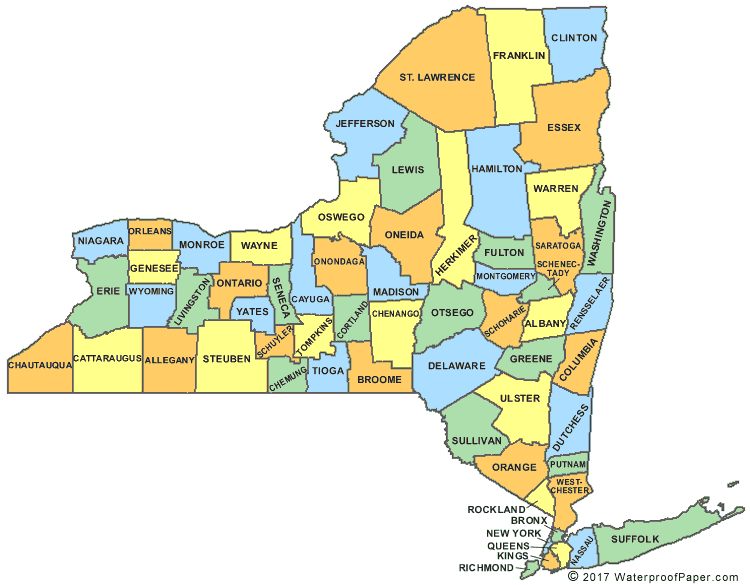
For the record, I choose Chautauqua County because – check a map  – it’s about as far away from Manhattan geographically as you can get and still be in New York state, not because I think it’s provincial. I doubt they’re all that familiar with Manhattan’s crimes in, say, Jamestown or Celoron. Besides they’ve been a little preoccupied there with that “Scary Lucy” statue.

So why did the judge grant Matt’s unconstitutional request to move Antonov’s trail to Texas? I have no idea. We didn’t see the change of venue hearing or meet the judge, so I have no way of knowing why the judge did what the judge did. There could be a few reasons. Hell, considering Matt’s history of unethical behavior, we can’t even eliminate bribery.

Why did Matt Murdock choose the unconstitutional venue of Texas instead of the constitutional venue of Chautauqua County? That’s another story.

Literally. We found out why Matt chose Texas in Daredevil/Punisher: Seventh Circle # 4. And that’s another story. (Okay, it’s a later chapter in the same story but for the purposes of the joke that’s as good as another story.) And because it’s another story, it will also be another column.

Or, in the immortal tradition of comic books everywhere, to be law-tinued.

REVIEW: Aliens: 30th Anniversary Edition

aliens-30th-anniversary-blu-ray-dvd-aliens_glamourskew_g1_rgb-1-e1472136615984-5229770The 1980s was perhaps the first decade where sequels were crowding the theater screens and most were justifiably vilified by critics and fans alike for being little more than a retread of the original. That changed when director James Cameron, fresh off a little indie production The Terminator, was tasked with a sequel to 1979’s surprise hit, Alien.

The Hollywood executive merry-go-round delayed the sequel by several years, although that allowed Cameron to hone his ideas with producer/wife Gale Anne Hurd. He envisioned a story where the humans were akin to the Americans during Viet Nam, strangers seriously outnumbered in a strange land. After insisting the film star Sigourney Weaver, who was in a contract dispute with 20th Century-Fox, all the pieces came together.

When the movie opened in 1986, it set a new higher standard for what a sequel should be, which was expanding upon the characters and universe seen in the first film. At the same time, it also was one of the first films of the modern era to hang so much of the film on a female protagonist. As a result, it was the right film at the right time, in the hands of a rising director who it box office gold.

20th Century Home Entertainment is celebrating this achievement with a handsome Aliens: 30th Anniversary Edition. The box set comes with a digital HD code and a booklet featuring art culled from Dark Hose Comics’ assortment of Aliens-related comic covers plus a handful of art cards.

Weaver’s Ripley, sole survivor of the Nostromo, awakens 57 years later and winds up leading an expedition back to LV-426 and the malevolent lifeform awaiting them. The film continues to be a thrilling adventure thanks to Weaver, Michael Biehn, Paul Reiser, Lance Henriksen, and Bill Paxton. Not only is it an action-adventure thriller, but it deepens Ripley by her protecting Newt (Carrie Henn), the young survivor of the human colony. All of which results in the now-famous but then-explosive climax as Ripley, in armor, confronts the Alien Queen.

The Blu-ray transfer is excellent (same one from the Aliens Anthology) and the sound superb, making for a good home viewing experience. You can choose the theatrical or 17-minute longer extended edition, which is nice to have. All the old special features are reprised here along with. The Inspiration and Design of Aliens featurette. However, you can only access the new feature through HD streaming and only 10 times between now until 2019 when it presumably vanishes.

Despite that flaw, this is one of the strongest anniversary editions of a film to come out in a long time and is recommended.

Molly Jackson: Passion and Geek Activism

captain-planet-2883186

We geeks are a passionate group. Not just for the stories we love, but in most aspects of our entire existence. We look for ways to share our passion, like joining fan groups. And very often, we use our passion for causes that need our help. Everyday geeks champion causes around the world, whether it’s a fundraising event or just raising awareness for a comic creator in need.

Honestly, when I think about geek causes, I immediately think Captain Planet. Yes, I know that doesn’t make the most sense, but it is the truth. As a kid, I loved watching Captain Planet help out a group of diverse teenagers protect Mother Earth. And travel the globe without parental supervision. As a kid, I loved the idea of no parental supervision. Each episode gave a call to action based on that lesson of the week. Don’t litter, teach your parents to recycle, plant a tree. Simple but effective as a kid. But with those weekly lessons of helping others, along with my wonderful Girl Scouts experience, I learned a lot about giving back.

As an adult I quickly embraced the need for these events, throughout all the parts of my life. The best ones are always the geeky events, where my love for a TV show, comics, or any franchise can be shared while helping others. Nowadays we see geeky causes popping up frequently. Blood drives at SDCC, celebrities auctioning off set visits and trips to premieres, Browncoats Global Can’t Stop The Serenity fundraisers, 501st Legion raising for a variety of causes; these are just a few examples but there are so many more of varying size. Every group can find a charity group to support, a member to help. Or you can turn to the thoroughly geeky (but official) groups like Comic Book Legal Defense Fund and the Hero Initiative.

A lot of my pieces include a call to action within them. Frankly, you would be hard pressed to find a week where a ComicMix columnist doesn’t have a call to action. Even yesterday, columnist Joe Corallo shared a call to action about supporting comics writer Rachel Pollack. But you don’t need to wait for a call to action to make a difference.

Since you are reading this, you are obviously a passionate geek. (Or a family member of mine.) And while I said you don’t need a call to action, I’m going to give you one anyway to get you started. So your call to action is to go out and find your cause. If you don’t like those that I mentioned above, ask your friends, your local comic shop, the Internet. Check with your favorite fan pages. Don’t just look for opportunities to give money, look for chances to make a difference. Use all that bubbling passion for geekdom towards something more.

 (The ComicMix staff would like to congratulate Molly on her awesome conquest of the EtherTrolls!)


Martha Thomases: Call Any Vegetable

screaming-peppers-6552688

capt-carrot-1337236It is harvest time. The Green Market is a riot of colors, and I can’t seem to eat fast enough to take advantage of the riches of the season. I spend far too much time worrying about what to cook so that I don’t have to throw away any of my beautiful produce.

This might seem like a stupid thing to obsess about — why don’t I just buy less? — but it’s far better than my other current obsession, which is to wonder if I should have kissed that guy I like, and, if so, would there have been tongues, and had I brushed my teeth recently enough for that to happen. Often, it’s no fun inside my head.

No matter. Too much good food is not a bad problem to have. It’s certainly better than the obsession with death that seems to be once again encroaching on American superhero comics, a genre I like because it’s often full of hopeful fantasy. Here and here and here, just to take three examples from various rumor mills around the ‘Net. (Beware! Those links contain spoilers.)

I know that heroism involves risks, and that death is a part of life. I’m just bored with killing off characters as a stunt to get attention. It makes story- and character-driven deaths less meaningful.

So let’s talk about vegetables. Superhero vegetables.

Surprisingly (to me, at least), there are very few. One is a Green Lantern, and one is a Guardian of the Galaxy, who is also currently a movie star.

cuddling-carrots-2395993Alas, Captain Carrot is not, in fact, a vegetable. And Swamp Thing can be food, but he can also be poison, since he can be any plant he chooses to be.

With the growing concern about children’s health, it’s not a surprise that parents want to find ways to get their kids to make healthier food choices. And it’s not a surprise that these parents, thinking that superheroes are kid stuff, would try to co-opt the vocabulary and imagery of comics to tempt their children.

Some have even found a way to make a business out of it. A successful business that seems to be accomplishing its goals, at least so far. And they have Aasif Mandvi among their celebrity spokes-plants!

I don’t know what you might like to eat, or what variety of nutrients makes you feel your best. Because we are human and capable of infinite variety, you probably have a different list than I do. I find that whatever I want to eat, I want to add more vegetables to it (except for, maybe, ice cream). In the process, I suppose I am causing the death of these vegetables, or at least creating the demand that is the incentive for farmers to kill them.

It’s possible vegetables have feelings. Whether that is true or not, they have more life than a fictional character.

Even one with super-powers.