Tagged: Reviews

0

Dogtangle by Max Huffman

Comics do at least half of their storytelling through images – but sometimes I wonder if some creators think their images can communicate deep, complex concepts that are clear and crisp in their own minds, even when they don’t embody those ideas in words.

Max Huffman’s graphic novel Dogtangle  brings up those thoughts: it’s obviously full of ideas, and Huffman is clearly coming from a specific viewpoint and stance, but his words only sketch lightly around the edges of his premises, leaving his energetic, deeply particular art to carry a lot of the weight of his story here.

That art is deeply caricatured, verging into pure design at times; his characters, to my eye, disappearing into his tinted pages as just more elements to shock or delight the viewer. It’s a deeply cartoony, distinctive style – I think I see graffiti influences, especially in his display type, and maybe equally in his defiant love for stark pages and imagery that doesn’t quite come into focus unless you already know what you’re looking at.

Dogtangle has plenty of dialogue, and a few captions to define what we’re look at, but not nearly enough words to explain all of the complexities of Huffman’s weird, satirical world. Concepts are thrown onto the page once for the reader to catch, and I suppose Huffman assumes that reader will assemble the elements in their own minds to match the model he has in his own. But I found Dogtangle, as it went along, more to dissolve in my mind to a sequence of striking images – vignettes, scenes, or moments – that sit like beads next to each other but don’t connect or combine to form a coherent whole.

I’m sure there is a story here, in Huffman’s mind. I’m just not sure it made it onto the page in a format that’s intelligible to most readers.

Here’s what I can tell you. Vernon Smilth is a local gadfly in Business Park, making long speeches during boring civic meetings in the converted Taco Bell, trying to slow down the relentless redevelopment of the town. He’s a failure at this, and there’s no sign that he does anything for an actual living: this is all he does that we see.

At one meeting, he meets Caressa Vignette, head and face of the pharmaceutical company named for her. We later on get the usual corporate hugger-mugger, in vague terms, so she doesn’t outright own the company, but her actual title and role and what Vignette really does is never clear – they make stuff, she’s in charge, that’s as far as Huffman wants to explain.

Smilth and Vignette fall in love, eat soup, get married – in the course of about two pages. They both want to do something big, something impressive. And Smilth has an idea: to create a Hypermutt. (The word is always presented in display type, like a splash page, in that Huffman graffiti-esque style, so it’s deeply difficult to read.)

Like many things in Dogtangle, exactly how this works is vague and doesn’t make much sense. But the Hypermutt is basically a specialized Katamari: once created, it is a big ball of dog that absorbs any other dogs that touch it. This supposedly is the next big product for Vignette, which is supposed to be satirical, but I have a hard time even seeing the space where the joke is supposed to be: this is not a consumer product at all; it can’t be sold to multiple people; and it seems to have nothing to do with the actual business of a pharmaceutical company.

Anyway, they make this thing, which is not as central to the book as you might imagine.

Almost immediately, Smilth and the hypermutt disappear – Vignette gets a ransom note for one or both of them, but we don’t see anyone nab either of them. Smilth is threatened and beaten by one of the Business Park zoning nabobs, apparently because his useless complaints at meetings were slightly less useless than Huffman made them appear. He has angered Powerful Forces, and He Will Pay.

What does that have to do with the Hypermutt? Did this Florida-based zoning overlord also grab the dog for some unspecified reason? Well…maybe? It’s never clear.

Back in Business Park, Vignette goes into business-crisis mode, running the gauntlet of shouted questions from reporters and hiring Ermine Slalom, a high-powered something-or-other (lawyer?) who will help her keep control of the company…but that plot gets derailed quickly by new characters Simon (Slalom’s little four-eyed nephew, who she’s caring for) and Smilth’s formidable mother, who arrives at the same time and is kept in the dark about her son’s disappearance.

From that point, a lot more stuff happens – some of it in what seems to be a completely different alternate universe where all of these characters are living in medieval Europe, for no obvious reason. Oh, and it flashes forward what I think is a few years, to Simone Slalom – who I thought at first was Simon’s mother, but maybe she’s an older sister? – where the Hypermutt now dominates the sky and has ruined the world.

Because what happens when dogs get stuck together in an ever-growing ball is that they fly into the sky and form a layer of cloud…obviously. (Duh!)

Anyway, this is SF and it is satirical, so of course there is an apocalypse, and this one is the Hypermutt apocalypse. At this point, the reader starts to wonder if the build-things-everywhere, knock-down-the-old-city, make-all-the-money folks are actually supposed to be our heroes. They did try to stop the apocalypse and their motivations were clear and reasonable, if venial.

Back to plot: Simone once pet-sat the Hypermutt, and was “the best sitter ever,” so now she has to retrieve Smilth from inside the flying cloud of dog. That sentence makes slightly more sense in context, though not very much. She does, he is freed, the Hypermutt collapses or dies or something, and the world…is maybe slightly less apocalyptic in the end? Huffman ends the book with a deeply enigmatic stretch of mostly-wordless pages that I assume mean something to him but left me flipping back and forth to figure out if he actually explained anything or told us where he left any of these characters.

(As far as I can tell: no.)

So Dogtangle is a deeply weird book, a massively particular book, and one that I suspect you might need to be Max Huffman to understand. Well, maybe Huffman could explain it to you in person, too – that’s possible. But, if you’re just reading it, do not expect it all to come together or make conventional narrative sense. It will look awesome, full of bizarre pages, and you may find yourself asking questions like “All of the pages are tinted, and the colors shift repeatedly throughout the book, from blue to yellow and so on, to end with orange. Does that mean anything?”

I suspect, in Huffman’s head, there’s a lot of meaning here. But it is not particularly clear on the page.

Reposted from The Antick Musings of G.B.H. Hornswoggler, Gent.

0

Tomorrow the Birds by Osamu Tezuka

Osamu Tezuka made a lot of comics. According to Wikipedia , over 700 works, comprising more than 150,000 pages. I doubt even half of that has been translated into English. So the view any North American reader has of his work – unless that reader both is fluent in Japanese and has access to a library-worth of Tezuka – is going to be limited, tentative, and gatekept by other people.

I come back to Tezuka periodically, though I think I found the period and style I find most compelling first: Tezuka was inspired by the adult-oriented gekiga movement in the mid-60s, and changed up his style and concerns for at least one strand of his work going forward for the next twenty years. (Tezuka died of cancer, at only 60, in 1989.) Vertical published a lot of that Tezuka material, around fifteen years ago, including The Book of Human Insects , Ayako , Ode to Kirihito , Buddha , Dororo , Black Jack , MW , and Apollo’s Song .

There’s probably more in that style – to say it again, Tezuka was ridiculously prolific – but I haven’t seen anything newly-published along those lines in years. So I’ve poked into other Tezuka styles and series – the well-regarded early adventure Princess Knight , for example, and more recently the anthology Shakespeare Manga Theater  and the odd One Hundred Tales . But the seriousness and darkness of those core gekiga works hasn’t come out in anything else I’ve seen.

But I keep looking. So this time I grabbed Tomorrow the Birds , from the time-frame that also saw those gekiga books. It was serialized in S-F Magazine between 1971 and 1975, collected in Japanese not long afterward, and translated into English for this 2024 edition by Iyasu Adair Nagata.

It’s somewhat more serious than the ’50s-era Tezuka books I’ve seen – it comes close to the doomy gekiga, especially early in the book – but still has some goofiness in it. And Tezuka seems to have leaned heavily into the serialized nature of this story to tell very different kinds of stories – to the point that the back half of the book feels a bit like “well, here’s a Western set in this world, and now here’s a fable, and then let’s try a ghost story.”

Tomorrow is basically a future history, spanning what seems to be at least a thousand years, told in nineteen mostly short chapters. In the near future, magpies (maybe corvids in general) have gotten smarter, learned to harness fire, and start attacking humanity. Very quickly, over the course of the first four or five stories, Japan surrenders to the birds and helps them destroy other human nations – I expect this was a political dig – and human civilization ends. The birds turn into anthropomorphic birdmen in a mechanism Tezuka wisely does not explain – though, as you can see from the cover, he does note that their heads get substantially larger to house more complex brains.

There’s also a minor thread of an alien civilization monitoring Earth, and how they have interfered to create the rise of the birds. This is another bit of Tazuka’s SFnal satire, and also gives him his ending – I saw it coming, but it’s well done.

Each of the nineteen stories in Tomorrow is separate. The first few, during the war between humans and birds, take place in a short period of time – maybe one generation at most – but the rest of the book stretches down long centuries, as birdman civilization grows, changes, and is expressed differently in different places on earth. As I said, we get a very traditional Western – with a human in the Noble Savage role – and several other clearly genre exercises, as if Tezuka was working down a checklist of kinds of stories to tell in this milieu.

The stories are mostly in the downbeat, tragic, or SFnal if-this-goes-on mode: things go badly for the main-character humans in all of the stories, and often not much better for main-character birds. This becomes a bit obvious once the reader notices it – and any reader will definitely notice how the first few stories are all “birds attack humans, humans lose” – but each story is strongly told, and all of this material does have a similar tone and sweep and seriousness to his core gekiga works.

It is a goofy premise, but Tezuka sells it well, and gets through the “birds destroy human civilization by setting things on fire” bits quickly enough that most readers won’t argue too much. We take it as allegorical, accept the WWII echoes and the core Japanese-ness of the idea, and see where the story takes us. Tomorrow the Birds is not quite as darkly uncompromising as something like MW or Ode to Kirihito, but it’s from the same strain of Tezuka’s work and has many of the same concerns and ideas.

Reposted from The Antick Musings of G.B.H. Hornswoggler, Gent.

0

Elric: The Dreaming City by Roy Thomas and P. Craig Russell

Most of the Roy Thomas-scripted adaptations of Michael Moorcock’s Elric novels came out as individual comics issues – five or eight or so for each novel – and were eventually collected into book form. But The Dreaming City  was instead a single graphic novel from Marvel in 1982 – maybe because this is the original 1962 novella “Dreaming City” rather than the alternate-title-for-the-first-novel Dreaming City, which has confused several generations at this point.

To be clearer: the novella “Dreaming City,” when I first read the Elric books, was collected in The Weird of the White Wolf, at that time the third “novel” (actually a fix-up, like many of them) in the series, and now I think fourth. There have been remixed editions of the series since, so it also sits in different books with “Elric” in their titles.

I suppose the important thing to note about this adaptation is that it is the third in the recent Titan unified-covers reprinting of all things Moorcockian and Eternally Championing, Elric sub-series – third by internal chronology – but that it was first in the sense that Thomas wrote it first, P. Craig Russell drew it first, and it came out into the world four years before the adaptation of the first novel in the series, Elric of Melniboné.

(Also see my posts for the first two books in this Titan series: Elric of Melniboné  and The Sailor on the Seas of Fate . Though both the original Moorcock stories and the vicissitudes of publishing adaptation series makes the timeline and details too convoluted to easily follow.)

I should also note that the next volume in this Titan series reprints the Thomas-scripted adaptation of The Weird of the White Wolf, which I expect – I haven’t read it since about 1986 – also includes an adaptation of “The Dreaming City,” in the context of that fix-up. So I have that to look forward to.

“Dreaming City” was one of the very earliest Elric stories, and, as many have noted repeatedly since then, Moorcock started out with the most dramatic, central story of his doomed albino hero, and has spent six decades since filling in smaller, lesser stories around them. What that means is: if you only read one Elric adaptation, it should be this one: it’s early enough to be unfussy, it has some of Russell’s most energetic artwork, and it’s early-80s full-of-captions style captures the feel of Moorcock’s prose well.

So this is shorter than the other Elric adaptations, tells a story of tighter scope – originally a novella, not a fix-up of short-fiction like the “novels” – and is one of the major events of this doomy, gloomy albino’s life.

In Dreaming City, for good and sufficient reasons which are not provided here, Elric leads a large force of Sea Lords – pirates, basically – from the Young Kingdoms to plunder his homeland, sack its capital city Imrryr, slaughter basically all of his people, and depose his evil cousin Yyrkoon. He does succeed in those things, though he also intended to save his cousin and lover Cymoril, who does not survive this story.

He also does not succeed in getting more than a tiny fraction of his human forces back from Imrryr alive, in keeping with Elric’s usual results to his actions: pretty much everybody but him dies, usually in horrible ways that make him sad. But that’s the deal with Elric, and this was one of the first stories to codify that. Thomas and Russell turn Moorcock’s often-purple prose into equally grand and exciting pages here; I’ll repeat that, if you’re interested in either Elric in general or the comics adaptations thereof, this is a great place to start.

Reposted from The Antick Musings of G.B.H. Hornswoggler, Gent.

0

Red Ultramarine by Manuele Fior

What do you get when you tell the story of Daedalus and Icarus, and combine it with a parallel story about a modern architect named Fausto? Does it matter if the architect stays resolutely a secondary character, and makes no deals with any infernal agencies? How about if the whole thing is told in slashing, imagistic hues of black and red? Or if the architect’s girlfriend Silvia is the main character?

Those are some of the elements in Manuele Fior’s graphic novel Red Ultramarine , which I think is his earliest work to be translated into English. The Italian original came out in 2006 – and is the earliest book listed on his website – and this translation, by Jamie Richards, is from 2019.

I don’t think I entirely understood what Fior was trying to do here. Why does King Minos seem to be the same person as the esteemed doctor that Silvia consults about her boyfriend’s obsession? How does that doctor’s assistant, Marta, connect the two worlds – Silvia and Fausto in the modern day, Icarus and the rest in ancient Greece? And why is Marta young and gorgeous – and, notably, naked – in Greece, but older and more settled with the modern doctor?

The story, such as it is, bounces back and forth between the two timelines. Icarus works with his father near the labyrinth, both are eventually thrown into it and have to escape, and do so in the traditional way with the traditional tragic end. Meanwhile, Silvia consults the doctor – who hectors her and rants about Faust for no obvious reason – about her boyfriend’s obsession with perfection and labyrinths, is given a cream by Marta that promises to make the large birthmark on her face “go away,” and uses that cream, which turns her entire body the color of the birthmark and sends her back to the time of Icarus. Silvia consults the doctor – who is somehow also in ancient Greece and has the same face as Minos, but is dressed differently, so maybe they’re not the same person? – and demands that he send her back to her world, and he responds in much the same confusing wordy flood as before, which makes her hysterical.

All of the dialogue in Red Ultramarine talks around things: nothing is stated clearly. No options are laid out cleanly. The connections are symbolic, imagistic, implied. And all of the talk about Faust doesn’t lead anywhere cleanly – it comes across as a red herring.

Speaking of colors, the title is also a bit perplexing. The book is steeped in red – several of the characters, especially in Greece, have dark red skin tones, and red is an element on every page. Ultramarine, though, is entirely absent from the book – that slash of blue on the cover is the only blue in the entire book. The art inside uses black to complement red – black as the base, the core element, red as the embellishment, most of the time.

The art is gorgeous and striking, almost abstract at times in its stark outlines and elegant simplicity. It’s not simple in a cartoony sense, but simple like design, like a mid-century poster. It’s visually stunning throughout, a succession of compelling pages, even as the words confuse and obfuscate.

In the end, I took this as an early work by a creator still figuring out what he wanted to say and how to say it. Possibly also a creator more comfortable with pictures than with the words that partner them – able to make the art say what he wanted but not quite as adept yet with the words.

Reposted from The Antick Musings of G.B.H. Hornswoggler, Gent.

0

Was That Normal? by Alex Potts

Philip is about forty. He has one of those jobs you can do from anywhere, on a laptop, so he does it from his apartment, alone. He lives in a British city, probably mid-sized – not very specific, not very special. His apartment is garden-level, which means he looks out his window, while typing on that laptop, below the street. He doesn’t have any long-term friends, or any connections with colleagues that we see – the closest person in his life is his landlady/roommate, an older woman who intermittently tries to engage Philip and be friendly with him.

Philip isn’t all that good at being engaged and friendly. He’s wrapped up too much in his own head, the kind of person who obsessively thinks about what’s he’s doing, what he should be doing, and if there’s anything that he wants to be doing. (There usually isn’t..) He goes out to the pub now and then, because he thinks he should or because he thinks he’ll have a good time this time, but he inevitably ends up drinking too much to be social and pays for it later.

Was That Normal?  is a graphic novel, by British creator Alex Potts . It covers a few months in Philip’s life – how he starts from that point of being stuck, how he’s searching for connection, what happens to him, and where he ends up. There are no major epiphanies, no huge revelations, no amazing transformations – like all of us, Philip is deeply embedded in his own life, and all changes will be gradual and incremental.

But he does want more, want something different. He does try, in his fumbling, uneasy way, to open up to experience, to look for things that would make his life brighter. He gets dragged out to a concert, and is struck by the singer, Gina. He sees her around town, and strikes up a friendship.

He obviously wants more, but things are messy – Gina has a volatile not-quite-ex and doesn’t seem terribly interested in anything more serious than friendship with Alex. But she is friendly, and it looks like it’s been a long time since Philip had a friend.

He’s uncomfortable with a lot of the day-to-day of life, the kind of person who over-thinks everything and then has trouble just doing even the little bits of social interaction that more thoughtless people never waste a moment on. That might not change – or not entirely. He’s going to stay Philip. But he might be able to be a Philip a little more comfortable in his own skin, a Philip who tries more things, a Philip who spends more time with people and gets better at it. I do say “might” – Potts, again, is not going for epiphanies or transformations here; this is a realistic, grounded story about a real person in a real world, and nothing is guaranteed. 

Potts draws Was That Normal? with a slightly rumpled, indy-esque line – immediate and grounded, with his people not quite as pretty as a reader might expect. His panel borders are hand-drawn, just a bit uneven. The colors feel just a tone or two off from purely realistic – slightly more of a picture than the thing itself, usually in earthy tones, with lots of yellows/tans, browns and dull reds for backgrounds.

Was That Normal? could be a little hard to take, particularly for readers with a lot of Philip in their own makeup – but it’s well-observed and thoughtfully true, and does provide some hope for this Philip…and, by extension, for all of the rest of us.

Reposted from The Antick Musings of G.B.H. Hornswoggler, Gent.

0

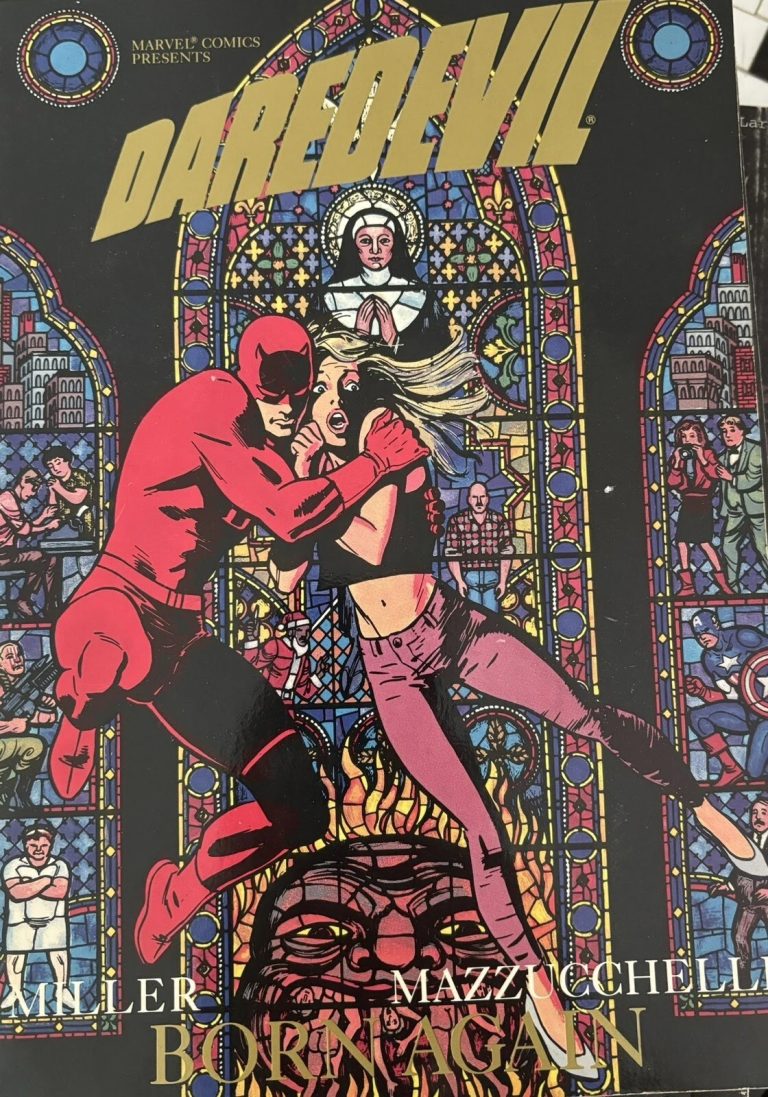
Daredevil by Frank Miller & Klaus Janson, Vol. 3

Credits are always a tricky thing for assembly-line comics. Projects tend to have a particular, clear breakdown of responsibilities – this guy writes, that other guy draws, a third guy inks – but those comics tended to be monthly, and monthly deadlines lead to messiness. (Ask the guy who spent sixteen years in a business that had a minimum of seventeen “months” a year.)

And creators want to work with each other – sometimes the same crew for a while, sometimes a one-off with that idol of theirs or the new guy doing interesting stuff.

When it comes to gather all of that messiness into a book, sometimes the publishers err on the side of simplicity. The first time the “Frank Miller Daredevil” was collected, it was under roughly that title, even though Klaus Janson drew the vast majority of those stories. For the second go-round, Marvel decided they needed to add Janson to the title, which makes a lot of sense.

But it meant that there was a first book with stories mostly written by or with other people, one of them inked by Frank Springer, and most of them drawn by Miller and inked by Janson. And then a second book that really was all Miller/Janson, the core of the run.

And this third, concluding volume gets messy again, with Daredevil by Frank Miller & Klaus Janson, Vol.3  collecting not just the climax of their run together – Daredevil issues 186-191 – but several odder and quirkier things, several of which Janson had nothing to do with. So it’s yes Frank Miller, as before, and some embarrassed shuffling of feet about how much Janson there is.

There are three quirkier things, so I’ll take them first, in the order they appear in the book and in increasing order of importance and strength.

Miller and Janson did an issue of What If…? in 1981, with co-writer Mike W. Barr, asking the comical question “What if Matt Murdock became an agent of S.H.I.E.L.D.?” It would be a very standard late-’70s, early-’80s Marvel comic, much like the stories in the first Miller/Janson volume, is what. Talky, obvious, full of cramped panels and way too much narration from that boring bald giant on the moon. This is included, I assume, for completionists.

Miller returned to Daredevil for a one-off issue, #219, in mid-’85 (about a year before the Born Again sequence with David Mazzucchelli), apparently in large part to work with John Buscema. The credits are a bit vague – the splash page credits everything to Miller (with an asterisk), Buscema, and inker Gerry Talaoc – but I assume Miller wrote this story and did layouts that Buscema finished. This is a hardboiled “crooked town” story in twenty-ish pages, with Matt Murdock (out of costume) wandering into this Jersey hellhole and incidentally (and almost accidentally) cleaning it up on his way back out. This story has many of the weaknesses of both Marvel comics of the era and Miller in particular, but it’s a solid piece that works on its own level.

And the last eighty pages or so of this book incorporate the 1986 graphic novel Daredevil: Love & War, written by Miller and drawn by Bill Sienkiewicz, in what ended up being a try-out for their Elektra: Assassin project almost immediately afterward. This is very much a one-off, but it’s glorious and energetic, with Sienkiewicz at the height of his ’80s inventiveness and Miller’s multiple-narrators captions working quite well. Daredevil himself doesn’t actually do a lot in this story, actually – he is necessary to the plot, I’ll admit, but he also sets off for a whole lot of derring-do that fizzles entertainingly.

I’ve left the meat of the book for last: issues 186-191 is the big ninja storyline, the single most important vector for their takeover of American culture (particularly comics culture) later in the ’80s. But we can’t blame Miller and Janson for that. The stories are muscular and taut, with Miller dialing down his wordiness and telling this story visually a lot more than was standard for Marvel at the time. It includes all the greatest hits of the Miller Daredevil: Matt’s mentor Stick and the small band of good-guy ninjas he leads, his dead-but-gets-better global-assassin ex-girlfriend Elektra, the super-evil ninjas of The Hand and their world-domination plots, the Kingpin, and a cameo by currently-paralyzed assassin Bullseye.

Those issues, though, in the best Marvel Manner, actually starts with some hugger-mugger about Matt’s current girlfriend, Heather Glenn, and the family company she supposedly runs that has gotten involved with…gasp! horror!…some kind of munitions work. As usual with Big Two comics of this era, both the legal and the business details are ludicrous and unbelievable to anyone who is not twelve, and all of the characters talk about it in mind-numbing detail that only proves how little any of the creative team involved understood law or business. But, eventually, the Heather subplot ends and we get to the ninjas, who are thankfully much quieter.

My takeaway from this, and the whole mass of Miller/Janson Daredevil stories, is that everything is part of its time and place. The best of this material is as good as any adventure stories in comics form anyone has made over the past century. But a lot of it is dull, cliched and obvious, rolling out wallpaper-like standard plots, themes, and concepts that are third-hand at best and threadbare if you look too closely. The three Daredevil books have nearly a thousand pages of comics: three to four hundred of that is pretty darn good. The rest you need to slog through to get to the high points.

Reposted from The Antick Musings of G.B.H. Hornswoggler, Gent.

0

Walt Disney’s Donald Duck: Donald’s Happiest Adventures by Lewis Trondheim and Nicolas Keramidas

About a decade ago, writer Lewis Trondheim and artist Nicolas Keramidas made a bande dessinée for Éditions Glénat, the French arm of the global Disney octopus, about Mickey Mouse. It was called Mickey’s Craziest Adventures  and pretended to be rediscovered pages from an obscure (probably American) 1960s comic, telling a long, convoluted and all-adventure story on its big pages. It didn’t entirely make sense, but that was the point: it was supposedly roughly half of the pages of a decade-long story that was all cliffhangers and hairsbreadth escapes to begin with.

A few years later, they did it again, though in a slightly less breathless register: Donald’s Happiest Adventures  similarly pretends to be a serial from an incredibly obscure ’60s comic. But, this time, they happily state that they found the whole thing, and can present the full story of how Donald was tasked by his Uncle Scrooge with finding the secret of happiness. Happiest was published by Glénat in 2018, and an American edition followed in 2023, translated by David Gerstein.

The structure is the same as the Mickey story: Trondheim and Keramidas pretend that each page stood alone as a monthly installment of the story, so the story leaps forward regularly, with each page being a moment or a thought or a particular place. Trondheim’s Donald has the standard irascibility, though he doesn’t break into full-fledged tantrums here as he sometimes does in stories by other hands. He’s also more philosophical than Donald often is, a lot like other bird-coded characters in other Trondheim stories, like Ralph Azham or Herbert from Dungeon or Trondheim’s self-portrait in Little Nothings .

But if you’re going to have a story about Donald Duck searching for the meaning of happiness, you need to have a version of Donald who is capable of finding happiness and of talking about it coherently – not always a guarantee in every version of Donald.

Like the Mickey story, this one ranges widely – Donald is summoned by Scrooge to go retrieve a fabulously valuable artifact from an obscure corner of the world, but unwisely questions Scrooge’s motivations and finds himself instead sent to find the secret of happiness. In particular, the secret of making Scrooge happy, which is even more difficult than doing so for Donald. (Donald has moments of happiness throughout the book, as a careful reader will notice – but he’s not happy all the time, which is what he thinks he’s looking for.)

Donald meets and talks with a vast array of other characters – the fabulously lucky Gladstone Gander, the down-to-earth Grandma Duck, the genius Ludwig von Drake, and so on – as he asks each of them in turn what happiness is. Along the way, he gets into adventures that span the globe, including a stint in a nasty totalitarian country where, luckily, the shackles are all made of cardboard. He also runs across Mickey several times, helping capture Pegleg Pete each time and getting a reward from the police forces who pop up, always right after the hard work is done.

It’s a fairly talky story, because it’s about finding happiness, and Donald needs to talk to nearly every character about it. (He doesn’t have any conversations with Pete, which is a possible miss, since Pete has always seemed quite content with his lot in life, despite having all of his schemes fail miserably.)

As he must, Donald does eventually make it back home to Duckburg, and has an answer for Scrooge that makes the old miser happy, at least for that moment. It’s not the secret of happiness, but that of course is Trondheim’s point: there’s no such thing. Along the way, Happiest is thoughtful and adventurous in equal proportions, a good story for people who are willing to do a little thinking during their Donald Duck adventures.

As in the Mickey book, Keramidas draws it in a style that I can’t quite call off-model but doesn’t quite look right. (Though I mean that as a compliment: purely on-model is boring.) His characters are energetic in that cartoony way and his pages crisply laid out to accommodate all of Trondheim’s long speeches – and to look as if each one could have been a full entry of this serial. 

Some reviews of this book have missed the fact that the ’60s origin is…how do I put this delicately?…not actually true. But you, my dear readers, are smarter and more perspicacious than that, so I’m sure the metafiction here will be no trouble for you. If you’re looking for a combination of philosophy and Disney adventure – and why not? it’s a fun mix – Donald’s Happiest Adventures will provide a lot of enjoyment.

Reposted from The Antick Musings of G.B.H. Hornswoggler, Gent.

0

Kiosco by Juan Berrio

I didn’t know this was wordless going into it. Wordless books pose a challenge to the critic, for all the usual dancing-about-architecture reasons, but this is sweet and lovely and expressive, so let’s see what words I can dig up that Juan Berrio didn’t need.

Kiosco  is a horizontally-formatted graphic novel, generally one big wide panel to a page, originally published in Spain by DIBBUKS in 2014 and published in this edition for the US market by Europe Comics in 2017. It doesn’t credit a translator; it didn’t need one. Someone wrote the descriptive copy in English, but then I bet someone wrote descriptive copy for this in Spanish, French, and German earlier, and we don’t credit those people, either. (No offense: I’ve written descriptive copy for books, back in my misspent youth. It’s a skill, and a necessary function, and I didn’t get credited, either.)

The main character is a young man. We see painting apparatus in his apartment, and him working at it, so we think he’s an artist. But the way he makes his living, we think, is by running a little coffee-and-pastry stand in a local park, in whatever city this is he lives in. A kiosk, we might say in English. I gather “Kiosco” is the Spanish equivalent.

This is the story of one day. He gets up, gets ready, pokes at a painting briefly, and then sets off on his bicycle to work with a tray of croissants. He opens the shop, the sun rises, and he’s ready to greet the day.

But though the park is full of people passing through, no one is spending money at the kiosk. Berrio shows time passing, with some wonderfully expressive pages in soft earth tones – I’m not sure if it’s watercolor or colored pencils. He goes back and forth between the hubbub of the passing crowd – different every time, a fascinating array of different faces and body language and gesture, all going somewhere else to do something else – and our main character, standing and fidgeting and cleaning the stand and tables yet again to keep himself busy.

There are a few scenes of someone almost shopping at the stand, but no one actually does. It even rains, to make this a comprehensively bad day.

Eventually, though, he does have a customer. I won’t spoil it. It’s lovely and bright and happy, and that ends his day in the kiosk and, soon afterward, the book.

I don’t know if Berrio typically works wordlessly; I found this book randomly and the only other Berrio book I see available in North America is similarly wordless, for kids. (But he has a long list of previous works on his Spanish site , and wordless comics famously travel the most easily.) This is a sweet little book in a lovely cartoony style, and I’d love to see more of Berrio’s work make it over to my side of the Atlantic.

Reposted from The Antick Musings of G.B.H. Hornswoggler, Gent.

0

Girl in the World by Caroline Cash

Caroline Cash took over the Nancy comic strip at the beginning of this year, after a try-out run (before and after a couple of other creators) a year before. Her predecessor was Olivia Jaimes, a female creator who rejuvenated the strip in 2018 and is shrouded in mystery. Well, slightly more mystery than any other name on a national media entity where you never see the human being behind it – she’s pseudonymous and has guarded her privacy, though the assumption is she’s also known as a cartoonist under her real name, whatever that is. [1]

I liked the Jaimes Nancy; so far (it’s January 31 as I write this) I’m liking the Cash Nancy; and I liked Cash’s brief run in 2024. So I figured I should see what else Cash has done. She was best-known, pre-Nancy, for her ongoing comic PeePee PooPoo, with a confusing numbering scheme that has so far gone 420, 69, 80085, and 1. (I may have the order wrong, for obvious reasons.) Before that, though, she had a standalone graphic novel, Girl in the World , as her comics debut in 2019. So I took a look at that.

Girl follows a large cast, almost all female – there’s one gay man I remember, and possibly other men in minor roles as passers-by, but it’s a story about a lose friend group of women, during one long night. (Yes, there is a Bechdel Test reference at the end.) They’re all young, and I guess to complete the cliché I should say they’re all restless, too. They’re all part of the same set in whatever city this is – Cash herself is from Chicago, but the city here is unnamed but mostly low-rise, rowhouses and buses and dark late-night streets.

These girls – I guess I should call them girls, from the title? – have different things they can do this night: the organized ones are Facebook events, to make this even more 2019, but the characters mostly ditch organized frivolity early and spend their time traveling with each other to the next thing, talking and just hanging out.

There’s no larger plot: this is a book about those conversations, about what this group of young women are thinking about and worried about and unhappy about in this random night in 2019. They’re different people – Cash does, I think, give them all names and personalities, but the names don’t get used much, as friends don’t dialogue-tag each other all that often.

Cash’s art style shifts and alters – at first I thought she was creating looks for each cluster of characters, but I think, in the end, it’s more a new creator working on her first long work – trying new things, using all of the tools she has, pushing in every direction she can, using each new blank page to learn something new.

Girl is a very “indy” book – that art style, that kind of storytelling, that feeling of a young creator trying things out in public. I find that kind of work energizing, and this is a great example of the type.

[1] I would love to work up a conspiracy that Cash is actually Jaimes, and this is a complicated double-fakeout to go public and switch her art style. But Cash is barely thirty, and I think was still in art school when “Jaimes” took over Nancy, so the timeline really doesn’t work. Sad, because that would be an awesome thing to at least pretend to believe in.

Reposted from The Antick Musings of G.B.H. Hornswoggler, Gent.

0

Man’s Best by Pornsak Pichetshote, Jesse Lonergan, and Jeff Powell

If I were cynical – and I am, a lot of the time – I’d think of this book as “We 3, but with a happy ending!” or maybe, more vaguely, “We 3 in SPAAAACE!”

That might be reductive, but, really, how many other comics about three uplifted and cyborged animals fighting to save their humans can you think of? Sometimes, the precursor is glaringly obvious.

Man’s Best  is a 2024 SF comic, originally five issues long and then collected into a single book-sized volume, written by Pornsak Pichetshote, drawn and colored by Jesse Lonergan, and lettered by Jeff Powell. (I don’t usually credit letterers, but Powell is on the cover, and I try to defer to the book most of the time.)

There is a starship, heading to an alien planet to test a terraforming device. Earth, of course, is falling apart in the background, for thematically important but non-specific “people are fighting” reasons – it’s not quite the ’70s-standard population-bomb argument, but maybe a revised and updated version of that. Among the humans, there is a Captain and a Doctor, and then an undifferentiated mass of everyone else.

The Doctor – a woman, and very feminine-coded, with big fluffy hair and huge circular glasses – has three animals, said specifically to be for emotional support on this journey. (The Captain is similarly masculine-coded, all craggy features and eyepatch.) But the animals also are heavily cyborged, or maybe just lightly cyborged (one definitely has a new leg) and live inside exoskeletons that augment them. They are Athos, Porthos, and….Lovey; two dogs and a cat, with the cat as the leader in a twist that will amuse anyone who has ever met a cat.

For some reason – this really isn’t clear – the Doctor is running the animals through training sessions in what seems to be a Star Trek holodeck, in which they fight giant robots they call Klangers. This is the beginning of the story, so they do not work well together, and fail. This clearly sets up Narrative Tension for when the animals have to battle robots for real later in the book.

Anyway, the planet they’re supposed to test the terraforming doohickey on is missing, which leads to some doomy speeches from the humans. But a planet suddenly appears, and the ship crashes into it. The animals wake up, somewhat later, in the wreckage. The humans are all gone.

So they decide – not without squabbling, because we need to see them squabble a lot for aforementioned Narrative Tension reasons – to save the Doctor and the Captain, somehow, using their various technological enhancements and The Power of Friendship. (Well, they don’t say the latter.)

The planet they landed on is some kind of third-generation copy of the Well World, with various regions separated by some kind of gates – we don’t see big walls around the hex-equivalents, so it might be implemented somewhat differently, but it’s the same idea: a big planet full of sentients from lots of other planets all over the place, each in their own habitat. And, of course, there are robots that run the whole thing, which are hostile to Our Animal Heroes. Plenty of the inhabitants of the individual regions are somewhat hostile, too, so there’s a lot of running and fighting and squabbling, as the animals see their tech enhancements get degraded, destroyed, or removed along the way.

They also learn a bit about the purpose of this world, and do, of course, eventually get to the Doctor and the Captain, where there is a Shocking Revelation and a big Boss Fight with a robot that looks just like the one from their training. In the aftermath, the animals need to make a decision about The Fate of Earth, and we readers think they make a pretty good one – but it is a bit of a “Lady and the Tiger” ending as to whether their decision will work.

For all of the “Earth is doomed because people Can’t Get Along” talk and the eternally-squabbling animals, this is a fairly positive story: it does come down on the side of humanity being salvageable, which could be a bit of a stretch in a story about uplifted animals made to fight robots. I found it a bit talky but pleasant, and didn’t argue with the premises (how are these animals uplifted? they seem to be just plain shelter rescues who can magically talk to each other in clear idiomatic English and eventually communicate with humans, too) as much as I normally would. And Lonergan is a great story-telling artist, particularly for SF stories like this one: he gives the action sequences a lot of punch and energy.

I found Man’s Best to be somewhat lighter and fluffier than I think it wanted me to, but it’s just fine for what it is. And if you want cyborged-animals-fighting-robots action, it can’t be beat.

Reposted from The Antick Musings of G.B.H. Hornswoggler, Gent.