
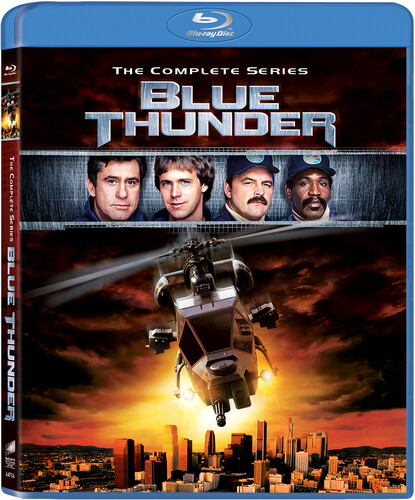
REVIEW: Blue Thunder: The Complete Series
By Dayton Ward
June 1983: It was right around the end of my sophomore year of high school when some friends and I did what we often did on a Saturday: head to the nearby Cineplex to catch a movie. We’d already done our duty as Star Wars fans and taken in multiple screenings of Return of the Jedi along with viewings of Lone Wolf McQuade, Psycho II (we had to sneak into this one thanks to its “R” rating), and even Spacehunter: Adventures in the Forbidden Zone. Not much of the remaining fare tickled our fancy, except for one flick that we’d somehow missed to that point: Blue Thunder.
A movie about a super-advanced helicopter that seemed like it could be the flying cousin of KITT from Knight Rider, with that guy from Jaws (and Jaws 2!) as its pilot? Sure, we were in (we had to sneak into this one, too), and the film proved entertaining enough to wile away that particular Saturday afternoon. At that age, with VCRs still out of reach for normal peasants like me, I don’t think I saw it again until is showed up on one of the cable movie channels or even broadcast TV, and I do remember renting it when it arrived in one of the approximately 1,500 video rental stores which seemed to pop up in Tampa in the mid-1980s.
As a teenager with a job after school, I wasn’t watching a lot of television at that point, so I was only peripherally aware of Blue Thunder’s television spin-off when it premiered on ABC in early January 1984 with hopes of capitalizing on the film’s popularity. I was actually more dialed into the launch of Airwolf, which arrived on CBS just two weeks later as a not-at-all subtle attempt to cash in on the apparent fascination with super-cool helicopters. I only saw a handful of episodes of Airwolf in those days, owing to reasons already given, and I never watched a single episode of Blue Thunder. Indeed, I’d never sampled the series at all until ComicMix came calling with an invitation to review the new Blu-ray complete series set. So, here we are!
First things first: the series is not a sequel or follow-up or even a retelling of the original Blue Thunder film. Like many TV shows spawned from movies (The Odd Couple, M*A*S*H, Planet of the Apes, Fame, to name just a few), it’s a reworking of the film’s basic idea with conventional TV storytelling of the era in mind. Instead of an experimental helicopter designed for covert surveillance and overt response to major incidents such as civilian unrest or terrorism against large-scale public events, Blue Thunder in the series is a loaner from a fictional federal government to the Los Angeles Police Department for use during…well, that’s quite the question, isn’t it? Part police procedural and part 1980s action-adventure. it’s like CHiPs crossed with The A-Team. Despite the occasional “serious” storylines, the show’s approach is much lighter than the movie’s more serious, even ominous plot. Even the theme music in the vein of other upbeat action shows of the day.
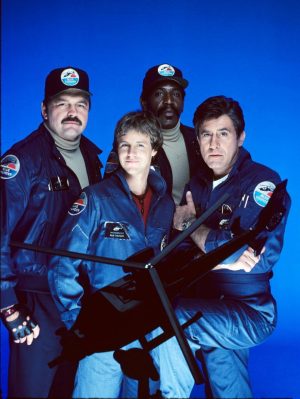
Roy Scheider’s Frank Murphy from the movie is replaced by Frank Chaney as portrayed by James Farantino, already a twenty-year veteran of Hollywood whose most recent credits at this point in his career included his role as Commander Richard Owens, executive officer of the aircraft carrier U.S.S. Nimitz in the 1980 time travel movie The Final Countdown.
(For those who haven’t yet seen this one, his role is somewhat pivotal. Just sayin’.)
Chaney, like Murphy from the film is also a seasoned helicopter pilot whose career includes service in the Vietnam War. Whereas Murphy’s bouts with post-traumatic stress disorder are a key plot point, Chaney’s wartime past is only mentioned a few times over the course of the show’s brief life and is a relevant point in only a single episode. This is in stark contrast to Chaney’s on-air counterpart, Airwolf’s Stringfellow Hawke, who also flew helicopters in Vietnam. His history, along with that of St. John, his brother, who has been listed as missing in action from the war, influences much of that show’s ongoing storyline.
A young Dana Carvey steps into the role first inhabited by Daniel Stern in the film. Whereas Stern’s Richard Lymangood serves as Murphy’s observer and flight engineer of Blue Thunder’s onboard computer systems, Carvey’s Clinton Wonderlove (really? really?). Even the nickname bestowed upon officers in this role, “JAFO,” has been understandably cleaned up for TV: “Just Another Frustrated Observer.” I leave it to your memory or imagination to decipher what the “F” stands for in the movie. In the beginning, Carvey seems miscast in the role, but as the series progresses, his character manages to have a few decent moments, including one predictable instance of him being forced to pilot Blue Thunder despite having no actual flying experience (Chaney talks him through it, because it really is just that simple, amirite?).

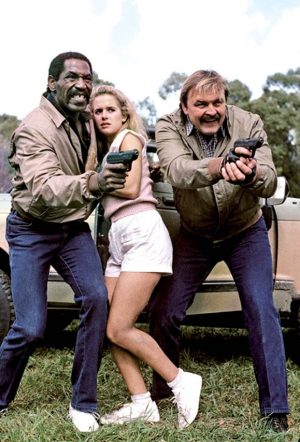
One big deviation from the movie is the addition of two more officers as part of Blue Thunder’s support team, in the form of football players turned actors Dick Butkus and Bubba Smith. As Richard “Ski” Butowksi and Lyman “Bubba” Kelsey, the pair is responsible for “Rolling Thunder,” an oversized van which serves as ground support for Chaney and Wonderlove. Following their NFL careers, Butkus and Smith would each appear in a variety of guest television and film roles over the ensuing decades. Smith is perhaps best known for his multiple turns as Moses Hightower in the Police Academy films. Many of those roles involved football of some kind, including one of personal Butkus favorites, “One of Our Running Backs,” a third-season episode of The Six Million Dollar Man.
Behind the camera, Blue Thunder boasts some very familiar names for fans of TV spanning the 1960s to the 1990s. Roy Huggins, creator of the classic series The Fugitive, served as an executive producer on the series. Jeri Taylor, writer and producer for numerous successful TV series across the 1970s, 80s, and 90s, including Quincy, M.E. and Magnum, P.I. as well as Star Trek: The Next Generation, Star Trek: Deep Space Nine, and Star Trek: Voyager (the latter of which she also co-created), co-wrote the first episode with David Moessinger. In addition to co-writing scripts for (among many other things) classic science fiction films such as Dark Star, the original Alien, The Return of the Living Dead, 1990’s Total Recall, to name a few, as well as the Blue Thunder film, he returned to co-write the series’ third episode. O’Bannon also provided the story for an additional episode and served as executive story consultant for a handful of other installments.
Translating Blue Thunder from a sinister government asset intended for nefarious purposes, as hinted at in the film, to an LAPD loaner wasn’t without its problems, mostly from a standpoint of, “Why is a helicopter with a freaking machine gun patrolling the city’s highways?” The original film offered a glimpse into the more sinister uses to which Blue Thunder and its array of surveillance equipment and weapons could be put. Conversely, the TV series, with rare exceptions, spends nearly every episode making the viewer wonder why such an advanced machine is being employed for comparatively mundane purposes. In 1984, this idea felt quaint, even silly, but in 2026, where modern police forces have availed themselves of all manner of military equipment and tactics? One can’t help but ponder the disturbing possibilities. This only rarely comes up over the course of the series, which is disappointing because the potential for that sort of storytelling seems like it’s right there, waiting.
None of this is helped by low budgets and noticeably subpar production values. One particularly egregious example is the “helipad” that is home to Blue Thunder, which is very obviously a soundstage set when depicted by the Blu-ray’s unforgiving high definition, especially when viewed from the office windows of Chaney’s boss, Captain Braddock.
Aerial photography can be pretty expensive, and the same was true back when the show was in production. In addition to using the same heavily modified Aérospatiale Gazelle helicopter from the film for the flying scenes, the series’ effects team like their movie counterparts also utilized scale models to create footage which could not be safely (or economically) accomplished within the series’ financial constraints. This translates into a lot of closeups of Blue Thunder’s individual components, most notably the machine gun as well as the surveillance cameras and microphones. This is usually accompanied by numerous shots of fingers flipping switches, turning knobs, or pressing computer keys in addition to the expected shots views of hands on the helicopter’s flying controls. Speaking of the cockpit, most scenes set there look exactly like what they appear to be: a mockup on a soundstage. You only rarely get the sensation that Chaney and Wonderlove are actually flying in a real helicopter. This and the model work were far more convincing in the film.
The budget rears its ugly head again and again in the form or reused flying footage, either from the original film or the series itself. Indeed, I noted the same shot of Blue Thunder taking fire over a desert mountain range—complete with strafing hits along its right side—in four of the first six episodes.
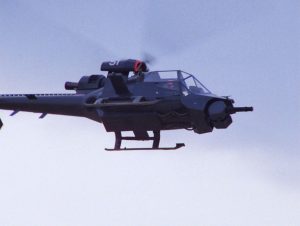
Low ratings led to Blue Thunder being canceled after just 11 episodes. Meanwhile, Airwolf continued its adventures for three seasons on CBS before the network sold the show to the USA Network, where it limped along for an additional season before being permanently grounded. Both series found varying degrees of extended life over the years thanks to reruns on different networks such as USA and the Sci-Fi Channel as well as local television syndication. The Blue Thunder series was originally released on DVD way back in 2006 (did I really just say “way back” in reference to 2006?), and that seemed to be the limit to its post-broadcast appeal, but never underestimate monetizing nostalgia!
As for this new Blu-ray set? The three discs contain no special features, which I suppose shouldn’t come as a surprise given that most of the main cast, except for Dana Carvey, had passed on. I mean it. There aren’t even trailers for other series in this vein, which feels like a lost opportunity when aiming this at collectors and fans of this era of television. As for the series itself, it was originally shot on film, so there was at least decent-quality material to work with when it was pulled from the vault and readied for its original DVD release.
For the Blu-ray, the series was further cleaned up with a 1080p MPEG-4 AVC transfer and a new lossless audio transfer to DTS-HD 2.0 Mono. To be perfectly honest, I read this off the packaging and other material I found online. I’m not the guy to tell you what any of that means, beyond that I think for a show that’s over forty years old, it looks and sounds pretty good on my TV. People who know more about this sort of thing seem to agree with me, which means that’s not too bad for a short-lived series that likely was considered disposable after is cancellation.
As a teen of the 1980s, I admit to an unhealthy obsession with favorite films and television series of that era, including some which arguably have not aged very well at all. Therefore, I can’t fault anyone who seeks to add the Blue Thunder TV series to their collection (seriously, you’re talking to a guy who still has both seasons of Buck Rogers In the 25th Century and War of the Worlds on his shelf). If that’s you, then grab this one and hit the skies.
Or, you could just watch the original movie again.