
REVIEW: Salvage
Salvage
By Renée Nault
256 pages/Ten Speed Press/$19.99 (sc)
 Class conflict has powered countless speculative stories, and Salvage uses that familiar tension to frame a near-future romance with an ecological warning beneath the surface.
That setup gives Nault plenty of visual and thematic promise, but the book never develops its social divide or ecological premise enough to make the romance feel fully persuasive.
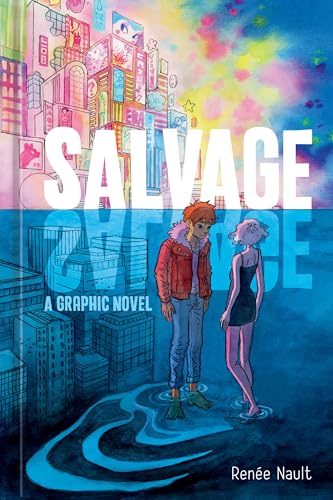
A generation or two ago, a cataclysm submerged entire cities. The survivors rebuilt society into two sharply divided worlds: the Uplands, home to the contemporary one percenters, and the Flats, where residents scavenge remnants of the past and sell them in markets to survive. Paolo comes from one of the more successful Flats families, but he would rather devote his time to painting. Instead, his skill as a deep diver keeps pulling him into increasingly dangerous searches for valuable relics.
Then Paolo meets Jules, an accomplished sculptor whose privileged circle drifts from one trendy club to another. Her life looks glamorous but hollow, made emptier by an absent film-star mother. Paolo is quickly smitten, seduced by how the other half lives, and he hides his nocturnal activities from his parents and best friend, deepening the tension at home.
Nault, who gained attention for adapting The Handmaid’s Tale, brings a pleasant watercolor style to this imagined world. Her pages capture the needed contrasts between Paolo’s drowned landscape and Jules’s polished social sphere, and it is noteworthy that Jules seems to resemble the artist herself.
The larger problem is that the worldbuilding feels incomplete. The Uplands show little evidence of having adapted to catastrophe: technology, architecture, and social customs seem largely unchanged despite a disaster that happened only a generation or two earlier. The Flats feel more convincing by comparison, though even the soggy remnants of the old world seem implausibly well preserved after decades under salt water.
Additionally, the characters remain too familiar to surprise us. Paolo, Jules, and the people around them rarely develop beyond recognizable types, making the story predictable just when its setting should feel strange and urgent. Salvage is pretty to look at, but beneath the surface, it is murky and dissatisfying.