REVIEW: Dracula Has Risen from the Grave
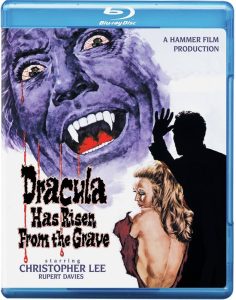 The Hammer horror film revival was well underway by the time Dracula Has Risen from the Grave arrived in 1968. This was the fourth film starring Bram Stoker’s notorious vampire and the third with Christopher Lee wearing the fangs (he skipped the second one), and it is a mixed offering.
On the one hand, screenwriter Anthony Hinds explores religious themes that other Dracula entries have barely acknowledged. In this interpretation of the legend, faith is as powerful as the physical manifestations of religion.
On the other hand, director Freddie Francis was far more interested in the romance between Maria Mueller (Veronica Carlson) and Paul (Barry Andrews), with him later lamenting how much of that plot was trimmed by the studio. It served to reduce the Lord of the Vampires to a supporting player and mere antagonist to their love.
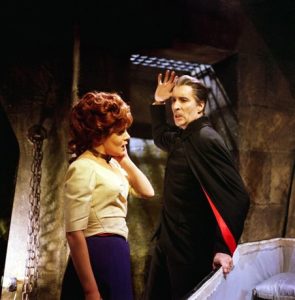 After being drowned in holy water in the previous entry, Dracula: Prince of Darkness, a visiting Monsignor Ernst Mueller (Rupert Davies) attempts to exorcise Dracula’s castle in order to allow the frightened villagers to once again attend mass freely and unafraid. After affixing a giant cross to the castle doors, he injures himself, and the trickle of blood resurrects the vampire, who seeks vengeance. His goal is to ruin the monsignor by seducing his daughter, using the mesmerized tavern girl Zena (Barbara Ewing) as his lackey. He also places the local priest (Ewan Hooper), whose faith has lapsed, under his command, a useful pawn.
 Things hum along until a climactic fight in which Paul and the priest actually stake Dracula. However, Paul is an atheist, and the priest is spiritually lost, so they cannot say the required prayers to seal the death. In the film’s best scene, Dracula removes the stake and seems invincible.
It’s interesting to note that Lee himself objected to this sequence, telling historian John Brosnan, “Everyone knows a stake through the heart is the very end of a vampire. I objected at the time, but it was overruled. It was an extremely gruesome sequence. The blood came pouring out.”
Awash in religious themes and imagery, the film carries a heft the previous installments lack, but it also lacks an interesting Dracula, who is given to little more than staring at tender young necks in lust or snarling at his opponents.
Visually, Fields, who took over from series director Terence Fisher, made it a more slowly paced feast of landscapes and atmospherically lit castles. His cinematographer Arthur Grant borrowed a technique Fisher once used in The Innocents (1961), and applied color filters any time the count or his castle are seen. It’s a nice touch.
Effective in its day, it doesn’t hold up as well today. Considered a strong entry in the Hammer catalog, it has more to do with Ewing’s presence along with its religious themes. When it came to America in 1968, Warner Bros even went with a tongue-in-cheek one-sheet undercutting the horror.
The film has been repeatedly released, and the new Blu-ray disc appears to be identical to the 2015 release. The 1080p, AVC-encoded Blu-ray transfer is rich and captures the rich color and subtle touches such as the filters. It is accompanied by a serviceable lossless DTS-HD MA 1.0 audio track.
There are no special features beyond the trailer, which is a shame given the available Hammer lore to mine.