And here are four more graphic novels (or similar beasts) that I neglected to write about soon after I read them, when they were fresh in my mind. Let’s see what I care to remember…
Mister Wonderful is part of the endless repackaging of Daniel Clowes, though this piece (unlike most of his recent books) didn’t first see life as a single issue of his old comics series, Eightball. No, this first appeared in the short-lived New York Times Magazine “Funny Papers” section, one of the few moments when the Grey Lady tried to emulate regular newspapers.
The story has been reworked slightly — each large NYT page has been broken into two shorter, wider pages, to pad the length up to something that can be called a book — and there are some other changes as well, but it’s still the same, just told in a slightly different form. (And it’s also a story very similar to Clowes’s last standalone graphic novel, Wilson, which I reviewed here last year.)
Marshall is a middle-aged sad sack, divorced, lonely, nearly broke and with no real hopes of getting any better. He narrates this story — intensively narrates it, in a caption-filled style very out of fashion in most of mainstream comics, which shoves us directly into his head and holds us there, hostage perhaps, until the end of the book. Marshall isn’t great company, unfortunately — he’s obsessive about his own shortcomings, and self-flagellation is only interesting for so long.
Mister Wonderful is the story of one day in Marshall’s life — one night, really — starting with a blind date, and continuing on from there. Marshall’s been set up with Natalie by mutual friends, and Natalie is probably just as damaged as Marshall is, in her own ways — but we only see her through Marshall’s eyes, and only see her when Marshall gets out of the way, which is hardly ever. So Mister Wonderful is primarily a tour through Marshall’s psyche, with short stops along the way to take in some real-life events that illustrate that his poor self-image is well rooted in his actual competencies.
It doesn’t have the satirical edge of Clowes’s earlier work — Clowes wants us to identify with Marshall and care about him. (Mister Wonderful is most like a work by a slightly more friendly, and less formalist, Chris Ware.) But Marshall is undeniably tedious and suffocating — though he is nowhere near as horrible as the “hero” of Clowes’s Wilson was, so he does have that to (very slightly) recommend him. Clowes can create characters that are damaged, self-obsessed, and fascinating — recall Enid and Rebecca from Ghost World — but, these days, he’s tending to leave off “fascinating,” which is unfortunate. (more…)


 , the first in a new series (teen-focused, I think) by Mark “Akiko” Crilley, about a guy who discovers secret supernatural powers.
 , a highly acclaimed 2009 semi-autobiographical book (by a guy who now goes under a different name, for reasons I’m not entirely clear on) about herpes.
 , collecting comics work by Roger Langridge (along with his brother, Andrew) from around twenty years ago.
 , an old collection (1991) of Roz Chast cartoons
 , a similarly vintage (1992) book of Sam Gross cartoons
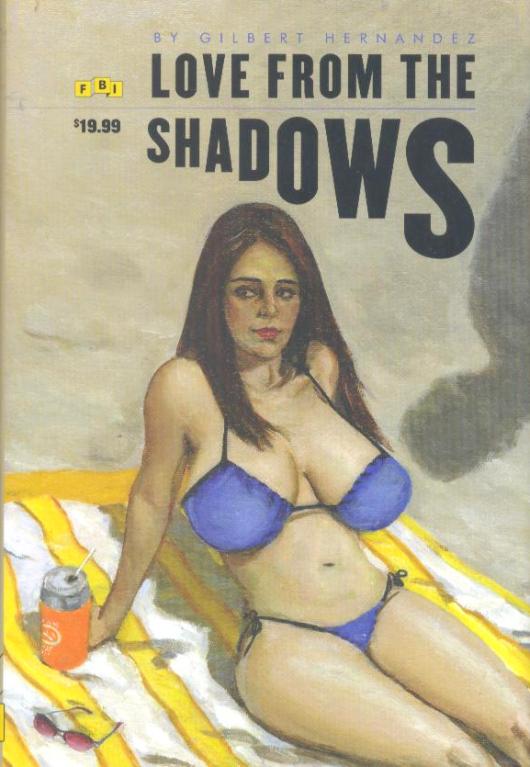
 , an original graphic novel that came out earlier this year from the indefatigable Gilbert Hernandez, which has a loose (and probably indescribable) connection with his Love & Rockets material.
 , which was the first new book of his I didn’t read since
  — entirely because his prior novel,
  , was such a gigantic stinker — and which I used to have, in first edition hardcover, before the recent unpleasantness.


 , the first novel he narrates, but give him a break: he’s a fifteen-year-old boy from a small town, and his brain doesn’t work the way everyone else’s does.


 by Nnedi Okorafor (DAW)
 )
) , edited by Kate Bernheimer & Carmen Gimenez Smith (Penguin)
 by Karen Joy Fowler (Small Beer Press)


 edition. (Particularly since the
  book is out now, all shiny and new, so this is terribly old news.) Each editor shifts the material somewhat — Gaiman’s volume leads off with a long excerpt from the Jonathan Lethem/Farel Dalrymple/Gary Panter Omega the Unknown, the first Big Two story in the series, which feels significant — but the core of each book is very similar, drawing from the same group of major mid-career “alternative” cartoonists, from Gilbert Hernandez (here represented by a story done with his vastly less-prolific brother Mario) to Ben Katchor to Chris Ware to Peter Bagge to Bryan Lee O’Malley to C. Tyler to Robert Crumb. As usual, the series editors, Jessica Abel and Matt Madden, picked a hundred notable works from their year — September 1, 2008 through August 31, 2009 — and sent those to Gaiman, who chose from them (and, possibly, from a few things he discovered on his own) to make this collection. Gaiman’s introduction makes it clear that this isn’t the “best” comics of the year — nor even the best “American” comics of the year, whatever that may mean — but it is a big collection of a lot of very good comics (and a few clunkers, though precisely which ones are clunkers may be a matter of personal taste) at a reasonable price. The whole series is a great way to discover what’s going on over on the more interesting, less punchy side of the modern comics world, so I recommend this book, as I do its predecessors, for people who like stories told in comics form, though probably not for the kind of people who like the things that draw in the crowds of maladapted boy-men every Wednesday.