Watch the new “Ant-Man and the Wasp” trailer
Because you haven’t had enough Marvel movies in the last five days, here’s the new trailer for Ant-Man and the Wasp — now featuring 100% more Black Goliath!

Because you haven’t had enough Marvel movies in the last five days, here’s the new trailer for Ant-Man and the Wasp — now featuring 100% more Black Goliath!
Here we go, folks. In theaters April 27th. Are you getting ready?


Ebony magazine reports that Black Panther is going to have an even bigger impact in America than expected, as people are signing up voters at screenings.
#WakandaTheVote is a measure from the Electoral Justice Project (EJP) which will allow moviegoers to register to vote at Black Panther screenings throughout the nation. The mission was the brainchild of EJP founders Kayla Reed, Jessica Byrd and Rukia Lumumba.“This weekend we wanted to meet our people in Wakanda,” Byrd and Reed told Blavity. “We know that for some it’s a superhero world, but we know that the world we deserve is still waiting to be built — and we want to build it! This upcoming spring and November 2018 midterm elections are an important step in building that new world, and we want to take every opportunity to engage our communities in the conversation of electoral justice. We will be registering people to vote at movie theaters across the country so that we can #wakandathevote at the ballot box.”
We confess we look forward to seeing certain people freak out over this.
Source: #WakandaTheVote Allows for Voter Registration at ‘Black Panther’ Screenings


Mark Evanier has been writing and collecting stories from various other comics editors about freelancers who do or do not get their work in on time, and the motivations for why they might end up delivering late:
The artist was a freelancer who worked for many companies and editors. I absolutely sympathize with anyone in that position because that’s been my entire career for 49 years now — juggling assignments, working for several places at the same time.
By his own admission, this artist worried incessantly about not having enough work to meet the expenses of life. Even when he had a full dance card and was turning down work, he was fretting, “What if there’s nothing more after I hand in my current assignments?” When I asked him to draw the story for me, he should have said no, he didn’t have time. He was already committed to too many other jobs but on impulse, he said yes. […] He thought he was doing both of us a favor by taking on the job…and he thought he’d have more time than I said.
I’m going to throw in at least one other reason that’s related to this: occasionally, there are artists who are just too good at their job— by which I mean that there’s just not as much challenge as there used to be. After you’ve drawn 2000 pages of comic art in your time, many of the problems in doing the job go away and you get bored. How many different times can you draw the same character, after all? The challenge is the composition and breakdown of the page, but after that– eh. He knows he can finish it, and he knows what it’s going to look like when he’s done. (Think of it like a surgeon who hands off the closing to someone else.)
So in at least one case that I know of… the artist pushes the clock. He gets as close to the deadline as possible, maybe even a little beyond it, and then he starts working. The challenge is to do the job while racing against the hard limit, all while dodging emails and phone calls from people in the editorial office who are getting closer and closer to heart attacks. And by challenging himself on speed, he gets that thrill from creation again.
But… as you might suspect, sometimes he blows the timing. Something comes up, something goes wrong, someone shows up inviting you on a treasure hunt.
The question then becomes at that point… can you trust the artist again? Well, maybe. But an editor will always have that worry in the back of his mind… and from that point on, he’ll have a backup plan when working with that artist.
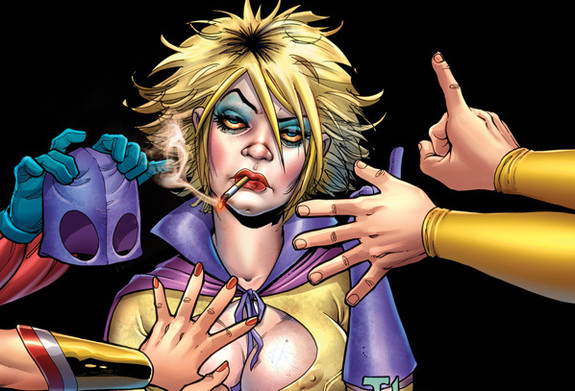
Image from Small Blue Yonder.
For your late-night comics related watching: “The Pro” by Garth Ennis, Amanda Conner, and Jimmy Palmiotti— now animated! (Dear lord, NSFW.)
Or read the book.

It’s been over thirty years in the making, but it looks like it’s finally going to happen– Kitty Pryde and Peter Rasputin are finally getting married in X-Men Gold #30.
All we can say is this:

The important question, of course: will it be a Jewish wedding?
Because… well, you’ll see.

 Cinamon Hadley, whose appearance inspired the look of Death in the Sandman comic series, passed away today according to Sandman co-creator Neil Gaiman.
The body-piercer and goth icon whose portrait was immortalized as the second eldest in a family of anthropomorphized forces called the Endless, Hadley was described as extremely tall, extraordinarily thin, with bone-white skin, impeccable make-up and thin, black hair.
According to Gaiman in The Sandman Companion, he imagined the character as looking like ‘60s singer Nico as she appeared on the cover of Chelsea Girl. But the comic’s artist, Mike Dringenberg, had other ideas, and thought of a good friend in Salt Lake City. Gaiman writes, “He sent me a drawing based on a woman he knew named Cinamon—the drawing that was later printed in Sandman 11—and I looked at it and had the immediate reaction of, ‘Wow. That’s really cool.’”
Cinamon was diagnosed with the advanced stages of small cell neuroendocrine carcinoma of the colon in 2017. After a brief remission, the cancer returned and spread.
Our condolences to her family, friends, and fans. We hope she’s well met by someone who looks a lot like her.

 Yesterday, Judge Janis Sammartino handed down a ruling in our ongoing case, Dr. Seuss Enterprises v. ComicMix, allowing the case to proceed to discovery while narrowing the allegations in significant ways. Buried in the order is a very important point that has implications for the entire comics industry, to wit (with footnotes and citations omitted):
Plaintiff claims Defendants misappropriated “the unique illustration style [of] the characters and backgrounds found throughout Dr. Seuss books, that have come to be instantly recognized by consumers as source identifiers for Dr. Seuss.” Defendant argues trademark law does not protect an artistic style. …
Most courts have held there is no trademark protection for the “style” of an artist. Style is a matter more properly protected by copyright law. …
Plaintiff cited no authority to support its assertion that its general “style” is a protectable trademark. Plaintiff only argues that the book can be subject to both trademark and copyright protection and that distinctive characters can qualify as trademarks. Plaintiff claims the Ninth Circuit has recognized Plaintiff owns trademark rights to “the character illustration of the Cat [in the Hat’s] ‘stove-pipe hat’.” But the illustration of the Cat’s hat is different than the general “illustration style” and non-specific “characters and backgrounds found throughout” Plaintiff’s books, in which Plaintiff asserts trademark rights now. And Plaintiff does not allege trademark rights in any specific character or background image in [Oh, The Places You’ll] Go! The Court is not holding illustrations of specific characters within Go! are precluded from trademark protection, but at this stage of the proceedings and based on the information in front of the Court, the Court finds that Plaintiff’s claimed general “illustration style” is not protectable.
What does this mean for comics? It puts plainly what many artists in the comics industry already knew: you can’t be legally dinged for drawing like Jack Kirby, or Neal Adams, or John Buscema, David Finch, Jim Lee or anybody else— not directly copying art, which might lead to a copyright infringement claim, but drawing in the style of a particular artist (or if you prefer, a particular school of art, like, say, the Bolognese or Kubert school) isn’t a trademark infringement. When we speak of an artist’s “trademark style” we’re not actually speaking of a legal trademark, and as such it’s not something that can be legally claimed.
And this means that if, say, Ty Templeton draws a portrait of me looking like I was drawn by Dr. Seuss, there’s not a thing Dr. Seuss Enterprises can do about it.
Of course, this is generally a good thing. This means that no artist can be charged with stealing someone else’s “trademark style” or the way they draw (or for that matter, how they shoot a photograph or a movie). We all learn from each other, we all influence each other— particularly in comics— and we all build on other works and artistic traditions and styles to create new works of art to tell stories.
If you’d like to read the ruling, click here.


I have a theory. See if this sounds plausible to you.
It’s the early 80s, and you’re a comic fan. You grew up with the medium, and now that you’re in your twenties or even early thirties, you seen the medium grow up with you. Stuff that was once considered just kiddie fare is now being treated with respect, even if the newspaper headlines read “Pow! Bam! Whap! Comic books aren’t just for kids anymore!” The industry has never seemed healthier with new comic book companies starting all over the place and some of them even healthy like First, Eclipse, Fantagraphics, Comico, Pacific, Aircel… and you’re looking for a career. And you decide, “Hey! I love comics! I know what comics are good! I even have a lot of back issues in my collection! I should open up a store!“
And so you do.
And you survive a lot of ups and downs in the industry. You made it through the black-and-white bust, you had to switch distributors when the great consolidation happened in the 90s, you’ve dealt with all the wacky cover enhancements. Hell, you even survived pogs.
But you’re in your sixties now, and lugging around long boxes to conventions isn’t as much fun as it used to be, if it ever was. Your back issues aren’t selling like they once did, and their overall value has dropped, taking out a large hunk of what you thought was going to be retirement nest egg. And even though comic book movies are bigger than you could’ve ever hoped for as a kid, the stuff that’s coming out today doesn’t thrill you like it once did, and the sales seem to be a bit weaker than in the past… which really sucks because you’re gonna have to keep working in your store selling this stuff, and why can’t they make books like they used to?
Well, it can’t be because of you; you’ve done the work, put in the hours, driven a lot of miles. And it can’t be just be bad luck — things don’t just happen, things happen for a reason.
Then you go home and look at news that’s targeted to your 60+ white male demographic (oh, don’t give me that look— if you opened up a comic store in the 80s, you were almost certainly a white male) and you see stories about PC culture run amok and then maybe, just maybe, a small voice pipes up in the back of your mind and says:
Hey, maybe the SJW‘s really are to blame for this.
And that’s when you’re in trouble.
You’ve diagnosed that you’re in pain, but you misdiagnosed what’s causing that pain. I promise you, SJWs are not causing all the problems in retail right now— and if Sears and K-Mart couldn’t figure out what was coming at them, you shouldn’t feel bad that you couldn’t either. But it’s entirely possible that your problem is this: your store clientele is too much like you.
They’re older. They’re probably male, probably white. And just like you, their priorities have changed with age. The habit of driving to the store on Wednesdays stopped when they changed jobs. If they’ve got kids, they’re older now and (if the parents are lucky) they’ve moved away. They’ve moved on a bit themselves, and the old stuff just isn’t doing it anymore.
Meanwhile, that other store? The one in the location that’s gotten hip? Ask yourself: is it that the store owner is trying to get hip people to show up there by pandering to them, or are the hip people going there because it’s cool on it’s own? And what are they doing to get people who aren’t like you into their store?
There are stores (I’m not going to embarrass them by name, but I’ll bet you know people who are visiting them) who are doing well by continuing to do what they always do: they find cool things and show them to appreciative customers. Sometimes, that means asking people who aren’t your customers yet what they would appreciate. And if you have other things that are cool to other people, great! Their money is as green, and they’ve got more to spend if you can show them something neat.
If you were opening your store for the first time today, what would you want to do? Would you try to reach the audience of today, or the audience of thirty-five years ago?
Choose with great care.

Columns / Glenn Hauman / News
Stephen Colbert, we have your writer for “The Chronicles of Amber”!
January 20, 2023


The Law Is A Ass #460: Those “For Life” Sentences Are Nonsense
February 24, 2022