Author: Tommy Hancock

MOONSTONE MONDAY-CHICKS IN CAPES AT CLIFFHANGER FICTION!

MOONSTONE CLIFFHANGER FICTION

This week we bring you the first half of a SUPER HEROINE story appearing in the recently released Moonstone collection, CHICKS IN CAPES!  The staff behind this project, from editors through the writers, artists, and all others involved are women and put together not only super hero fiction from a feminine perspective, but also produce some of the best action, drama, and adventure you’ve read anywhere in a long time!  Enjoy Elaine Lee’s tale, MISCHIEF, this week on CLIFFHANGER FICTION!

MISCHIEF
by Elaine Lee

Her side and rearview mirrors blazed like a terrible binary star.
            The giant SUV trying to climb up Mischief’s tailpipe had three banks of retina-searing lights all trained on the back of her ’92 Honda Civic. It felt like the mothership had descended from on high and now had her tiny vehicle caught in the grip of its tractor beam.
            Mischief leaned forward over the wheel beyond the range of the blinding mirrors to peer through the windshield at the road ahead. She blinked a few times to clear the spots from her eyes, and a double yellow line swam into view. No shoulder. Well, she’d be damned if she’d let this guy push her into going faster. Didn’t he know there were large numbers of suicidal deer just waiting to leap at any car that dared to drive on this road?
Not that a crash would hurt the guy behind her. That thing he was driving looked like the box her car came in. It wouldn’t need airbags. A slave to hurl himself between the driver and the shattering windshield probably came standard. Mischief took a deep breath and tried to calm down.
In truth, a crash wouldn’t hurt her much, either. Not much could these days. But it would crush the Civic with her computers in the back seat, and those she would definitely miss. Perhaps in the event of an accident, she would have time to alter the Civic’s molecular structure as well as her own. Perhaps. But she couldn’t count on it.
Frustrated, Mischief raked the wayward bangs from her eyes and the hair touched by her moving fingers changed color from its usual nondescript sand to a shining blue-black.
How the hell did she get here? Driving down County Route 1 in upstate New York with all her earthly belongings in a rust-bucket Honda borrowed from a friend? How had her life gone so horribly awry that she felt the need to escape it entirely?

Mischief’s secret identity, Wendy Webber, sat in a Williamsburg coffee shop called The Present Tense shooting skater zombies with a harpoon gun. A tester for Death’s Head Games, Wendy often drifted over to the Tense to game on her laptop while tossing back espressos, thus avoiding the acute cabin fever that came from working and sleeping in the same 10 x 12 ft. room. She had half an espresso, three harpoons, a tenth of her life force, and no resurrection draughts left. The zombies were closing in.
“Yum!” said their leader. “Ill brains, Brah!”
Bells tinkled as the front door to the Tense swung open and a young man with artfully rumpled hair, wearing skinny black jeans, a gray hoodie, and a vintage leather jacket entered and loped toward Wendy’s table. He slung a dirty canvas messenger bag over the back of a chair, fell into the seat, scanned the shop to see who was watching, and struck a pose that said, “You don’t know me yet, but you will.”
Theo always looked as though he were waiting to be discovered. She loved that about him—loved his utter lack of shame. And she had to admit that he certainly had “it,” whatever “it” was. She loved that about him, too.
Wendy had enough shame for the two of them, which would’ve been surprising to most people, had they known what she was. People with super powers were supposed to be…well…super. Tiny and flat-chested, Wendy certainly didn’t look super. Though cute as the proverbial bug’s ear, she always seemed to have a coffee stain on her shirt or a button missing. Bad hair days were the norm. Worse, she looked back on her life thus far as a horrifying daisy chain of embarrassing moments and missed opportunities.
How the hell do you get ahead in a career, any career, when you’re running off to fight crime every few minutes? Super villains were not, by and large, very accommodating and refused to confine their criminal activity to the hours between 6:00 and 11:00 pm. And a gal could hardly put “superhero” on her résumé.
She imagined the interview, “Well, yes, there is a two year gap in my work experience, but I was actually being held prisoner in an extra-dimensional warp by a space-altering super-mutant with some really nasty mommy issues.”
Don’t call us. We’ll call you.
Super villains certainly had it easier, as far as making the bucks went. Steal a priceless diamond. Hold a world leader for ransom. Hire yourself out to an evil corporation that’s wrecking the environment for fun and profit. And if all else failed, you could sell your patented death ray on eBay. There were no similar options for a superhero. If a hero charged for her heroics, could she even call herself a hero? Somehow Wendy didn’t think so.
So she had suffered through a succession of McJobs, the best of which was her current gig with Death’s Head. It was more fun than slinging hash, she could make her own hours, and nobody asked her the kinds of questions about her life she’d have to lie about. Even if they did ask, she could say something like, “I have to fly out to Montauk and defeat some super villains who are melting the beach sand into glass to make a giant lens with which to fry Manhattan,” and they would just laugh and think she was moonlighting with another company. Death’s Head didn’t care what she did when she wasn’t killing their zombies.
Currently, the zombies were munching down on the brains of Wendy’s avatar, so she quit the game without saving and turned to Theo. “I have something I want to talk to you about.”
“You should do your hair like that,” Theo said, nodding toward a girl with a shock of white hair that listed slightly to starboard atop her head.
“Good idea. I’ve always wanted to look like a toilet brush,” quipped Wendy, mentally kicking herself as soon as the words had left her mouth. “Anyway, I need to talk to you about something.”
Theo heaved a big sigh. “What have I done wrong now?”
“This isn’t about you,” Wendy said, trying hard to sound reasonable. “It’s about me.”
“Oh, wow! You’re breaking up with me. You’re breaking up with me, right!”
“No!”
“It sounds like you’re breaking up with me.”
“No, I love you, Idiot! I just need to talk to you about something important. Can we take a walk? Maybe to the park?”
Theo looked around the coffee shop. “You’re scared I’ll make a scene here.”
“I just want to tell you something that I don’t want everyone else to hear.”
“Oh, my god, you’re not…? Are you? Because that would be…”
“No, no, no, no, no, no, NO!”
This was not going well. Not at all. During the early days of their relationship, Wendy had decided against sharing her big secret with Theo. Having had several relationships with fellow superheroes go super sour, she desperately wanted something normal. As normal as any relationship could be that began with a big lie at its core. But that had been almost a year ago and, though they had thus far avoided the talk about sharing a place, most of Theo’s belongings had migrated to Wendy’s apartment. In every way that didn’t include sharing the rent, they lived together. And if things were ever going to move forward, she would have to fess up.
“Okay. I’m going to tell you, but you can’t freak out. You have to keep your voice…”
Wendy’s cell chirped, signaling a text. She held up a finger to signal “one second” and grabbed the phone. The text was from her last ex.
“Ur needed. Emp State. Stat.”
Wendy pocketed the phone, stood, slipped her laptop into her bag and gave Theo a kiss.
“This’ll have to wait. Something’s come up.”
“What?”
“Tell you later,” she said, tossing a twenty onto the table and spinning on her heels.
“Wait a minute,” Theo called as Wendy made for the door. “We were supposed to go to the flea market to look for old vinyl!”
“Surprise me!”
To the sound of tinkling bells, the door swung closed behind Wendy. Still on the move, she quickly scanned the street, looking for a place to change. There! An alley! That would do. As she ducked between buildings, she suffered a twinge of guilt about the way she’d left Theo.
“Another damn daisy for the chain,” Wendy muttered to herself. She was beginning to feel like Marley’s Ghost.
In the shadows behind a dumpster, Wendy stripped off her pleated mini and tee. Immediately, the molecules that made up the fabric of her ordinary black tights began to combine with available particles in the air surrounding her. Metamorphosing into material with the tensile strength of spiders’ silk, this supple, shining armor crawled over her body to become a revealing black costume. And as the costume manifested, Wendy’s body changed with it, becoming taller, more voluptuous, her freckles fading, while her fair hair grew and thickened, its color brightening to a shining red-gold. On her feet, the shabby Converse high tops were transforming into black boots, with white starbursts emblazoned on the sides. Within seconds, Wendy was gone—in her place stood Mischief.
Mischief reached to touch the brick wall beside her. The hard surface beneath her hand seemed to soften and give way, opening into a compartment in the building’s side. She shoved Wendy’s clothes and laptop bag into the hole and immediately, the brick surface grew over it, hiding her belongings from view. Tapping effortlessly into her power, she heated the air immediately surrounding her lower body, rose above the buildings on the resulting updraft, and took off toward Manhattan.
On her way to the Empire State Building, Mischief had a few minutes to think about how things had been left with Theo. This was the third time Wendy had tried to tell him about her super half and it was the third time she had failed. Maybe this really was a sign. Things were going pretty well, for the most part. Did she really want to risk what was, by any accounting, a pretty good thing? Why rock the boat?

“Oh, great!” Mischief thought.
The fog was rolling in and the SUV’s three banks of lights were creating an envelope of glowing mist around her car that was impossible to penetrate with normal human sight. And normal human sight was all she had to work with, as her powers didn’t include X-ray or Infrared or any type of Thru-Fog vision. She couldn’t see anything until she was practically past it. What was it with fog lights? It was Mischief’s experience that fog lights only served to illuminate the fog, while great numbers of large ruminant mammals hid safely on the far side of the glow, biding their time. Was there a shoulder now? She couldn’t tell.
Mischief realized she was clenching her jaw and tried to relax it.
It would be easy to blame her current problems on Theo but, truth be told, she had never been lucky in love. As was the case with most female superheroes, Mischief had always had problems with her personal life. Several relationships with male heroes had turned into nasty competitions as, she’d been told, when a writer marries another writer or actor dates an actor—only worse. You live together, you work together, you accidentally rip the fabric of the space-time continuum together. It gets tense.
And what do you do when an affair with a super-jock is over? Changing the apartment locks is a joke when your ex can walk through walls.

Still fretting about the way she’d left things with Theo back in Brooklyn, Mischief circled the Empire State Building and spiraled down toward the 102nd floor observatory. She’d only had this new power, something akin to flight, for the past few months. Though it might be more correct to say she’d only realized she had it a few months ago. Her power was constantly revealing itself. Initially an ability to alter her own substance, which included shifting shape to mimic other beings, it had gradually expanded into the power to alter any object in physical contact with her—in this case, the air beneath and around her.
Cooling the warm updraft that held her aloft, she lightly touched down on the observatory deck. As she looked out over the borough of Manhattan from the vantage point of its tallest building, she was slightly shocked to realize that this was her third or fourth battle with super villains at this very location. What was it about the Empire State Building that attracted this sort of thing? She vaguely remembered once thinking that superheroes primarily caught bank robbers and foiled assassination plots. But ever since her own powers had manifested, Mischief just seemed to fight other beings with superpowers with all the resulting destruction of private property. No wonder so many “normals” hated them!
            “Look! It’s Mischief!”
            Speaking of normals, the tourists had spotted her and were calling that name. God, she disliked that name! A mishearing of her chosen hero name, Ms. Shift, printed several years past in the Daily News, had been picked up and endlessly reiterated by mainstream media hacks and Internet bloggers alike, resulting in a moniker that hinted at a less-than-forthright character. Once the name had stuck, she had never been able to shake it off.
            “Mischief! Where? Over there!”
            Tourists were surrounding her now, cameras clicking, instant images snapped with cell phones already speeding through cyberspace toward various news and networking sites. Tomorrow would be hell, but there was no time to think about it now.
            “Where’s the fight,” Mischief thought, realizing she could feel the building trembling beneath her feet. This wasn’t good.
            “Get down!” she shouted to the crowd, “Cover your heads!”
            The crowd scattered, some screaming, others running in circles, all doing anything other than getting down. The building’s trembling became a violent shaking, and most of the uncontrollable mob was thrown to the observatory deck. There was a weird half-moment of perfect silence, then the wall before Mischief exploded, and Amp walked through the falling rubble.
            “Lookin’ good, hot stuff,” he said, brushing cement dust from the bright red spandex that made the most of his natural attributes. “Glad you could make it.”
The guy knew how to make an entrance, she had to give him that. How many men were there who could pull off red Spandex? Though Amp’s power to drive bursts of concussive force into anything he touched didn’t require that he have an inordinate amount of muscle, the skin-hugging outfit certainly did. So, when Amp wasn’t engaged in thwarting super villains, he pretty much lived at the gym; just one of the things that annoyed her about him back in the days when they were dating.
“Happy to see me, babe?”
“Not especially,” Mischief said flatly, “but you’re certainly happy about something.”
The interesting bulge in Amp’s Spandex was a byproduct of his talent for amplifying and focusing available energy. In short, blowing up walls gave him wood. It had been a problem during their brief relationship, as Mischief had never known when he was truly interested in her or when he just needed to work off some excess energy. She’d begun to feel like his exercise bike.
            “You know, you could help me with this,” he grinned.
            Mischief was about to tell Amp just what it was she’d like to help him with, when a giant tentacle burst through the hole in the wall, grabbed Amp, lifted him high into the air, then tossed him high over the barbed wire coils at the top of the observatory wall.
“Cephalopod!” Mischief yelled, as a second tentacle wrapped around her waist.
In an instant, she had stretched herself thin as a strand of linguini, slid from the Cephalopod’s grasp, then bounced back into her previous shape, leaping over a third tentacle to hurl herself over the wire just as Amp was passing her on his way to a date with the street below. Mischief dove, compressing her substance into a lead-dense arrow. Once past him, she turned in the air, returning her body to Mischief form and grabbed him.
“Gotcha!”
Marshalling her power, she tried her trick of heating the air to achieve an updraft beneath them, but the Spandex-wrapped hunk in her arms was far too heavy to get much of a lift. What a lousy time to learn the limitations of her new ability!
“Hey, babe, try to land under me, will ya? I just replaced the suit!”
Mischief briefly considered dropping Amp and flying back to Brooklyn, but thought better of it. She concentrated on expanding the fat cells in her body and prepared herself for impact.
“AUMmmmmmmmmmmmmmmmmmmmmmmmmmmmmmmm!” came the awesome sound, as though all the world’s Hindus and Buddhists were chanting the sacred word at once and in perfect harmony.
The numinous tone reverberated in Mischief’s ears, filling her head with light, surrounding and buoying her up, and slowing her velocity until she found herself, Amp still in her arms, bouncing on a spongy cushion of sound. Her first thought, “I’m alive,” was followed quickly by, “Oh, crap!
With a high-pitched whine the sonic pillow deflated, dumping Mischief and Amp unceremoniously onto the sidewalk. Mischief scrambled to her feet, not an easy task at her current size and density, and spun to face The Vibe, a large part of her mass hurrying to catch up with the rest of her so that she appeared to undulate. He stood before her, glowing with violet light, his “aura of self-righteousness” Mischief sometimes thought when she was in a particularly bitchy mood.
“Thanks,” she said, meaning it.
            The Vibe gazed at her with that maddening look of concern, so favored by mainstream newscasters when they wanted to convey empathy for whatever person they were eviscerating on air. Head tilted. Slight smile. Tiny, vertical line between the brows.
“I hope you understand that this is said with love, but you need to lose some weight,” crooned The Vibe, flicking a speck of orange light from his otherwise pristine violet aura. “Just for your health. I’m worried about your health.”
Flushed with embarrassment, Mischief glanced down to see great mounds of flesh pushing over, rolling under and poking out through the formerly sexy cut-outs and plunging neckline of her skimpy costume. She looked like a ten-pound sausage in a five-pound skin.
Embarrassment and guilt were the emotions Mischief most associated with the time she had spent in domestic less-than-bliss with The Vibe. He just seemed to have that effect on her, though he would surely say “no one can make you unhappy but you,” which would serve to make her just that much more unhappy. It had taken her nineteen months to realize that the source of her misery was the gentle, thoughtful guy in her bed. He was classically passive-aggressive, which had finally sent her running toward Amp, a more straightforward soul.
Directing energy through the repulsive gelatinous mass encasing her, Mischief quickly diminished the fat cells, returning her body to the voluptuous figure she preferred while in super-persona, then turned toward The Vibe, perky breasts aimed at him like twin torpedoes.
“Healthy enough for you?”
“Sarcasm is the lowest form of humor,” The Vibe admonished.
“Maybe ‘low’ is what I’m going for!”
“That makes me so sad,” The Vibe professed, oozing sincerity.
“Heads, up!” Amp yelled. “Incoming!”
A beam of energy tore across the sidewalk to explode a nearby hydrant, and water burst from the hole.
“It’s Blast!” Mischief shouted, throwing herself sideways to avoid a second beam.
As she hit the sidewalk, the pavement beneath her gave way, becoming pliable foam that bounced her back to her feet as a taxi behind her burst into flames.
Blast, a truck-sized Neanderthal with shoulders like goalposts, stepped from the building’s entrance, psionic fire in his crazy red eyes. Amp dropped to his knees and, hands on the pavement, sent a shock wave into the concrete that ripped a jagged path of rock-like debris straight toward Blast. With a laugh like a donkey’s bray, Blast loosed a beam of psionic flame that stopped the advancing rock, blasting it to gravel and ash.
“Amp be’s a silly little man!” Blast chortled.
Behind the stretched Spandex, Amp’s manhood shrunk visibly. His face turned as red as his suit. Aura humming like a fluorescent tube on steroids, The Vibe inhaled from his diaphragm, preparing to loose an acoustic blitz.
“AUMmmmmmm…” he began, his sound-force swelling toward the inevitable crescendo.
Ka-Blam!
The Vibe was knocked off his feet, his sound bomb dying mid-hum. Encased in his aura, now a fear-tinged green, he rolled backward like a pill bug, knees to chin, away from the heart of the battle.
“Vibe fight like girl!” Blast guffawed, his gargantuan shoulders heaving up and down.
“I’ll show you how a girl fights, you lumbering dimwitted hunk of meat!”
Mischief sprang forward, dodging a psionic flare by stretching her substance around it as it passed. The Blast hurled another. She deflected it with her belt buckle, which she stretched into a mirror, and kept advancing. Another blast knocked her feet from under her, but her bones were rubber by the time she hit the street. She rolled upright and began to run at the Blast once again.
“Get back! I’ll take care of him!” both of her exes shouted at once, dashing past her straight at the Blast.
As different as her superexes were, they had one thing in common—super-sized egos. As she tore through the space between them determined to get to Blast first, Mischief thought warmly of her very normal boyfriend, Theo. When she got back to Brooklyn, she would tell him everything, the whole shebang. They would laugh about it then make love. Then they would…
            Something hit Mischief’s head. Time wobbled and the world spun. As the ground rushed toward her in slow-motion, she could feel herself losing control of her power, her costume going crazy, swarming like insects over her numbing skin. Its super-strong fabric ripping itself to pieces, the costume slithered and wriggled like a thousand blacksnakes on crack, finally disintegrating, as her semiconscious body morphed into shape after shape, running through its entire repertoire of colors, contours, and sizes, to finally settle into the form of Wendy Webber. Wendy Webber on a bad hair day, naked as the day she was born.
“Naked!” was Mischief’s last thought, as she slipped into unconsciousness to the accompaniment of many clicking phones.
END OF PART ONE, Come back next week to catch the conclusion to this super heroine funfest at MOONSTONE CLIFFHANGER FICTION!!

ORDER YOUR COPY OF CHICKS IN CAPES HERE-
http://moonstonebooks.com/shop/item.aspx?itemid=688

AND AN ALTERNATIVE COVER HERE-

VAN ALLEN PLEXICO AVENGED…ER…INTERVIEWED!

VAN PLEXICO-Writer/Creator/Publisher
by Chuck Miller, ALL PULP Staff Writer

AP:  Van, it’s good to have you in the interviewee’s seat at ALL PULP again!  In your view, are superhero comics a linear descendant of pulp adventure magazines, or do they represent different evolutionary tracks?

Van: Same genus, different species, maybe?  I think that a lot of the comics writers that came along and made superheroes (and superhero comics) big again in the 1960s and beyond would have been pulp adventure writers if they had been born a few years earlier.  The two have similar appeal, and (for the most part) similar audiences, but maybe slightly different flavors. And I also think comics have been able to go into a lot of different areas that the pulps weren’t, such as the whole “cosmic” phenomenon of guys like Kirby and Starlin and now Abnett and Lanning.  With a few notable exceptions, pulps tended to be more grounded in the real world, or in history, for the most part.


AP: Your affection for Marvel’s Avengers series is well known, and your own “Sentinels” series features a super-team. What is it about the team dynamic that appeals to you, both as a fan and as a writer? What are your thoughts on other teams, like DC’s Justice league or even Doc Savage’s Fabulous Five?

I like big casts.  I like lots of different characters rotating in and out of a story.  You tend to get the potential for lots of fireworks that way.  Of course, it’s nice to have a well-defined set of “core characters”– the few that pretty much always hang around the Mansion or the Satellite or Hall of Justice or what-have-you.  But beyond that core, it’s neat to see how other, diverse individuals interact with them–and with each other.  How will Character X get along with… the android?  the mutant witch?  the Amazon?  the dark loner?  the god?

As a writer, a big cast gives you a lot to work with, in terms of various powers as well as various personalities.  And it’s simply not as boring.  Get tired of writing the acrobat guy? Focus on the super-scientist or the armored guy or the radioactive lady–or bring in someone new. 

There’s plenty to appreciate about the Justice League, but–at least for me– the DC characters have always worked better individually than as a team.  They just don’t fit together well, at least for me.  I’d make an exception for the Legion of Super-Heroes, of course, because they were mostly created as a team and have always had that dynamic.

The Avengers are my favorites and always have been, partly because they seem to mesh together, story-wise, so well– even when the characters themselves are squabbling (or especially when they’re squabbling, because that’s when their real personalities come roaring out!).

AP: You’ve also tackled Sherlock Holmes. How far back does your interest in the Great Detective reach? Do you see Holmes as a sort of forerunner to the pulp heroes of the 1930s, and even the modern superhero?

Absolutely, because the one thing that Holmes and all of those later characters share is some sort of special ability that sets them apart from the average man and woman.  I think that’s one reason why things like “League of Extraordinary Gentlemen” have broad appeal within the comics community.  It’s not just the novelty of “Victorian super heroes”—it’s recognizing that these characters share that one key element with modern superheroes:  the “Extraordinary.” 

Watson really is the perfect foil, because he’s a normal guy (not a buffoon, as so many later interpretations made of him).  You need someone like Watson to relate the stories to the reader, because Holmes himself is so antisocial.  He’s not a likeable guy personally, but he’s terrific fun to follow as he does his thing.  He’s the original anti-hero superhero—you may not like him, but he’s the best there is at what he does!

When a couple of years ago Airship 27 offered  me the chance to write Holmes stories, it was one of those strange twists of timing where I had just the previous month or so finished reading the entire original Holmes collection, just for fun.  My brain was fully saturated with the style and structure of those stories.  Even so, they were extremely difficult to write, but enormously satisfying.


AP: Obviously, pulp in the 21st century isn’t going to be exactly like pulp in the 1930s. There’s a whole different perspective, and more than half a century of scientific and cultural progress. There was a certain simplicity and innocence to those early stories that one cannot really take seriously today, as a reader or a writer. What are your thoughts on that?

I think that as modern pulp writers, we have to be very careful.  As you say, there are elements to the classic pulps that simply cannot be replicated today—and shouldn’t be.   Conversely, a big part of what we’re doing is trying to recreate at least something of the experience of reading a classic pulp. We want to give the readers that feeling you would have gotten by reading the classics in their day.  It’s a tricky proposition.  The best modern pulp writers can pull it off. 

AP: What led you to this particular kind of storytelling? What do you find attractive about heroic adventure? What is it you want to convey to your readers that can be done better in this genre than any other?

I want to tell stories that are fun, that are successful as fiction, and that incorporate ideas that are important to me.   I work extremely hard on them, writing and rewriting.  I spend a great deal of time and effort on the “musicality” of words and phrases and sentences and paragraphs, inserting as much of a lyrical nature as I can get away with.  It is very important to me that stories “sound” good to the ear, as well as being good stories in general.

I study other writers’ work constantly, tearing it apart to figure out what they did that worked so well and sounded so good.  I read in a very wide range of genres and styles, from Japanese poetry to science fiction to pulp noir and crime fiction to British nautical and historical adventures, as well as history, politics, economics, and then superhero comics.  I think every bit of it helps—it all goes into the mental hopper, and you never know what will conglomerate together and come out.

For the Sentinels books, as an example, I want to tell a huge, vast saga that covers many worlds and covers centuries of time. As a kid, I was utterly enthralled by the big, brain-melting conglomerations like Jack Katz’s FIRST KINGDOM, where cavemen and robots and mutants and starfleets all coexist and interact, or Jim Starlin’s “Metamorphosis Odyssey,” blending science and magic and hordes of aliens and the death of galaxies.  Thus you will find that kind of thing in the Sentinels books.  I love stuff like “Babylon 5,” where the very fate of the galaxy hinges on the decisions of a few individuals at key moments in history, played out across this epic backdrop.  To do that as an actual comic book would have taken me a hundred years.  As novels, I can fit a stack of comics installments into each novel, and move the big story along—while also digging much deeper into the heads and the motivations of the main characters than comics would generally allow, given limited space.  It all sort of became pulp when I started actually writing the stories and that was the natural form they took, right from the start.

AP: Human beings seem to have a natural affinity for storytelling, for a great many purposes. What kind of connection do you see, in cultural terms, between contemporary superhero/pulp fiction and epics like “The Odyssey” and “Beowulf?”

These are the cultural touchstones of each society, generation after generation.  They define what each society and each generation considers good or bad, right or wrong, desirable or detestable.  These kinds of stories, for every generation in every age, shape the very people that then go on to shape the society itself.  You have to have this—a society with no mythology is culturally destitute and rudderless.

AP: What do you like to read, and what have you taken from it over the years? Is there any writer or character in particular that inspired you and helped you shape your own narrative voice? What about movies, radio dramas and TV programs?

I am the product of a childhood spent reading whatever science fiction and comics I could get my hands on.  My reading preferences, as I have said, broadened out considerably as I grew up, but there’s little doubt the core of my narrative voice was shaped by the prose poetry and recurrent themes of Roger Zelazny.  I’m afraid there is a touch of his Corwin of Amber in nearly every main character I write.

Zelazny was aided and abetted in shaping my writing style and interests by the technical imagination of Larry Niven, the cosmic concepts of Jim Starlin and Jack Kirby, the superheroic alchemy of Doug Moench and Jim Starlin, and the voice and perspective of Carl Sagan.

In more recent years I’ve been heavily impacted by the writing of Patrick O’Brian (the Master and Commander series), Dan Abnett (elevating media tie-in fiction and military prose to an art form), James Clavell (big, sprawling Asian epics) and the prose styles of Donald E. Westlake (Parker) and Robert E. Howard (Conan and Solomon Kane).  They all have taught me valuable lessons about how to properly tell a story and tell it effectively and in an exciting fashion.

AP: You are a history professor as well as a writer of pulp/superhero adventures. These are obviously two subjects about which you are passionate, so there must be a few connections between the two. How does your interest in, and knowledge of, world history inform your fiction writing? You have said that you prefer big, epic sagas to short stories. What is the connection there, between the writer of
fiction and the professor of history?

Probably the main connection and appeal for me is in digging around in the background of big, important historical events and being able to root out the various intertwined causes—why things happened, who caused or contributed to them, what the consequences were, and why.  Once you have done that a few times as a historian, you start to see commonalities—causes and effects that are similar across different eras and different parts of the world.  Those kinds of things translate well into stories set in the future as well as in the past because, at their core, all stories are really the same, whether they’re set a long time ago or a long time from now.

AP: Suppose you were approached by the richest man or woman in the world, whoever that might be, and he or she offered to bankroll any project you wanted to do. You would have complete creative freedom, you could obtain the rights to any character or characters you wanted to use—there would be no legal obstacles, you could freely use anything you wanted, your own characters and/or any others—in a novel, comic book, TV series or movie. What would you do?

The Sentinels in every medium!  Seriously, I’d love to see a series of movies based on the Sentinels, in the vein of what Marvel’s doing with its Avengers-related characters right now.  I think it would work very well, because it’s as much a sort of big-budget space opera saga as it is a superhero story.

Lots of folks have asked about the possibility of seeing a comic book series based on the Sentinels, and I’m not opposed to the idea.  It does seem like a natural, since many of the main characters are essentially super heroes and super villains.  It’s not a big priority for me, though, at least for now, simply because I worry that converting them into comic books might cause them to kind of blend in and lose a big part of what (I think) makes them special; they might be seen as just another comic book super-team. 

The property would work well as a television series, I think—it would look a lot like “Heroes” (which I didn’t watch until after the first three books were finished), but with a serious cosmic angle; sort of “Heroes” meets “Babylon 5,” you might say.

As far as properties that don’t belong to me, I’d love to produce a live-action movie or TV series based on Roger Zelazny’s “Amber” novels.  I’ve even gone so far as to write an outline for a screenplay.  (I think it’s out there on my web site, somewhere.)  Corwin and his scheming royal brothers and sisters seem like a natural fit for an HBO series.  This needs to happen!

AP: You seem to always have a great deal going on. Have you got anything new coming up that you’d like to talk about?

I sure do, and I sure do.  First up, the premiere volume of Mars McCoy: Space Ranger just came out from Airship 27.  This is a very cool retro-SF throwback character in the vein of Flash Gordon and the Lensmen, complete with spaceships and blast-cannons and space pirates and robots.  I helped create the character’s supporting cast and I co-edited the book, so I’m certainly hoping it will find a large and appreciative audience.  The second volume, which I hope will be coming along soon, will contain a 45,000-word Mars McCoy novella that I wrote and that I think is one of my more entertaining efforts of the past couple of years.  For that one, I tried to channel Dan Abnett writing 1950s space opera as if it were Warhammer 40,000. We’ll see what people think of that!

The next volume in the Sentinels series, Stellarax, is very close to being finished.  I try to get one of these out every year, and the announced publication date for this one is July 12, 2011. We will see if I can meet that deadline.  This is going to be a big book—at least 100,000 words—and will wrap up the second major story arc of the series, called “The Rivals.”  It’s the most “cosmic” one yet, with vast, Kirby-esque space gods threatening to devour the Earth, in one fashion or another.  Our heroes are trapped in Earth orbit and have no clue how they’re supposed to deal with a menace on this scale—and that’s before the alien nano-virus shows up and starts turning everyone, human and alien and robot alike, into zombies!  Can’t wait to wrap it up and get it out to the growing Sentinels fan base and see what they think.  Chris Kohler returns with his signature interior art (I can hardly imagine a Sentinels book anymore without Kohler art accompanying it!) and Rowell Roque again supplies the fantastic cover—which completes a three-panel mural when you lay it and the two previous volumes down next to each other.

I also have a story in the upcoming Lance Star-Sky Ranger, Vol. 3 anthology, called “Thunder Over China.”  It was fun to get to play with Bobby Nash’s 1930s air-ace characters a little bit, and I think I got ol’ Lance into a pretty good fix. 

There are a bunch of other things simmering on the back burner, but that’s probably enough for now.  Make sure to give Mars McCoy a try, and look for the Sentinels in Stellarax, coming (I hope) in July!

A BOOK A DAY DOUBLE HEADER-PART 2

www.bearmanormedia.com

Dangerous Curves

Dangerous Curves
 

Named a Top 10 book of 2010!
“We were like dragonflies. We seemed to be suspended effortlessly in the air, but in reality, our wings were beating very, very fast.” – Mae Murray

“It is worse than folly for persons to imagine that this business is an easy road to money, to contentment, or to that strange quality called happiness.” – Bebe Daniels

 “A girl should realize that a career on the screen demands everything, promising nothing.” – Helen Ferguson

In Dangerous Curves Atop Hollywood Heels, author Michael G. Ankerich examines the lives, careers, and disappointments of 14 silent film actresses, who, despite the odds against them and warnings to stay in their hometowns, came to Hollywood to make names for themselves in the movies.

On the screen, these young hopefuls became Agnes Ayres, Olive Borden, Grace Darmond, Elinor Fair, Juanita Hansen, Wanda Hawley, Natalie Joyce, Barbara La Marr, Martha Mansfield, Mary Nolan, Marie Prevost, Lucille Ricksen, Eve Southern, and Alberta Vaughn.

Dangerous Curves follows the precarious routes these young ladies took in their quest for fame and uncovers how some of the top actresses of the silent screen were used, abused, and discarded.  Many, unable to let go of the spotlight after it had singed their very souls, came to a stop on that dead-end street, referred to by actress Anna Q. Nilsson as, Hollywood’s Heartbreak Lane.

Pieced together using contemporary interviews the actresses gave, conversations with friends, relatives, and co-workers, and exhaustive research through scrapbooks, archives, and public records, Dangerous Curves offers an honest, yet compassionate, look at some of the brightest luminaries of the silent screen. The book is illustrated with over 150 photographs.

A BOOK A DAY DOUBLE HEADER-PART 1

 http://www.bearmanormedia.com/

Al Bowlly

Al Bowlly
 

Al Bowlly was Britain’s first pop singer, some say the world’s first, if you define pop singer as someone who stands in front of a band and sings the hits of the day strumming a guitar.  He rose to prominence in the decade before the Second World War, before the phrase “pop singer” had been invented, and has now become the voice of the 1930s as evidenced by the use of his recordings in films and TV drama set in that decade.  In fact, when it comes to British musical nostalgia of the 1930s, the biggest name worldwide is Al Bowlly.  During most of the 1930s, Al was Britain’s leading popular singer and was sometimes billed as the “Ambassador of Song.” 

However, during his career, Al never won the fame he deserved.  It is even said that he is more famous today than he was then, although he is now definitely recognized as Britain’s leading light in that era of popular song.  Even though the competition was good, Al was a head and shoulders above his nearest rivals when it came to his artistry and originality, but his popularity rating did not always reflect this.  He was renowned within the inner circles of musicians in the London music scene as “the man,” but to the contemporary public listeners in the early 1930s Al Bowlly’s name seemed almost a well-kept secret.

WAYNE REINAGEL, AUTHOR OF EPICS, INTERVIEWED!

WAYNE REINAGEL-Publisher/Writer/Artist

AP: Wayne, thanks for stopping by ALL PULP once more! Your interviews in the past concerning the first two books in your epic PULP HEROES trilogy still pull the viewers in! Before we get into what you have happening right now, remind us what PULP HEROES is about.

WR: The original concept of Pulp Heroes was to involve all the greatest heroes of the pulp era in one gigantic epic story, traveling around the world and backwards through time 150 years utilizing a series of flashbacks. The overall story would explain the beginning, middle, and end of the pulp era, roughly 1931 to 1949.

Chronologically, Khan Dynasty is the first part of the epic. It introduces one of the main characters from More Than Mortal and takes place seven years earlier, in 1938, during a period where our heroes are above reproach and filled with the unbridled arrogance of youth. They were still considered supermen by the adoring general public, and respected and trusted by the authorities. My first novel, More Than Mortal, is actually the middle of the epic, although I didn’t realize this when I was writing it. It marked an age when mankind stood on the brink of destruction during the final days of WWII, in 1945. A time when a large number of people sacrificed everything they had to make the world a better place and defeat the Axis forces. The final novel, which I’m writing now, is Sanctuary Falls. In takes place in 1949 and the Cold War is in full swing. The hard years of the Depression are a thing of the past. Joseph McCarthy, communism, and Wertham’s Seduction of the Innocent loom large on the horizon. The entire outlook of the world was altered after the war because it marked an end to an age of innocence, especially after Pearl Harbor, the battles in the South Seas, and the bombing of Japan. And as one of my characters noted, some things, once done, cannot be undone. And because of all of this, the world has changed and moved on. Our steadfast heroes are no longer desired by society and some are even branded as vigilantes. And so, these mystery men are forced to adapt to this strange new world. And, just as the pulps ended in 1949, so too will the story of our heroes.

AP: You have a new work coming out very soon that is set in the same universe as PULP HEROES, is that right? Share what you can about MODERN MARVELS.

WR: Modern Marvels – Viktoriana takes place in the darker corner of the Infinite Horizons universe and is set exclusively in 1888. August 8, to be precise. (8/8/1888) The story revolves around the concept that every 111 years a planetary alignment takes place that allows beasties, ghoulies, and things that go bump in the night to invade our planet from adjoining dimensions. This explains why London burned in 1666 and why certain unexplained events occurred during the Revolutionary War in 1777. And thus, a fellowship of nine unique individuals gather together to combat the forces of evil. To add to the confusion, our heroes find themselves trapped in a battle between this ancient evil and the vampire nations, lead by illustrious Count Dracula.

AP: You have some definite historic powerhouses in MODERN MARVELS. Why these particular figures from history? What makes them just right for this story?

WR: As I mentioned in a previous interview, when I briefly hinted at this project, the novels I read as a youngster would greatly influence my casting call for Modern Marvels. When I first started reading for recreation at age seven, I began with Dracula, Frankenstein, War of the Worlds, Journey to the Center of the Earth, The Time Machine, The Lost World, and many other classics from the previous century. So when I came up with this concept of gathering a group of writers together, I naturally thought of the authors of the novels I loved as a child. And the setting of Victoria era England was perfect. And what is more natural than to tie each writer to their own greatest creation? Which means H.R. Haggard is the hunter/warrior of the group. H.G. Wells is the scientist. Conan Doyle is the doctor and forensic expert. And so on. Honestly, I couldn’t have asked for a more interesting and diverse group of people. And, since Shelley and Poe are supposed to be dead in 1888, I had to explain why they are still above ground and walking around.

AP: In PULP HEROES, you used largely your take on fictional characters. Although you do some of that in MODERN MARVELS, you rely much more on your take on actual once living real people. Why the shift between the two series? Which is easier for you to write?

WR: Well, Pulp Heroes was my homage to the pulp characters of the 1930’s and 1940’s that I spent most of my teens reading and enjoying. Modern Marvels is my personal adoration of the people who wrote the classics before I discovered the world of pulps. One day I simply realized, that if it weren’t for this group of Victorian writers, the pulp writers would have lacked the enormous inspirational wellspring from which the pulp world drew its wealth and endless source of material. These were the unique men and women, an entire generation of idealists and thinkers of the 19th century, who inspired the great pulp writers of the 20th century, such as Dent, Gibson, Howard, Burroughs, and so on. You probably couldn’t throw a stone and not hit a writer who didn’t grow up reading these classics and wasn’t somehow influenced by them. I dare say that nearly the entire pulp genre drew from this group of writers, whether it was gothic horror, heroes and adventurers, lost civilizations, or even space travel or time travel. These guys are the progenitors of the pulp genre.

I’m referring to Edgar Allen Poe and Jules Verne, the men who first developed the theory of a Hollow Earth. Henry Rider Haggard, the original discoverer of the lost worlds and lost civilizations genre. Jules Verne and H.G. Wells, the founding fathers of science fiction. Mary Shelley, John Polidori, and Bram Stoker, the progenitors of modern Gothic horror. Edgar Allen Poe and Arthur Conan Doyle, the intellects behind the first forensic detective characters. Harry Houdini, the greatest escape artist of all time. And Nikola Tesla, the inventor of alternating electrical current. These are men and women who shaped generations to come and even the world in which we currently exist. And without their visions, the pulp world would not have been the same.

These wonderful men and women are responsible for thousands of books, millions of written pages, spanning a period of over one hundred years. And many of their works are still in print today. Hollywood movies constantly tie into these timeless classics. The story of Frankenstein, where scientists who don’t respect the power of their own creations, has been used and adapted thousands of times. Shows like Twilight and Vampire Diaries owe a huge debt to Bram Stoker’s Dracula. (By the way, vampires in Modern Marvels – Viktoriana don’t sparkle. They are referred to as the ‘infected.’) The ever-popular CSI TV shows began their origins with Conan Doyle’s Sherlock Holmes and Edgar Allen Poe’s C. Auguste Dupin. Then there’s King Solomon’s Mines, War of the Worlds, 20,000 Leagues Under the Sea, The Time Machine, Allan Quatermain, The Lost World, and the list goes on and on.

In response to the second question, Pulp Heroes was much easier to write, simply because I had already read so many of the pulps. With Modern Marvels, I not only had to reread many of the classics, but also intently studied biographies and autobiographies of every one of the characters. I spent every morning for five months writing the story and every evening reading additional research material.

AP: Why epics? What appeals to you about the grand sweeping tale more than short stories?

WR: I love the concept of the grand, heroic journey, battling overwhelming odds. And I believe a good story should not only entertain, but also allow the reader to get to know each character in the story intimately. It should make them laugh, cry, adore the heroes, and boo the villains. Going an additional step further, I try to give the villain enough character and charisma that the reader feels a connection to them as well. They might be bad, but it’s understandable why they are who they are. Sometimes, they’re not truly evil. They merely have their own agenda.

AP: Is there a theme or themes within MODERN MARVELS, a greater lesson or moral beyond the action and adventure? If so, what is it?

WR: Any time you gather together a group of individuals to accomplish a goal, there will be conflict. Each person must adjust to the group dynamic in order to contribute. For instance, in real life it’s rumored that Poe might have been murdered by members of the Freemasons, because he publicly spoke out against the organization. But several of his companions in Modern Marvels – including Verne, Doyle, Stoker, and Haggard – were members of the secret fraternity. Is this a conflict of interest? You bet. Patience and tolerance must be practiced between members to succeed. And I like to believe all my novels have themes and lessons for the reader. Events that take place that will make them think for a while, even after they’ve finished the book.

AP: You provided your own artwork for the PULP HEROES books. Will you do the same for this novel? If so, can you describe your artistic process in creating the images?

WR: As before, I’ve painting the cover, several advertising posters, and a handful of interior illustrations. This way, both the writer and artist segments of my brain get to contribute to the final product. I do all of my artwork using Photoshop and Illustrator. To use these programs you must still have the skills, but they simply make the job cleaner, faster, and easier. In writer terms, it’s the difference between using a typewriter and a computer program like Microsoft Word.

AP: There’s definitely an increase in pulpy goodness these days with various publishers and writers throwing their fedoras into the arena. What do you think is the draw for a creator toward pulp fiction?

WR: Mmmm. Pulpy goodness describers it to a ‘T.’ Fast-paced excitement and breath-taking adventure. Traveling around the globe to distant lands. Battling the bad guys and stopping those insane plans for world domination. Saving the beautiful damsel in distress and keeping the world safe for democracy. Heck, what’s not to love? Honestly, I can’t think of anything else I’d rather write.

AP: OK, sort of an extension of that last question. What do you feel pulp creators as a whole need to do to not only maintain, but increase the fan base for pulp tales? Should they change anything or focus more on something than on other things?

WR: If you are searching for a perfect example of the right way to do things when dealing with pulp-related characters, see what Ron Fortier and Rob Davis are doing over at Airship 27 Productions. These are authors and artists who are also loyal fans of the genre, writing stories about the characters they love and enjoy. The wrong way? Check out the recent Doc Savage comic series by DC Comics, where they randomly altered everything interesting about Doc and his amazing five. He was completely homogenized. In my opinion, if the initial goal is to completely change everything about a character, just create a new one.

AP: MODERN MARVELS, stand alone or the beginning of another series? If it’s the kickoff for more, can you give any hints of what’s coming?

WR: Oh, there will be more, I assure you. I really enjoyed working on this novel. I have two more novels already outlined. The first one is called Modern Marvels – Gothika. And a few of the main characters in Modern Marvels – Viktoriana will also show up in Pulp Heroes – Sanctuary Falls. That’s one reason I did this novel before finishing the third book of the Pulp Heroes Trilogy.

AP: What else is happening in the world of Wayne Reinagel writing wise in the near future?

WR: Next up will be Sanctuary Falls and then a series of art books loaded with various pulp hero short stories, including the long-awaited Hunter Island Adventure.

AP: Thanks, Wayne!

THE LONG MATINEE TAKES ON BATTLE:LA

THE LONG MATINEE-Movie Reviews by Derrick Ferguson

BATTLE: LA

2011
Columbia Pictures

Directed by Jonathan Liebesman
Produced by Jeffrey Chernov and Neal H. Moritz
Written by Christopher Bertolini


Much of the creative entertainments we enjoy are done according to formula, agreed?  Why is such practiced, especially in movies?  Because there are certain movie formulas that are guaranteed to work no matter if the movie is made in 1959 or 1977 or in 2011.  Criticizing a Western for having gunfights at high noon, horses and buffalos is kinda silly because when you watch a Western you have certain expectations of what you’re going to see.  After all, isn’t that why you’re watching a Western?  Because you know the formula, you just want to see them played out in a different mix, is all.
Now, as my dear Aunt Lottie would put it; I say that to say this: I’ve read reviews criticizing BATTLE: LOS ANGELES for being a cliché war movie.  Not that the reviews are wrong.  In fact, it is a cliché war movie.  This is exactly the same kind of movie John Wayne and Audie Murphy were making back in the 40’s and 50’s except the enemies were German and Japanese soldiers, not aliens.  In fact, this could have been a war movie set in Afghanistan or Iraq as that’s how it’s played out: as a modern day war movie.  The only exceptional thing about the enemy is that they come from Outer Space and not Over There.

Meteors land in the waters off major coastal cities.  And inside the meteors are spacecraft containing hostile alien soldiers that swiftly spread into the cities, killing every human in sight.  They make no effort at communication and are not interested in taking prisoners for anal probing.  They’re simply and efficiently going about the job of exterminating the human race.

Marine Staff Sergeant Nanze (Aaron Eckhart) is forced to put off his retirement as he has to replace a platoon sergeant for an important mission.  The platoon he’s assigned to has to rescue civilians from an LAPD station within three hours.  That’s when the Air Force is going to carpet bomb the area.  The platoon commander, Lt. Martinez (Ramon Rodriguez) is kinda leery about Nanze.  The Staff Sergeant is a good Marine, no doubt about that.  But a lot of rumors about Nanze’s last mission have been floating around Camp Pendleton that he doesn’t like.  But orders are orders and so the platoon is off on their mission.  One that swiftly goes wrong as they are ambushed time and again by the relentless alien invaders.

All that you can get just from the TV commercials and the trailers.  BATTLE: LOS ANGELES isn’t trying to make you think it’s going to be one thing, then get you in the theater to find out it’s something else.  It’s about a platoon of Marines trying their best to survive against an enemy they never dreamed they’d be facing.  The movie is as brutally uncomplicated as a cast iron skillet upside the head.  Before the invasion, we get brief vignettes of the various platoon members and they each are a proven War Movie Type: The Green Lieutenant Who Has No Combat Experience.  The Virgin.  The Heroic Black Guy.  The Soldier With A Dark Past.  The Soldier Who Choked Under Fire And Fears He’s A Coward.  And as you watch each one of their vignettes, go ahead and play the game of Who Gets Killed And In Which Order.

So what’s right about the movie?  Aaron Eckhart, who I’m convinced is incapable of turning in a bad performance.  He plays his role as if he’s assuming you’ve never seen a War Movie before.  Michelle Rodriguez surprised me in this one.  Usually she plays one of two roles: The Pissed-Off Latina With Bigger Balls Than Any Man or The Really Pissed-Off Latina With Bigger Balls Than Any Man.  But in this movie she dials her usual anger way back and comes off more as a person and less like a stereotype.
I also liked how we never really get to know the aliens or why they’re here.  Oh, there’s some kind of technobabble about them needing our resources but it’s really not necessary.  They’re The Enemy and that’s all we need to know.  The aliens are tough mollyfoggers but they’re not indestructible.  They’re worthy adversaries for the platoon.

What didn’t I like?  That damn shaky-cam.  The use of it renders the firefights a jumble of meaningless images.  The use of shaky-cam in this movie is so bad that in the first two firefights I could swear that the entire platoon was wiped out and I was honestly surprised when everybody regrouped alive and well.  Once the action starts, the Marines are difficult to tell apart.

So should you see BATTLE: LOS ANGELES?  You should if you can’t wait until the summer to see a summer popcorn movie.  ‘Cause that’s what it is, no more no less.  It’s just here a few months early, that’s all.
116 minutes
PG-13

NEW RELEASES FROM THE MAN IN THE MOON…STONE!

Awaken your sense of ADVENTURE!


HOT OFF THE PRESSES!1. KOLCHAK Files #2 (can be found under “horror”).
2. The SPIDER #1 (“action”)
3. ZORRO, More tales of! (“action”)
4. CHICKS in CAPES(“action”)
5. ROTTEN #9
6. Can-huggers (Banzai, Capt Action, Ghost Skull, &
Moonstone logo!) (“novelty”)
& spec variant version(“horror”)


SUPER SALE ITEMS!1. The PHANTOM KGB Noir, issues #1-6were $2.99, NOW, while supplies last,
JUST $1.50!
—————————————————————–2. VAMPIRE, PA #1-3were $3.99 NOW JUST $0.99!————————————————————–2. DOMINO LADY: NOIRwas $3.99, NOW JUST $0.99!————————————————-3. PAT NOVAK for hire
great story, great dialogue, great art, noir!
Steven Grant/ Tom Mandrake
48pgs, was $4.95, NOW JUST $0.99!
———————————————————–


Previously released:
1.Capt Action/Green Hornet Special (action)
2. Honey West #3(mystery)
3. Northern Guard #2 (action)
4. Savage Beauty #1 (action)
5. The Spider: Burning Lead GN (action)


AT PRESS NOW:
Honey West #4
Rotten/Zombies vs Cheerleaders Flip book!
AngelTown HC
Kolchak, Banzai, Honey West keychains!


MOONSTONE NEWS TRANSMISSION
Coming up:
*HACK SLASH/Zomibies vs Cheerleaders
one shot of mirth and merriment!
*PHASES OF THE MOON
a 3 issue mini series featuring SHEENA, Capt Action, The Spider, Domino Lady, Kolchak, and Honey West!


Thanks for your kind attention,
Joe, your Man in the Moon

ALL PULP INTERVIEWS BILL CRAIG!

BILL CRAIG, Writer/Creator
Interview by Chuck Miller, All Pulp Staff Writer
AP: Welcome back to ALL PULP! You’ve been busy since the last time we talked. What have you got going on right now that you’d particularly like to bring to the attention of our readers?
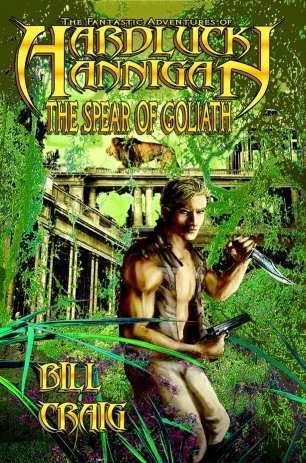
Bill:  Well I just finished off a short story for a future Airship 27 book, and I am in the home stretch on the next Hardluck Hannigan book: The Golden Scorpion, and then I was just invited to submit a story for a new weird western anthology, Showdown At Midnight, from the same people who did Six-Guns Straight from Hell.
AP: What do you like to read, and what have you taken from it over the years? Is there any writer or character in particular that inspired you and helped you shape your own narrative voice?
Bill: I read a lot of mystery, high adventure when I can find it, and westerns.  Doc Savage and the Shadow were inspirational and I used to be able to set down and read one of them in a couple of hours.  Of course I was younger then.  Also Don Pendleton’s Executioner and Jerry Ahern’s The SURVIVALIST both taught me a lot about making my characters human enough for the readers to care about.  Don and Jerry both mentored me to a great degree and I still keep in touch with Don’s wife Linda and with Jerry and his wife Sharon.
AP: Describe for us the writing process. Is there a particular time of day that you find more productive? Do you listen to music? What sort of an atmosphere do you like to work in?
Bill:  I usually write from about 9:30pm till about 11:30pm after I put my 5 year old to bed.  When I listen to music, it is either Jazz or a Soundtrack.  I like when the house has quieted down for the night and actually find rainy nights in the summer when I can open the patio and listen to the rain hitting on the tin roof.  Great atmosphere!
AP: How do you define “pulp?” Everyone seems to have somewhat different ideas about what it entails. What would you include or exclude from the definition?
Bill:  To me “pulp” defines anything that takes place before 1950.  After 1950, it becomes under the label of  “High Adventure”.  Jerry Ahern’s The Takers is a good example and of course the Gideon Hunt books.  But Doc Savage and the Shadow both ran to near the end of the 1940s so I feel the forties need to be included under the definition.  Anything before 1900 falls under the heading of Historical.
AP: Obviously, pulp in the 21st century isn’t going to be exactly like pulp in the 1930s. There’s a whole different perspective, and more than half a century of scientific and cultural progress. In what way do your stories remain true to pulp’s origins, and in what ways do they depart from that?
Bill:  Well, for one thing, the Hardluck Hannigan books take place during World War Two.  But Nazis aren’t the only enemies that Hannigan faces.  He’s also fought a demon and a Russian scientist who wanted to wipe out life on the surface of the Earth and maintain a utopian society in an undersea city.  Future plans also have him going up against criminal masterminds and war profiteers as well.  As far as a departure, the characters are much more three dimensional and you begin to almost think of them as real people.
AP: One of your series stars, Mike “Hardluck” Hannigan, takes place against an authentic historical backdrop—he finds himself contending against Nazis. And there is more than one layer of history and/or folklore here. In “Emerald Death,” for example, you have the story itself set in the Nazi era, and you also have the backstory of the Emerald of Eternity, and, in other stories, the Spear of Goliath and other exotic relics. Are you a history buff? How much do you draw on genuine historical personages and events?
Bill:  I do enjoy history, and I find the World War Two era and the old west to be my favorite areas.  In River of the Sun, Hardluck Hannigan and his friends went in search of legendary explorer Colonel Percy Fawcett, and Englishman who vanished in the Matto Grasso region of the AmazonBasin while looking for a lost outpost of Atlantis called “Z”.  It’s nice to sometimes use the search for a lost historical artifact either real or fictional to use as a catalyst to set the quest for that particular book in motion.  Though sometimes, it’s fun to use a mystery to set them on the road to adventure.
AP: I understand that you based Mike Hannigan on your father. Tell us a bit about that.
Bill:  My Dad is a very important figure in my life.  He grew up in the great depression and read Pulp tales himself.  He also is a Korean War vet and has a good knowledge of the era I am writing about.  Like Hannigan, my Dad grew up on a farm in Greensboro, Indiana.  But unlike Dad, Hannigan left in search of adventure, while my Dad left in service to his country.
AP: You’ve done several novels featuring Jack Riley and Moria Clark. Tell us a bit about that, and how you think those stories compare and contrast with the Hannigan novels. You’re coming from a somewhat different area there.
Bill:  The Jack Riley books are more in tone of what I refer to as High Adventure.  Like the Hannigan books, they are generally globe-spanning stories against large than life villains.  One such being my Oriental Mastermind, ChiPei who both Riley and Hannigan have fought.  He also appears in the Eye of Ka, my story for Airship 2’s upcoming anthology, Tales of the Hanging Monkey which is also a creation of mine.  Difference wise, Riley is an ex CIA agent turned Chicago Cop, and Moria Clark is his investigative reporter girlfriend.  Usually one of their jobs is the catalyst for whatever adventure they go on.  In book four, it was a honeymoon cruise that landed them in the Bermuda triangle and a confrontation with ChiPei.  They faced him again in The Mummy’s Tomb, which actually introduced an 80 some year old Hardluck Hannigan who was one of Riley’s heroes growing up.
          Both series have elements of the fantastic, where the Hannigan books are set against a historical backdrop, the Riley books have each been drawn from headlines in the news at the time they were being written.  Big Oil was a villain in two of the books, the Russian Mob in another, Chi Pei in one, another was the return of an old villain that was bankrolling genetic research to breed perfect killers, and then up against Chi Pei again in the final book.
AP: Have you ever come up with a story idea or concept that you found intimidating? Is there anything you’d like to tackle that you haven’t attempted yet?
Bill:  The Child Stealers was a very intimidating book because it dealt with Child Abductions through Social Services and then the children were sold either into slavery or for genetic testing.  Another dark book was a one shot thriller The Butterfly Tattoo about a serial killer in a small town.  I’d like to write a full length western novel.
AP: You recently did a Hardluck Hannigan video trailer. What inspired you to do that, and how did you go about it?
Bill:  Actually Don Gates had done a trailer for Challenger Storm, his upcoming title for Airship 27 and I liked it.  Plus, I thought it might be a  good way to build up a buzz for The Golden Scorpion which I am hoping to have out in early May.  I simply used Windows Movie maker and shots of all the covers plus some additional artwork that Laura Givens created for me, and then added American Patrol as the music to provide some period authenticity and give the trailer a lively soundtrack.
AP: What’s coming from Bill Craig? You seem to have quite a number of irons in the fire. Any projects you want to discuss? Publications? New characters or series? 
Bill: I am working on the next Hannigan of course, as well as the next two Decker P.I. books, Smugglers’ Blues and A cold and Lonely Death.  I am also in the middle of a project titled Harmony Hills: Savage Autumn about small town secrets.  I’m in line to do stories for some other Airship 27 projects and contemplating a new modern day action series following a character named Jake Donovan.  And of Course Hardluck Hannigan 8: Peril in the North.

THE LONG MATINEE races along the edge with BLADE RUNNER!

THE LONG MATINEE-Movie Reviews by Derrick Ferguson

BLADE RUNNER: The Theatrical Version
1982
Warner Bros.
Directed by Ridley Scott
Produced by Michael Deeley
Screenplay by Hampton Fancher and David Peoples
Based on the novel “Do Androids Dream of Electric Sheep” by Philip K. Dick
There’s a good reason why BLADE RUNNER is still hailed as a masterpiece of science fiction/neo-noir/detective pulp filmmaking today.  It’s just that good.  This is the movie; along with “Alien” released two years earlier defined the look and feel of science fiction movies for the next thirty years.  BLADE RUNNER is innovative in a lot of ways but most of all in the way it presented the future.  Of course, for us living in 2011 which isn’t so far away from the 2019 depicted in the movie we can get a chuckle at how far off the movie is in predicting where we would be.
But you look at the movie and what pulls you in is how lived in it looks.  This is no sterile “Logan’s Run” future where everything is clean and shiny.  This is a nasty future with dirt, grim, filth, machines that are made to be functional not pretty.  People wear real clothes with wrinkles that need to be washed.  There are billboards everywhere urging you to buy, buy, buy.  The streets are clogged with pedestrians that walk too fast who cuss at cars that honk at pedestrians who walk too slowly.  All the people don’t look pretty. In fact they look bored, worn down, used up, tired.  Kinda like the people you pass everyday on your way to and home from work, right?
Rick Deckard (Harrison Ford) is enjoying his retirement.  Once an honored member of L.A.’s Blade Runner Squad, he got sick of it and quit.  You see, his job was killing.  Killing Replicants.  Genetically engineered humanoids created by The Tyrell Corporation as slave labor for Earth’s off-world colonies.  The Replicants are stronger, faster and smarter than humans.  In fact, The Tyrell Corporation claims that their new Nexus-6 models are “More Human Than Human”.  And maybe they are.  Six of them prove resourceful enough to make it back to Earth and Los Angeles.  Which is where the Blade Runner comes in. 
Deckard is pressed back into service by his old boss Bryant (M. Emmett Walsh) and Bryant’s brown-noser Gaff (Edward James Olmos) to hunt down and retire the Nexus-6 Replicants.  It won’t be easy as they’re the most advanced Replicant models.  And they are determined to get to their creator Tyrell (Joe Turkel) and find a way to extend their four-year life span.  Deckard has to navigate through a minefield of humans and Replicants, all with their own agenda and their own plans to discover the truth of what being human means.  At the end of this tangled road is Rachel (Sean Young) a Replicant who believes is human and puts her trust and love in Deckard.  A man who comes to question his own humanity as the line between Human and Replicant becomes more blurred in his relentless pursuit of his quarry.
I love BLADE RUNNER.  That’s the simplest and best way I can put it.  I saw it during its original theatrical run and I love it now.  Mostly because of the way that it looks at the future by looking back.
Let me explain: even though BLADE RUNNER is a movie about the future, there are a lot of throwbacks to the past which make the movie look even more futuristic simply because we haven’t seen stuff like this in movies in a long time.  Rachel’s hair styles and clothing, inspired by Joan Crawford’s look of the 1930’s.  Deckard’s clothing and trenchcoat, inspired by private eyes of the 50’s.  The gritty, noir-ish look of the city with it’s rain-swept streets.   The reto-technology.  And I love the multi-cultural look of the movie which implies that Los Angeles of the future is a Third World culture unto itself.
At the time this movie was made Harrison Ford was #1 at the box office.  And why not?  He was starring in two major movie franchises and he took the BLADE RUNNER job to expand his range.  And I think he pulled it off extremely well.  There’s a real Humphrey Bogart-ish quality to his performance in this one.  The role of Deckard is obviously meant to be a throwback to Sam Spade and Philip Marlowe and it works.  Again, the whole success of this movie lies in the setting and technology reaching to the future while the clothing, attitudes and style of filmmaking reaches to the past.  It an extraordinary melding of past and future that many films have tried to copy but only BLADE RUNNER captured and captured exceedingly well.
Sean Young quickly got a reputation in Hollywood as being exceeding difficult to work with which I think is a shame.  She’s astoundingly good in this movie and I again point to her Joan Crawford-influenced make-up, wardrobe and style of acting as to why.  Rutgar Hauer steals the movie in terms of acting.  As Roy Batty his final speech has gone down in movie history.  And rightly so.  Few movie characters have died in such a memorable fashion as Roy Batty. 
So should you see BLADE RUNNER?  Chances are you already have.  At least one of the several versions available.  There’s a Director’s Cut.  A Final Director’s Cut.  An Ultimate Final Director’s Cut.  An Ultimate Platinum Final Director’s Cut and who knows how many others.  Last I heard there were seven versions available.  My recommendation?  Start with the Theatrical Version so you can see it the way we saw it back in 1982 and then go from there.  But any way you see BLADE RUNNER, but all means see it and enjoy it.  

ALL PULP ON VACATION! BUT NOT LONG!

ALL PULP just had a chance to take a few days with family and that doesn’t come very often, so ALL PULP WILL BE ON VACATION, but will return to exciting life on WEDNESDAY, MARCH 23!!!

Take some time with your own while we’re gone!