The Mix : What are people talking about today?

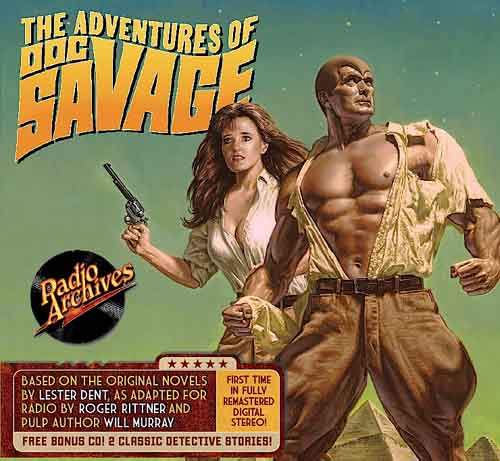
The Adventures of Doc Savage
Now available!
The Legendary Radio Series Restored and Remastered to Digital Stereo!

This eight-CD collection also includes a fascinating documentary “The Sound of Bronze: The Making of ‘The Adventures of Doc Savage'”, as well as original cover artwork by Doc Savage Bantam artist Bob Larkin.

RadioArchives.com is proud to present “The Adventures of Doc Savage”, the definitive version of the radio series that most Doc Savage and pulp fiction fans consider the finest audio version of the legendary Man of Bronze and his Fabulous Five!

First heard over National Public Radio and produced by Roger Rittner’s Variety Arts Radio Theatre, this brand new eight-CD collection presents two complete classic Doc Savage stories, fully dramatized and starring some of the best professional voice talents in the country. Based on the original novels by Lester Dent, writing as Kenneth Robeson, these timeless tales of adventure were adapted for audio by Rittner and well-known pulp historian and author Will Murray. Produced in full range stereo, each episode includes impressive sound effects and a full musical score.

This new compact disc collection – the first commercial release of this impressive thirteen-episode series – features two exciting multi-part adventures. First is the seven-part “Fear Cay”, an action-packed adventure in which Doc, Monk, Renny, Ham, Long Tom, Johnny, and cousin Pat Savage pursue the Fountain of Youth Gang to a remote Caribbean island full of booby traps and intrigue – including a mysterious force that can turn a man into a skeleton in a matter of seconds! Then, Doc and his team are enmeshed in the atmospheric six-part lost-city thriller, “The Thousand-Headed Man”, where they seek a lost expedition in the jungles of Indochina and an ancient treasure guarded by the fantastic Thousand Headed Man.

This collection has been completely remixed, remastered from the original recordings, and is presented in enhanced digital stereo. Also included is a brand new documentary, “The Sound of Bronze: Making ‘The Adventures of Doc Savage'”, featuring interviews, anecdotes from the cast and crew, and never before revealed details of how the series was conceived and created. The set, released in cooperation with Conde Nast, also features cover art by Doc Savage Bantam artist Bob Larkin and two bonus radio shows featuring two of the top detectives from 1940s, Philip Marlowe and Michael Shayne. And, at our website, you’ll find extensive liner notes written exclusively for RadioArchives.com by pulp historian and author Will Murray, writer of seven “Doc Savage” novels.

Priced at just $24.98, this exciting CD set, full of action, suspense, and mystery, is sure to occupy a special place in the personal library of any Doc Savage, pulp fiction, or old-time radio fan – and it’s now available from RadioArchives.com!

RadioArchives.com is one of the largest distributors of old time radio and pulp fiction entertainment in the United States. Specializing in fully restored radio programs, remastered from original recordings, we are known for our outstanding audio fidelity, impressive packaging, and commitment to top quality customer service. In addition to radio shows, RadioArchives.com also carries a full line of reprinted pulp fiction favorites, including all of the issues of Doc Savage, The Shadow, The Spider, The Avenger, and The Whisperer.

SAVAGE TALES BLOG HITS MILESTONE!!

News from Blog Creator/Writer Peter Miller-

10/4/10
Today my blog  has hit 100,000 page views!

I started this blog to get me writing on a regular basis and I’m pretty proud of how its gone. I’ve posted over 36 pulp of the week reviews including the first 18 Doc Savage novel. I have posted  numerous Comic-Con reports and board game articles and reviews. I have posted new material for the Weird War II game, Tannhauser.

All in all, I am happy that people are reading and keep coming back.

ALL PULP congratulates Peter on this milestone!  Fantastic!

Skultar Chooses His Next Victim…

So, at the beginning of last month, we told you all about the White Elephant Music Club’s first songwriting challenge. You remember that, right? Oh, we know you do, because we scared the fluids right out of your nether regions when we announced it. Since the prizes include a visceral death at the hands of Skultar in his upcoming graphic novel, it was no surprise that the White Elephants got some great submissions. Good on all of you, you weak and pathetic bards! Skultar told me personally he was so inspired by the contest, he’d considered picking up a Gibson Flying V and writing his own awesome theme song. Lucky for the contestants, though, Skultar opted not to do so, because he realized playing guitar and ripping metal riffs would only get in the way of all the murdering.

All that being said, we here at ComicMix would like to congratulate the winner, Chris Cogott, for his winning tune, the aptly named “Skultar.” The contest was judged by our friend Russ Rogers, Mark Wheatley (Skultar’s co-creator), and Julia Sherred.

Since the White Elephant Music Club is totally rad, you can visit their bandcamp page and download the entire album of finalists for free! In addition to Cogott’s winning tune, you’ll get an awesome metal romp from Kevin Savino-Riker (“Skultar’s Blade”), a hilarious spoken-word comedic piece by JoAnn Abbott (“The Ballad of Skultar“), a lounge-lizard schmoozefest from the well-named wait, WHAT? (“S-K-U-L-T-A-R“), and more! And for the price (ahem, FREE!), you can’t beat it. We suggest you hop over, download the tunes, pop ’em in your iPod, and go pillage a village. Hmm, that rhymes. Now, all I need is some murderous riffs, and I’ve got an instant classic.

Take it away, Skultar!

Review: ‘Atlantis the Lost Continent’

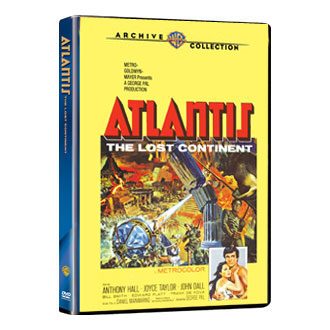
atlantis-archive-9532902Back in the dim pre-cable days, the independent stations in New York would run movies at all hours of the day. Those of us addicted to television were exposed to movies both great and not-so-great with amazing regularity and repetitiveness. One of those pleasures was in spotting performers we knew from other roles, at different times in their careers. For me, one of those discoveries was Edward Platt, who I only knew as the Chief of CONTROL on [[[Get Smart]]]. But there he was, in priestly robes, in a tale of lost Atlantis. It was years before I remembered its name,[[[ Atlantis the Lost Continent]]]and it was even some time after that before I realized it was from director George Pal. (more…)

National Graphic Novel Writing Month, Day #6: Four-color, true grit, or somewhere in between?

By now, you should have an idea for a story, and you might even know who some of the characters are. Your next question: how are you going to present the story?

To quote the greatest criminal mastermind of our time: “Some people can read War And Peace and come away thinking it’s a simple adventure story.” How you present the story is very important.

Let’s say you were writing a Batman story… why not, everybody else has. What type of Batman story are you going to tell?

Remember, this is a character who’s a cheery Saturday morning cartoon on The Brave and the Bold but he’s also beating people to a pulp in The Dark Knight, a film that pushed the limits of PG-13. He’s a toy for toddlers, a sociopath in Frank Miller’s work, and sometimes just flipping weird in Grant Morrison books. And it all works.

But more on point, the tone of your story has to be considered. It’s easy to contemplate a noir Batman story, but you could just as easily write a science fiction Batman story. Or a comedy. Or a spy story. Or a fable. Or horror. Or musical comedy– okay, it’s tough to do musical comedy in comics, but it’s been done in other media.

And more importantly, you can tell the same sequence of events, but you can frame it in different ways. You can look at your buddy’s romantic troubles as tragic or hilarious– or both, if they’re like my friends.

This will also affect who your choice of artist will be. Granted, you may or may not have control of who will end up drawing your story, but you can write as if you are picking the artist. A Batman story drawn by Jack Kirby will feel much different than one drawn by Neal Adams, and that will feel different than a story drawn by Timothy Truman. But again, you can use that to your advantage. No one will expect a story drawn by, say, Gene Colan to be a laugh riot. And yet, there were a few funny Batman stories that he drew.

Tone is your secret weapon– people expect a comic book story to be told a certain way. Surprise them.

Remember: you can follow all the NaGraNoWriMo posts here!

INTERVIEW with KG McABEE, Pulp Author!!!


AP: Tell us a little about yourself and your pulp interests.

KGM: I can still remember my dad buying Batman comics and reading them to me, and my keen desire to learn to read them myself. One of my first loves was Jules Verne; I read 20,000 Leagues Under the Sea in 4th grade and my teacher kept asking me if I understood it. Well, certainly, though I admit I had to skip over some of the technical terms. Then I started on Andre Norton and Heinlein’s juveniles in 5th grade, and on to Robert E. Howard, H.P. Lovecraft, Talbot Mundy, Sax Rohmer, C. L. Moore, ERB…so many, many fascinating writers!

AP: How did you get your start as a pulp writer?

KGM: My tendency, when anyone says, “Can you write—”, I say, “Sure!” And since I’ve read so much pulp, it seemed a natural step to try writing some. When I was first starting to write professionally, I did some REH pastiches for Tom Johnson’s pulp magazines: Conan-ish, Solomon Kane-ish and Breckinridge Elkins-ish shorts. Tom liked my work and introduced me to Ron Fortier of Airship 27, who recently published the GIDEON CAIN, DEMON HUNTER anthology edited by Van Plexico, and Ron Hanna of Wild Cat Books, who publishes the STARTLING STORIES magazine where I’ve been lucky enough to have several shorts and novellas. Ron Fortier also got me involved with a Domino Lady anthology which ended up being released by Moonstone Books.

AP: There seem to be many different opinions about what can be defined as pulp. What do you look for in a pulp story as a writer and a reader?

KGM: I think pulp is by definition adventure-and-atmosphere heavy and strongly plot-driven, with character a close—or sometimes not so close—third. That said, I do consider character to be of prime importance, especially as a reader. If I don’t care about the characters, why would I want to read about them? That, I think, is part of the appeal of long-running pulp characters: Doc Savage, The Shadow and the rest. The reader gets a feeling, almost, of family; I know I would love to have a meal or go on vacation with Doc and his Fabulous Five, listen to Monk and Ham argue, marvel at Johnnie’s vocabulary. The adventures of these characters are great, but really, what does the reader remember? An exciting trek in a submarine or why Monk named his pet pig Habeas Corpus?

AP: Where can readers find information on your books?

KGM: My website, which needs updating desperately:
And the one with my collaborator, Cynthia D. Witherspoon—we write urban fantasy and steampunk as Cynthia Gael—

AP: What upcoming projects do you have coming up that you can tell us about at this time?

KGM: I’m working with my collaborator, Cindy Witherspoon, on the aforementioned urban fantasy series called THE BALEFIRE CHRONICLES. Book one, BALEFIRE AND MOONSTONE, is available from Gypsy Shadow Publishing and at Amazon. Book two in the series, BALEFIRE AND LODESTONE, is done and we’ve started on book three. Under the Balefire umbrella, we’re also doing a series of steampunk novellas; the first one, BALEFIRE AND BRASS, is complete and under consideration. I’m also finishing up a fantasy and hope to do more pulp soon.

AP: Do you have any shows, signings, or conventions coming up where your fans can meet you?

KGM: I’ll be a guest author at Pagan Pride Day in Clemson, SC on October 9. On November 2, I’m doing a NaNoWriMo kickoff in Woodruff, SC. I’m teaching creative writing classes in Asheville and Charlotte, NC, for

AP: And finally, what does K. G. McAbee do when she’s not writing?

KGM: Not writing? If I’m not writing, I’m thinking about writing. Seriously, though, I do try to spend as much time as I can writing, but I also read an enormous amount; I think it’s not only necessary for a writer but the most fun you can have. I also tutor English and algebra at two local community college branches, which is odd because I don’t have a degree in either; my degree, strangely enough, is in industrial electronics. But I’m with Heinlein; he said a human being should be able to do anything from diaper a baby to cook a meal to lead an army to colonize a planet; specialization is for insects. I’m definitely one of Heinlein’s Children. www.twwoa.org in November and December. And I’m giving a presentation called “Airships, Submersibles, Difference Engines and Steam Men: Reading, Researching and Writing Steampunk” at the Upstate Steampunk Extravaganza in Greenville, SC. www.cynthiagael.comhttp://kgmcabee.books.officelive.com

nagranowrimo-6393652

National Graphic Novel Writing Month, Day #5: Whose Story Is It, Anyway?

nagranowrimo-1182709Editor’s note: We were all ready to discuss who you should be focusing on in your graphic novel, and then we remembered that John Ostrander, writer of GrimJack, Munden’s Bar, Star Wars: Legacy and Suicide Squad, had already answered the question for us a while back. So we’re reprinting his piece from October 25, 2007.

In any given story, one of the primary questions that must be
answered by the writer is – whose story is it? For example – in any
Batman/Joker story, we assume that the story is going to be about
Batman. He is the title character, after all. However, the story can be
about the Joker – taken from his perspective, with the Joker as the
protagonist and the Batman as his antagonist. A protagonist, after all,
is not always a hero.

Sometimes, when I’m having problems with a story, I’ll go back to that
simple, basic question – whose story is it? The answer sometimes
surprises me. When I was writing my historical western for DC, The Kents,
I assumed for a long time that the story was about Nate Kent, who was
the direct ancestor of Pa Kent, Clark’s adoptive father. It was only
when I was deep into the story that it occurred to me that the story was
actually about Nate’s younger brother Jeb, who takes a wrong road,
shoots his brother in the back at one point, becomes an outlaw, and
eventually has to make things right.

The story may not always be about a person. When I wrote Gotham Nights,
the focus of the story was the city itself, and the city was comprised
not only of its buildings and roadways but, more importantly, the people
who lived there, of whom I tried to give a cross-sampling. Batman was a
part of all that because he is a part of Gotham City but the miniseries
didn’t focus on him. It was Gotham City’s story.
(more…)

Win a Digital Download for ‘King Kong’

King Kong remains one of the most imaginative, exciting and innovative movies of all time. The story alone is a pulse-pounding gem but then you add in Willis O’Brien’s groundbreaking special effects you have an instant classic. The 1933 film is being released today on Blu-ray and is now available as a digital download.

Warner Bros. Digital Distribution is releasing of
the classic film King Kong for Download at iTunes..  Take the beast on the run! 
Fans can now enjoy KING KONG on their iPhone, iPad and more…

Warner Digital has given us a digital download to give away to one lucky ComicMix reader. All you have to do is tell us what makes you go ape. The best answer provided in the comments section byt 11:59 p.m. Thursday evening will win this special treat.


Video Game Review: “Spider-Man: Shattered Dimensions”

I’ll admit it: I’m a sucker for[[[Spider-Man]]] video games. Good, bad; I’ve played them all (own them all too).  So when they announced Spider-Man: Shattered Dimensions where you’d be able to play as four different Spider-Men across four different dimensions, I was sold.  Taking Amazing, 2099, Noir and Ultimate (in the symbiote suit) and having them all working toward a common goal (save their universes, and all the other ones) is pretty daunting…what makes it more so is making each version unique and fun.  After some stellar games in the past years (the ones based on the first two movies) and some not so stellar ones (the one based on the third movie), it’s high time ol’ web-head got a title befitting his comic roots…all of them.

It seems Mysterio has found a mystical tablet that grants him unimaginable power…and of course Spidey has to show up in the nick of time and thwart his schemes…sort of.  In the fracas, he accidentally shatters the tablet, sending pieces of it across dimensions.  With the help of Madame Web and the other versions of Spider-Man, he must regain control of the fragments before they fall into the wrong hands…and rips the universe apart in the process.  There’s plenty of fan service throughout, but is that enough to make a good game?

(more…)

INTERVIEW-Russ Anderson, Writer/Editor with Pulpwork Press!!!

RUSS ANDERSON, Editor of HOW THE WEST WAS WEIRD, Pulpwork Press/Writer
AP: Who’s Russ Anderson?
russanderson-4371111
RA: A writer/editor/father/husband/bicyclist/amateur bear-fighter living in the Baltimore-DC area of these United States. In regards to what the readers of All Pulp might care about, he’s also one of the dudes behind the late Frontier Publishing and the editor of HOW THE WEST WAS WEIRD from Pulpwork Press. Furthermore, he enjoys talking about himself in the third person.
AP: What have you written and where can we find it?
RA: (Russ is disappointed to be abandoning third person already.)
I wrote “Mythworld”, a novel about Greek gods pressing for a comeback in the modern age, and the hijinks that ensue because of it. Mythworld appeared on the late Frontier Publishing website, but isn’t currently available. Maybe I should do something about that. Also, I wrote a short story called “The Origin of Flight” that appeared in a print superhero anthology that is no longer available called “Truth, Justice, And…”
So basically, you have to just take my word for it that I write. Oh! Except for my flash non-fiction story, Little Beagle Puppy, which is still available on Flashquake at http://www.flashquake.org/archive/vol2iss3/.
AP: How did you get hooked up with Pulpwork Press?
RA: I’ve known everybody at Pulpwork for about ten years, so the real question is why it took me so long to get involved over there. Fortunately, when I had a project I wanted to put together for them, our prior friendship greased the wheels of progress a bit.
AP: What’s the story behind HOW THE WEST WAS WEIRD?
RA: I wanted to be part of the club over at Pulpwork Press for a while, but hadn’t been successful in carving out the time to write a long-form project in a long time. So I pitched How the West Was Weird as an anthology mainly as a way (a) to get a project going with those guys without having to spend a year writing a book, and (b) to reconnect with some of the writing buddies that I’d started to fall out of touch with since Frontier went under. To that end, the story submissions were invitation-only, and I only invited writers I’d worked with whose stuff I enjoyed.
I sometimes feel like I didn’t edit HOW THE WEST WAS WEIRD so much as hosted it, since it really was just an excuse to get a bunch of my pals together. Fortunately, the book has transcended my selfish reasons for creating it and become something I’m really proud of.
As for why I went with a weird western, there’s no story to that. I enjoy the mash-up of those two genres quite a bit, and it was different from anything Pulpwork was doing. So here we are.
AP: What’s your definition of a weird western?
RA: The western isn’t defined by its location so much as it is by its tropes. There are certain plot elements (life on a frontier, the cycle of revenge) and certain character archetypes (the mysterious drifter, the lawman) that make a story a western, regardless of where it’s located. I don’t think anybody would argue that “Seven Samurai” and “Outland” aren’t westerns, even though one’s set in feudal Japan and one’s set on a moon of Jupiter.
The weird western basically takes those tropes and either presents them in an unusual setting, or adds elements from other genres into the western framework. The most popular seems to be the horror-western – those two just seem to go together like peanut butter and jelly – but I’m a big fan of the steampunk-western and the space-western myself.
AP: There are other weird western anthologies out there.  What makes HOW THE WEST WAS WEIRD special?
RA: Can I say “because it’s good”? Is that snarky?
Well, how about the fact that it’s wrapped in an extremely pretty cover by Jim Rugg, artist/creator of “Street Angel” and “Afrodisiac”?
Also, it’s awesome.
Next question.
AP: Do you think that the weird western is a legitimate genre that will be around for awhile or is it just a phase that’s going to fade out as soon as the next bright & shiny thing comes along?
RA: Genres don’t really go away, do they? They may get put back on the shelf as they fall out of favor, but they always come back. I don’t think the weird western is ever going to fully disappear now that it’s out of the box.
I think the question is misleading, since it’s not like the genre is setting the world on fire right now. There’s a biiiiiiigg gap between it and, say, the vampire teen drama, and I think that’s primarily based on Hollywood’s inability to get the weird western right. Whenever they try, we get stuff like the Will Smith “Wild, Wild West”, or “Jonah Hex” starring Brandon from The Goonies. And that’s fine, I think. In a few years, everybody’s going to be sick of vampires stalking high school girls and the weird western will still be chugging along just fine.
All that said… you have to remember that the weird western is really only about 20 years old, so eventually the unique aspects of it will start to seem less and less unique. I think as time passes, the “weird” elements will begin to define the genre that the story falls into, and you’ll start seeing weird westerns in sci-fi, horror, and fantasy anthologies. It will be treated as a subset of other larger genres rather than being its own thing.
AP: There have been rumors of a HOW THE WEST WAS WEIRD 2.  Any truth to those rumors?
RA: Absolutely. A bunch of the guys who contributed to the first one have already promised me stories for volume two, along with some new faces. What’s more, I had a chance to talk to Jim Rugg at this year’s Baltimore Comic Con, and he’s on board for the cover too. I’m shooting for it to be twice as awesome as the first one, though I’m concerned about whether the binder can possibly contain all that.
I have no idea when it will hit the streets. I expect to be done with it by next spring, so we’ll have to wait and see when we can fit it in to Pulpwork’s publishing schedule at that point. Also, keep in mind that the last time we did this, my wife got pregnant halfway through, which added – no kidding – exactly nine months to the process. It should be out sometime during 2011, though.
AP: What other projects have you got in mind?
RA: I’ve got a 10 month old daughter, who’s enough of a project all by herself, thanks.
AP: Here’s your chance for a shoutout or to plug/pimp something.  Go.
RA: Buy HOW THE WEST WAS WEIRD. If you haven’t gathered as much from the rest of this article… it’s awesome.
AP: Any final words of wisdom?
RA: Like Linda Hunt said in Silverado: “The world is what you make of it, friend. If it doesn’t fit, you make alterations.”