HANCOCK TIPS HIS HAT TO THE GREEN LAMA-UNBOUND!!
TIPPIN’ HANCOCK’S HAT-Reviews by Tommy Hancock

It’s finally here, just in time for New York Comic-Con… Lone Justice Volume 1!
Ask
for it if you don’t see it and order it if it is sold out in your
store! The Diamond order code: JUL100357 LONE JUSTICE TP VOL 01
Or if you don’t have a store near you, order Lone Justice Volume 1
from Amazon.
Day seven, and we’re already seeing script fragments come in. I just read one, and sent back the note: “Decent screenplay, lousy comic.”
Why? Because he took pages to get to the point, a slow tracking shot that revealed very little about the plot, situation, or characters. While that can work on screen, it’s death on a printed page. Get to the point.
Mark Waid has a much better rant on this on this that I do:
At BOOM!, I get a l-o-t of
eight-page scripts that, for no good reason, burn up the entire first
page with a slow zoom into a New York restaurant kitchen. This makes me
homicidal. If your story is about a chef and geography is incidental, just show me the damn kitchen. Tick, tock.
I love RESERVOIR DOGS, but if you handed me a comics script that began
with four pages of gangsters debating the merits of Madonna, I would not
only reject it, I would break your keyboard.In a 22-page comic,
figuring an average of four to five panels a page and a couple of
full-page shots, a writer has maybe a hundred panels at most to tell a
story, so every panel he wastes conveying (a) something I already know, (b) something that’s a cute gag but does nothing to reveal plot or character, or (c) something I don’t need to know is
a demonstration of lousy craft. Comics are expensive. Don’t make me
resent the money I spend buying yours. Every single moment in your
script must either move the story along or demonstrate something important about the characters—preferably both—and every panel that does neither is a sloppy waste of space.
You do this by entering the story as late as possible, telling enough to get people up to speed on the situation and go.
Want an extreme example of this? Here’s the trailer for this past summer’s Knight and Day:
Fine trailer, but it just wrecked the movie– because Cameron Diaz has just explained to Marc Blucas what happened to her in under two minutes what will now take the first half-hour of the film to show– I have to sit through at least thirty minutes to get to where I get new parts of the story.
Don’t waste your limited number of pages, and don’t waste your reader’s time.
Remember: you can follow all the NaGraNoWriMo posts here!
Japan’s nicest bad boys are, as one of their new album cuts says, causing “Trouble,” out on their first world tour, appearing to frenzied fans. And they’re stopping at NYC’s Roseland Ballroom for only the second time in their 6-year history of music-making together on Saturday, October 9th to rock our world.
The concert is part of a weekend here that begins with their
appearance at NYAF on Friday 10/8 at 4:30 p.m. Long associated with the genre,
Hyde, via L’Arc and solo, can be heard on the opening themes to popular animes such as Fullmetal
Alchemist (second season’s opening, “Ready, Steady, Go!”), Moribito (“Shine”), and Blood+ (second season’s opening,
“Season’s Call”).
L-Arc~en~Ciel’s HYDE and Oblivion Dust’s K.A.Z. are back as Vamps, with their second full album together, Beast. The album is more of what the guys of this Japanese supergroup are famous for over their decade of music making… from the
delicious crunch of the darkest cuts from Hyde’s 2006 solo album (his first
full-collaboration album with K.A.Z., who was co-producer on HYDE’s 666 in 2004), Faith,
such as “Jesus Christ” and “Countdown,” with the trebly, joy-filled,
optimism of “Season’s Call,” and pure emotions of “Evergreen” on new
tracks like “Devil Side,” “Angel Trip,” and “Get Up”. They are driven by
K.A.Z.’s guitar that is very much in the world of U2’s The Edge, with a
rhythm section that is at once lyrical and full of quirky cross-rhythms
that keep
things interesting, all very tight and energetic. And above it all soars
and
snarls, with promises worthy of a vampy vampire that True Blood’s Lafayette might describe as “sex on a stick,” is
Hyde’s unmistakable voice that just gets better with age – he’s
40-something and is a tattooed, leather-clad, pouty Peter Pan, in perfect
shape, lately sporting blond hair that is at once striking and strange. Darkly
fey. K.A.Z. is all spikey hair, sunglasses, and guitar hero.
The chemistry of
this collaboration is totally apparent and fun to see and hear on the tracks
and production and live-concert videos. This album may not be my favourite of
Hyde’s work to date (that’s still Faith
and L’Arc cuts such as “Ready, Steady, Go!” and “Shine”). Lyrically, it’s not
up to the power and beauty of past work and the English can be rather raw,
though some of the playful double-entendres
do tempt and tease as they ought. Nonetheless, it is a fun album, a dancin’,
jammin’, party album, worth having in a fan’s collection and a good entry piece
for those new to the HYDE-K.A.Z. multi-verse. I anticipate an electric atmosphere
for the show with NY audiences who rarely get to hear their fav J-Rockers live,
stoked and hungry and rarin’ to go!
I’ll return with a review of
the show and backstage goings-on sometime after the event. Stay tuned!
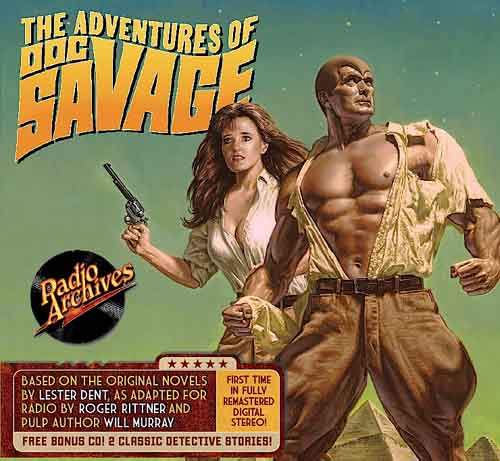
The Adventures of Doc Savage This eight-CD collection also includes a fascinating documentary “The Sound of Bronze: The Making of ‘The Adventures of Doc Savage'”, as well as original cover artwork by Doc Savage Bantam artist Bob Larkin. RadioArchives.com is proud to present “The Adventures of Doc Savage”, the definitive version of the radio series that most Doc Savage and pulp fiction fans consider the finest audio version of the legendary Man of Bronze and his Fabulous Five!
First heard over National Public Radio and produced by Roger Rittner’s Variety Arts Radio Theatre, this brand new eight-CD collection presents two complete classic Doc Savage stories, fully dramatized and starring some of the best professional voice talents in the country. Based on the original novels by Lester Dent, writing as Kenneth Robeson, these timeless tales of adventure were adapted for audio by Rittner and well-known pulp historian and author Will Murray. Produced in full range stereo, each episode includes impressive sound effects and a full musical score. |
|
|
This new compact disc collection – the first commercial release of this impressive thirteen-episode series – features two exciting multi-part adventures. First is the seven-part “Fear Cay”, an action-packed adventure in which Doc, Monk, Renny, Ham, Long Tom, Johnny, and cousin Pat Savage pursue the Fountain of Youth Gang to a remote Caribbean island full of booby traps and intrigue – including a mysterious force that can turn a man into a skeleton in a matter of seconds! Then, Doc and his team are enmeshed in the atmospheric six-part lost-city thriller, “The Thousand-Headed Man”, where they seek a lost expedition in the jungles of Indochina and an ancient treasure guarded by the fantastic Thousand Headed Man.
This collection has been completely remixed, remastered from the original recordings, and is presented in enhanced digital stereo. Also included is a brand new documentary, “The Sound of Bronze: Making ‘The Adventures of Doc Savage'”, featuring interviews, anecdotes from the cast and crew, and never before revealed details of how the series was conceived and created. The set, released in cooperation with Conde Nast, also features cover art by Doc Savage Bantam artist Bob Larkin and two bonus radio shows featuring two of the top detectives from 1940s, Philip Marlowe and Michael Shayne. And, at our website, you’ll find extensive liner notes written exclusively for RadioArchives.com by pulp historian and author Will Murray, writer of seven “Doc Savage” novels. Priced at just $24.98, this exciting CD set, full of action, suspense, and mystery, is sure to occupy a special place in the personal library of any Doc Savage, pulp fiction, or old-time radio fan – and it’s now available from RadioArchives.com! RadioArchives.com is one of the largest distributors of old time radio and pulp fiction entertainment in the United States. Specializing in fully restored radio programs, remastered from original recordings, we are known for our outstanding audio fidelity, impressive packaging, and commitment to top quality customer service. In addition to radio shows, RadioArchives.com also carries a full line of reprinted pulp fiction favorites, including all of the issues of Doc Savage, The Shadow, The Spider, The Avenger, and The Whisperer. |
|
News from Blog Creator/Writer Peter Miller-
I started this blog to get me writing on a regular basis and I’m pretty proud of how its gone. I’ve posted over 36 pulp of the week reviews including the first 18 Doc Savage novel. I have posted numerous Comic-Con reports and board game articles and reviews. I have posted new material for the Weird War II game, Tannhauser.
All in all, I am happy that people are reading and keep coming back.
So, at the beginning of last month, we told you all about the White Elephant Music Club’s first songwriting challenge. You remember that, right? Oh, we know you do, because we scared the fluids right out of your nether regions when we announced it. Since the prizes include a visceral death at the hands of Skultar in his upcoming graphic novel, it was no surprise that the White Elephants got some great submissions. Good on all of you, you weak and pathetic bards! Skultar told me personally he was so inspired by the contest, he’d considered picking up a Gibson Flying V and writing his own awesome theme song. Lucky for the contestants, though, Skultar opted not to do so, because he realized playing guitar and ripping metal riffs would only get in the way of all the murdering.
All that being said, we here at ComicMix would like to congratulate the winner, Chris Cogott, for his winning tune, the aptly named “Skultar.” The contest was judged by our friend Russ Rogers, Mark Wheatley (Skultar’s co-creator), and Julia Sherred.
Since the White Elephant Music Club is totally rad, you can visit their bandcamp page and download the entire album of finalists for free! In addition to Cogott’s winning tune, you’ll get an awesome metal romp from Kevin Savino-Riker (“Skultar’s Blade”), a hilarious spoken-word comedic piece by JoAnn Abbott (“The Ballad of Skultar“), a lounge-lizard schmoozefest from the well-named wait, WHAT? (“S-K-U-L-T-A-R“), and more! And for the price (ahem, FREE!), you can’t beat it. We suggest you hop over, download the tunes, pop ’em in your iPod, and go pillage a village. Hmm, that rhymes. Now, all I need is some murderous riffs, and I’ve got an instant classic.
Take it away, Skultar!
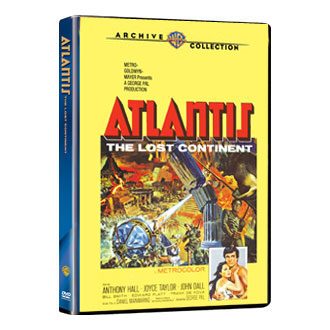
Back in the dim pre-cable days, the independent stations in New York would run movies at all hours of the day. Those of us addicted to television were exposed to movies both great and not-so-great with amazing regularity and repetitiveness. One of those pleasures was in spotting performers we knew from other roles, at different times in their careers. For me, one of those discoveries was Edward Platt, who I only knew as the Chief of CONTROL on [[[Get Smart]]]. But there he was, in priestly robes, in a tale of lost Atlantis. It was years before I remembered its name,[[[ Atlantis the Lost Continent]]]and it was even some time after that before I realized it was from director George Pal. (more…)
By now, you should have an idea for a story, and you might even know who some of the characters are. Your next question: how are you going to present the story?
To quote the greatest criminal mastermind of our time: “Some people can read War And Peace and come away thinking it’s a simple adventure story.” How you present the story is very important.
Let’s say you were writing a Batman story… why not, everybody else has. What type of Batman story are you going to tell?
Remember, this is a character who’s a cheery Saturday morning cartoon on The Brave and the Bold but he’s also beating people to a pulp in The Dark Knight, a film that pushed the limits of PG-13. He’s a toy for toddlers, a sociopath in Frank Miller’s work, and sometimes just flipping weird in Grant Morrison books. And it all works.
But more on point, the tone of your story has to be considered. It’s easy to contemplate a noir Batman story, but you could just as easily write a science fiction Batman story. Or a comedy. Or a spy story. Or a fable. Or horror. Or musical comedy– okay, it’s tough to do musical comedy in comics, but it’s been done in other media.
And more importantly, you can tell the same sequence of events, but you can frame it in different ways. You can look at your buddy’s romantic troubles as tragic or hilarious– or both, if they’re like my friends.
This will also affect who your choice of artist will be. Granted, you may or may not have control of who will end up drawing your story, but you can write as if you are picking the artist. A Batman story drawn by Jack Kirby will feel much different than one drawn by Neal Adams, and that will feel different than a story drawn by Timothy Truman. But again, you can use that to your advantage. No one will expect a story drawn by, say, Gene Colan to be a laugh riot. And yet, there were a few funny Batman stories that he drew.
Tone is your secret weapon– people expect a comic book story to be told a certain way. Surprise them.
Remember: you can follow all the NaGraNoWriMo posts here!