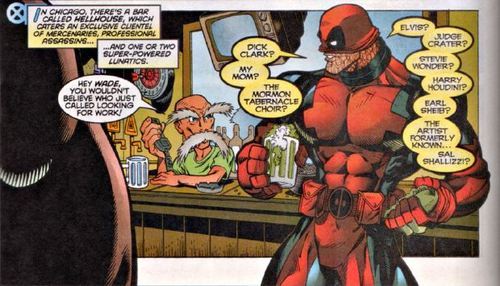
Deadpool? Who the heck is Deadpool? What the heck is a Deadpool?
That’s Deadpool? Looks like he’s wearing a costume that Spider-Man gave to the Salvation Army. Superhero, huh? With his own movie. It made how much? A hundred and thirty-five million dollars opening weekend? American money?
Yeah, I didn’t see Deadpool coming either. Oh sure, I caught some of the television commercials, but nothing on the screen made me want to plunk down the price of admission. I thought that maybe I’d watch it on cable, maybe some night after Marifran’s crashed. Or maybe we’d watch it together. Some time. Maybe.
Deadpool is not exactly a household name, like Superman or Spider-Man. Despite a connection with the über-popular X-Men, I doubt that Deadpool has penetrated the public consciousness – or at least he hadn’t, before all those TV ads.
Now? Bet the mortgage money that a sequel is already heading our way.
Savants-to-come may extract meaning – or Meaning – from the Deadpoolian success. I won’t even try. Instead, I’ll content myself with observing that, obviously, the Great Superhero Surge has not waned. And if the showbiz folk can extract a Deadpool from the yellowing pages of ageing funnybooks and transform him into profit, mightn’t there be other forgotten/obscure/abandoned characters waiting for similar transformation?
Here’s a thought: why not take these almost-anonymous characters half way back to their birthplaces – those yellowing pages – and reinvent them as animated cartoons? Not the kind of paperdollish creations that used to inhabit the Saturday morniing wasteland. No, give them the same prime time treatment that was once given to The Flintstones and is currently accorded The Simpsons and The Family Guy. And while, yes, I’m proposing that these new shows feature superheroes, I wrote nothing about human superheroes. With a nod to Ralph Bakshi’s version of Mighty Mouse, let’s resurrect funny animals and, as is done with the Simpsons and Family Guy, give them not-so-funny themes.
Hoppy The Marvel Bunny, anyone?
Another idea? Sure. Four words: Herbie The Fat Fury. And who might he be? Herbie – last name Popnecker – was a tubby, lollypop loving kid who had secret superpowers. These he used to fight evil, which is, after all, what superheroes do, even if they’re not terribly imposing superheroes. Herbie lived on the newsstands, in various titles published by the American Comics Group, from 1958 to 1964. Then, poof. Gone!
I think Herbie has possibilities. He could work as an animation property – again, let us remember Family Guy – or in live action. It might be difficult to find the right actor to play him, but hey! that’s why those folks out on the west coast get the big bucks. The only other snag I can foresee is the “fat fury” sobriquet. Some citizens might find it offensive. Well, okay, drop it if that seems prudent. Not much will be lost if you do.
And admit it: aren’t you just a wee bit weary of muscled people in tight costumes? Like Deadpool?
Seven random thoughts on a post-Valentine’s Day afternoon.
I’ve started to measure time in “DC Comics Reboots.” Usually about four years, give or take. In other words, if Abe Lincoln used that designation his most famous speech with have started “21 DC Comics Reboots ago…” Yes, I know DC insists it’s not a reboot, despite cancelling and replacing their entire superhero line with new versions of the same old thing. And I suppose Superman doesn’t have a Big Red S.
O.K. Jughead is asexual – although I’d bet he won’t be in the CW teevee series. But I ask you this: did Kevin Keller out him by saying so in public at Riverdale High? Don’t get me wrong; that was a great scene and it feels as though the revelation was common knowledge. But, like Martha and Joe before me, I hadn’t thought about asexuals being a class of people subject to routine discrimination. It’s been a while since a mainstream comic book actually lit the flames of thought inside my fevered brainpan.
Deadpool was the Airplane! of superhero movies. Brianna Hildebrand’s scene where she halts the big battle sequence in order to finish texting was brilliant and Stan Lee’s cameo was the finest use of a nonagenarian comic book writer ever. However, I think Stefan Kapicic owes Paul Frees’ estate a check for his use of Boris Badenov’s voice, and at the end where Morena Baccarin worked things out (no spoiler alert), I kind of felt sorry for Detective Jim Gordon. Although, to be fair, Morena’s had a great deal of varied superhero work in recent years.
In last month’s issue of Doctor Fate – a wonderful and soon-to-be-cancelled New52 series – writer Paul Levitz deployed my favorite verse from the Koran. Yes, sports fans, I actually have a favorite verse from the Koran. Of course, Islam being an organized religion and therefore greatly disorganized, the verse is phrased in a variety of ways and its veracity has been questioned by some. But the line goes “Blessed is he who makes his companions laugh” and I think that’s a great sentiment. Nice job, Paul.
Riddle me this: How many Spider-Men does it take to fill the Marvel Universe? Answer: How many have you got? I wouldn’t be surprised if there were more Spideys right now than Green Lanterns. So stop bitching about the inevitability of concurrent Sam Wilson and Steve Rogers Captains America. That’s only two. Thus far. Oh, wait. Isn’t there a teen-age girl from 2099 or from another, no-longer existent universe? O.K. Three.
Counting up the number of secret origins devised for Wonder Woman over the past 75 years is akin to defining π to the last decimal point: you’re going to give up or die of old age before you complete your mission. I might have read them all, but I’ve probably read nearly all. And the current one that’s unfolding in Legend of Wonder Woman is, by far, the best thought-out and best realized of the bunch. Kudos to Renae De Liz and Ray Dillon on a thankless job – thankless because it’s not the origin in the upcoming Wonder Woman movie and, therefore, probably will be ignored. I hope not.
Now that Playboy magazine has dropped the tits’n’snatch, the relic from the beat generation has decided to off the cartoons as well. This surprises me only because its two most famous cartoonists, Gahan Wilson and Hugh Hefner, are still alive. Well, in ‘Ner’s case, that’s subject to debate. Nonetheless, it’s a shame that the magazine that regularly gave us the work of Jack Cole, Jules Feiffer, Shel Silverstein, Bobby London, Harvey Kurtzman and Willy Elder will not extend that welcome to a new generation of artists. I’m not sure what Playboy’s place in this world might be, but I’ve been asking that question for several decades now… as have a great, great many of former and current employees and contributors to the publication. It’s not the end of an era; that era ended the day Al Gore learned how to spell “Internet.”
After what seems like decades of waiting (oh wait: it was actually about 10 years!) the Deadpool movie finally opened in theaters this past weekend to the tune of a record-shattering $135 million at the box office; and it was everything I’d hoped for. It was exactly the Deadpool movie that we needed at this point to get the franchise rolling – a dynamic R film that pulls no punches about who Deadpool is and why he’s not a traditional hero, yet invests us in his unorthodox character and worldview and gets us rooting for him anyway. And as I walked out of the theater, despite any minor critiques I may have, I felt distinctly the warm, zen-like glow of happiness from having just experienced the fulfillment of longtime hopes I’ve cherished for the manifestation of just such a Deadpool film.
Anyone who knows me or reads my work will be well aware that I’ve been a huge Deadpool fan for years and have written all kinds ofthings about the character, including a journal and Twitter as Deadpool and several webcomics featuring Deadpool for Reelz.com and MTV Splash Page. I’ve also advocated for Ryan Reynolds playing the title role in a Deadpool movie since 2010, and have covered the movie as it developed as well. Perhaps that’s why a whole several people are very excited to hear my opinions on the Deadpool movie.
Well, friends and internets – My opinions: let me tell you them.
(Warning: spoilers ahead!)
Deadpool is a crazy, hilarious, action-packed, totally inappropriate, slightly heartwarming, somewhat horrifying, gleefully violent, fourth-wall-breaking, satisfyingly mixed-up bag of awesome that makes way more sense than that sounds. It’s a welcome addition to the universe of comic book movies, and one with the potential to add both more fun movies to its own franchise, and bring some levity to upcoming X-Men ensemble movies. It’s also a take on the early Joe Kelly issues of the Deadpool comic, issues I’ve always loved and that did a lot to define the character, including establishing his incessant, pop-culture heavy banter, his work as a mercenary for hire, his romance with Vanessa Carlysle, and his relationship with supporting characters Weasel and Blind Al. The movie pulls heavily and, despite some necessary screenplay alterations, pretty faithfully from Deadpool’s origins as told in Kelly’s 1998 Deadpool & Death Annual, which establishes the backstory of Wade Wilson getting cancer and being given Wolverine’s healing factor by a shady Canadian government program in an attempt to cure him so he could work for them, his manifesting his mutate powers and in the process the ugly cancer tumors and scars we know so well, and his creating the Deadpool persona after his transformation.
Deadpool is an origin story that makes you forget it’s an origin story; a uniquely off-kilter flash back-and-forth plotline that manages to interweave the frenetic fight scenes and scattered behavior and commentary of post-op Deadpool with the more straightforward backstory of Wade Wilson in a way that keeps both interesting and interlocked, and allows for a story beyond his origin. This fits the character to a T; and also makes it possible for a movie starring a character known for random comments and wacky unpredictability to include a lot of heart in the form of a sweet (and salty) love story (the Deadpool marketing people weren’t completely pulling your chain on that one) as well as moments of gravitas and even desperate sadness. And that’s important, because although you won’t often see Deadpool crying into his beer, his origin is a damn sad story, and the dark undercurrents beneath the wisecracking guy in the red-and-black suit are what make him so interesting.
To portray that character, they couldn’t have found a better actor than Ryan Reynolds. Not only has Reynolds got the physique and athleticism for the role, but he also is a master of quick, snarky or sardonic comedic timing and delivery. However, as with the comics character, the over-the-top action and comedy are only two facets of a subtly complex character. The success of Reynolds as Deadpool comes from his ability to marry the snarky persona believably to the darker aspects of Deadpool’s personality, and deftly convey both Deadpool’s genuinely bizarre sense of black humor, and the manner in which the character also uses humor as his armor and as a mask for his pain and despair. Reynolds moves seamlessly from sight gags to exuberantly violent fight scenes to tender moments to intense anger to desperate sadness, and the undercurrents of strong emotion he manages to convey beneath gags and lightning-quick comments are what keep this from being just another ultraviolent comedy. I don’t know that there is another actor out there who could break our hearts during the scene in which Wade cries quietly in the bedroom as he decides to leave Vanessa; and a few beats later, have us roaring with laughter along with Deadpool at the sheer absurdity of a man being murdered via a slow-moving Zamboni.
Of course, in real life, we wouldn’t think any of that violence so funny; but Deadpool’s moral compass is so far off that if we tried to follow it, we’d end up (knowing him) somewhere on Uranus. Reynolds gets that, and plays the character with a charismatic, exuberant energy that pulls us fully into Deadpool’s worldview and makes us forget we’re laughing at, e.g., someone being “skewered like a fucking kabob.” As a passionate fan of Deadpool, Reynolds is wholly invested in this character, and has been wanting to play him in a movie for years (and actually got to play Wade Wilson for a good 15 minutes of X-Men Origins: Wolverine, but we won’t say any more about how that turned out). The Deadpool of the comics has, in fact, compared his appearance to “Ryan Reynolds crossed with a Shar-Pei” – and the movie cleverly acknowledges that (as well as Spider-Man’s origin) when Ryan Reynolds as Deadpool says he was “bitten by a radioactive Shar-Pei.” (Other fun facts: both Deadpool and Reynolds hail from Canada, and both have thrice alliterative names – Wade Winston Wilson and Ryan Rodney Reynolds. It’s like he was made for the part!)
Reynolds as Deadpool drives this movie; but it also succeeds in the realm of pulling the character’s look and fighting style from the comics onto the screen. The red and black costume is Deadpool to the last detail, including the inevitable pouches (which are sent up subtly in the movie when Deadpool puts a pamphlet from the cab into a pouch, then minutes later when it’s time to pay says he never carries a wallet when he’s working because it ruins the lines of the suit. There have been many jokes in the comics about what on Earth he keeps in all those pouches). And because the choreography of Deadpool’s completely badass fighting style (a parkour-like mix of elegance, economy, humorous distraction, efficiency, and brutality) was done so well that it was like seeing his comic book fight scenes come to life, Deadpool is the only action movie about which I’ve said, “I would have been happy to sit through more fight scenes.” I’ve always liked the mixture of fighting styles portrayed in the comics, and seeing them on the big screen reminded me of all the comics storylines that have established just what a powerhouse fighter Deadpool is. Sure, he’s not a tank like Colossus; but with his level of precision and skill, his unorthodox and unpredictable but successful tactics, and his healing powers, there’s a reason Deadpool stands above pretty much every melee fighter in the Marvel universe (bucking for first with Wolverine).
Although I say I’d be happy to see more fight scenes in theory (and in future Deadpool movies!), of course in reality too many fight scenes can overwhelm the story. The screenwriters struck the right balance here, devoting enough time to the establishment of Wade’s prior character and relationships to give them meaning alongside his transformation into Deadpool and into his action-heavy revenge scheme. They also did a good job introducing a roster of interesting character relationships without an excess of heavy-handed exposition; and when exposition was needed, cleverly used Deadpool’s fourth-wall-breaking trait to help things along. I do think that the main villains (Ajax and Angel Dust) are fairly opaque, and we don’t learn much about their motivations, but they are well acted and delineated enough to be effective in the story; and Ed Skrein’s Ajax, while he may not be the most horrifying villain I’ve ever seen on screen, is definitely one of the ones I’d most like to punch in the face.
Deadpool’s allies fare a bit better in the development category. T.J. Miller is excellent as Wade’s buddy Weasel, serving as a sort of loyal sidekick who prefers not to actually be around when the action goes down. In character, he’s very like the Weasel of the later comics (Cable & Deadpool era, because in the earlier comics Deadpool was much harsher to him), despite some differences in detail. Miller’s dry delivery makes him memorable, and Miller and Reynolds have a great rapport on-screen, which makes their friendship believable and their banter very amusing. Blind Al (Leslie Uggams) is great in her roommate role, and despite the movie losing some of the weirder, darker aspects of the Wade/Al friendship (see DeadpoolVolume 1 Issue 14), manages to nail the bickering but weirdly caring dynamic they have in the comics. (“Listen Al, if I never see you again, I want you to know that I love you very much,” says Wade as he leaves for the big showdown. “I also buried 1,600 kilos of cocaine somewhere in the apartment – right next to the cure for blindness. Good luck.”) Even the cabbie, Dopinder (who is not featured in the comics) has his moments and his own little difficult romance going on, which results in a pretty damn funny scene with “Mr. Pool.”
Although X-Men ally Colossus (voice, Stefan Kapicic; facial performance, Greg LaSalle) isn’t given much dimension, he does well as a moral foil for Deadpool, and is endearing in his patient attempts to convince Deadpool to be a hero. And his superhero speech and Deadpool’s ensuing choice at the climax of the movie make for the most morally thought-provoking moment of the film. Negasonic Teenage Warhead (Brianna Hildebrand), the other X-Men character and Colossus’s trainee, doesn’t get a ton of dialogue, but Hildebrand manages to do a lot with her screentime and I love what the writers have done with both Negasonic’s character and her powers thus far (which they’ve changed from the comics, but given she’s barely in the comics, I don’t foresee any fan rage). In outward character she is the quintessential moody teen (as per the hilarious opening credits), which Deadpool instantly calls her on; but that interaction establishes an immediate mocking rapport between the two, and by the final fight scene, they are working together as a better team than he and Colossus ever do. And of all the superpowered characters in the film, her powers are undoubtedly the most bombastically badass, as she can basically be a human bomb (slightly similar to Nitro). Negasonic is also a cool choice because she’s previously unexplored in the X-Men movie realm, and would make a good possible addition to the roster of characters that orbits Deadpool for a sequel, or could be explored further in other X-Men movies.
Of course, the driving force for much of the movie’s plot is Wade Wilson’s love story with Vanessa Carlysle (Morena Baccarin). And if Vanessa and that relationship had not been completely believable, the movie would have fallen apart. Kudos to the writers for penning one of the weirdest, but also possibly most human and authentic, big screen romances I can think of; and to Baccarin (and Reynolds) for making it feel entirely credible and natural. As the lovers note in the movie, they work not because they look like they should on paper, but because their individual quirks fit perfectly together, “like the weird curvy edges of jigsaw puzzle pieces” to form a whole picture. Although Baccarin unfortunately has to fill the damsel in distress role for a while in order to further the plot, there is enough substance built into her character and the romance prior to that point that she transcends that role because we already know her as a whole person, and their relationship as a solid, real thing. Plus, Vanessa does get to do a little ass-kicking of her own, getting in at least one solidly impressive blow on Ajax. And although I was slightly sad she’s not Copycat simply because I would have liked to see it, its canon and it works much better at this point in the movie franchise’s story to have her be a non-mutant. At least we got a little nod to Copycat in Vanessa’s white-streaked hair; and it’s possible that if she shows up again, we’ll get to see her in her full mutant glory.
Although we didn’t get to see Copycat, Deadpool gave us plenty of other references to the comic outside of, obviously, the main cancer and Ajax/Workshop storyline and key supporting characters Vanessa, Blind Al, and Weasel. Along with things I’ve mentioned like the pouches, Vanessa’s hair, and the Shar-Pei bit, other favorites of mine include:
Deadpool running into Bob amongst the faceless lackeys hired by Ajax (and although in the comics Bob’s wife is named Allison, I’m assuming in the movie she’s Gail for Gail Simone, a fantastic comics writer who wrote some great Deadpool comics);
The Hellhouse, a.k.a. Sister Margaret’s School for Wayward Children, in all its seedy glory;
A revenge plot flipped from the early Deadpool issues, in which Ajax is hunting down Deadpool via tracking his former Weapon X buddies (who did time with him in The Hospice/Workshop) and then killing them after they’ve given him the information he needs;
The heel-face turn plot point of Ajax telling Wade the “superhero” program was never meant to turn him into a hero, but was intended to turn him into a super slave (in the comics origin story, Wade did have a chance at being permitted to be Weapon X’s version of a superhero, but the cancer cure didn’t take, which is how he ended up in The Hospice). This echoes the Landau, Luckman, and Lake comics storyline wherein Deadpool signs on to save the world and then discovers that they never actually intended for him to be a hero in the sense he thought, because LL&L’s idea of “saving” the world is allowing an alien being to bring “peace and bliss” to Earth by robbing everyone of free will, leaving inhabitants in an inert stupor).
Deadpool seeking a fix for his ugly face. There are actually several stories in which Deadpool temporarily becomes handsome again/loses the ugly mug, but none of them end well (except, arguably, that thing with the One World Church, since it kicked off Cable & Deadpool, the most awesome reluctant buddy comic ever).
Deadpool bonding with Worm. Although not referred to as Worm in the movies, Deadpool’s Workshop friend David Cunningham has something subtly wrong with his right eye and side of his face, which echoes the cybernetic implant on Worm’s face in the comics, and Worm’s last name in the comics is Cunningham. The two become friends, and as in the comics, Cunningham dies near the time of Deadpool’s escape (although in the comics he’s lobotomized by Ajax, and Deadpool kills him in a mercy killing. This is itself likely an homage to One Flew Over the Cuckoo’s Nest, which Deadpool’s comics origin echoes in many ways).
Several references to Fabian Nicieza and Rob Liefeld, creators of Deadpool, including Liefeld’s name on a coffee cup and one of the characters in the Hellhouse being named Liefeld; and both names appearing on freeway exit signs. There’s also a line in the credits that thanks Liefeld and Nicieza “(With Tongue).” Oh, and let’s not forget the waitress in the Hellhouse, Kelly, who I assume is a reference to writer Joe Kelly;
Deadpool with a knife in his skull, à la oh-so-many of Deadpool artist Reilly Brown’s awesome Deadpool sketches, in which he loves depicting the merc as a literal human pincushion stuck full of things, being gnawed by rats, or even on fire. (The scene also references Daniel Way’s Pool-o-Vision, but I hate that in the comics, so pffft. It’s excusable in the movie because of the knife in the brain, though. Speaking of Daniel Way, the pizza guy scene echoes one in his run on the comics.)
Wade’s Bea Arthur shirt (in the pizza scene). Deadpool in the comics has an obsession with Bea Arthur, who he thinks is uber sexy.
Deadpool breaks his limbs to escape shackles in Issue 9 of the Joe Kelly run, when he’s escaping from Deathtrap. (I love that issue so: “Die, Teddy Ruxpin, Dieee!”) The broken limbs he gets during the Colossus movie fight, and then sawing off his hand to escape the handcuff, both echo that scene. Also, the baby hand growing back in the movie echoes a plotline in Issue 3 in which his finger had been cut off, and he’s trying to grow it back but only grows back a tiny stub at first.
The Dead Pool. Although in the comics Wade names himself after the Dead Pool run by Worm in The Hospice, and in the movie it’s run by Weasel at the Hellhouse, the inspiration is at least similar. The reference to Captain Deadpool is also great.
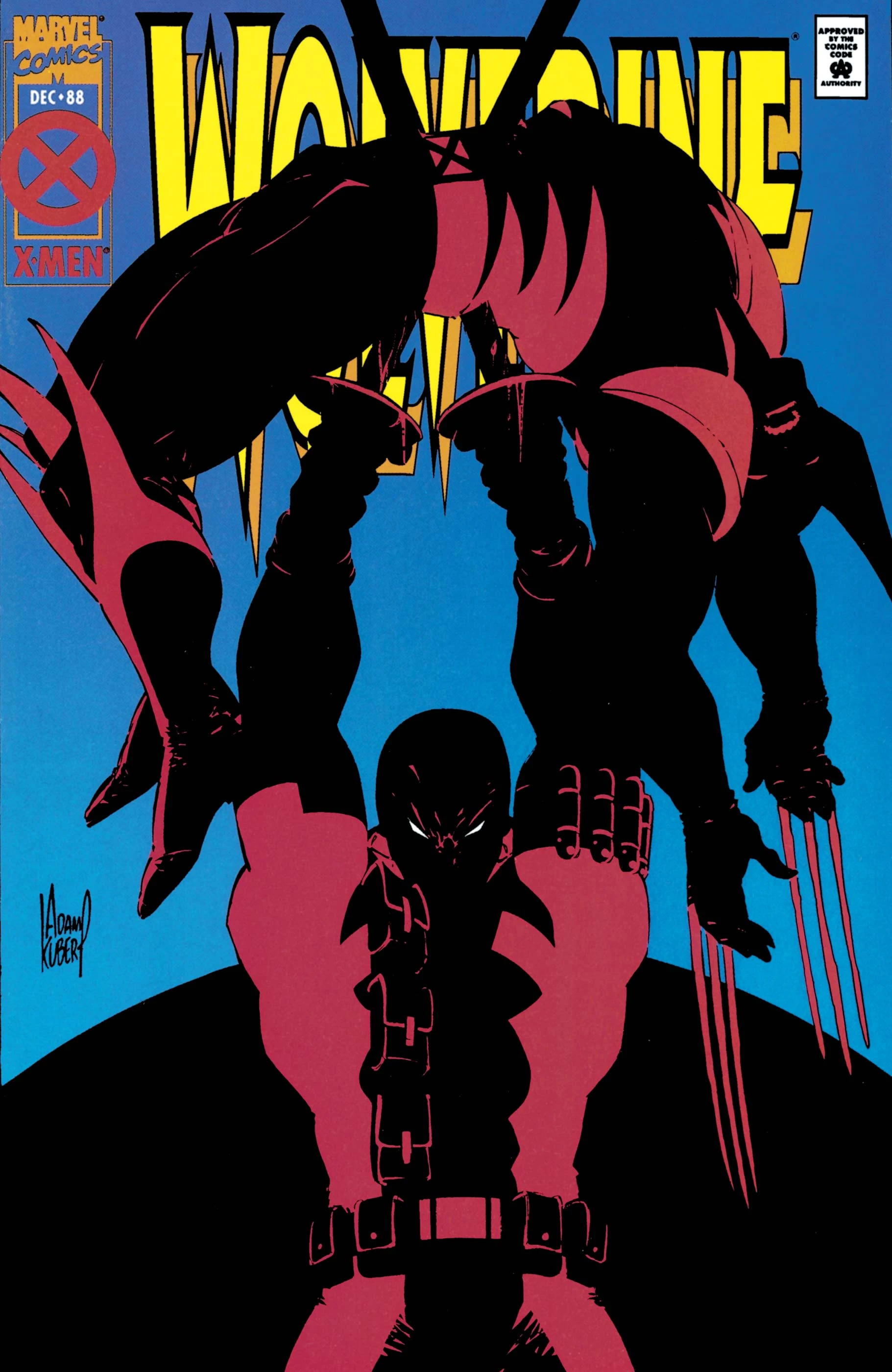
The way Deadpool impales one of the guys on the freeway with two katanas echoes the cover of Wolverine Issue 88, the issue where Deadpool and Wolverine first meet.
The way Vanessa touches Wade’s face after seeing his scars for the first time is reminiscent of Siryn’s gesture in the comics when she first sees him without his mask.
Meta fourth wall-breakage. Deadpool references the fourth wall a number of times in the movie, as in the comics, but the Blind Al bit where he breaks “sixteen walls” was probably my favorite allusion to it.
When Wade and Vanessa are finally together again and about to kiss, he says, “And now, the moment I’ve all been waiting for.” I’d take that to be a subtle reference to the multiple voices/speech boxes he deals with in the comics.
The little Deadpool bust on the shelf in Wade and Al’s apartment is a nod to how into his own brand and merchandise Deadpool is. (I was honestly surprised not to see the Deadpool boxers and the boots with the Deadpool symbols on the soles!)
The flipped running joke about Deadpool joining the X-Men is great. For some time in the comics, Deadpool liked to refer to himself as part of the X-Men team, and the team continually told him with great exasperation that he’s not a part of the team. Of course, I assume this is also set-up for bringing him into the greater X-Men movie universe, as he eventually does work with the X-Men in the comics.
And speaking of the X-Men universe and the future of Deadpool, now that we have this movie in theaters and it’s doing so well, naturally everyone is speculating about what comes next (besides the release of the soundtrack with that hilarious Deadpool theme song. Of course Deadpool gets his own theme song, along with the best Stan Lee cameo to date). The sequel was greenlit a few days before Deadpool opened; and in the fantastic end credits scene, Deadpool confirms (if you can believe him) that we’ll be seeing Cable in the next film. Given I’ve been saying since the moment Deadpool was a reality that the next logical step is filming the best messed-up bromance ever, a.k.a. Cable & Deadpool, I’ll be overjoyed if that’s the case. And it makes so much sense. Now that the character in both tone and origin is established, it will be easy to introduce Deadpool, e.g. through an X-Force movie (which <a href=”
Reynolds wants to see happen), to the larger ensemble franchise; and then to roll from that into Cable & Deadpool, a storyline that again primarily focuses on Deadpool (and Cable), but also involves a number of other mutants and has a much grander scale, since Cable is literally trying to save the world before he dies.
Going next to Cable & Deadpool will allow for further development along the lines of the absolute funniest moments in the film, which are when Deadpool is mocking others (particularly Colossus, Negasonic, and “Agent Smith”), skewering the X-Men franchise and superhero movies (“McAvoy or Stewart!?” killed me, and his excitement at the “Superhero Landing!” was a riot) and engaging in or laughing to himself at gallows or black humor (the aforementioned Zamboni scene, spelling out FRANCIS, and the T-Rex joke being good examples of this). Yes, a surprising amount of the crass humor in this movie does land (and Deadpool’s creative cursing is pretty good, his reference to Ajax as a “shit-spackled Muppet fart” being the best), but I’d love to see the sequel really keep focus on the satire and the more complex humor; and bringing Deadpool into the larger X-Men universe or pairing him with Cable (a man who he grudgingly respects, even when he doesn’t always like him) will allow for that. (Side note: I’ve seen some speculation already that maybe other superhero movies should up their ratings to R, considering that Deadpool is doing so well; but I think that would be a mistake. The smartest move, for both future Deadpool movies and other superhero movies, is to stay true to the character(s), and base both content and choice of rating on that. Deadpool being what he is, I had no issue with this film being R, and think future R-rated Deadpool films would be perfectly appropriate – but I also hope the most important goal remains making movies that capture the tone and essence of the character.)
Moving to the Cable & Deadpool storyline will also create an opportunity for another story that will hold together underneath all the jokes, and a more thorough exploration of morality through Deadpool’s eyes. In this film, Colossus’s speech as Deadpool is about to shoot Ajax in the head, and Deadpool’s reaction, which is hilariously and typically Deadpoolian, are also a pointed commentary on the superhero world and the way superheroes’ choices to rise above the villains they fight can be seen as noble and heroic, but could also be viewed simply as an unwillingness to be the one to rid the world of their evil. Of course, taking that final step is also problematic, as it gives rise to the concerns that started Marvel’s Civil War storyline, about having superpowered beings running around accountable to no one. The majority of the superpowered need to walk the line to remain in the good graces of the public; whereas Wade simply does not care and follows his own skewed code.
But examining that code, and Deadpool’s struggles in the comics with making the right choices and being a hero, could make for a great and complex movie sequel, and the Cable & Deadpool storyline has the moral questions and hard decisions built right in. Now that Deadpool has been established, I want to see the sequel delve even deeper into what’s underneath the wisecracks and the crazy now that he’s post-op Deadpool. I want to see Cable developed into a three-dimensional and perfect foil for Deadpool, and I want to see Deadpool forced to make hard choices in his own unique way. And, of course, I want them to showcase more of that crazy elegant fighting style, because it is badass. And, and, and…is there anything else I want? Well I would say a Deadpool unicorn, but I already have one. So I guess all that’s left to say is, OMG Deadpool was super awesome and I want to see it again; and…
Over the last week or so, we’ve seen two positive affirmations of the greater queer community at two of the biggest comic franchises. Over at Archie Comics, Jughead is officially asexual. Down at Marvel, the pansexual Deadpool crushed box office records for an R rated movie at the box office. Will these queer portrayals in comic culture start a push for better and more complex looks into the sexualities of the characters we read and watch, or are we in for more of the same?
Let’s start with Archie. For years, Archie Comics has been slowly reinventing itself. With the help of creators like Dan Parent, the openly gay Kevin Keller has been a breakout student down in Riverdale. Following some years later, Chip Zdarsky has Jughead officially come out as asexual. I think it was an interesting choice having Kevin Keller be the one to use the word asexual in conversation with Jughead, rather than Jughead use the word himself, as a way of seeming to carry the tradition on from one character on the queer spectrum to another. And the way the conversation went did so without taking away from Jughead’s agency, unlike Marvel’s poor handling of Iceman being outed in All-New X-Men nearly a year ago.
I applaud Archie Comics and Chip Zdarksy for expanding its representation to this sexual orientation minority. Asexuality is something that both inside and outside the queer community has been argued over and is often misunderstood. Asexuality manifests in different ways for different people. For Jughead, he also identifies himself as aromantic, which is perfectly fine. Not all asexuals are aromantic. Asexuals don’t necessarily have an entirely non-existent sex drive. They may just have a low sex drive. They may end up in a monogamous relationship with an opposite sex or same sex partner where they may engage in sexual activity. That doesn’t mean they aren’t asexual. Just like when a bisexual person is in a monogamous relationship, that doesn’t suddenly mean they aren’t attracted to the opposite gender of their partner. And no, it is never, ever, ever your job to try to help them see that sex is great and they’re missing out. Ever. Never ever. Please always remember that.
This isn’t something I immediately knew and understood at a young age. It took time. I remember as a teenager on the internet in the late 90s to early 2000s checking out sites like the now defunct xy.com and chatting with a few men who identified as asexual. At the time, I thought if they weren’t sexually attracted to the same sex they wouldn’t be here, and that they were repressed and looking for someone to help them come to terms with their sexuality. That was wrong of me and I understand that now.
Some of the arguments and tension towards the asexual segment of the queer community comes not only from some of the misunderstandings, but it also comes from asexual treatment in our society and laws versus treatment of people in the LGBT community. The asexual community hasn’t necessarily in the minds of other people been affected the same way by our laws. That’s not entirely true in that an asexual who is not also aromantic could have potentially been denied the ability to marry who they wanted until recently, as well as being affected by other homophobic or transphobic laws on the books.
Asexuals also have to deal with societal pressures like most people in the queer community do. I certainly can relate to being in uncomfortable conversations with people that were aggressively heterosexual in nature when I was younger, either not out or not as confident at the time and not being sure how to handle the situation. Not to mention the conversations about how you need to have hetero sex before you can rule it out. Again, please don’t tell people they need to have sex to understand themselves and especially never imply to people that you are the one they should be having sex with in that scenario.
Moving on to Deadpool, I’ve mentioned in at least a few of my previous columns that although Deadpool is being billed as the first pansexual superhero in a major motion picture, that we have to wait and see how that ends up being handled. My fear was that most of Deadpool’s behavior that falls outside of the heteronormative would end up being joke fodder. I was at least partially right.
This isn’t really a spoiler for anything major in the movie, but if you’re avoiding anything regarding details in the Deadpool movie (or want to avoid the kind of vulgar subject matter that conspires in the movie) you may wanna skip the next paragraph.
Now that we got that out of the way, here’s the deal. We do see Deadpool engage in some behavior that’s considered outside the norm. He’s confident in himself, his sexuality, and it doesn’t make him any less of a powerful and threatening character. However, most of the instances when he’s doing something outside the heteronormative, it’s a joke. When he’s with his girlfriend they have a montage of different holidays they have sex on. For International Women’s Day, she ends up pegging him. It’s played for laughs. Other instances including kissing a pizza delivery boy on the cheek after threatening him, and complimenting his male taxi driver. This doesn’t necessarily help all that much in terms in pansexual representation.
If sexuality outside the norm is played purely for laughs, it’s just a joke and it’s not about being inclusive. That’s not also to say that we shouldn’t have any fun with sex and sexuality either. And I will give Deadpool credit in that it’s good to see more heroes who have less traditional sexualities and can help combat the dated and offensive notion that queer people are somehow weaker and can’t be taken seriously. More and more characters in nerd culture like Doctor Who’s Captain Jack Harkness have been coming out and combating this for years now, but stereotypes are damaging and linger.
Between Jughead and Deadpool in this last week, I feel that it was one of the best weeks for greater queer representation in comics and comic culture. Sexuality is not black and white, and I think these characters and the stories being told with them in comic culture are helping to show that sexuality is complicated, fluid, and can’t truly be encompassed by a single word.
Oh, and it can be profitable at the box office too.
We think we know Steve Jobs, the maestro behind Apple but unless you read one of his biographies or watch Jobs or Steve Jobs, you only have impressions. General audiences will recognize the man in the black turtleneck and know he gave us the iPod, iPhone, Macintosh, etc. but most will mistakenly credit him for being the builder of these gadgets.
Read Walter Isaacson’s wonderful biography or study Jobs through the myriad video interviews or articles available online and you come to understand he was a visionary who pushed, prodded, cajoled, wheedled, and demanded his workers to meet his exacting standards.
Capturing that volatile and complex man on film would be a challenge for any production crew but director Danny Boyle and screenwriter Aaron Sorkin were the kind you wanted for something challenging. Sorkin took Isaacson’s bio as a starting point but then read and read more material. He spent time with Jobs’ first partner Steve Wozniak and knew he couldn’t write your standard bio pic for a most un-standard figure. The resulting Steve Jobs is out tomorrow from Universal Home Entertainment as a combo pack with the Blu-ray, DVD, and coupon for Digital HD.
Instead, he boiled the story down to three pivotal product introductions (the Macintosh, the Black Cube, the iMac) and stuffed all the drama into backstage antics in the countdown to taking the stage. Events and conversations are telescoped into these three vignettes with a sprinkling of flashbacks. Sorkin then led us through the fourteen years by focusing on the evolving nature of his relationships with several key people in his life: Woz (Seth Rogan), Apple CEO John Sculley (Jeff Daniels), his marketing chief, Joanna Hoffman, and finally, his daughter Lisa (Makenzie Moss, Ripley Sobo, and Perla Haney-Jardine), who he at first refuses to acknowledge any blood relation and comes to cherish. The Sorkinisms are largely missing but his rapid-fire style remains visible.
That father/daughter relationship humanizes Jobs and provided Sorkin with the emotional spine to the film. Otherwise, we’d revile the volatile Jobs as he treats one person after another as a mere functionary in service to his grand vision.
Boyle is a visual stylist and gave each act a fresh look and feel, starting with shooting with three different film stocks (16mm, 35mm, digital) and staging each in a different way.
What makes the film work, better than the box office and critical acclaim admitted this past fall, is Michael Fassbender and Kate Winslet, the latter nearly unrecognizable in a tough part. Fassbender doesn’t look like Jobs but inhabits the persona and you believe him to be the mercurial genius who slowly mellows across the years.
The 123 minute film is worth a look if you haven’t read up on Jobs or if you want to see a lovely ensemble tackle a difficult topic and freshen the bio pic genre. The movie’s high definition transfer is superb and the DTS-HD Master Audio 5.1 lossless soundtrack is its match.
There’s a three-part feature on the making of the film which is quite compelling. Inside Jobs: The Making of Steve Jobs (44:11) explores everything from the story structure to recreating three specific time periods, and the extensive rehearsal process for each, which led to excellent performances all around.
The movie comes with two audio commentaries, one from Boyle and one from Sorkin and Editor Elliot Graham. Each are fascinating in their own way although there is some repetition from the special feature.
So it turns out that I maybe I do have a TARDIS, because I was able to finish watching Jessica Jones and to catch up on Supergirl.
You remember that basically crappy review of Supergirl I gave a couple of months ago? Well, the show is getting there, though, im-not-so-ho, they arenât taking advantage of what could be some great story arcs. Except for Alex Danvers. And Cat Grant. And Hank Henshaw. But more on that in a bit.
I watched âStrange Visitor From Another Planet,â an hour that really could have called âWhy Did You Abandon Me?â Hank Henshaw, a.k.a. Jâonn Jâonzz the Martian Manhunter, struggled with the personification of survivorâs guilt and abandonment in the appearance of a âWhite Martian,â a member of the âotherâ Martian race responsible for the Martian holocaust â a literal âStrange Visitor.â And while the psychological voices from beyond the grave â including his wife and two daughters â chastised Jâonn Jâonzz for abandoning them by not joining them in death, Cat Grant dealt with her own, different kind of survivorâs guilt and abandonment issues when her âStrange Visitorâ turned out to be the child she had chosen to abandon in her drive to become a professional success, now all grown up and wanting to know why she hadnât loved him enough to stay. âBizzaro,â a twist on Mary Shelleyâs Frankenstein, borrowed â well, stole â the origin of the sad creature from DCâs New52 reboot, only instead of Lex Luthor creating the âmonsterâ from splicing Supermanâs DNA with human DNA and injecting it into a teenager, it was Maxwell Lord splicing Supergirlâs DNA with the human DNA of comatose young women who âresembledâ Kara Zor-El. I thought the show sorta fell down on this one â it was essentially a âmonster of the weekâ episode with Bizzaro Supergirl dying at the end and Maxwell Lord becoming âThe Man in the Glass Booth,â kidnapped and imprisoned â for now â at DEO headquarters. Which is rather illegal, and I assume will lead to further ramifications down the line.
One immediate ramification of Max hanging around the DEO, though, is that he just happened to be handy when the alien chest-hugging flower called the âBlack Mercyâ dug its tentacles into Supergirlâs rib cage and inflicted her heartâs desires upon her in a hallucinatory mind-game. Many of you will recognize this as an adaptation of Alan Moore and Dave Gibbonsâ 1985 Superman Annual #11 story, For the Man Who Has Everything.
Itâs not a bad adaptation, but if you remember FTMWHE, itâs not quite up to par in comparison, especially in the Krypton sequences. Granted, the showâs budget had to be a serious factor in producing this episode, but in Supermanâs dream world, we really become invested in Kal-Elâs life on Krypton and in Kryptonian society. Kara Zor-El, however, never leaves her home. She just sits in the âliving roomâ talking with her parents and Aunt Astra, who was never banished to the Phantom Zone. Oh, yeah, and we also meet a prepubescent Kal-El, though there is neither mention of nor a visit from Jor-
El and Lara. And though there is mention of a serious boyfriend, we donât meet him nor do we see anything else of what Karaâs dream life if Krypton had not exploded entails.
In Supermanâs dream state he has no memory or sense of anything wrong â well, the dream does start becoming increasingly disturbing â but Karaâs immediate reaction when waking up in her bed on Krypton is one of confusion and a sense that something is definitely wrong. But as the Black Mercy continues its psychic invasion, Kara starts forgetting, and by the time âvirtual realityâ Alex shows up she has accepted her life for what it is and does not recognize her âTerranâ sister.
Itâs a good attempt, but not one for the ages. For one thing, for a story about Supergirlâs lost dreams, itâs a fantastic showcase for Alex, who totally steals the scene(s). Alexâs quest to save her sister, her devotion to her, is really what this episode is about â and I donât know if thatâs what the writers had in mind. In fact, lately it almost seems that the title should be Supergirlâs Sister, Alex Danvers. She has become the most well developed character on the show (with Cat Grant coming up behind and Hank Henshaw/Jâonn Jâonzz nipping at Catâs heels). Itâs too bad, because this could have been a real showcase for Supergirl/Kara Zor-El.
And, again, wasnât it convenient that Max Lord was on DEO premises so he could help develop the âvirtual realityâ psychic connection thing-a-ma-jig that got Alex into Karaâs dreamland in the first place?
However, Melissa Benoist did a bang-up job in displaying Supergirlâs anger and rage and hurt and sorrow when she woke up. Echoing Mooreâs words, she spits out âDo you know what you did to me?â and then âBurnâ as she lashes out with her heat vision against Non, the evil â and oh so incredibly boring â Kryptonian whoâs Aunt Astraâs husband, and who exposed her to the Black Mercy in the first place.
Thereâs a lot more plot about Nonâs plan to destroy Earth (or something â Iâm not quite sure exactly what he wants to do), but thereâs a twist at the end that really disappointed me, which now means that itâsÂ
Astra is killed by Alex.
This is right up there with the whole âfooling Cat Grant and convincing her that Kara isnât Supergirlâ storyline. I mean, Boo! Hiss! Really, Bernanti, Adler, et.al., killing off what could have been a fascinating character and story arc? Again, Boo! Hiss!
And as for JJ â it left me shaken and stirred, with that uncomfortable feeling you get when youâve had a horrific nightmare which stays with you all day, or after youâve made the mistake of watching a double feature of Fail-Safe and Dr. Strangelove (Or How I Learned To Stop Worrying And Love The Bomb) on Turner Classic Movies.
SPOILERS HERE FOR ANYBODY WHO HAS ALSO BEEN LATE TO THE PARTY!
What really got me was the straightforward and uncomplicated denouement of David Tennantâs Killgrave â a simple twisting of his neck, a quick dislocating of his cervical vertebrae, a horrific rupturing of the right and left common carotid and vertebral arteries, and heâs as dead as the Tyrannosaurus Rex that King Kong killed using the same method â only with a lot less fight than in that epic battle. It was so straightforward, not what is usually expected when dealing with the gifted, as the showâs super-powered individuals and others called them; in comic-book land fights are usually a chance for the artist to strut his stuff, consisting of many panels and sometimes many pages of balletic and brutal brawling. What I thought, as Jessica approached Killgrave, was that she was going to rip his tongue out, which would certainly, I think, have been an apt Sisyphean punishment for him â King Sisyphus of Ephyra was punished by Zeus for his hubris, lying, greediness, and self-aggrandizing by being condemned to push a gigantic boulder up a steep hill, only to have it roll back down to the bottom before reaching the top, repeating this pattern forever and ever and ever.
Killgrave with his tongue is essentially powerless, and as I said, it would have been a fitting punishment; but Jessica said she was going to kill him and she did. But though it looked simple it wasnât; Jessica Jones literally killed her demon. But the question is: Will it be enough? Stay streamed.
I am in no way dissing Krysten Ritter or anybody else in the cast of this superb show â Krysten Ritter was nominated for a Criticâs Choice Award, but I think itâs sin that no one else was nominated (Jessica Jones was ignored by the Golden), especially David Tennant.
I now have an even bigger crushon appreciation of David Tennant.
Heâs getting handsomer and handsomer and handsomer.
His acting chops just keep getting better and better and better.
Geek Culture in popular media has some dark and grisly stories to tell. IâÃÂÃÂm talking about shows like Gotham, The Walking Dead, Deadpool and the upcoming Suicide Squad movie. But itâÃÂÃÂs a big tent with lots of room.
CBSâÃÂÃÂs Supergirl show is on the other end of the spectrum. Supergirl is a positive, upbeat program that focuses on heroism without the grimness or grittiness that so many other comic shows embrace.
Over the years, however, SupergirlâÃÂÃÂs adventures have had many different styles. SheâÃÂÃÂs run the gamut from being sweet and innocent to sultry and sexy (with goth-esque overtones). With a fresh and friendly point of view, Sterling Gates and Jamal Igle jumped onboard to the Supergirl comic in 2008. They never looked back. Today we see so much of what they brought to the party baked into televisionâÃÂÃÂs version of Supergirl.
I caught up with Jamal Igle, the brilliant artist of that Supergirl comic series, to see what he thinks about TVâÃÂÃÂs Supergirl and on his other projects.
Ed Catto: The CBS hit show Supergirl seems to embrace so much of the version of the character established by you and writer Sterling Gates. WhatâÃÂÃÂs your reaction?
Jamal Igle: I was over the moon, to be honest. ItâÃÂÃÂs a little surreal to see the things youâÃÂÃÂve drawn homaged on screen. There have been subtle changes in some cases like substituting Alex Danvers for Lana Lang, Hank Henshaw/ JâÃÂÃÂonn JâÃÂÃÂonzz sort of standing in for Inspector Henderson but the broad strokes were definitely maintained.
EC: Did you know about this approach before it debuted?
JI: I had heard some rumors before hand but I have some media connections who got to see the CBS upfront presentation and confirmed it for me.
EC: Do you watch the show, and whatâÃÂÃÂs that like each week?
JI: I watch it with my daughter, we both enjoy it immensely. ItâÃÂÃÂs definitely gotten stronger with each subsequent episode. I particularly like how they manage to balance the interpersonal relationships between the characters with the action. ItâÃÂÃÂs fun for me to see Kara and Alex interact on one level as sisters and then as partners.
EC: Was your approach to Supergirl dictated by management or did you and Sterling develop that approach?
JI: No, in fact just the opposite. I think, at least for me we were going against the grain a bit. Keep in mind that when Sterling and I first came on the book, the series was a bit rocky in terms of characterization. It floundered after Jeph Loeb and Ian Churchill left and the sales had dipped a bit as they were trying to find an origin and a take that would work. Sterling came in with an honest to god love for the character that was infectious and made me love her as well. It seemed to work because we started to get some serious notice for what we were doing,
EC: How was your Supergirl received by management? How did the fans like it?
JI: The majority of the fans loved it, and a lot of women came back to the book as well. There were some detractors of course. One example that always sticks out to me is a poster from the old DC Comics message boards who went by the name âÃÂÃÂLarry GardnerâÃÂàwho was incredibly upset by what we were doing. âÃÂèâÃÂè âÃÂÃÂThose of us Supergirl fans who continue to be pissed off by the undershorts and Supergirl’s lack of hormones, spirit, and personality need to keep up our angered posts and let them know their gender double standards and anti-Supergirl witch hunt will never be tolerated.âÃÂÃÂ
There were some in the upper management that werenâÃÂÃÂt too keen on what we were doing either. They thought our approach was too prudish, that she was being written like an old woman. When the subject of the fore mentioned âÃÂÃÂSupershortsâÃÂàbecame known after an interview I did on Comic Book Resources was picked up by NPR and a slew of feminist blogs, DC started turning down media requests from newspapers that wanted to cover the story. So the irony that the very same approach that some derided has been embraced by a large television audience hasnâÃÂÃÂt been lost on me all these years later. âÃÂèâÃÂè
EC: How did Supergirl sell then?
JI: There was an uptick in sales for a good portion of our run, in fact we were at one point outselling Superman and Action Comics for about six months.
EC: Firestorm is an integral part of the CW show, DCâÃÂÃÂs Legends of Tomorrow. WhatâÃÂÃÂs been your reaction to that?
JI: IâÃÂÃÂm a fan, and again itâÃÂÃÂs awesome to see one of my designs translated into another medium that way. The first two episodes have been great.
EC: YouâÃÂÃÂre now working on a comic called Molly Danger. Can you tell us about how that started and what itâÃÂÃÂs about?
JI: I originally created Molly back in 2003 as an animation pitch, but I ended up trying to make a comic series out of it. After many misfires, I put the series to the side until 2010 when I was approached by an editor at a publishing company looking for kidsâÃÂàcomics materials. So I revisited the concept and adapted it to its current form. When I finished my contract at DC, I was approached by another writer about trying to put together a Kickstarter and I decided to do Molly instead. After two successful KickstarterâÃÂÃÂs, Molly is well on her way as an ongoing series. Molly Danger is looks and acts like a 10 year old girl, but sheâÃÂÃÂs actually an immortal, invulnerable, super humanly strong 30 year old. SheâÃÂÃÂs an incredibly famous hero with fans, merchandise deals but sheâÃÂÃÂs also an incredibly lonely person. SheâÃÂÃÂs trapped because on the one hand sheâÃÂÃÂs probably one of the most famous people on the planet, but she isnâÃÂÃÂt allowed to have a private life. It tears at her and thatâÃÂÃÂs where the story begins.
EC: How are Molly Danger and Supergirl alike?
JI: Beyond the similarity of their power sets, theyâÃÂÃÂre both âÃÂÃÂgoodâÃÂàpeople, genuinely altruistic and loving. I think they share a love of humanity and a need to believe in the better nature of people.
EC: And what makes them different?
JI: Molly is much more world weary and cynical, even if she doesnâÃÂÃÂt like to admit it. The nature of Molly’s physical condition keeps her separate from the world and that creates a bit of pathos for her.
EC: Molly Danger is published by Action Lab Comics. What makes that publisher unique, and what are some of the other titles they publish?
JI: I think in terms of publishers, Action Lab has an incredibly diverse line-up of creator owned book as well as company created titles. Everyone involved on the business side of the company are people who self published or worked for large marquee publishers. So, while itâÃÂÃÂs a young company, the staff is comprised of established professionals who are incredibly serious about building the type of company we want to see flourish. The fact that as a smaller publisher, we have the luxury of developing new talents and giving them a platform is something many companies in our position can do. WeâÃÂÃÂve grown exponentially over the past few years and I feel that Action Lab will be the next marquee publisher in comics.
ComicMix comments upon pop culture and entertainment and, in this silly season of primaries, politics qualifies as entertainment. Sometimes perverse entertainment, I grant you. I’m from Chicago and I was raised during the reign of King Daley the First so I know from political entertainment. As Studs Terkel said many long years ago, “Chicago is not the most corrupt American city. It’s the most theatrically corrupt.” So that’s my standard.
I was raised Republican but, on reaching voting age, I became a Democrat because that was the only way to vote in a mayoral election that counted in that city – the Democratic mayoral primary. The last Republican mayor of Chicago was “Big Bill’ Thompson was booted out of office in 1931. There is no Republican Party to speak of in Chicago.
So I know from political entertainment, although currently it’s hard to decide to laugh, cry, or go screaming into the night.
Let’s start with the Democrats, the apparent adults in the room. In the New Hampshire primary this last week, Bernie Sanders got 60% of the vote and fifteen delegates to the Democratic National Convention. Hilary Clinton’s share got her nine. However, as Larry Wilmore pointed out on The Nightly Show, the Democrats also have something called superdelegates and all six of those went to Hilary. So, despite Sanders clearly winning the popular votes, they both left New Hampshire with fifteen delegates each. Now there’s Common Core math for ya!
The real entertainment, though, was over with the Republicans where an actual reality show star topped the field in the GOP version of the New Hampshire primary. Donald Trump’s numbers, as he himself might say, were huuuuge. He got 35% of the votes and that was more than twice the numbers posted by his nearest competitor, Gov. John Kasich of Ohio. (All together now – “Who?”) Even the GOP leaders don’t want Trump. His nearest competitor is Senator Ted Cruz and the GOP higher-ups don’t much care for him, either. I understand most of Cruz’s fellow senators are not fond of him.
In addition to Trump, there are two other Republican candidates seeking the Presidential nomination who have never served in public office – Dr. Ben Carson and Carly Fiorina, although Fiorina dropped out of the race after New Hampshire. Their main appeal to the voters seems to be that they have never been politicians. The distaste for Washington seems so deep that some voters will take someone who has zero experience in politics and give them the most difficult, most challenging job in politics.
Before this whole brouhaha started, the presumed nominee was going to be Jeb! Bush, brother of former President George W. and son of former president George H. W. Bush. That flamed out pretty fast. He now has his mother stumping for him as well as his brother, not known in most circles as the best Prez of the U.S.A., will also be on the election trail. One of the saddest things I’ve seen was Bush pleading with a sluggish audience to applaud. And then there was the moment in the Republican debate when Bush interrupted Trump only to be shushed by the real estate tycoon.
You have to say that Trump is the real star of the show. He gets the attention, the audience, and the best (or worst) lines, He reminds me of Captain Boomerang when I wrote him in Suicide Squad. Every time you thought he had gone as low as he could, he’d find a new level to which to sink.
Here’s a sample of Trump:
“What can be simpler or more accurately stated? The Mexican government is forcing their most unwanted people into the United States. They are, in many cases, criminals, drug dealers, rapists, etc”
“I will build a great wall – and nobody builds walls better than me, believe me – and I’ll build them very inexpensively. I will build a great, great wall on our southern border, and I will make Mexico pay for that wall. Mark my words.”
“All of the women on The Apprentice flirted with me – consciously or unconsciously. That’s to be expected.”
“Donald J. Trump is calling for a total and complete shutdown of Muslims entering the United States until our country’s representatives can figure out what is going on.
On unemployment numbers: “5.3 percent unemployment – that is the biggest joke there is in this country… The unemployment rate is probably 20 percent, but I will tell you, you have some great economists that will tell you it’s a 30, 32. And the highest I’ve heard so far is 42 percent.” (Note: during the Great Depression, unemployment peaked at 25%.)
About his daughter, Ivanka: “Yeah, she’s really something, and what a beauty, that one. If I weren’t happily married and, ya know, her father…”
EEEUUUUHHH!
Trump has been generous in providing fodder for Noah Trevor, Larry Wilmore, Bill Mahar, John Oliver, and now Samantha Bee (whose new show is great) as well as all the late night broadcast folks and comedians and satirists across this great country of ours. That’s added to the entertainment value. Still…
Can you seriously see Trump with the nuclear codes? Can you see Trump at an international conference and talking to our allies who might not be our allies afterwards? Can you see Trump nominating a Supreme Court Justice and maybe more than one? Can you see Trump “negotiating” with Congress and maybe telling them all that they’re fired? Some people can and that cheers them. Me? I don’t know if it’s a comedy or a horror story.
Forgive me, friends. I need to take a break from the comic bookery in order to indulge in my guiltiest of pleasures – pro wrestling. A big to do went down this week, and it behooves me to share my thoughts, feelings, and praise. In case you want to be technical about it: the WWE had some (terrible) comics out in the late 90s. This column doesn’t have anything to do with that, but maybe that will grant me the temporary pass for the week? Yeah… that’s the ticket.
On Monday evening, Brian Danielson – known to WWE fans as Daniel Bryan – retired from professional wrestling. He is 34 years old. As he would explain it to his hometown crowd in Seattle (Brian hails from Aberdeen, WA), he’s simply no longer fit for in-ring competition. “I started wrestling when I was 18”, he began, “… and within the first few years I’d gotten five or six concussions.” Brian explained that over the course of 16 years, he’d suffered from too many concussions, ten of which are documented. After being sidelined a little under a year ago with a final scan that showed swelling and lesion on his brain… it was time to take his bow.
Over the twenty-minute promo, Brian humbly thanked the crowd and the WWE Universe for getting behind him. He used the term “grateful” a lot. He held back tears. He thanked the special kids – like Conner Michalek – who showed him what real grit is. He thanked his family and his wife. He also mentioned that he’s totally down for making a Bella baby, and giggled with glee as 10,000+ fans shouted “That’s what she said!” He ended his speech with a nod to his father, who saw Brian be cheered at so loudly that it stopped the entire live segment shortly before his passing. Brian led the crowd in one last “Yes! Yes! Yes!” chant, and went to the locker room, no longer a professional wrestler.
I could regale you all with the tale of how Daniel Bryan restored my faith in the WWE product. I could wax poetic on how he proved that a solid work ethic paired with a fearless attitude helped elevate him from the undercard to main-eventing Wrestlemania in front of 70,000 fans. I could breakdown the entirety of his career for you, in an effort to show that he beat the odds in 16 years far better than the immortal (and racist) Hulk Hogan or Stone Cold Steve Austin. But others well versed in the Internet Wrestling Community have already done this. If you care, I implore you to seek it out. I, as always, am choosing to digress.
Brian Danielson’s retirement brought streams of tears to my face. Here is a man, only eight months my senior, being forced out of the thing that defined his life up until this point. And make no bones about it: he will never wrestle again. For better or worse, stopping now means he has the time to find new passions and new meanings. I’m sure becoming a father may be one of them. He’s also an eco-friendly Earth-hugger… which means he may be saving the planet instead of putting it into a LaBelle Lock or delivering a Shining Wizard to it. And maybe, if he’s willing, perhaps Brian would return to the WWE to train the next generations of superstars. But as the aforementioned Texas Rattlesnake would declare… it takes a long while to get professional wrestling out of one’s system.
More than anything else, Brian Danielson (and his alter ego) was able to make me remember why I loved professional wrestling in the first place. His passion leaked from every pore. When the crowd would shout his name in cheers so loud that he couldn’t finish a sentence… the creeping grin that couldn’t escape his face showed a performer who was clearly in the game to play it, not just to pay the bills. In the ring itself, Danielson could do it all. He put his body on the line in every match, knowing that being a head shorter and 30 pounds less than nearly any opponent left the burden on him to convince fans he was worthy of wins. He proved to me that anything is possible if you put enough effort into it. Call that cheesy if you must, because I agree with you. But it doesn’t take away the truth: Daniel Bryan made me a believer.
I’ve no snark, nor witty way to end this week. I only want to take my little corner of the internet to post loudly to Brian Danielson:
This column is going to make me sound old. Really really really old.
In the new issue of Jughead by Chip Zdarsky and Erica Henderson, Jughead comes out as asexual. As I write this, it hasn’t yet appeared on the stands, but I’ve loved the series so far and I’m really looking forward to it. Still, the newssent me on a tour of the Internet to exciting new avenues of political correctness.
(Note: I want to be politically correct here. I am trying to understand people who are new to me, and I want to be polite and respectful.)
The first thing I found out is that this isn’t even really news. Comicbook.com had the story way back on September 25. My first reaction was surprise that this didn’t show up on any of my feeds at that time. My second reaction was admiration for Archie’s publicist for getting two hits with the story.
The next thing I learned is that I didn’t really understand what asexual meant. I thought it just meant a person who wasn’t interested in sex. I was wrong. If you read the link (and it’s fascinating), you’ll see that identifying as asexual is much more complicated than my initial assumption.
As most things are.
Living life and meeting people is the easiest and most fun way to have one’s assumptions challenged. When I was a kid, society told me that homosexuality was a perversion indulged in by people who were too immature to form meaningful relationships. I learned differently when I met actual gay and lesbian people. Society told me that sex was only for reproduction, and that it was something only men liked, something that good girls only did so they could have babies. I learned differently when my own hormones kicked in, and feminism became a thing. Society told me that transgender people had extreme cases of body dysmorphia. This is a case where society not only told me the wrong thing, but actual science has made it possible for there to be emotionally healthy alternatives to “just learning to live with it.”
And just in researching this column, I found out about skoliosexuals, about whom I was completely ignorant. I look forward to maybe meeting some and having even more of my assumptions shattered.
At the same these changes in social attitudes happened, comic books grew up. My childhood was filled with stories about Lois Lane wanting Superman to give her a “super-kiss.” Characters might wear revealing costumes, but they were all chaste. It wasn’t until underground comix, and then the direct market, that a mass market saw comic book characters who had adult relationships with adults.
(Note: Yes, it is my opinion that an awful lot of comic books are still smarmy and giggly about sex. So are most humans. Alas.)
This week, we’re seeing a comic book character who is shocking because of his lack of interest in sex. He is being written (I think, based on the few pages I’ve seen) respectfully, as a character, not a caricature like Sheldon Cooper on The Big Bang Theory.
(Is Sheldon supposed to be asexual? Or is he supposed to just be really repressed? Or don’t the writers even think about such things when all they want is a laugh?)
As an old person, I find myself looking at Jughead indulgently, thinking that as a teenager, his sexuality is probably at its most fluid, and that he might just be going through a stage.
And then I realize what I sound like, and try to shut up.
We use cookies to improve your experience on our site. By using our site, you consent to cookies.
Cookie Preferences
Manage your cookie preferences below:
Essential cookies enable basic functions and are necessary for the proper function of the website.
Name
Description
Duration
Cookie Preferences
This cookie is used to store the user's cookie consent preferences.
30 days
These cookies are needed for adding comments on this website.
Name
Description
Duration
comment_author_url
Used to track the user across multiple sessions.
Session
comment_author
Used to track the user across multiple sessions.
Session
comment_author_email
Used to track the user across multiple sessions.
Session
WP Consent API is a plugin that standardizes the communication of accepted consent categories between plugins.
Name
Description
Duration
wp_consent_{category}
Stores your consent preference for a specific cookie category (e.g., functional, marketing). It ensures consistent consent management across WordPress plugins supporting the WP Consent API.
30 days
Statistics cookies collect information anonymously. This information helps us understand how visitors use our website.
Google Analytics is a powerful tool that tracks and analyzes website traffic for informed marketing decisions.
ID used to identify users for 24 hours after last activity
24 hours
_gat
Used to monitor number of Google Analytics server requests when using Google Tag Manager
1 minute
_gali
Used by Google Analytics to determine which links on a page are being clicked
30 seconds
_ga_
ID used to identify users
2 years
__utmt
Used to monitor number of Google Analytics server requests
10 minutes
__utmb
Used to distinguish new sessions and visits. This cookie is set when the GA.js javascript library is loaded and there is no existing __utmb cookie. The cookie is updated every time data is sent to the Google Analytics server.
30 minutes after last activity
__utmc
Used only with old Urchin versions of Google Analytics and not with GA.js. Was used to distinguish between new sessions and visits at the end of a session.
End of session (browser)
__utmz
Contains information about the traffic source or campaign that directed user to the website. The cookie is set when the GA.js javascript is loaded and updated when data is sent to the Google Anaytics server
6 months after last activity
__utmv
Contains custom information set by the web developer via the _setCustomVar method in Google Analytics. This cookie is updated every time new data is sent to the Google Analytics server.
2 years after last activity
__utmx
Used to determine whether a user is included in an A / B or Multivariate test.
18 months
_ga
ID used to identify users
2 years
_gac_
Contains information related to marketing campaigns of the user. These are shared with Google AdWords / Google Ads when the Google Ads and Google Analytics accounts are linked together.