The Mix : What are people talking about today?

REVIEW: The Great Escape

the-great-escape-7623001I’m not sure we’ll get every story of heroism, bravery, and ingenuity that made World War II so endlessly fascinating, but by now we seem to have gotten the best of them. The war had a scope involving millions of people on a global scale never seen before so the stories of the atrocities and acts of mercy continue to be uncovered and justly celebrated. And yet, one of the most enduring tales was not about a battle. Instead, the true story of the massive escape from Germany’s Stalag Luft III demonstrates a never-say-die attitude that demoralized the enemy. Thinking themselves clever, the Nazis collected their most troublesome prisoners and placed them in one facility, thinking they would be able to keep a better eye on them. They were all officers and treated a such, with the expectation that they would not cause trouble.

What the Germans forgot was that a prisoner’s first job was to escape and that’s exactly what these disciplined, highly-trained and clever men managed to do. It was an international effort that saw them survey and engineer three tunnels (cheekily nicknamed Tom, Dick, and Harry) that would allow 250 soldiers flee captivity. Paul Brickhill who was there, immortalized the effort in his 1950 nonfiction account The Great Escape.

It was a story ripe for Hollywood but studio after studio turned it down until finally John Sturges finally convinced United Artists to finance the production. Sturges both produced and directed from a screenplay credited to James Clavell, W.F. Burnett, and Walter Newman. Compromises had to be mader to make it palatable to Hollywood and its audiences. The American POWs who helped dig the tunnels were relocated seven months before the escape so reality was twisted to keep the yanks on hand. Additionally, characters became composites of real people, so it had the look and feel of what happened without the exact details.

great-escape-james-garner-and-donald-pleasence1The film is headlined by Steve McQueen, looming large in the marketing but small in the grand scheme of things, James Garner, Richard Attenborough, James Donald, Charles Bronson, Donald Pleasance, James Coburn, and David McCallum. (McCallum at the time was married to future Star Trek guest star Jill Ireland, who fell in love with Bronson during the shoot.) The Stalag was reconstructed with frightening attention to detail in Bavaria and the film benefitted from a fine Elmer Bernstein score. Technical advisor Wally Floody, a former prisoner at the dreaded place, was stunned at how real it felt.

A movie about digging tunnels for much of its 172 minutes might sound dull, but Sturges kept thigns interesting by showing how the men forged bonds and overcame fear and adversity. None of the characters were especially deep but all were idiosyncratic enough to remain interesting.  Some action pieces, such as the iconic motorcycle, were added. When released in 1963, it was a surprise hit and has showed enduring staying power, referenced in countless pop culture sources and is credited as an inspiration for the questionable sitcom Hogan’s Heroes.

Now 50 years old, the film remains entertaining viewing and 20th Century Home Entertainment has just released it on Blu-ray for the first time. Unfortunately, they did not use the occasion to remaster the film; merely transfer it from the 2004 two-disc release. As a result, it looks fine but should look better.

Great EscapeThe film was great fun and serious drama but it won no awards except from the men who were there, who later told Sturges what a fine job he did. Those anecdotes, recorded in 1974, survive on one of the many commentary tracks that were also ported over from the last release. Coupled with the fine lossless DTS-HD MA 5.1 audio, it is satisfactory but not what the movie and today’s viewers deserve.

The bonus features from the 2004 release are here with the exception of the trivia track and the photo gallery. But we do get:

Commentary with Director John Sturges, Cast and Crew, as Steven Jay Rubin, author of Combat Films: American Realism, 1945-1970, stitches together a series of interviews into this track. He managed to speak with  Sturges in 1974 and later Coburn, Garner, McCallum, Pleasance, Jud Taylor, Sturges’ former assistant Robert Relyea, stuntman Bud Ekins, art director Fernando Carrere, and McQueen’s one-time manager Hilly Elkins.

The Great Escape: Bringing Fact to Fiction (12:21) which originally ran on History Channel, narrated by Burt Reynolds.

the-great-escape-7623001The Great Escape: Preparations for Freedom (19:50): Another History Channel featurette looking at how the escape was really executed.

The Great Escape: The Flight to Freedom (9:22): Another History Channel featurette compares the reality versus the Hollywood version of events.

The Great Escape: A Standing Ovation (5:58): Another History Channel featurette examining the 1963 reaction by POWs to the film.

The Great Escape: The Untold Story (50:47): Made for British audiences, this used a mix of interviews and re-enactments.

The Great Escape: The Untold Story—Additional Interviews (9:35).

The Real Virgil Hilts: A Man Called Jones (25:01): American Army pilot David Jones, who participated in the famed Doolittle Raid, was the template for McQueen’s character and gets a nice profile here.

Return to The Great Escape (24:09): Rubin directed this 1993 Showtime entry with Garner, Pleasance and Coburn, reminiscing.

Original Theatrical Trailer (2:42)

Mike Gold: U.N.C.L.E. S.H.I.E.L.D?

Gold Art 130515Hoo boy. My Uh-Oh sense is screaming its fool head off.

Here’s the inevitable backstory. In the late spring of 1965, Nick Fury Agent of S.H.I.E.L.D. replaced The Human Torch in Marvel’s Strange Tales monthly. I liked the Human Torch in Fantastic Four, but this series was sadly second-rate. I also liked Nick Fury and his contemporary appearance in the just Big-Banged Marvel Universe. But I really loved the teevee series The Man From U.N.C.L.E. (damn; typing all those damn dots is gonna wear real thin) so the new Nick Fury was met with a minor adolescent fangasm.

Timing is everything. U.N.C.L.E. was just ending its first season, and the next two would suck the chrome off of a mid-sixties Buick. Over at Marvel, Stan and Jack were just warming up. A couple years later Jim Steranko would take S.H.I.E.L.D., and comics, to a whole ‘nother level. My feelings towards U.N.C.L.E. remained positive, but in a more hopeful sense. That hope actually paid off in the show’s final half-season, and the series remains iconographic to this day.

Meanwhile, S.H.I.E.L.D. became a critical part of the Marvel Universe – but attempts at maintaining it as an ongoing series proved unsuccessful. It attracted some great talent, but not great sales. I doubt most humans were aware of the organization until Iron Man 1 came along.

Maybe it was the success of the Marvel movies that finally got the Man From U.N.C.L.E. movie off the ground. I hope so, as that appeals to my sense of Cosmic Balance. Guy Richie is directing it, and Tom Cruise and Armie Hammer are starring as Napoleon Solo and Ilya Kuryakin, respectively.

Uh-Oh.

I can’t say anything about Mr. Hammer except that his great-grandfather, Armand Hammer, became the world’s wealthiest man by selling lots of stuff to the Soviets. This appeals to my Cosmic Balance thing. Nonetheless, he is barely noticed in the trailers to the upcoming movie The Lone Ranger, in which he plays the lead but Johnny Depp plays the Star. But I can say a lot about Mr. Cruise.

Tom Cruise is, in my opinion, a good actor. Sometimes great. He stars as the continuing lead in the Mission: Impossible series. He stars as the continuing lead in the Jack Reacher series. In both series, as well as most of his movies I’ve seen, he doesn’t play the character, he makes the character Tom Cruise. That’s fine for M:I – his character is original, even though the series is not. But, as noted, I have a fondness for Napoleon Solo, the human being spy who kidnapped other human beings to engage them in adventures that even Alfred Hitchcock would find amazing. If the movie is called The Man From U.N.C.L.E., I want to see Solo on the screen and not Cruise.

I also have a fondness for S.H.I.E.L.D. agent Phil Coulson, who earned those feelings in a whole lotta recent Marvel movies. The same guy, Clark Gregg, is playing the character in the new teevee series Agents of S.H.I.E.L.D.

Perhaps that Cosmic Balance can be described by the old sawhorse “What goes around comes around.” But I gotta tell you, my fanboy reaction to Agents of S.H.I.E.L.D. is one of great anticipation.

The Man From U.N.C.L.E. movie? Not so much.

But I hope I’m wrong.

THURSDAY: Dennis O’Neil

FRIDAY: Martha Thomases


Lots of Looks at Now You See Me

Now you see Me is an intriguing, showy looking film opening on May 31, opposite After Earth. The story pits an elite FBI squad in a game of cat and mouse against “The Four Horsemen”, a super-team of the world’s greatest illusionists.  “The Four Horsemen” pull off a series of daring heists against corrupt business leaders during their performances, showering the stolen profits on their audiences while staying one step ahead of the law.To entice you, Summit has released the first four minutes of the film along with other clips and cool looking one-sheets.

Additionally, Summit recently announced their Now You See Me “Diamond Heist Challenge.”

In this magical challenge, all thirteen diamond playing cards – from the Ace through the King – have been hidden in various places online, from various websites to social media platforms, even in the New York Times crossword puzzle from Friday, May 3 (your first hint!).  Like the characters in the film, players will have to look closely to uncover the mystery.  Discover the hidden diamonds and join the ranks of the world’s greatest illusionists!

Once each of the thirteen diamond playing cards are found, participants can unlock exclusive video content featuring the stars of NOW YOU SEE ME utilizing Blippar, the image-recognition phone app. Each of the thirteen images, whenBlipped, will unveil a unique video.

Here is how to Blipp:

1) Download the free Blippar app from the iTunes App Store or Google Play.

2) Open the app, point your phone at the image and have it fill your screen.

3) Watch the image come to life and view the exclusive video.

Participants can find a list of clues here: NowYouSeeMeMovie.com/DiamondHeistChallenge.

Watch the Instruction Video for more information: 

A series of motion posters featuring the characters were also released.

THE SHOWMAN

THE ESCAPE ARTIST 

THE MENTALIST

THE SLEIGHT 

THE AGENT

THE DEBUNKER 

THE MONEY 

THE ROOKIE

New Red 2 One-sheet

Red2_DomPayoff_fin5_ Summer-theater frameRed 2 is coming this summer and it’s promising to look as much fun as the first one was. Summit is releasing this sequel, based on the WildStorm graphic novel by Warren Ellis and Cully Hamner in late July with the full cast returning (although Ernest Bognine is sadly no longer with us). Instead, we get the addition of Catherine Zeta-Jones, which is just fine with us. The new one-sheet was released today.

The Buck Starts Here!

buckrogers-9753460
Cover Art: Howard Chaykin
new_buck-4732619
Art: Howard Chaykin

Hermes Press has released the first cover for Buck Rogers in the 25th Century, a four-issue mini-series written and drawn by Howard Chaykin premiering August 2013.

Here’s how Hermes Press describes the book:

“Before Star Trek and Star Wars, Buck Rogers captivated audiences around the world and made science fiction a national obsession. Now, over 80 years after the creation of the newspaper strip that became a household word, Howard Chaykin has returned the character and his universe back to basics: Buck Rogers, former World War I ace is accidentally suspended in time only to awaken to a new and different earth, 500 years in the future, fragmented by war and ruled by an omnipotent force — the Chinese. Now, Buck along with Colonel Wilma Deering, begin a new fight, to free the United States!”

The Point Radio: Anne Heche Is Out To SAVE NBC

PT051313

Actress Anne Heche returns to TV in the new NBC comedy, SAVE ME (premiering with two episodes Thursday at 8pm). She talks about the message the show delivers and her reasons for turning to more comedy in her career, plus John Krasinski shares what it was like to close the door to THE OFFICE one last time and DC axes four New 52 titles, including one surprise victim.

Take us ANYWHERE! The Point Radio App is now in the iTunes App store – and it’s FREE! Just search under “pop culture The Point”. The Point Radio  – 24 hours a day of pop culture fun for FREE. GO HERE and LISTEN FREE on any computer or on any other  mobile device with the Tune In Radio app – and follow us on Twitter @ThePointRadio.

“Moth City” Brings Thrillbent Up To Five Days A Week

Moth City

We’ve been lax in telling you about the new stuff coming from Thrillbent, and with Tim Gibson bringing his stunning comic Moth City to Thrillbent starting today, we have our story hook.

Moth City is a compact manufacturing island given to an American tycoon, Governor McCaw, by the Chinese Nationalist government. In exchange, McCaw is to outfit the government’s vast army as it attempts to destroy the Communists and unite the world’s greatest nation. Now, after a brazen and brutal murder, McCaw must unravel the island’s secrets before everything he has built is wiped out by the warring factions. New issues will be posted on Thrillbent.com for free, every Tuesday. Here’s a video preview:

And here’s the first chapter:

Tim spent three years illustrating worlds, characters and monsters for Steven Spielberg and Peter Jackson, with film credits including Tintin, District 9 and Avatar to his name. Moth City is the project he’s been secretly working on along the way. Tim lives with his fiancée in Wellington, NZ.

Moth City will be joining Thrillbent’s other continuing series, including:

Arcanum, written by John Rogers with art and colors by Todd Harris:

Insufferable, written by Mark Waid with art by Peter Krause and colors by Nolan Woodard:

The Endling, written by Jonathan Larsen, illustrated by Cecilia Latella, and coloring by Paul Mounts and Jenn Manley Lee:

The Eighth Seal, written by James Tynion IV, illustrated by Jeremy Rock, and colored by Nolan Woodard

The Damnation of Charlie Wormwood, written by Christina Blanch and Chris Carr, artwork by Chee:

All strips are lettered by Troy Peteri.

Michael Davis: The Black Plague

There is an unwritten law in the black community: support black projects in the arts, especially film and television ventures. The thinking is if we don’t support them then it will be that much harder to get another project made with black stories as the draw.

It’s hard as shit to get a black project green lit in Hollywood unless your last name is Perry. I’ve seen one Tyler Perry film and have no desire to see any others. It’s just not my thing. Nothing but respect for the man and his work but it’s just not for me. His films are the thing for an awful lot of black people and that is the audience he and his partners at Lion’s Gate pursue.

Now, a film like Red Tails was my thing. I’m a sucker for anything WWII and the story of the Tuskegee Airmen is just so badass as soon as it was announced I was on board. Before I could see the film I’d heard it was terrible. I saw it, did not like it and that’s all I’m going to say about it.

George Lucas, who put the project together and who wrote the check for most of the $58 million dollar budget (which I think is the biggest budget ever for a film that features a black cast) said that if the film flopped (and boy did it flop) then it will be that much harder to make another big budget film with a black story line and black cast.

The film Peeples premiered last Friday. Perry produced it but he did not star or direct the film. The film bombed as Tyler’s faithful stayed away from it. I had no intention of seeing it; again, not my thing. Why did the movie fail so dreadfully among the Tyler faithful? It’s not like there were any other black films out there to watch so why didn’t it preform?

Maybe because the film sucked? Or perhaps unless Perry put’s on a dress, black audiences won’t think it was funny?

I think the movie flopped because Iron Man 3 was the film most moviegoers wanted to see over the weekend. No, Iron Man is not a black character… and that’s my point, I like millions of other black movie goers, don’t decide to just go see black movies.

Duh!

We decide to go see a movie. The audience for Tyler’s movie will also go see Iron Man and to think they won’t because Tony Stark is not black, just stupid.

Iron Man, like Superman, Batman, the Avengers and Spider-Man, were born in our beloved comics media. In many ways the comics industry is much more liberal creatively than film and TV but still we lack the balls to see beyond race on many fronts.

Consider this, Static Shock was a major hit for many years on television and more than a decade after its release it’s still being shown somewhere. Yet despite that massive success on TV has never been any toys, games or fucking underoos. Hollywood and the comics industry have what seems like a written law, which is black superheroes won’t sell.

Bullshit.

Black superheroes done badly or marketed badly won’t sell. But then again that’s true of any superhero. The entertainment industry, of which comics are becoming an even bigger part of, still follows the notion that America falls down on racial lines when it comes to creative content.

That’s even more bullshit.

The most influential person on television? Oprah.

The biggest name in sports? Tiger.

The most powerful man in the world? Barack.

Not one of the above could have gotten to where they are without overwhelming support from non-black people so clearly; comics, film and television are all missing something. Hancock was a movie about a black superhero movie and it made more than half a billion dollars worldwide. Spawn and Blade were also very successful yet still I hear black superheroes won’t sell. What did they have in common other than black leads?

They were not marketed as black movies, and they all were well made.

After Earth, the new Will Smith movie, will be out on May 31st. For the majority of that film only Smith and his son are on screen. It’s a father and son movie science fiction movie, not a black movie – although Smith and his son both happen to be black.

I’m sure some will say if the movie bombs it was because it was a black movie, others will say, if the movie succeeds it’s because it’s a Will Smith movie.

I have no wish to see it regardless, it just seems weak to me but then again, Red Tails seemed to me like a sure bet, so what do I know?

Wednesday: Mike Gold – Great Uncle Shield

Thursday: Dennis O’Neil – Tony Stark Grows Up


Emily S. Whitten: A Chat with Cartoonist Nick Galifianakis

Whitten Art 130514As you may know if you’ve read my column recently (and if you haven’t, what’s wrong with you?? Well, don’t worry – you can always catch up here), I’ve declared it Interview Central, following on my time at Awesome Con DC. There, I interviewed the amazing voice actors Phil LaMarr and Billy West. Both were delightful, so if you haven’t gotten a chance to check out those columns (and/or audio recordings) yet, scoot on over to those links and do so!

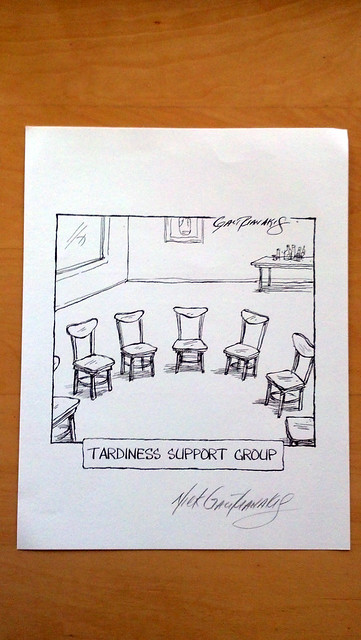
While at Awesome Con, I was also happy to be able to catch up with the very talented cartoonist Nick Galifianakis (and to obtain this cartoon for my wall. Hah! I love it!). If you’re not already familiar with Nick’s work, you really should check it out, pronto, because it is wonderful stuff. Both insightful and hilarious, and sometimes hitting uncomfortably close to home, Nick’s relationship-oriented cartoons regularly accompany the nationally syndicated advice column Carolyn Hax, and have been a regular staple of The Washington Post since 1997. Nick has also previously published his work as an editorial cartoonist and illustrator for USA Today, US News & World Report, and various other nationally distributed periodicals.

In 2001, Nick illustrated Carolyn Hax’s book, Tell Me About It: Lying, Sulking, Getting Fat … and 56 Other Things NOT to Do While Looking for Love, and in 2010 he published a collection of his cartoons entitled If You Loved Me, You’d Think This Was Cute: Uncomfortably True Cartoons About You. (FYI, his book is available for purchase on Amazon or you can get a signed copy via Nick’s website. I highly recommend picking it up). In 2006, Nick was nominated for the Reuben Award for Outstanding Cartoonist of the Year in the Newspaper Illustration category, and in 2012, won the Reuben Award for Advertising Illustration.

To me, one thing that makes Nick’s cartoons so wonderful is the way they manage to come across as both very personal and fairly universal at the same time. He also has a unique talent for distilling an entire relationship issue or situation down into one illustrated panel, which hits the reader with all of the impact that most people couldn’t convey in several pages. I find that talent fascinating, and am happy to have had the chance to talk with him about his work and his process, and to be able to share that chat with you here. So read on for more details!

Nick, thank you for doing this interview. Let’s start at the beginning – when did you first get interested in art and/or start drawing?

I started drawing like many other artists – my whole life, I don’t remember not drawing. Any flat surface would do.

And how did you end up doing the style that you do for the relationship cartoons, and do you do other styles as well?

I don’t really think of them as styles. You draw well enough to get your point across – whatever it is you’re trying to say at that time is how you draw. Sometimes that may require something leaner; or something with more volume; and you have to strike that balance. But you draw well enough to say what you’re trying to say. If you start showing off with your draftsmanship prowess, you get in the way of what you’re trying to say. Unless that’s what you’re trying to say. So when people say, “I can only draw stick figures” – well that actually might be all you need to be able to draw to make your point.

True! You focus a lot on the relationships between people in your cartoons in The Washington Post, which accompany the advice column written by Carolyn Hax. How did that come about?

I was a political cartoonist before that. I started in small papers and then worked my way up to USA Today. And then I actually sort of became bored with political cartoons, for a couple of reasons. One was that when there’s an issue of the day, you know that tomorrow four hundred different cartoonists are all going to gun for that same exact issue. There’s going to be overlap, and there’s something about the lack of uniqueness in the target that bothered me. And also, if you were to look at a political cartoon from the late 1800s, and it’s on, for example, the budget or the economy, it’s going to be quite similar to one of the ones you see today.

So I got bored with that and wanted to try something else. I had always noticed people and their interactions. Always. That dynamic has just always held my attention for some reason. And so when Carolyn created her advice column, the editor, Peggy Hackman, suggested that I do a little icon to go with it – but I wasn’t interested in doing an icon, so I did a whole sort of conceptual cartoon connected to the column, but also one that stood alone. And it satisfied something in me. It seemed to work out as a great partnership – still does, thank goodness. Carolyn is absolutely brilliant; hands-down the best advice columnist – not only out there, but probably ever. She’s been a partner long-term, outside of our marriage and then outside of our divorce. It’s like the institution between us stands alone.

And how does that work, when you’re doing each individual cartoon that goes with a column? Does she send you the column first, or do you sometimes have an idea and she writes about that?

No; she sends me a column, then I read through and I edit the column. And I write a bunch of stuff down, and she incorporates it. And then I do a cartoon to accompany it.

I have to know – as someone who writes relationship cartoons, do your friends always come and ask you for relationship advice?

No.

They don’t do that? Really??

Close friends rarely do; unless things are completely out of whack; then they do. But the people who do ask are friends who are sort of the second circle of friends; or people who you’ve just met who you’ve become friendly with. People that I’ve known since I was seven – they don’t ask me about that stuff. Not unless everything is completely falling apart.

That’s interesting. What is the process when you’re having an idea? Is it ever because you’ve seen something particular?

Well, I am trying to peg it to a column; but I do have feelings about that kind of thing. Feelings about jealousy…or you know, “How do I feel about this particular situation?” – controlling people; really insecure people; people who talk a lot. So I have a response to that kind of thing, and then it’s a matter of, one, noticing it. People say, “Where do you get your ideas?” Well – I get my ideas the same place you get your ideas. It’s just a matter of noticing that it is indeed an idea. And then there’s how you feel about that idea, and you tap into sort of the “honest portal;” and then once you identify how you feel about that thing, how you’re working out feeling about that thing, then the trick becomes how to express that.

At that stage, I choose to do it for an audience of one person. I choose me; because I figured out that by doing it that way, it guarantees that it’s honest, which, in turn, I believe that the authenticity is recognized by many, many people. As opposed to sitting down and saying, “Okay, here’s the idea, how can I make this appeal to a lot of people?” That’s how you create sitcom television.

So the ideas come from what you’re feeling, and you think about how you react to it?

Totally. It’s literally an audience of one.

Do you ever see other people doing something and start from there, or is it always with you? Like, when you’re observing other people, do you sometimes start from there?

Sure; all the time. Sure – you know, how people interact; how they hold hands; how they cut each other off; the unrealistic expectations they have of each other. But always it’s how I feel, how I can relate to it. Where am I in the thing – and then that helps me get it across to everybody else.

That’s fascinating. Well obviously, we know where to find your steady work, which is with the advice column in the Post; but tell me, are you working on other projects as well? Are you working on another book, or other projects?

Yes, I have a few things that are going to be coming out in the next year or year-and-a-half. One is an “art of” book that’s not my own. One is an art book that is my own. One is a World War II book.

Ooh – what’s your angle on that one?

I’ve interviewed hundreds of people who are now over the age of ninety, who either witnessed, were around, or actually took part in this particular battle in Greece. So that’s the focus.

Wow, that’s really neat. Are you going to illustrate that too, or will it be just prose?

No, just prose.

Well I look forward to that. What’s the “art of” book, can you tell us?

I can’t say yet; but it’s going to be a huge book, with a lot of impact.

Cool! And so people can find out about that from your website?

Yes. Everybody will find out about that there.

Great! Well, thanks, Nick; this has been awesome.

•     •     •     •     •

And thanks to everyone who’s been reading these great interviews! Check out Nick’s work on his site or The Washington Post’s site, or in his book, and as always, until next week, Servo Lectio!

TUESDAY AFTERNOON: Michael Davis

WEDNESDAY MORNING: Mike Gold