DOUBLE FIGHT CARD-SALMON GETS IN THE RING WITH TWO!
If memory serves – and how often does that happen? – I saw my first 2012 Christmas decorations in late summer. In Miami, maybe? At the merchandise mart that adjoined the convention hotel? Anyway, months before anything resembling the start of the Holiday Season, which seems to have climbed into the vicinity of Halloween.
(And are you now bracing for one of my hate-Christmas screeds? Am I preparing to validate Fox News’s diatribes against The War On Christmas, ho ho ho? Naw. Maybe next year.)
What I am wondering, though, is whether any of our comic book bretheren still produce the annual Christmas story. In fact, I’m wondering if they ever did. I know that I wrote at least a couple of them, two featuring The Dark Knight (ah, but was he a silent knight? a holy knight?) and a third, I think, starring one of his favorite adversaries, that feminine feline funster, Catwoman. Two of these were commissioned, produced by editorial fiat, and what the hell? We’re pros, right? Guy behind the desk says Christmas story and we say, how many pages and when? The other, a Batman, may have been my idea, or, more likely, it may have originated with My Favorite Editor, Julius Schwartz.
And, o holy holly, while typing the above, I forget the weirdest Christmas-Meets-Batman of them all: A Slaying Song Tonight. This eight-pager appeared in an anthology, Batman Black and White, and I’m pretty sure it was my idea to make the thing a Christmas story and if you insist on my telling you why, I’d guess that I hadn’t done a Christmas piece in a long time and I felt like revisiting old turf. Maybe I shouldn’t even mention this because it surely wasn’t an annual anything: rather it was, as they say in the British publishing dodge, “a one-off.”
(An oddity concerning Batman Black and White: the book was conceived and edited by DC’s color editor, Mark Chiarello. And for those of you who haven’t seen it: yeah, every story in it was in black-and-white. And consider this a Recommended Reading. And finally, to end this windy digression – Mark, if Slaying Song was your idea, I apologize.)
Where were we…? Wondering if comics do Christmas stories anymore. Well, if they aren’t published, or if there are fewer of them than in days of yore, it may be because these stories, from Dickens onward, were focused on one day, a holiday, Christmas. Well, Christmas isn’t a day, not for a while now. A … what? Season? That’s closer. What it has evolved into, this Christmas, is something we don’t have a name for. Not yet. Shall we coopt a bit from an old Seinfeld and call it “festivus”? Or how about frumalackel? You like that – frumalackel? Sleep on it.
Frumalackel or Christmas, I’m not complaining. It is what it is – what it has become, and it is not wise to argue with reality, and so I won’t. Not this year.
Next year? Who knows?
FRIDAY: Martha Thomases
Using the new Doctor Who Limited Edition Gift Set, your noble author will make his way through as much of the modern series as he can before the Christmas episode, The Snowmen.
It’s mauve, and dangerous, and thirty seconds from the center of London. The London of the Blitz, where one more metal canister falling from the sky barely got noticed. But this one is a bit special, as it creates..
THE EMPTY CHILD / THE DOCTOR DANCES
by Steven Moffat
Directed by James Hawes
“Gimme some Spock, for once! Would it kill ya?”
Chasing a mysterious drone ship through time and space, the TARDIS lands in London during a German attack in the Blitz. A band of homeless children are sneaking into homes during raids and eating people’s dinners, Rose meets up with a staggeringly handsome time agent from the 51st century (I know, what are the odds?) and a young boy in a gas mask is looking for his “Mummy”.
The drone ship is a mobile alien ambulance, the young boy is transforming people into empty zombielike creatures like himself, and the head of the homeless children has quite a secret to hide. Captain Jack Harkness has grabbed the remains of what he claims is a Chula warship, and dropped it into the timestream to attract the attention of a passing Time Agent. His plan is to sell it to them, but before they can inspect it, he’s placed in a spot where it’ll be blown up by a German bomb. It’s basically a con job, to get back at the Time Agency for deleting two years of his memories. Problem is, the ship wasn’t empty; it was filled with nanogenes, programmed to repair living beings. the first one they found on earth, a small boy killed in the crash of the ship, was badly damaged, and once they fixed him, thought he was the proper template for the rest of humanity. Only by showing the nanogenes how humans actually work can they fix things, and there’s only one person who can do it, if she makes a very brave choice. And for once, nobody dies.
An absolutely chilling pair of episodes. Using the darkness of a blacked-out London in an air raid, the mood of the story is dark and tense. The transformation of the victims of the child is one of the scariest bits of work the series has had. They actually edited out some additional sound effects of cracking and groaning flesh, because they thought it went too far.
Steven Moffat first offered his services to the BBC as a writer for Doctor Who at the age of eight. His entire career has been aiming toward the chance to finally do so, and this was his official shot, and he brought his A-game. I say “official”, because as most fans know, he got to write the Comic Relief sketch “The Curse of Fatal Death”, starring Rowan Atkinson (et al) as The Doctor. Moffat was able to keep to a promise The Doctor made in all of the episodes he wrote before taking over the series – “Everybody lives”. For a show with a surprisingly high casualty rate for children’s entertainment, Moffat kept his death toll to zero for his entire series of episodes. Not something he was able to do once he took over; indeed, some say he made up for lost time.
This two-parter also features the first appearances of what may be the most popular new character of the new series, the inimitable Captain Jack Harkness. Jack Harkness plays a perfect foil to The Doctor, with plenty of tension and pissing contests for all. Russell took him and ran, bringing him on as a Companion, making him immortal, and then over to Torchwood, where he had quite a run indeed. John Barrowman fit the role like a glove, and he gained the popularity an actor of his ability deserves. In addition to being a host and presenter for many British TV shows, he’s made it to these shores on Desperate Housewives, and currently on Arrow as Malcolm Merlyn. He is also firmly on my “‘I’m not gay, but” list.

In honor of the day and time, we present this classic from Schoolhouse Rock, “Little Twelvetoes”.
Now if man had been born with 6 fingers on each hand, he’d also have 12 toes or so the theory goes. Well, with twelve digits, I mean fingers, he probably would have invented two more digits when he invented his number system. Then, if he saved the zero for the end, he could count and multiply by twelve just as easily as you and I do by ten.
Now if man had been born with 6 fingers on each hand, he’d probably count: one, two, three, four, five, six, seven, eight, nine, dek, el, doh. “Dek” and “el” being two entirely new signs meaning ten and eleven. Single digits! And his twelve, “doh”, would be written 1-0. Get it? That’d be swell, for multiplying by 12.
Hey Little Twelvetoes, I hope you’re well.
Must be some far-flung planet where you dwell.
If we were together, you could be my cousin,
Down here we call it a dozen.
Hey Little Twelvetoes, please come back home.
Now if man had been born with 6 fingers on each hand, his children would have ’em too. And when they played hide-and-go-seek they’d count by sixes fast. And when they studied piano, they’d do their six-finger exercises. And when they went to school, they’d learn the golden rule, and how to multiply by twelve easy: just put down a zero.
But me, I have to learn it the hard way.
Lemme see now:
One times 12 is twelve, two times 12 is 24.
Three times 12 is 36, four times 12 is 48, five times 12 is 60.
Six times 12 is 72, seven times 12 is 84.
Eight times 12 is 96, nine times 12 is 108, ten times 12 is 120.
Eleven times 12 is 132, and 12 times 12 is 144. WOW!
Hey Little Twelvetoes, I hope you’re thriving.
Some of us ten-toed folks are still surviving.
If you help me with my twelves, I’ll help you with your tens.
And we could all be friends.
Little Twelvetoes, please come back home.

This is a great book for fans of tv detectives and tie-ins. As a book all on its own, though, I’ve read better.
THREE OUT OF FIVE TIPS OF THE HAT-Enjoyable read, love the way Joe Mannix comes off the page. ÃÂ I just wish that there were real people populating the book around him, not cardboard cutouts.
We used to be the bastard child of our American culture.
We were embarrassed by our public image. As we aged, we demanded our pastime mature along with us. We started to infiltrate the means of production, bringing our all-important ideas and ideals along with us. After all, the comics field skipped a generation – few could enter a business that, in the 1950s, was rapidly shrinking. Besides, the Reader’s Digest and the Saturday Evening Post were painting comic book writers and artists as child pornographers. Better to write for the torrid magazines where buff, all-American manly men were saving all-American buxom brunettes from Uncle Joe Stalin and his legion of rodent-faced S & M fanatics, leaving the comics door open for those starry-eyed youngsters who knew no better.
Nature abhors a vacuum, and publishers facing diminished profits understood that our generation worked for a lot less money than the cranky old geezers who wanted to unionize. This same generation was also entering the rest of the public media. Together, we took pleasure in the modern media adaptations of our favorite characters because at least they took our childhoods seriously.
Then we got legitimate. It’s all Richard Donner’s fault. He made Superman – The Movie, the first massive attempt to portray the American comics medium as a serious, legitimate part of our cultural heritage. It was as successful as it was straight-forward, well-produced, well-acted, and well-written. Heroic fantasy took hold of a greater percentage our culture and hasn’t let go.
Comics were taken seriously. The stuff was taught in colleges and in art schools. A decade later Batman came out, upping the ante all the more. Then the Spider-Man movies, the X-Men, the Avengers Universe… Our pastime was generating more revenue in theaters and on television in two years than it had on the newsstands in the previous fifty combined.
And then the people who owned the movie studios that always offered style over substance – style über alles – began to understand there was money to be made in them thar hills. Talent was discounted as necessarily expensive bait. Warner Bros. realized they actually owned a major comic book company, a fact that was purposely kept mostly hidden from them for decades by that very comic book company. Disney understood that the House of Mouse lacked a relevance to the 21st Century audience and their subsequent creations, as popular as they were, weren’t the cultural icons that were found at the House of Ideas. So the Mouse bought them.
And now, more than ever, its employees are being treated as cogs in these massive corporate machines. They need to be oiled and dusted and maintained for a while, but you can replace any or all of the cogs without damaging the icons, without diminishing the shine on the family jewels.
And so we grieve and we fret each time another massively talented creator gets replaced. But that’s how it works in the legit world.
Always did, always will.
The moral of the story: don’t quit your day job.
THURSDAY: Dennis O’Neil

Pulp Ark 2013 is proud to announce that noted Author, Publisher, Actor and modern Renaissance man in general Allan Gilbreath will be Master of Ceremonies for the the third annual Pulp Convention and Creator’s Conference April 26-28, 2013 in Springdale, Arkansas.

Although he denies being raised by wolves, Allan Gilbreath still enjoys quiet moonlit evenings. He is an accomplished skeptic, cook, gardener, computer geek, martial artist, and avid student of arcane knowledge. Allan is also a nationally recognized and award-winning author, publisher, speaker, and instructor. He has appeared on television, stage, radio, web/podcast, and tours the country in live appearances. He enjoys serving on convention panels and can cover a wide range of topics from the serious to the outrageous. In his adult vampire novels, Galen and Dark Chances, he links sensual fantasy with danger and predation to excellent effect. His exceptional use of plot tension between the various characters sets a wonderful stage for the little details that bring it all to life. Allan’s Jack Lago supernatural mysteries are known for their attention to detail and suspense. His short stories have appeared in numerous anthologies and his collection, Allan Gilbreath: A Short Story Collection.
“Pulp Fiction,” Tommy Hancock, Founder and Organizer of Pulp Ark said, “began as a medium, a means by which stories were told. It has since grown far beyond that and can be considered a style, a methodology, some would even say a field or something else. Even in its heyday, though, as now, one thing could definitely be said about Pulp. It covered many areas and appealed to all sorts of people. For that reason, Allan Gilbreath is the ideal creator to lead this year’s Convention and Creator’s Conference. Not only does he have multiple skills and talents, Allan is the type who enjoys all aspects of conventions, who walks through multiple genres like most people walk down the street-with ease and comfort. He knows what it takes to make fans and guests alike feel like a show is more than that, that it’s an event. And best of all, the biggest fan at a convention Allan is at is Allan.”

Concerning acting as Master of Ceremonies, Gilbreath said, “The genre known as Pulp Fiction hold a dear place in most people’s hearts. Chances are that a “Pulp” style book was one the first books that you read just for fun and then had to read more. I am very excited to acting as the emcee for Pulp Ark 2013. I can’t wait to entertain and introduce the public to the new and growing world of Pulp Fiction. This convention will offer everyone a chance to come out and meet some of the actors, writers, and other celebrities from the Pulp Fiction world on a personal level. We will be available to sign autographs and answer questions. I hope to see lots of old and new fans at Pulp Ark 2013.”
![]() |
| Cover Art: Francesco Francavilla |
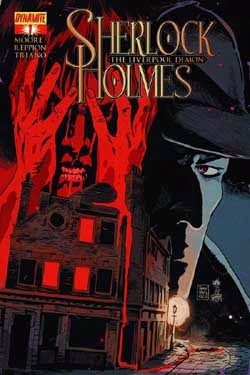
The first issue of Dynamite Entertainment’s Sherlock Holmes: Liverpool Demon series arrives in comic shop today, December 12th. Written by Leah Moore, John Reppion with art by Matt Triano, Sherlock Holmes: Liverpool Demon is a 5 issue mini series.
About Sherlock Holmes: Liverpool Demon–
Sherlock Holmes is busy doing what he does best, solving a case of far-reaching international notoriety. It has landed him at the Port of Liverpool, a bustling hub of commerce both legitimate and illicit. As that chapter closes, ours begins. They head to Lime Street Station, to catch a fast steam locomotive home to London and Baker Street, when violent weather keeps The Great Detective and Watson in Britain’s second city a while longer. Long enough to encounter a monster, discover the Liverpool underworld, and to become embroiled in one of his strangest cases yet.
32 pages
Full Color
$3.99
Rose decides to do something very emotional and foolish. The results of her actions are dour indeed, and all because she chose to have a…
FATHER’S DAY
by Paul Cornell
Directed by Joe Ahearne
“An ordinary man – that’s the most important thing in Creation”
Seized by memories, Rose asks The Doctor to take her back before her father Pete died. He died in a road accident when Rose was only a baby, and Jackie has gone to great lengths to tell her daughter what a fine man he was. The Doctor agrees – they attend Pete and Jackie’s wedding, where he gets her name wrong in the vows. Rose, thinking he’d be “taller”, is already starting to suspect his story may have grown in the telling. Asking to visit the moment Pete died, twice, she makes a horrible choice – she saves her father from being hit by the car.
She’s overjoyed, but The Doctor is livid. He tries desperately to get her to understand the enormity of what she’s done, and she refuses. He storms off, but when he realizes what’s happening to the world, he races to find her. She and Pete have headed to their friend’s wedding, and mysteriously, a number of guests are missing. Time is starting to go wrong – songs are playing on the radio that haven’t been released yet, and Rose’s phone is picking up a call from Alexander Graham Bell.
Meeting up with Jackie (and a baby Rose) at the church, it’s more apparent that the tales she told her daughter were just that. Pete’s big plans were just dreams, and he was much more Ralph Kramden than JR Ewing. And all around them, mysterious creatures are snipping people out of time. This moment is a wound, and the Reapers are here to pick at the scab. As things get more serious, Pete realizes that he is not meant to be here, and is forced to make a very serious decision to make it right.
Solid acting all around, in a very serious episode, even with the moments of levity. Pete Tyler is a character who will return in the Tennant run of the series, as part of a long-form plotline that will tie into the season finale. While he may not have planned it from square one (as moffat appears to do) but Davies was not a stranger to the long plot.
This is the first story of the new series where time travel itself is integral to the plot. The average Doctor Who story takes place in a single location and time; time travel is little used in the story itself. Here, we see a number of paradoxes, and how they all affect time itself. Moffat will do that great deal more when he takes over the show, and of course in the classic Blink. Using time travel is very complicated, and requires a lot of explanation to make sure the audience can keep up. The challenge is keeping things entertaining, and Paul does it here expertly.
“I can do anything” – quite a different mindset for this Doctor than for Ten or Eleven. Ten spent a lot of time talking about how he couldn’t do things, right up until Waters of Mars, when he came to the decision that, being the last Time Lord, he can do anything he damn well pleases, a decision that bites him BUT quick. Even Eleven comes to his “Time can be re-written” realization, causing him to take massive risks, and only luck having them come out on his side.
One of the most shocking moments of the episode is one of simplest effects in the world, indeed there’s no effect at all. The Doctor opens the TARDIS and it’s just an empty box. Well…yeah. But we’re so used to it NOT being just a box that it feels so wrong. Wonderful moment.
The costume work in the 80s is positively unsettling. from Pete’s unconstructed jacket with the rolled up sleeves to the mad curly hairdo on Jackie, it’s hilarious. It’s nice moment of fun against the dramatic story. And anyone who thinks that Stormageddon, Dark Lord of All is the cutest baby to appear on Doctor Who has forgotten about this episode. The expressions captured by the director are priceless, and how they’re edited into the proceedings are hilarious.
Rose accuses The Doctor of being jealous, that for once he’s not the most important person in her life. It’s not the case, but at the end of the day, it’s Pete that saves the day, by doing something that the Doctor couldn’t. And that only makes Rose love him more. And that’s a feeling that will carry through that plot thread for some time to come.