Tagged: Batman

Chuck Dixon-Comic Creator and Pulp Writer

AP: Tell us a little about yourself and your pulp interests.

CD: If you want to know the history of comics you have to go back to the newspaper strips and the pulps. Those are the parents of the comic book. In the 70s they were reprinting a lot of stuff so I got to sample G-8, the Shadow, Conan, Captain Future and lots of other classic pulp characters.

AP: What does pulp mean to you?

CD: Story. Story. Story. Pulp is pure plot advancement and action. No pretense to literature or art. Pulp has become our literature. Lost is pulp. What you see on the bestselling book lists is all pulp. Most of our movies are pulp. But there’s art there nonetheless. Cormac McCarthy is literary pulp.

AP: You are known as a writer of comic books and pulp stories. How did you get your start and what was your first published work in each?

CD: I’m like 99.99% comic book writer. A few pulpy short stories as opposed to thousands of comics scripts.

My first paying work was for an awful Heavy Metal rip-off called Gasm. That was like 1978. I futzed around on the edge after that for a few years and then got a break on Airboy and Savage Sword of Conan almost simultaneously. My first pulp thing was a Kolchak story for Moonstone.

AP: You have worked on short prose tales for Domino Lady and The Spider Chronicles. What draws you to these shorter stories and can we expect to see more short pulp from you in the future?

CD: What draws me to short stories is my fear of working in prose. I only wrote those stories because Joe Gentile at Moonstone dared me. The idea of writing a long form novel is intimidating to me. I’m a comic book writer through and through. The only reason I would turn to writing prose full time would be out of desperation. And wasn’t that what drove most pulp writers?

AP: Mixing comic books and pulp has brought some interesting characters to the masses. Airboy was one of those characters. How did you come to be associated with Airboy? What is it about this character that continues to thrill readers?

CD: I think there’s a core improbability to the character that’s appealing. Here’s this kid with this ridiculous plane who gets to kill bad guys in the name of his country. No parental supervision and he winds up with one of the hottest characters in comics as his girlfriend. Pure wish-fulfillment fantasy.

AP: You’ve written many comic books and are often associated with the Batman family of titles as well as kick starting one of my favorite titles, Birds Of Prey. What is it about writing comics that keeps you coming back for more and are there any areas in comics that you’ve not worked in that you would like to try your hand?

CD: I dream of writing an ongoing daily strip. Though, these days, that’s like dreaming of being a radio scripter.

AP: What, if any, existing pulp or comic book characters would you like to try your hand at writing?

CD: Fantastic Four, the Jetsons and the Lone Ranger. The Shadow would be fun. I actually got to meet Walter Gibson. What a workhorse that guy was! And a self-effacing gentleman to talk to. Probably the first real writer I’d ever met. Also, the Lone Ranger. And any of the Edgar Rice Burroughs characters.

AP: Who are some of your creative influences?

CD: Aw, anything. I’m a very eclectic reader. Anything from Jim Thompson to P.G. Wodehouse. In comics my biggest influence was Archie Goodwin. A massive talent a mentor to me when I was trying to break in with my weak efforts. Stan Lee as well. Charles Schulz to a great extent and Larry Hama who was my first editor at Marvel and really helped me polish my craft for the bigs.

AP: It’s understood that pulps inspired many comic book creations. Are pulps still a viable source of comic book inspiration or are the two more or less influencing/encouraging one another now idea wise?

CD: They’re the same genre in different mediums.

AP: What does Chuck Dixon do when he’s not writing?

CD: I’m always writing! Naps are nice. I enjoy walking and getting to the shooting range when I can.

AP: Where can readers learn more about you and your work?

CD: My website at either dixonverse.net or thedixonverse.com. Lots more about me there and a message board I frequent.

AP: Any current or upcoming projects you would like to mention?

CD: For lovers of pulpy SF, I have a new Alien Legion mini-series coming out soon from Dark Horse. Larry Stroman on pencils and Carl Potts inking. Fun stuff. I’m also on two GI Joe titles including Snake Eyes new monthly coming in May. And I’ve written some scripts for a new Spongebob Squarepants comic from Bongo.

AP: Are there any upcoming convention appearances or signings where fans can meet you?

CD: Nothing in the foreseeable future.

AP: And finally, what advice would you give to anyone wanting to be a writer?

CD: You won’t be working for publishing houses, you’ll be working for people. Your rapport with your editor is the most important working relationship of your life. Rather than schmooze your way into work, find editors you have something in common with; share a common goal with. It makes life easier. For both of you.

AP: Thanks, Chuck.

Warner Premiere Formally Announces ‘All-Star Superman’

DC Entertainment’s All-Star Superman was one of the better things to be released by the company during the past decade. It was universally acclaimed and awarded, recently being collected in an Absolute edition. Now, Warner Premiere is tackling Grant Morrison and Frank Quitely’s 12-part saga as their next animated feature. Here’s the formal press release:BURBANK, CA, (November 29th, 2010) – Grant Morrison’s beloved, Eisner Award-winning vision of Superman’s heroic final days on Earth is brought to exquisite animated life in All-Star Superman, the latest entry in the popular, ongoing series of DC Universe Animated Original Movies coming February 22, 2011 from Warner Premiere, DC Entertainment and Warner Bros. Animation. The highly-anticipated, full-length film will be distributed by Warner Home Video as a Blu-Ray™ Combo Pack and 2-Disc Special Edition DVD for $24.98 (SRP), as well as single disc DVD for $19.98 (SRP). The film will also be available On Demand and for Download.

In All-Star Superman, the Man of Steel rescues an ill-fated mission to the Sun (sabotaged by Lex Luthor) and, in the process, is oversaturated by radiation – which accelerates his cell degeneration. Sensing even he will be unable to cheat death, Superman ventures into new realms – finally revealing his secret to Lois, confronting Lex Luthor’s perspective of humanity, and attempting to ensure Earth’s safety before his own impending end with one final, selfless act.

The celebrity-packed voice cast is headed by James Denton (Desperate Housewives) as Superman, Christina Hendricks (Mad Men) as Lois Lane, and Anthony LaPaglia (Without A Trace) as Lex Luthor. The stellar cast includes seven-time Emmy® Award winner Ed Asner (Up) as Perry White, Golden Globe® winner Frances Conroy (Six Feet Under) as Ma Kent, Matthew Gray Gubler (Criminal Minds) as Jimmy Olsen and Linda Cardellini (ER) as Nasty. 
Arnold Vosloo (The Mummy), Catherine Cavadini (The Powerpuff Girls), Finola Hughes (General Hospital), Alexis Denisof (Angel), Obba Babatunde (That Thing You Do!), Michael Gough (Batman) and John DiMaggio (Futurama) round out the voice cast.

Based on the Eisner Award-winning DC Comics series/graphic novel of the same name by Grant Morrison with illustration by Frank Quitely, All-Star Superman is executive produced by animation guru Bruce Timm and directed by Sam Liu (Justice League: Crisis on Two Earths) from a script by acclaimed comics writer Dwayne McDuffie (Justice League: Crisis on Two Earths). (more…)

Review: ‘Batman Beyond the Complete Series’

batman-beyond-complete-series1-4554306I admit to being leery when Warner Animation announced their plans to follow the  amazing [[[Batman the Animated Adventures]]] with a next generation hero called [[[Batman Beyond]]]. After all, it was a clear departure from the source material and there was no knowing how this would work.

As it turns out, there was little to fear. The series, which ran from January 1999 through December 2001, honored the past and showed us a future Gotham City that still needed a Dark Knight. Rather than just add wrinkles and gray hair to all the familiar figures, things have changed. Dick Grayson seems to be gone, Alfred and Jim Gordon are dead with Barbara Gordon now the police commissioner. And sitting in the gloom of Wayne Mansion is a still-angry, infirm Bruce Wayne.

He knows there’s work to be done and in time, targets teenager Terry McGuinness as his successor. The youth has just lost his father to violence and Wayne’s appeal sounds logical so he signs on to don a high-tech cowl, sans cape. With Wayne barking orders in his ear, Terry is the new Batman, instilling fear in the hearts of 21st century criminals.

The series lasted a strong 52 episodes plus spawned a direct-to-video film and the character wound up on other series such as [[[Static Shock]]] and was given an epilogue in episodes of [[[Justice League Unlimited]]]. There was even the tangentially-related spinoff [[[The Zeta Project]]].

Obviously the brain trust that included Bruce Timm, Alan Burnett, Paul Dini, Dwayne McDuffie, and Glen Murakami rose to the occasion, taking everything they learned from their previous efforts and poured it into this series. The future was recognizable with sleeker architecture that cast new shadows on the city’s streets. The miniaturization and sophistication of the gear was not stretching the imagination and the new sorts of threats owe a nod to the rogues of the past but were fresh menaces.

Today, Warner Home Video has released the long–awaited [[[Batman Beyond the Complete Series]]] in a nifty box set. You get all three seasons of the series and the original extras plus a bonus disc. Tucked within the box is a nice 24-page booklet with character and set designs and some glimpses into the process. The box is slipped inside a plastic wrap that approximates animation cels and makes this a lovely package, perfect for the holiday season.

The episodes look great on DVD and the stories hold up after all these years.

There are three new featurettes all running about five minutes each, which looks back at the show’s origins and the thinking that went into the series’ design and architecture. You don’t learn a lot that’s new but the creators’ affection for Terry and his world is clear. There is also the 75th anniversary documentary [[[Secret Origin]]], which is nice but it would have been nicer to have the episodes and movie that Terry’s Batman appeared in, making this a real complete set.

Don’t Drink From Wonder Woman’s Cup!

Do you actually drink from those collectible glasses you’ve been hoarding all these years? You might want to give that another thought.

The Associated Press conducted a test on glasses featuring Superman, Green Lantern, Wonder Woman, Batman, and characters from The Wizard of Oz and they discovered these collectibles exceed federal limits for lead in children’s products by up to
1,000 times.

To break it down, the Feds limit lead content in children’s products to 0.03 percent. These glasses have a lead content between 16 percent and 30.2 percent. Not good.

These glasses were also high cadmium, which is considered even more dangerous than lead but there are no federal limits at this time.

Just in time for all the movie hype, Warners’ Green Lantern glass proved to be the most toxic of those superhero products, exceeding the federal maximum by 677 times.

A spokesperson from Warner Bros. told the AP “It is generally understood that the primary consumer for these products is an adult, usually a collector.” Amusingly, Warner’s own website features these classes
alongside school lunch boxes and children’s t-shirts.

On the other hand, if you’re a collector with no children and no intention to use these glasses to quench your thirst, you better buy them right quick.

MOONSTONE MONDAY-NOTED PULP ARTIST MARK MADDOX INTERVIEW!

MARK MADDOX AWARD WINNING ARTIST & HUMORIST

AP – Hi Mark, and thanks so much for stopping by All Pulp HQ. In the past few years you’ve made quite a name for yourself in the pulp field and it is a pleasure to finally be able to sit and talk with you about your art career. Why don’t we start with a little informal background. Where were you born and raised? Where do you live now? And do you have a “day” job with doing pulp art?

MM – I was born on Tyndall Air Force Base in Panama City, Florida to Don and Joann Maddox. I have one brother, Mike and three sisters, Elise, Carole and Jeanne . Being a military brat had us moving around a lot. We lived in Germany, South Dakota, Maryland and North Carolina. After my dad retired we moved to Tallahassee, Florida. Later, when I got married my wife Carlyn and I moved to Thomasville, Georgia, had two incredible kids and are now settled in Athens, about an hour east of Atlanta. We really like it here.
At present the only work I am doing is freelance… the fun kind: Book covers (some which are pulp), illustrations, comic book covers, monster magazine covers, private commissions, game design, concept designs, logos, etc. It isn’t at the financial level I would like yet but I’m fairly new to this type work. Before that I did straight corporate graphics which isn’t terrible but it’s not nearly as much fun as my current endeavors.
 
AP – Mark, what kind of art education do you have? Did you always want to be a professional artist or was it something that came to you later in life?

MM – My parents were very supportive of my abilities which started around the age of ten. In high school I took art classes but the teacher was a joke. Some of the interns that came in were a lot more beneficial to my creative advancement. My dad saw my talent as a possible life long career and pushed me to go to take the commercial art course at Lively Vo-Tech school in Tallahassee. I had a great teacher by the name of Oral Ledbetter. He was an old school commercial artist/ illustrator and he taught us things that are all but lost today with computers and such. I also went to the local community college and Florida State University which had good art programs.
 
AP – Were you a comic book or sci-fi fan growing up? And did either of these genres influence your taste in art?

MM – Comics, movies, monster magazines, television…I ate it all up. My particular favorite reads were Jules Verne, H.G. Wells, Doc Savage reprints, Edgar Rice Burroughs sci-fi, etc. Comics included Fantastic Four, Stan Lee and Jack Kirby Monster comics, Thor, Hulk, Captain America. Chester Gould’s Dick Tracy is easily my favorite comic strip. I’m actually one of those fans who likes Dick Tracy during his sci-fi period.
 

AP – Which artists, past and present, do you admire and did their styles have an effect on your own work as it developed?

MM – Dr. Seuss was awesome for a little kid. To this day I look at his work when I’m reading to my kids and marvel at it. Jack Kirby is, to me, far and away the greatest comic book artist. I am also a big fan of Will Eisner, Moebius, Frank Bellamy, Sergio Toppi, Joe Kubert, John Severin, Herge, Jose Gonzlez, Geoff Darrow, artists on the Jonny Quest TV show and so many more. I am a huge fan of illustrators like N. C. Wyeth, Dean Cornwell, Virgil Finlay, Franklin Booth, James Montgomery Flagg, Charles Dana Gibson, Basil Gogos, Sanjulian, etc. Fine artists include the impressionists, John Singer Sargent, Anders Zorn, Vermeer, Edward Hopper, Chuck Close and the Photorealists,

AP – Much of your early work is clearly inspired by horror and sci-fi movies. I take it you a movie fan? What is your favorite movie of all time?

MM – That’s not a fair question! I have so many favorites it’s impossible to pick just one. Lawrence of Arabia and Doctor Zhivago are two of my classic favorites. Raiders of the Lost Ark, Aliens and Universal monster movies are some of my genre favorites. Popcorn munchers include: Dracula A.D. 1972, Japanese monster movies, Omega Man, Hell Drivers. The list is so huge a ten gig hard drive couldn’t hold it.
 
AP – Okay, so how did you get involved with pulps?

MM – A guy named Blake Wilkie introduced me to Ron Fortier who was with Wildcat books at the time. We did a few tiny comic projects together and one day he dropped me a line saying he needed a cover for his book Captain Hazzard and the Curse of the Red Maggot. I think the artist that was to do it had to drop out at the last second. It was a dream come true for me. He needed it quick and I was willing to burn the midnight oil to get it ready.
 
AP – You seem to have a natural affinity for pulps. What is it about the genre that appeals to you?

MM – I was born in the early sixties and came back to the United States when the big thing was the campy batman TV show (I preferred The Green Hornet). I later found out about pulps, radio plays and cliffhanger serials (Tom Tyler as Captain Marvel, yay!) and realized there was a huge amount of this great entertainment from a long time ago where fantastic adventures were treated seriously. Doc Savage, The Shadow, John Carter, Weird Tales, etc. That’s just great stuff! Plus it fit right in with my love of comics and old Hollywood.

AP – You were the recipient of the first Pulp Factory Award for Best Pulp Cover of 2009.
Tell us about that and how it all came about? What piece did you win it for?

MM – The piece I won for was Airship27’s Sherlock Holmes: Consulting Detective. It was actually a piece that I resisted doing. I am a big fan of Holmes but in his original Strand Magazine form. When I was told I could do the art and design based on the original look and typography I was all for it. I was also allowed to dedicate the book to my late mother-in-law. She was a big Holmes fan and it would have pleased her so. I was very happy with the way that piece turned out because it was my take on Holmes and Watson the way they look in my mind’s eye. Most people don’t realize that Watson was a handsome, fit man.

AP – Weren’t you actually nominated for two covers that year and how did it feel to compete against yourself? Did you prefer one piece over the other?

MM – It felt great and strange! I was hoping they didn’t cancel each other out. The other cover was Captain Hazzard and the Python Men of the Lost City. And I really like them both equally. That’s a good feeling to have.

AP – Since your work for Airship 27, you’ve expanded your pulp career by working for other companies in the field. Tell us about your projects for Bill Cunningham’s Pulp 2.0 Press?

MM – I heard that Bill was going to be reprinting Don Glut’s Frankenstein books he had written in the sixties. Frankenstein is one of my all time favorite subjects and I had been reading Don Glut’s work since I was ten and I had been looking for those books for a long time. I wrote Bill and begged him to consider me for the covers.

I’ve completed the first cover in the series called Frankenstein Returns! I am very pleased with the way it turned out and Bills graphics look great on it. I’m getting ready to start volume two’s cover in the next month or so. I’m pretty excited about it.

AP – You also contributed covers to Win Scott Eckert’s CROSSOVER books, right?

MM – Yes, there are two of those so far and it was a lot of fun featuring all these classic characters together in the same image.

AP – You recently started doing covers for Moonstone Comics. Tells us about that and did the experience vary much from doing pulp covers?

MM – I’ve completed two covers and am working on a third. The first one was for Kolchak: The Night Stalker Files written by Christopher Mills . I was in front of the TV the night The Night Stalker film premiered in the early seventies and have been a fan ever since. It was another dream come true. The second cover was for the first issue of The Heap written by Charles Knauf (Iron Man and Captain America: Theater of War), featuring the creature from the Airboy comics of the forties. What could be better than a monster tearing the heads off of Nazis? The latest cover is for the great superspy Derrick Flint written by Gary Phillips (Vertigo Crime’s COWBOYS). I’m doing this piece with a nod to sixities design styles and having a blast. Moonstone publisher, Joe Gentile has been really great to work with.

AP – People who have met you personally all comment on your dry, acerbic wit. Have you always had this humorist bent and do you like looking at the world in a slightly skewered way?

MM – I don’t know. I come from a family smart mouths. Everything had to have a comeback. It’s a way for me to keep things lively and it’s nice to see people laugh.

AP – Is there any single genre you have yet to work in that you would really like tackle?

MM – Adventure, 60’s period Marvel heroes, monsters, drama, crime, sci-fi. I’d even like to tackle a western some time. In the seventies, Thrilling Adventures Magazine did a short comic about Lawrence of Arabia. I would love to work on something like that. A sort of adding on to the legend. Like the Daniel Boone TV show.

AP – So, wrapping this all up here. What’s on the horizon for you project wise? Can you give our readers some preview as to where your marvelous art is going to pop up next?

MM – Well besides the work for Moonstone I’ve got two new Hammer film books that are coming out. One called The Last Bus to Bray: The Unfilmed Hammer. It’s about many of the films that Hammer almost got produced but didn’t see the light of a projector for one reason or another. This includes the infamous Vampirella, a movie about Prince Vlad starring Yul Brunner, another about the Loch Ness Monster with backing by David Frost and many others. The other book is from Hemlock called Hammers Fantasy & Sci-Fi dealing with films outside of the Dracula and Frankenstein realm (One Million Years B.C., Quatermass, etc.). There are also one or two projects I’ve been sworn to secrecy on although I can say they are sci-fi and monster related… plus more artwork for Little Shoppe of Horrors.

AP – Mark, this has been a blast. Thanks so much.

MM – Thank you.


Hancock Tips His Hat to BC Bell’s THE BAGMAN!!


TIPPIN’ HANCOCK’S HAT-Reviews by Tommy Hancock
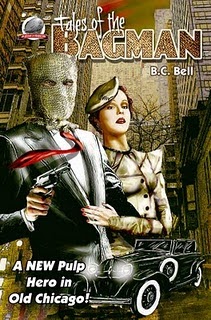
TALES OF THE BAGMAN by B. C. Bell

Cover by Laura Givens
Interior art by Kelly Everaert
Published by Airship 27Productions/Cornerstone Publishers

I don’t get it…I really don’t.

I had heard rumors prior to reading this book that someone out in the great wasteland we call the internet reviewed this book introducing The Bagman, a character created by BC Bell, and that reviewer said that he/she/it didn’t see much here to get excited about, that this was Bell’s attempt to do his version of Batman.

What I really don’t get is just what book that person was reading!!  This is not any attempt to rework The Dark Knight or any other character for that matter.  The Bagman does have his roots planted squarely in many long time concepts used to design pulp (and comic) heroes.  That is part of his appeal.  What Bell does, though, is tweaks and twists the old standards just enough that Frank ‘Mac’ McCullough, the former gangster who becomes the grass roots hero in 1930s Chicago, stands out as a fully realized character who, although he undergoes a sort of transformation when he wears the bag, stands on his own as a conflicted, yet dedicated human figure.

The cover art and interior art not only compliment the stories and the book as a whole, but the styles of Everaert and Givens compliment each other, adding a beauty and depth to this book that only adds to the impact of each tale told. 

Speaking of tales, there are three that make up the Bagman’s debut.  Let’s talk about them, shall we?

THE BIRTH OF A BAGMAN is literally that, the origin of how small time hood Frank McCullough moves from crime to crimefighter.  Bell takes his time in this tale, letting the reader get to know and like Mac before it’s ever really clear what’s going to happen to him.  Throw in Crankshaft, one of best supporting characters I’ve seen in a long time and this story is nothing but golden.  By itself, Five out Five Tips of the Hat.

THE BUGHOUSE MASSACRE is essentially The Bagman’s next step in the plan he develops in the first story-to rid his neighborhood of the Mob by eliminating them both professionaly and physically if he has to.  This story is just what it should be, a great follow up, a good introduction of other characters, and more building on who The Bagman is.  The intenstiy level on this one isn’t quite amped up as much as the first, but by the time Bell gets the reader to the incident referred to in the title, it doesn’t slow down a bit.  Four out of Five Tips of the Hat.

Finally, we have BIG CITY, BIG SHOULDERS.  Of all the three stories, this one, although good and wound up well and tight by the end, struggles in the beginning.  It felt as if Bell wanted to tie up several loose ends and introduce some things all in this story and although he does just that and all is well told by the end, following the actual direction the story is going is difficult in about the first half.  What Bell does do, however, is tie The Bagman forevermore into his city of Chicago.  The tour the reader is taken on through McCullough’s eyes is riveting and lets you know that The Bagman and Chicago are made for each other.  Three out of Five Tips of the Hat.

Taking all that into consideration and giving a definite Five out Five to the art and design of this book, BC Bell’s TALES OF THE BAGMAN clearly is destined to be a book someone looks back on and says ‘Batman’s got nothin’ on this guy!’

Four out of Five Tips of Hancock’s Hat (usually reserved for heads of state, arresting officers, and little old ladies, which is pretty darn good.)

PULP ARTISTS’ WEEKEND-PEDRO CRUZ SPOTLIGHTED! INTERVIEW AND GALLERY!!!


watson-7412076

AP – Hi Pedro, and thank you so much for agreed to doing this little interview with here at All Pulp. Let’s get started with a little background about yourself. Tell us something about who Pedro Cruz is. Where do you live, where did you grow up etc.etc. and what is your current status?

PC – Hi, thanks for having me. I live with my dear wife on the same town where we’ve lived since we were kids, a small suburb of Lisbon, the city where we were born, in Portugal. Thirty-five years ago (that’s how old I am) Portugal had just left a long dictatorship and, by modern standards, it was an incredibly old fashioned place! Just to give you an idea, when I was born, there was only one single TV channel (owned by the state) broadcasting in black and white for just about six hours every evening! Everybody saw the same shows and heard the same news – it was like growing up on a little village. We used to watch old Warner Bros. and Hanna-Barbera cartoons, Japanese animated series like Marco, Heidi, Future Boy Conan, experimental animation films from Canada and even from the old eastern bloc countries too, but also old ‘60s series like The Avengers, The Twilight Zone or The Outer Limits. There were many documentaries and we got to see old classic Hollywood and European movies in prime-time, something that would never happen now. Plus, most shows, even for kids, were broadcast in their original languages and subtitled, which made it easier for the kids of my generation to become polyglots and actually helped us learn to read. So TV had a huge part on shaping up my worldview. At the same time, there were plenty of newsagents with loads of comics featuring the Phantom, Mandrake, Flash Gordon, Prince Valiant, Popeye, Uncle Scrooge, Donald Duck, Mickey Mouse, Little Lulu, Tubby, Richie Rich, Casper, Hot Stuff, Turma da Monica, Superman, Batman, Spider-Man, Captain America, the Incredible Hulk, Conan… just to give you an idea, they could have a whole wall devoted just to comics. These were mostly Brazilian editions, as Brazil is an old colony of Portugal and we share the same language. I should point out that in terms of format, these were usually quite different from traditional American comics, about A5 in size ( 210 x 148 mm or 8.3 x 5.8 in ) and had from 64 to 300 pages featuring both current tales and reprints of old golden or silver age stories. And they were very cheap – I could read all the marvel line easily as one single magazine would be a sort of anthology consisting of one or two issues of the original editions of Captain America, the Avengers and Thor, for instances. Sometimes, they also featured articles on the authors or had pastimes or bring some kind of toy or poster… They were fun! On proper bookstores you had B.D. (Bande-Dessinée) hardcover comic albums with Tintin, Astérix, Spirou, Smurfs, Lucky Luke, Blake & Mortimer, Michel Vaillant, Ric Hochet, Valerian, Lieutenant Blueberry, Corto Maltese, Mafalda… I don’t want to sound like a grumpy old man, but nowadays, this reality I’m describing is mostly gone. Bookstores still have B.D. albums, but it’s very rare that you find newsagents carrying comics and there are very few anyway. Back to the past, my parents were very supportive and enthusiastic of me, they were big moviegoers and took me to see the Disney, Spielberg and Lucas movies that have had such a big impact on me and my generation. I was incredibly lucky of being born in the right time and place to experience this pop golden age and it left a mark in me that made me want to make things like what I saw in movies, cartoons and comics. I was an only child and my dad would bring home paper, pencils and pens in ample supply, so I’d spend long hours trying to draw characters and adventures either copied or imagined, in a style that echoed that same sensibility and aesthetic of all this pop culture. Later I went to study architecture in college, that seemed like a nice choice because I had the grades needed to get in there, it was a respectable profession and I still got to draw and learn art, but my heart was never there. During college, I worked for awhile at a small animation studio and it was an eye opener to how that really functioned. It was the galleys, really, you were just a cog in a machine. Animators got treated with very little respect and earned minimum wages. I left that, finished my graduation and went on to become a teacher while never stopping to draw. I won two awards on the annual public cartoon contest at Amadora Cartoon (the biggest comic convention here) and had quite a few illustrations, comics and cartoons published on DNJovem, a youth supplement that used to be a part of the print edition of Diário de Notícias, one of our leading newspapers. Unfortunately, there is no comics industry here in Portugal so I developed my blog as a way of showing my work. Currently, besides the comics on the blog, I’m also producing illustrations for Airship27.

AP –What level of formal art education did you have? What schools did you attend? Do you also teach art? If so, what kind?

PC – I graduated as an architect by the Faculdade de Arquitectura da Universidade Técnica de Lisboa and this year I’m taking a master’s degree on the area of Education, specifically Art Education. Currently, I work as a teacher on the public school giving art lessons to the 5th and 6th grades. My students are mostly children of African and gypsy ethnics from one of the most socially problematic suburbs in Lisbon, they’re extraordinarily creative and love expressing themselves through the arts which makes my job very fulfilling and fun too. I’m also coordinating a couple of projects at my school, one involving a role-playing game that helps pupils develop personal and social skills through problem-based learning, and another where I’m tutoring a small group of students developing a comic book and learning the different tasks involved in its creation (writing, penciling, inking, coloring, lettering).

jimanthony-2199791

AP –Did you always want to be a commercial illustrator? What was your first professional commission? Have you ever done work in the advertising field?

PC – I’ve always wanted to work on areas related to art, and had dreams of being able to draw as a full-time job. Unfortunately, the market here in my small country is diminutive and doesn’t pay all that well, especially if you want to have a house and family. The first time I got a professional commission was right after college, when an old classmate’s girlfriend asked for a caricature of all her fellow employees and her boss to give him as a good-bye present because he was moving to another department.

AP –Your website indicates you’ve done comic work. Have you always been a comic book fan and what are some of the comic projects you have worked on?

PC – I have always been an avid comic book fan and it’s only been on recent years that my consumption of comics has slowed down almost to a halt. I still read a book here and there but it has to be done either by a friend or from a very limited list of artists whose work I continue to follow. In spite of that, I still find great enjoyment in creating and drawing comics.
As far as collaborations in comics go, I worked on Guard Dogs, a series written by Jason Quinn for Starscape Illustrated, a UK-based fanzine. I drew “Helljacket”, a short story written by Steve Zegers for Ronin Studio’s Ronin Illustrated. I also drew the first issue of NiteLite Theatre’s White Ghost and a short story featuring the Semite, one of writer Mike Haselhoff’s characters. There’s also been Grace, a great short story written by Aria Ponto. My blog is the best place to find some of these and other comics, if you take the time to explore it.
I’ve done entirely on my own WHYM and METANOIA. At the moment, the later is still a work in progress which I post once a week on my blog but it has a definite ending. I also have a few more projects in different stages of development which will hopefully see the light of day sooner or later.

AP –What graphic illustrators have been the most influence on your development?
What did you learn being a fan of their work?

PC – Comic book art has always been my primary influence and the list of graphic illustrators who have and continue to influence my development would probably be too long to relay here. Speaking strictly for the pulp illustrations I’ve been doing for Airship 27, I’ve purposefully tried to do what I’d call a classic American style. To this end I’ve been using the duoshade technique, which I was first introduced to by the work of John Byrne in the early 1990s in comics such as his OMAC mini-series and Namor. Originally, this was done through the use of a special paper called craftint, I think, that had imprinted lines or dot screens in non-repro blue, that became visible when a special chemical was applied. I was fascinated with the results of such technique and thought it was a very efficient and graphic way of introducing value, tone and special effects that could enhance the sense of mood, place, texture and dimension in a drawing while still working with just pure black ink on white paper. I investigated more and learned that the original master of such technique in comic illustration was the late great cartoonist Roy Crane and have devoured his work whenever I’ve come across a reprint of his comic strips. Since I had no access to craftint boards or the chemicals used to develop that process, I ended up creating duoshade through digital effects on the computer. So, basically, those are the two cartoonists that have probably influenced most the work I’ve been doing for the pulps.

AP –Of all the artists in the field today, which do you admire the most and why?

PC – I am very omnivorous in my tastes but, speaking strictly of comics, of all the artists still regularly working professionally in the field, the one that still amazes me the most is Jean Giraud “Moebius”. I can look repeatedly even at his latest works, like Inside Moebius or Le Chasseur Déprime, and still feel surprised, inspired and refreshed. Looking at his work makes me want to draw! There’s no bigger compliment I can think of for an artist.

AP –How did you first become affiliated with Airship 27 Productions? Was this the first pulp illustrating you had ever done?

PC – My friend writer Aaron Smith came up with a story featuring Doctor Watson and Doctor Seward for a possible graphic novel for me to illustrate. Then he started to work for Airship27 and pitched the same idea as a novel to Ron Fortier, presenting the possibility of me working as an illustrator for the novel. Ron liked my art and asked if I was also interested in contributing illustrations for Jim Anthony Super-Detective, another of their series. Naturally, I jumped at the chance of illustrating pulp adventures. After all, many of the comic book heroes which I’d enjoyed so much as a kid had their roots on the pulps. I’d never done it before, but I’ve loved the experience so far. Ron Fortier and Rob Davis have been incredibly easy and friendly to work with. Their role as mentors behind this project can’t be over-emphasized and I hope our collaboration continue for many years to come.

AP – You’ve illustrated a Doctor Watson book and two featuring pulp hero Jim Anthony. Do you prefer one character over the other and do you have a different approach when doing the art for these two diverse characters?

PC – I like them both for different reasons. As far as the drawing goes, Jim Anthony comes easier because he’s just such an archetype, with his muscled physique, the strong jaw line and the defying attitude, so there’s really no way I could miss him other than on purpose. Doctor Watson, on the other hand, is much more of a challenge because not only is he closer to one of us common mortals, everybody knows him, which makes it intimidating. Drawing him is like sketching an impression of an old friend from back when you were a kid… only he is very famous, so you better make sure you draw him correctly!

AP –Is there a particular pulp or comic book character you would like to work on?

Why those characters?

PC – There’s a bunch of comic book characters I’d like to work on. Problem is they no longer have much character in them; they’re just properties. So, while I don’t rule out the possibility of working on pre-existing comic book characters – never say never – at this point in time, on that level, I’m much more interested in developing my own worlds, characters and stories, even if they are inspired by what came before. Which is basically the advice Jack Kirby gave young, new creators: if you want to follow on his footsteps, do your own thing. As far as pulp go, I think things are different as the characters I’ve been drawing for Airship 27 fall within public domain and aren’t owned by any one particular corporation whose sole intent is exploiting them and the authors involved for maximum profit at the least expense, with little care or regard for the original vision of the characters or their creators. With Airship27, there is a desire of respecting the characters and their original authors’ intentions as much as possible and everybody retains full rights to their own work, which is nicer. Beyond that, I’d like to have the opportunity of spreading my horizons and work on other genres like science-fiction and high fantasy.

AP –Here’s a tricky one. Of all the work you’ve ever done, which are you the most proud of?

PC – Oh, I won’t fall for that one, that’s like picking a favorite out of your sons. They all have their charming qualities and their faults too. Usually, the next project, the one that’s still floating in my mind’s eye, not yet materialized, that’s the one that excites me the most.

AP – Finally, is there anything you would like to plug here? Some project you want to let your fans know is coming soon? Feel free to promote away.

PC – I have my own blog www.pedro-cruz.blogspot.com where I regularly post. Again, as with drawing and making comics it is a way of communicating, of reaching out to people through my posts. Sometimes, it’s a funny video I come across on youtube, other times it’s just some rambling I have to put off my chest, often it’ll be some sketch or a comic. Currently, I’m serializing METANOIA, an experimental wordless comic, quite different from my pulp illustrations, in which I get to work with color. Once that’s finished I’ll probably take some months off to make the switch to producing fully digital artwork. For the last few years I’ve been using hybrid methods of creating art, but now it’s time to make the definitive change hoping it’ll improve my productivity while helping save some trees. If all goes well, you should all be seeing the results of that sometime in 2011. In the meantime, in terms of pulp fiction, I’m currently illustrating a new book featuring a couple of stories with Dr. Watson and Hound Dog Harker, and also a comic short story with none other than Jim Anthony Super-Detective.

AP – Thanks so much, Pedro. This has been most informative. Continued success in all your future endeavors.

PC – My pleasure.

FEATURED ARTIST-PEDRO CRUZ

Review: ‘Secret Origin: The Story of DC Comics’

secret-origin-cover-art1-9856603DC Comics had grand plans for its 75th anniversary but most of them were shelved when the company evolved into DC Entertainment and the mandate was to look ahead, not back. Still, there’s the mammoth book coming from Taschen and this month we’re being treated to the documentary [[[Secret Origin: The Story of DC Comics.]]] Narrated by next summer’s [[[Green Lantern]]], Ryan Reynolds, the 90 minute feature explores the company from beginning through today but given the wealth of subject matter, at best, this is a surface study.

The documentary makes good use of archival footage from creators no longer with us and mixes them in with fresh interviews so we hear from executives, writers, artists, and many of those who built the company. Among those you will see on screen include Neal Adams, Irwin Hasen, Marv Wolfman, Mark Waid, Dan DiDio, Jim Lee, Paul Levitz, Walter and Louise Simonson, Chip Kidd, Joe Kubert, Denny O’Neil, Mike Carlin, Grant Morrison, Neil Gaiman, Len Wein, Dwayne McDuffie, Geoff Johns, Karen Berger, Kyle Baker, Paul Pope, and Gerry Jones. Interestingly, Jenette Kahn, the architect for much of the company’s modern era, and current prez Diane Nelson do not appear.

This is a corporate history and as a result, it’s most famous black marks in its history, from the Fawcett law suit over Captain Marvel to the struggles of Jerry Siegel and Joe Shuster to gain some recognition and cash for[[[ Superman]]], are entirely omitted. Similarly, other corporate facts are either blurred, such as the separate companies[Detective Comics, Inc. and All-American Comics before becoming National Comics or the acquisitions of Quality, Fawcett, and Charlton’s heroes as each company folded are missing.

The chronology is a bit jumbled now and then but overall, we go from [[[New Comics]]] in 1935 though the forthcoming DC Universe Online. We’re treated to clips from the animated shows, live-action films, and some nifty archival footage of the Superman Writers’ Summit where the team plotted the death of Superman. The movie serials are ignored which is a shame and not enough emphasis is given to the current era of animation which was kicked off in 1990 and hasn’t looked back, influencing the comics and other animators.
(more…)

Review: ‘Legends of the Superheroes’

legends-of-the-super-heroes1-5014371The 1970s was not a kind decade for live-action television based on comic book heroes. First there was the Cathy lee Crosby misfire of a [[[Wonder Woman]]] telefilm then there were the Reb Brown[[[ Captain America]]] telefilms.[[[Spider-Man]]] made it to prime time as a series but it didn’t resemble the comic in tone or style and died a swift death.  But the absolute most mind-numbing and cringe worthy hours featured DC Comics’ stalwart heroes and villains.

I’ve never seen an NBC executive explain what made them think the two specials that aired in January 1979. The Challenge and The Roast, aired as [[[Legends of the Superheroes]]], were probably the first time mass audiences were introduced to [[[Green Lantern]]] or[[[Flash]]] or Hawkman but they certainly knew Adam West’s Batman, Burt Ward’s Robin and Frank Gorshin’s delightful Riddler. As a result, the aging trio donned the tights once more to anchor the two specials. A veritable who’s who of B-list performers and outright unknowns filled the remainder of the costumes.

Comic book fans probably loved seeing Captain Marvel, Hawkman, Huntress, Black Canary, and others in real life but the shows did not earn great ratings and have been derided by those who recall seeing them. While illegal bootlegs have circulated for years, Warner Archive has collected them on a single disc from the best source material available.

You have to love kitsch, bad writing, awful acting, and comic books to enjoy (or endure) these specials.

The Challenge pits a gaggle of villains led by Mordru the Merciless to once more destroy the world. The heroes split up and run around like idiots in an attempt to find and disarm the doomsday device. Mike Marmer and Peter Gallay, who wrote the script for both specials, apparently never learned that humor is derived from character and situation. Not a single hero or villain has a personality depriving the story from any humorous opportunities. The heroes act like dim-wits and never use their powers when they would be needed. The laugh track is badly handled since it is triggered by the lamest of activities. The costumes are authentic but clearly done on the cheap as were the visual effects. (And why on earth is Batman’s cowl worn over his cape?)

The Roast, hosted by Ed McMahon, has some genuinely funny lines but far too few and again, mostly ignoring their characters so are generic jokes. The villains and others arrive to roast the collected heroes, causing mayhem and nonsense.

Nicely, the disc does contain some deleted scenes and outtake, making this a true collector’s item but this is really for the die-hard fans only.

INTERVIEW WITH BARRY REESE, Writer/Editor/Reviewer

AP: Barry, it’s your turn on the other side of the table. Before we dive into your writing career, tell us a little about yourself.

BR: Well, I’m turning 38 on November 11, 2010 and I’m very happily married to my high school sweetheart. Together, we have a 4-year-old son. I was born and raised in Milledgeville, Georgia. I’m currently the Library Director for the Twin Lakes Library System, which is based in Baldwin County, Georgia. I’ve always loved reading and from a very young age, I wanted to be a writer. But somewhere in my teen years, I gave up on the dream and pursued other things… thankfully, things have a way of working out and in 2003 I was approached about writing for Marvel Comics. I jumped at the opportunity and spent the next four years writing various things for them, including a volume in their Marvel Encyclopedia series (the Marvel Knights volume) and quite a few entries in their Official Handbook of the Marvel Universe line of titles. I’m a huge comic book fan, love movies and music and spend far too much time pounding away at the keyboard.

AP: Now, onto Pulp. How long have you been writing pulp fiction? How/Why did you get into writing pulp? And can you give us a rundown of some of the stories/books you’ve written?

BR: Well, I always loved pulp growing up – when I was very little, my father had all the old Doc Savage and Avengers lying around and the covers really grabbed me. Even before I could read an entire book by myself, I would carry around those Doc novels. But by the time I became an adult, it seemed like very few people remembered those old heroes and even fewer were writing in that style. This wasn’t quite true, of course, but I was unaware of publishers like Wild Cat Books and Black Coat Press at the time.

So I decided that I’d take a break from the Marvel and role-playing game stuff I’d been doing and try to write something different. I decided to do a pulp novel because it seemed like it would be a fun thing to write and I wanted to enjoy the process. So I wrote The Conquerors of Shadow, which was basically my big love letter to the John Carter of Mars series that Edgar Rice Burroughs did. Around that time I came across a copy of Hounds of Hell, a book published originally by Wild Cat Books and written by Ron Fortier. It was very exciting and pitted Doctor Satan against the Moon Man. I was enthusiastic enough to write my first Rook story and from there I ended up contacting Ron Hanna of Wild Cat to see if he’d be interested in publishing them.

So far, my pulp career consists of: five published volumes in The Rook Chronicles (with a sixth coming next year); a pirate novel called Guan-Yin and the Horrors of Skull Island; Savage Tales of Ki-Gor, Lord of the Jungle; Rabbit Heart; and The Conquerors of Shadow. I’ve also completed a novel entitled The Damned Thing that’s awaiting publication from Wild Cat Books. Then there are all the short stories I’ve done for various magazines and anthologies! I won’t list them all but I’ve been included in books like How The West Was Weird, Tales of the Norse Gods and Airship 27’s upcoming Mystery Men Volume One. I’m also currently writing a series of stories starring a new character, Lazarus Gray, for Pro Se Productions.

AP: You are probably currently best known for one of your own creations. Can you tell us a little about The Rook starting with who he is and what he does?

BR: The Rook does tend to be the first thing people think of when it comes to me… The Rook is a masked vigilante who operates out of Boston in the late 1920s and early 1930s before moving to Atlanta in 1936. His real name is Max Davies and in classic pulp fashion, he watched his father die at the hands of criminals. Soon after this tragedy, Max began experiencing painful visions of future crimes. Deciding that he had to do something about these visions, he set off on a trip around the world, mastering almost all known forms of combat, as well as learning about various sciences and the occult. Unlike most masked heroes like The Shadow or The Spider, The Rook tends to encounter actual occult menaces with astonishing frequency. In a twist on things, he later learns that his visions are actually sent from beyond by his own father, who pressured his son from beyond the grave, hoping to create an instrument of vengeance. This places a tremendous strain on their renewed relationship.

AP: Where did the inspiration for The Rook come from for you? Is he based on anyone in particular?

BR: The Rook was inspired by a number of sources, most notably: Batman, Doc Savage, The Shadow, Indiana Jones and Nexus. I took all the things I liked about those heroes, added a bit of spice and created something that hopefully stands on its own.

AP: The Rook has a rich, varied supporting cast. Would you share a few of them with us?

BR: Well, first and foremost you have his wife Evelyn. A minor star on stage and screen, Evelyn Gould Davies is introduced in the very first Rook story I wrote (“Lucifer’s Cage”) and they’re married in the second. Evelyn sometimes adventures alongside her husband though she does this less frequently after they begin having children. They have two during the course of the series: William and Emma. Both of their kids end up becoming The Rook in the 1960s and 1970s, respectively.

Will McKenzie is the Police Chief and is, according to “Kingdom of Blood” (his debut), the youngest police chief in the country. Will has matinee idol good looks and is as brave as they come. Not only does Will help The Rook in his adventures but he’s also a major character in The Damned Thing, which is set in 1939. A few years after that he marries a former Nazi agent, who defects to the Allied side after falling in love with Will.

There’s also Leonid Kaslov, dubbed “The Russian Doc Savage” by many fans. The son of genius Nikolai Kaslov, Leonid is brilliant and capable. He has his own set of aides and battles alongside The Rook in numerous adventures, most notably “Kazlov’s Fire,” which was his debut.

Later in The Rook series (Volume Five), we’re introduced to The Claws of the Rook, which unites various supporting characters like Revenant, Frankenstein’s Monster, Catalyst and Esper into their team. The Rook adventures alongside them and also sends them into the field in his stead. They’re joined by public domain Golden Age heroes The Flame, The Black Terror & Tim and Miss Masque.

AP: Is a supporting cast important to a pulp character like The Rook? If so, what purpose does it serve, for both the story and the readers?

BR: I certainly think it helps flesh out the characters, to show them in various relationships and in different settings. Little scenes where we see Max hanging out with his kids or on a date with his wife helps make him a little more human than some of the classic pulp characters were depicted. It also reinforces the notion that The Rook isn’t a one-man army; he needs help and this sometimes makes him vulnerable. One of the things I wanted to do early on was give Max a stable relationship and one in which his wife was treated as an equal. While I love Doc Savage, The Avenger and The Shadow, I wanted a hero who was a little more human.

AP: Now, aside from the Rook, can you pick out your favorite one or two other tales you’ve written and discuss them?

BR: Sure! I love The Rook but I sometimes feel like everything else I do is cast under its shadow.

It’s not out yet but I’m very proud of The Damned Thing. It’s an occult noir set in 1939 Atlanta and is a bit of a kooky love letter to The Maltese Falcon. I had great fun writing it and it’s set firmly in The Rook universe. In fact, the main character (Violet Cambridge) shows up in 2011’s The Rook Volume Six.

Rabbit Heart was released in February 2010 and it’s a slasher horror novel with pulp influences. It’s set in my hometown of Milledgeville, Georgia and is a lot different than everything else I’ve written. It’s violent, it’s dirty and it’s just plain mean-spirited in places. But I’m very proud of it and think the main character (Fiona Chapman) was a lot of fun to write – and her partner in the story is classic pulp hero Ascott Keane (who used to fight Doctor Satan in the old days). I’m hoping that Rabbit Heart will get a few votes for Book of the Year in the Pulp Ark Awards but I don’t expect to win. The subject matter turns some people off and besides, as much as I pimp my work, there are those out there who seem dedicated to mobilizing their voters to ensure their books or their publisher’s books are the forefront of everything. I just don’t have the time or energy to engage in that much effort when it comes to awards.

The Lazarus Gray stories I’m currently writing for Pro Se Productions are good ones, too. Only one has seen print yet but eventually you’ll see the first six compiled into a collection. I’m also planning to team Lazarus Gray with The Rook for the Pulp Ark charity book.

And though I have no real idea when it will be out, I did an Avenger story for Moonstone that I really enjoyed. The Avenger is my all-time favorite pulp hero and to write an official story featuring him… that was a dream come true.

AP: This is a question that ends up in almost every interview ALL PULP does in one form or another. For Barry Reese, what does the term ‘pulp’ mean?

BR: Pulp is not an era. It is not specifically tied to the sort of paper the stories were printed on. That may have been where the origins of pulp came from and the earliest definition but it’s expanded beyond that. Pulp is a mindset. It’s about escapism. It’s about fun. It’s about excitement. Pulp doesn’t hold a mirror up to humanity in an attempt to examine what being human “means,” pulp is about telling you an exciting story that takes you out of your day-to-day life for a little while. I frequently tell this anecdote at conventions: The “point” of a Doc Savage story is this: if you build a crazy weather-controlling machine and try to take over the world, Doc Savage is going to come and kick your ass.

That’s the point of pulp. It’s beer-and-pretzels fiction.

AP: There’s the ongoing debate of whether or not pulp creators should be true to the standard set by the original writers of pulp fiction or if they should modernize/tweak/update both characters and concepts to give stories more relevance with a modern audience. What is your take on this?

BR: I think there’s room for modernization but not bastardization. If you’re going to remove the core premise and alter the characters beyond recognition, do something new and leave the old stuff alone. But you can certainly keep the spirit and update things. First Wave has gotten it all wrong but The Spirit stories by Darwyne Cooke got it right. Cooke updated The Spirit to a modern sensibility but kept all the charm of the original. First Wave has people using the names of heroes like The Avenger but nothing else.

AP: What are your strengths as a pulp author? What about your weaknesses?

BR: I think I create interesting characters and have pretty cool ideas. But I don’t think I write action scenes all that well and if you really break down my plots, I don’t think they’re particularly complex. For me, it’s all about putting the characters into situations where I can see what they’re feeling and trying to convey that in dialogue. So I’m good at characterization, not so good at the actual nuts-and-bolts of writing. I always hope that my enthusiasm will pass on to the reader and that will make up for any faults in my style.

AP: Now, you’re also one of the Spectacled Seven with ALL PULP. What are your duties with the news site and why is being a part of this important to you?

BR: I do the occasional interview, book reviews and I seem to have fallen into the role of doing the First Wave news items, just because nobody else will touch them.

I love pulp and I think anything that portrays it as a legitimate genre and community is a good thing. We’re kind of in a ghetto at present – even with the pulp “renaissance,” everyone’s sales are in the toilet and don’t let anyone lie to you. Massive pulp “hits” sell hundreds of copies, not thousands. We need to consistently improve our presentation and our message to get new readers and not just cater to the old ones.

AP: You’re also planning to attend Pulp Ark next May. You’re one of the guests and you’re doing a panel as well. Can you tell us about your panel, if you have it plotted out as of yet?

BR: I’d like to do something about capturing the spirit of pulp on the page. In other words, how do you write in that style? Is it a mindset? Are there specific techniques that can help? Does Lester Dent’s formula for writing pulp still apply today? That sort of thing.

AP: You have a project you’re working on that’s just recently been announced. Mind sharing with our readers a little about TURNING THE PAGE: TODAY’S PULP HEROES?

BR: It was a real honor to be approached about working on the project with Tommy Hancock and with Tom Johnson’s approval. We’re going to be looking at all the original pulp heroes created post 1955. Through fanzines and small press publications, there has been a steady stream of pulp characters created since the golden age ended and we’re going to shine the light on them. Many are well worthy of standing side-by-side with the classics. The first volume should be out sometime next year.

AP: You’re a librarian by trade. Does pulp have a place in our country’s libraries? And if so, why isn’t in more libraries or is it and the pulp community just isn’t aware of it?

BR: Of course it has a place in libraries. The library I run has books on its shelves by Derrick Ferguson, Maxwell Grant, Lester Dent, Robert E. Howard and many more. But why don’t most libraries stock it? The answer’s really, really simple.

Most pulp is published by print-on-demand publishers. Print-on-demand publishers are not generally listed by major resale vendors like Baker & Taylor, Ingram and Brodart. Almost all libraries do their book ordering through those vendors. My own Rook books aren’t listed in them so if I want a library to stock them, I have several routes I could take: I could sell the books to them directly or I could direct them to Amazon or Barnes and Noble or some other online source. But I can say from experience that a lot of libraries (including our own) don’t like buying from multiple vendors. It makes accounting more difficult and it’s easier to simply say “We order books from Ingram.” Print-on-demand works for the small market that is pulp but it is still regarded by libraries as being one step above a vanity press.

AP: All right, what does the future hold for Barry Reese and all his pulpy goodness? Any projects you want to share with ALL PULP?

BR: Both The Damned Thing and The Rook Volume Six are at Wild Cat Books now but I don’t think you’ll see either until sometime next year. I’m continuing to work on the Lazarus Gray stories and hope that eventually they’ll be as popular as The Rook has proven to be. And even though I always think I’m burning out on Max Davies, I’m sure I have more Rook novels in me. Another new character of mine, Dusk, will also debut in Airship 27’s Mystery Men book, so maybe folks will like her enough for me to write more.

Beyond that, we’ll see. Many of my books just came to me out of the blue and I’d imagine my next one will do the same.

AP: Barry, it’s been awesome to talk to you today!

BR: It was a pleasure. Thanks!