Tagged: Doctor Who

Review: ‘Sherlock’

It has been a very good year for producer Steven Moffat. He took over [[[Doctor Who]]], hired Matt Smith (after rejecting him for Watson) to replace the incredible David Tennant and kept the show high in the ratings. He has proven exceptionally versatile with the recent [[[Jekyll]]] miniseries, wrote the script for [[[The Adventures of Tintin]]] for Peter Jackson and Steven Spielberg and now has updated [[[Sherlock Holmes]]].

Arthur Conan Doyle’s indelible detective has survived pastiche, parody, and endless retellings of the classic stories. Moffat and Mark Gatiss took all the trappings and characters bringing them to the 21st Century. Dr. John Watson arrives after a tour in Afghanistan (some things never change) and meets Holmes, moving in with him at 221B Baker Street. Instead of a journal, Watson blogs about their cases and marvels at Holmes’ disinterest in the extraneous, even things like who is the current Prime Minister.

Benedict Cumberbatch is a strong Holmes, with an intense gaze and unshakeable focus making him reminiscent of another famous figure who stands apart from humanity, a certain Spock. He’s fortunate to be matched with Martin Freeman’s even-keeled Watson. They make a very enjoyable duo.

His intellect needs to be constantly engaged or he fears slowly going mad, using Watson as his tether to the world he seeks to protect. Watson craves a normal life, dating Sarah (Zoe Telford), a doctor, and making a respectable living. As a consulting detective, Holmes continues to take on cases, earning him the respect of DI Lestrade (Rupert Graves).  The only downside to the updating is that by placing Holmes in 2010, it oddly echoes [[[Fox’s House]]], which is directly inspired by Holmes with both figures driven and detached from mankind.

The three episodes that aired on the BBC over the summer and just completed a run on PBS are now available on a two-disc set from Warner Home Video/BBC Video. The roughly 90 minute stories give all the characters plenty of room to breathe while letting Holmes investigate his mysteries. Behind all three is the invisible hand of Moriarity, who finally reveals himself in time for the finale. The good news is that a second season of three episodes will arrive in fall 2011.

The stories, including “A Study in Pink” written by Moffat, are involving and enjoyable, requiring you to keep up and pay attention. The discs are complemented by the original 60 minute pilot, which was produced in January 2009 and was so well received by the BBC that they ordered 90 minute shows requiring them to rework and reshoot the story. It’s an interesting comparison. There’s also a 32-minute behind-the-scenes look at production of the trio of stories which is interesting. You can watch “A Study in Pink” with commentary by Moffat, Gatiss and Sue Vertue, while Cumberbatch, Freeman and Gatiss can be heard during “[[[The Great Game]]]”.

PULP ARTIST’S WEEKEND-TIM SALBER INTERVIEW


AP: Hi, Tim! Please take a seat. I want to thank you so much for permitting ALL PULP and myself the opportunity to interview you. Would you care for a cup of coffee or tea, a tall, ice-cold glass of lemonade, loganberry or sweet tea? I’d offer you an espresso but the diminutive alien that lives in our machine has invited some friends over to convert it into a transtemporal spaceport!
TS: You know, I have that same problem and have just given up on espresso. By the way, the little buggers are called Pithians, and there is an interesting anecdote about them in my book. I’ll have a small shot of Satchel’s Fire Water if you have any. I just love the flavor, and the little flames that burst out of your mouth after each sip are a real hoot.

AP: Salber? Is that French? How did you meet Tim Storm? Are you old school chums?

TS: Salber is actually of German origin and means “Salve Maker.” My early ancestors must have been alchemists of sorts. I’ve used the stage name “Tim Storm” for many years as a musician, as my pen name, and also when signing my artwork. I started singing for a rock band during my high school years, and our drummer enjoyed doing things to get my dander up. When I would get angry he would tell me “Calm down, Stormy.” I eventually realized that he was simply having fun with me, somewhat like the friendly rivalry between Monk Mayfair and Ham Brooks, so I took it all in good humor and started using the name. It sounded more like a name worthy of a pulp hero, or rock star than my given surname.
AP: Are you a native of Florida? Where were you born and raised? Could you tell us little about your family as you were growing up?
TS: My father worked as an engineer for NASA during the Apollo program. Having grown up and lived most of my life near Kennedy Space Center, I was lucky enough to have the opportunity to view countless launches of the Apollo and Saturn rockets, and eventually the Shuttle missions from my own back yard. Naturally, I became interested in the exploration of space and how it might play a role in mankind’s future. The space program stimulated my imagination, and I eventually began to wonder and speculate about the grander mysteries of the universe, such as the relationship between time and distance, as well as the anomalies of space, so these are some of the elements that are crucial to the plot of Magenta Zephyr and the Universe Bender. To quote from the book; “The universe is populated with phenomena that defy human understanding and challenge the laws of physics as we understand them. It is a boiling cauldron of cosmic soup peppered with unique singularities that blur the distinctions between matter and energy and distort the very fabric of time and space.”
I have one brother and three sisters and, although we all pretty much had our own interests growing up, we are a very close family as adults and we try to get together as often as possible. I am happy to say that my family members are some of my closest and most respected friends, though I am really the only one of my immediate family who is so immersed in the arts. Neither of my parents and none of my siblings have had the inclination to follow that path. I don’t really know why I seem to pursue all of the arts with such fervor. I’m always thinking creatively and just seem to view life as one big opportunity to continually create something interesting and unique. Maybe it’s because I so admire the great creative minds that have contributed in a positive way to our culture.
AP: What kind of books did you read when you were young? What led you to start writing fiction? What were your favorite TV shows? Did you participate in school sports? Do you remember the first movie you saw?
TS: As a boy I was first inspired by reading Mark Twain’s works featuring Tom Sawyer and Huckleberry Finn. My friends and I would build our own rafts and travel through the canals and swamps throughout Brevard County, FL and I began to realize that you can create your own adventure simply by exploring the world around you. Around the age of nine or ten I began to develop an insatiable desire to read everything I could get my hands on, and decided that I would like to create my own adventures to share with others.
During my teenage years I was deeply moved by the themes and style of Ken Kesey’s book One Flew Over the Cuckoo’s Nest. Other authors whose writing had a deep impression on me are Tom Robbins and Kurt Vonnegut, Jr. I really enjoyed their unconventional writing style and it helped me to understand that you can really create your own unique voice as an author. Some of my favorite authors are Robert A. Heinlein, Mark Twain, Edgar Allen Poe, Arthur Conan Doyle and Edgar Rice Burroughs. As far as modern authors, I love any well-written mystery or thriller with a unique protagonist.
I’ve always had a vivid imagination, and wrote my first novel at the age of fourteen. It was a detective novel set during the Great Depression and featured two young friends who had a penchant for solving crimes. Since then, I have developed a great number of story outlines and intend to develop them further in the future. Right now, I’m focusing on promoting Magenta Zephyr and the Universe Bender, but hope to get back to spending more time focusing on my writing soon. Many people have inquired about the sequel, so I suppose I really need to get cracking on that . . .
Some of my favorite shows while growing up were Star Trek, Night Gallery, The Twilight Zone, Night Stalker, and (believe it or not) Leave it to Beaver and The Andy Griffith Show. Though most of these were older programs and in syndication at the time.
AP: What inspired you or Tim Storm to create a female pulp hero like Magenta Zephyr? What gave you the idea for Magenta Zephyr & The Universe Bender?
TS: Since most famous fictional heroes are male, my intent was to create a strong iconic heroine that people could identify with. I wanted to write an adventure that would be fun and entertaining to read, whether the reader is a fan of science fiction or not. Being a musician, it seemed natural to incorporate some of those experiences into the novel as well, so the title character, Magenta Zephyr, is a musical superstar and an iconic heroine in the mold of the old Pulp Fiction heroes. The story features quirky characters, unique plot elements, and a healthy dose of humor. Along with presenting some of the deep questions posed by the mysteries of the universe, the book also deals with themes of human spirituality and other issues confronting humanity in a manner that is intended to stimulate the reader’s imagination. I wanted to write a book that has universal appeal and rises above the classification of a science fiction novel, in the same way that the Harry Potter novels have wider appeal among readers than books that are classified as “fantasy” novels.
AP: What is Magenta’s connection, if any, to the Wold Newton family of pulp heroes?
TS: I’m a huge fan of iconic fictional heroes such as Sherlock Holmes, Ellery Queen, and the old Pulp Fiction heroes, The Shadow, The Avenger and my all-time favorite Doc Savage. Magenta Zephyr is a larger-than-life heroine modeled after some of those old pulp magazine heroes and she is a direct descendant of Doc Savage and Tarzan, as presented in Philip Jose Farmer’s Wold Newton family tree. Many of the characters in the book are descendants of famous fictional characters linked to the Wold Newton universe, which is my way of paying tribute to the pulp genre.
AP: What was your weirdest childhood experience?
TS: I used to have extremely vivid dreams and terrifying nightmares. My bedroom windows faced a densely wooded area and I actually believed that I was visited by spirits that would drift out of the forest. I would wake up and I could feel them touching me and one time even seemed to be embraced by one of these ethereal creatures. I would try to scream but could neither move nor make a sound. As I grew older, I learned that these experiences are called “Sleep Paralysis” and are common for some people. It is a dream-state in which one is not fully asleep, yet not fully awake either. It is believed that these experiences are the origins of the Incubus and Succubus myths, and I can tell you first-hand that they are truly terrifying. I recently saw a documentary in which people were subjected to magnetic fields around certain areas of the brain and this state was induced. Many of the subjects experienced the presence of strange beings, and the doctor who was directing the study hypothesized that these might indeed be actual interdimensional beings, or possibly what we call “angels.” (Insert scary music here) It’s an extremely interesting phenomenon that has always intrigued me. Perhaps a subject for a future novel . . .
AP: Did you keep in touch with your childhood friends? Did any of them encourage you to be an artist, author or musician? Who introduced you to the Man of Bronze? What was the first Doc Savage story you read? Was Doc the first piece of pulp fiction you read?
TS: Interestingly enough, I still keep in constant contact with my closest boyhood friend, the person who introduced me to Doc Savage when I was about thirteen years old. His father was a huge fan of Doc Savage and my friend, Chris, would give the Bantam paperbacks to me after he and his father had finished reading them. I believe the very first adventure that I read was “Red Snow,” and I was instantly hooked! I began collecting them and buying them myself, and eventually acquired the entire Bantam catalog. I still own the entire collection as well as every other Doc related item I can find. I have about 20 of the original pulps, as well as all of the Street and Smith hardbacks. I probably have one of the most extensive Doc Savage collections in existence and still think that Doc is the greatest literary hero ever. I really tried to create a similar iconic character with Magenta Zephyr and think that I succeeded on many levels. Although, Magenta is more sensitive and artistic — much more able to relate to people on an emotional level than the stoic Doc. My friend Chris also introduced me to some of the great music that I grew up on . . . I owe him a huge debt for introducing me to the world of Doc Savage and influencing my taste in music.
AP: Where did you go to school? Were you a member of the drama club or school band?
TS: After the Apollo program ended, my family moved to Daytona Beach, where I attended my first year of High School. Then we moved to San Jose, California where I finished out my High School years. I was heavily involved in the Drama Clubs during high school and my most exciting and memorable times were with the crazy, creative people who tend to gravitate toward the performing arts. My proudest achievements during those years were playing the starring role as Randall McMurphy in “One Flew Over the Cuckoo’s Nest,” and writing and producing a play for children, based on my first novel, which was presented to numerous elementary schools in the San Jose area. I played the alto saxophone in the school band during my junior high years, but eventually dropped it and took up the guitar.
AP: Where did you get your graphic design training?
TS: I am a self-taught artist, spending much of my time in elementary school daydreaming and drawing cartoons. I had the opportunity to hone my skills as a graphic artist during my eleven years working for the newspaper, FLORIDA TODAY, based in Brevard County. I worked as a Creative Services Graphic Designer, developing and designing advertising campaigns for local businesses, as well as large national corporations. I’ve been employed as a writer and graphic designer for the past 15 years, and I enjoy helping people translate their ideas into reality, but my illustration and fiction writing give me the freedom to express my own creative ideas.
AP: What instruments do you play? Have you ever been the frontman for a band? Can we listen to music you’ve written somewhere on the internet?
TS:I play guitar and sing, and have been the frontman for a group called Shadowfax during the late 70’s and shared the spotlight with my songwriting partner, Barry Hicks, in a band called The Imposters during the 80’s and 90’s. I have a CD of my own original songs available online at:
I’ve been working with my partner, Barry, to mix some of the studio tracks that we recorded through the years and we hope to release a CD of the Imposters’ music sometime in the next year.
AP: Would you say that Magenta’s first outing in MAGENTA ZEPHYR AND THE UNIVERSE BENDER is speculative fiction or an outright tribute to space opera of times gone by?
TS: I would say that it is an equal measure of both. Although it has many of the elements of a traditional pulp story, it is written in an unconventional style and is unique in its presentation of those elements. I consider it to be a tribute to the pulp genre, but written for a modern audience.
AP: What books are you, currently, reading? Was there a summer blockbuster of a movie that you savored?
TS: I am a voracious reader, at least 2 or 3 books a week. I’ve been reading a lot of Clive Cussler, and I love the writing team of Douglas Preston and Lincoln Child and their Agent Pendergast novels. Agent Pendergast is an eccentric FBI agent whose eccentricities rival the great Sherlock Holmes. Also, love James Rollins and anything by Dean Koontz. I am really enjoying reading a lot of the new authors who incorporate historical elements with modern adventure and intrigue.
As for movies, I am thrilled by the proliferation of superhero-based films and I’m really looking forward to all the new Marvel hero movies that are planned for release in the coming years. Modern computer animation has made so many things possible on film that just couldn’t be done before, and I really enjoy any film that incorporates some of that amazing imagery. Lord of the Rings, Peter Jackson’s King Kong, The Transformers, X-Men . . . I just love all that stuff!
AP: Speaking of blockbusters, not only have you written one but you’ve also created something that no else has done before! What can you tell us about THE GREAT COSMIC BOOK?
TS: That’s one of my favorite parts of the novel. I use quotes from the Great Cosmic Book throughout the novel and actually incorporate it into the storyline. It’s an enigmatic book of irreverent universal wisdom that appears mysteriously throughout the universe. Its source is unknown and it is often found in hotel rooms, in place of the Gideon’s Bible. How the book is distributed is unknown, but it often appears in place of lost or stolen personal items and trinkets of negligible value.
I’ve created an online version intended to be an eternally expanding collection of new and original quotations; simple adages with profound insight into the mysteries of the universe, whether sublime or mundane. All visitors to the site are encouraged to submit their own contributions, as well as to browse through the existing entries. A couple sample entries:
“In the beginning one infinite spark ignited all of this divine madness.”
“When it starts to rain save the fire.”
I hope some of your readers will visit
AP: Do pigs fly?
TS: Not yet, but in the Universe according to Magenta Zephyr, famed geneticist Dr. Lunden Fogg, a descendant of the renowned adventurer Phileas Fogg from Jules Verne’s classic “Around the World in Eighty Days,” eventually creates the world’s first flying pig, a momentous achievement which has unfortunate consequences.
AP: Are there any book shows or comicbook conventions that you’ll be attending soon or in the year ahead?
TS: I am planning to attend some conventions in 2012, do some book signings and promote Magenta Zephyr, but it all depends on my work schedule.
AP:Is this your first published work of fiction?
TS: I’ve previously written and illustrated two children’s books; Monkey See, Monkey Do and Way Over Yonder. Magenta Zephyr and the Universe Bender is the first book that I’ve had published for more mature readers. It’s intended for an audience ranging from young readers to adults. (Side note: I also created the cover art for the novel.)
AP: Best part about writing?
TS: Writing is a form of therapy for me. It’s a great way to escape from the daily grind, vent my creative energy, and express myself. It’s a fantastic way to reach out and connect with people. It’s my hope that Magenta Zephyr and the Universe Bender will entertain people, stimulate their imaginations, and perhaps, on a deeper level, contribute to our culture in a positive way. Since this is my first full-length novel, that may be too much to hope for, but I believe those are the ultimate goals of most authors, and what motivates those of us who express our ideas through creative fiction.
AP: Biggest challenge in writing it Magenta Zephyr and the Universe Bender?

TS: The biggest challenge in completing the book was finding the time to write while
working full-time and keeping up with other daily obligations. It’s also difficult, as an author, to find that fount of inspiration and maintain enthusiasm for writing while dealing with the pressures that we face in this modern world. They’re the same challenges we all face, day to day, in motivating ourselves, setting priorities, taking care of our responsibilities, and making time to do what’s most important to us.

AP: What did you learn about writing you didn’t know before?
TS: I suppose it’s the same in any field, but I didn’t realize that writing is an art that requires an immense amount of dedication and personal discipline. While writing a book, an author has to really immerse himself in the characters and the world he is creating in order to maintain continuity in plot and style. If you’re not already a successful novelist, time is a precious commodity, so an aspiring author has to sacrifice leisure time and curtail their social life if they really want to fulfill their aspirations and complete a book. In learning how much effort it really takes to maintain focus and complete a full-length novel, I developed a deep respect for authors and professional writers.

AP: What’s next for you as a writer?

TS:I am currently working on an outline for the sequel to Magenta Zephyr and the Universe Bender, and I intend to write a series of books chronicling her adventures. I am also writing and illustrating a children’s book titled, Linus Hart, Private Eye, featuring a young lion in the title role and a cast of animal characters that I’ve developed over the past few years. In this particular book, I plan to include puzzles and educational elements, such as vocabulary and math exercises for young readers. I have numerous other projects in development including some treatments for animated cartoon series.
AP: Any parting shots? Someone you would like to say “Hello!” to? Something you’d like to unabashedly promote?
TS: Magenta Zephyr and the Universe Bender is published by iUniverse and is available at iuniverse.com, barnesandnoble.com, amazon.com, and other online retailers. Anyone interested in learning more about the book or purchasing it can visit the official web site at www.greatcosmicbook.com or the Magenta Zephyr web site and leave some quotes of their own.www.magentazephyr.com. Also, anyone interested in hearing my music can listen to clips and purchase tracks at www.cdbaby.com/cd/timstorm http://www.cdbaby.com/cd/timstorm

AP: Thanks again, Tim, for graciously allowing us the opportunity to interview you on behalf of ALL PULP! Good Luck and God Bless You on your current and future endeavors!!

TS: My pleasure, Sarge! I really appreciate the opportunity to share my love of the pulp genre and shamelessly plug my book!

INTERVIEW-WAYNE SKIVER-PUBLISHER/AUTHOR/RESTAURANTEUR/CONVENTIONEER

meinchefgear-5517578

AP: Wayne, thanks a ton for taking a break from your busy schedule, much of which we’ll discuss in a bit, to sit down with ALL PULP. Before we get into you and Pulp, can you give us a bit of background on yourself?

WS:  I’m tempted to quote Dr. Evil “The circumstances of my upbringing are quite inconsequential.”  but Sure:  I’m a lifelong fan and collector of comics and fantastic fiction.  My two first heroes were Batman and oddly enough Conan the Barbarian, the Marvel Comics version.  Those 1970’s Conan comics were the gateway to pulps for me and as a kid I devoured Robert E. Howard and quickly discovered and fell in love with Doc Savage.  My interests naturally led to me wanting to tell my own stories.

AP: You have your hands in several things pulpwise, so let’s tackle it in pieces. First, your writing. Can you give us an overview of your published works, both fiction and nonfiction, in the field of pulp?

WS: Yow…that list is getting away from me!  I was surprised myself when I started going over it recently.  From fan fiction and little no name local comic fanzines as a teen to my first “real” published story which featured my own pulp hero, Prof. Stone. about six years ago.  An overview:  I’ve written and am writing articles on Comics History for Jim Main’s “Comic Fan!” magazine, Several articles on the history of golden age heroes and classic comic creators, a well recieved article on the history of Doctor Who as well as a handful of Sci-Fi and Fantasy stories for Startling Stories and Lost Sanctum, I’ve had stories in various anthologies with classic characters such as Ki-Gor, The Black Bat, Doctor Satan and The Griffon.  I’ve done a good deal of costumed super hero prose, primarily in my own universe but I also contributed a story in that genre for Van Plexico’s Sentinels Widescreen edition.  The last couple of years I’ve been having some fun in the Western Genre.  I have a few original characters, most notably Prof. Stone.  I was (and still am) dumbfounded that I was recently asked to write an Avenger story for Moonstone.

AP: Now, you have a handful of original characters, but one stands out. Tell us about Prof. Stone.

WS:  Professor William Henry Stone is my homage to Doc Savage.  He’s not as simple as a pastiche though, he has very much become his own character.  One fan once described him as “A cross between Doc Savage and Remo Williams”.  I love that.  To date he has appeared in 2 novellas and half a dozen short stories.  He also guest stars in Barry Reese’s latest Rook volume.  Several new stories are in the works.

AP: You are also a publisher. Can you tell us about how you started Age of Adventure, what your company produces, and the mission and purpose of Age of Adventure?

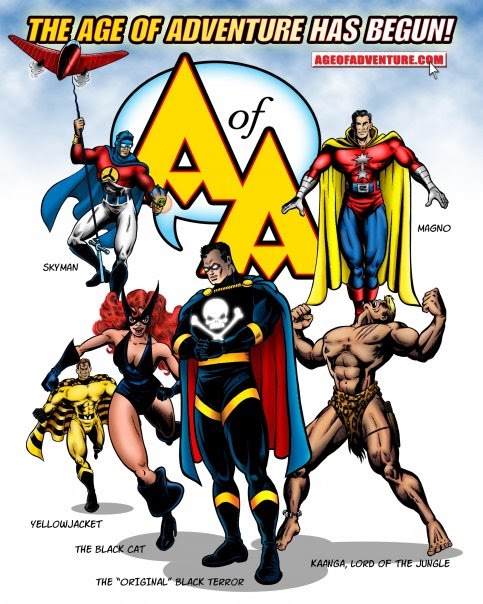
WS:  Age of Adventure (AofA for short) started out putting together collected editions of Public Domain Comic book material.  Basically it was stuff I wanted on my shelf in a nice format that didn’t cost too much.  Others seemed to agree and sales were good.  It quickly grew into what it is now.  We publish 3 ongoing magazines as well as the odd Pulp anthology, collection or novel.  You can check out our storefront at:  http://stores.lulu.com/goldenage1
We try to keep costs as low as possible so that more people can afford to enjoy them.  Our goal is simply to put out material that the fans want to read!

AP: Age of Adventure covers several sub genres within pulp, but two in particular have been prominent from you in the last year or so. What appeals to you about the western story and about war stories?

WS:  I don’t know if War stories are big from us, but I love a story that embraces adventure combined with brotherhood and often thats the core element of a good War story.  Our Westerns have been selling gangbusters!  I grew up watching Western movies and TV shows and have always been a big fan of John Wayne, Chuck Connors, Clint Eastwood, etc.  I feel that Western stories are so appealing due to the fact that its an American take on the classic Knight Errant.  Wandering hero, codes of honor, tin stars in place of armor and six guns instead of swords.  Plenty of damsels in distress too.  Whats not to love?  Every story is like re-visiting a Saturday morning of my childhood.

AP: You also are the organizer/creator of your very own convention? Can you tell us about that, what it’s called, its history, that sort of thing?

WS:  I run “Savage Con” once a year in St. Louis.  This will be the second year under that name, there were 3 prior which were known as the “LaPlata Doc Con” due to the fact that they were held in LaPlata, Mo.  The hometown of Doc Savage scribe Lester Dent.  It started as a simple gathering of Doc Savage friends and while we’ve kept our original crew of attendees its blossomed into something a bit bigger than it originally was.

AP: Doc Savage is definitely a well known character and has influenced many fans, writers, and artists? What goes into building a convention around a single character? Is there enough about Doc to warrant that much attention over a two or three day period?

WS:  Our get together is a day and a half and there is definitely enough Doc to fill that.  He’s the archtype for so many heroes today and has such a rich history and catalog of stories.  Doc fandom is very much a brotherhood all its own.  From buying, selling, and trading, to fanmade original swag, discussions and trivia.  One of our brotherhood, Matt Hiebert, put together a really wonderful “DOC”umentary even.

AP: What about this year’s Con? What’s the agenda for those who attend?

WS:  The typical Trading, Buying, Selling, and comradarie.  A silent auction for some original Doc Art, Trivia contests with prizes, and various pulpy films to be shown.  We may even have a book signing or two.  One of our regulars is Dr. Art Sippo who wrote “Sun Koh: Heir of Atlantis” released through AofA.  Art is one of the nicest and most knowledgeable guys you could ever meet.

AP: What are your long term plans for Savage Con?

WS:  I’m hoping to start attracting comic fans as well as pulp fans, and possibly expand some content that is still high adventure, but not nec. Doc-specific.  Just to add to the fun.AP: All right, now on to for what is probably for some the most interesting aspect currently of your relationship to pulp. You are a chef by trade. And now you own a restaurant. Can you describe the Raygun Café’ for us?
WS:  Absolutely!  Raygun Cafe’ was born in part out of my attempts to get some kind of Pulp Museum going.  Things didn’t work out in LaPlata to that end, though I and some other fans did get a nice, permanent Dent/Doc display established at the Library in his hometown.  Raygun is basically the pulp and comic version of a Hard Rock cafe’.  Pulp, comic, and Sci-Fi art and memorabilia, Serials, OTR, etc.  Thats the atmosphere and the food is second to none!  Italian beef, Gourmet Hotdogs, Panini’s, fresh, seasonal soups and stews and local micro brews and artisan beers.  A lot of positive buzz locally so far!

AP: Pulp is definitely a genre that is on the upswing, experiencing a renaissance. Is there a market for a pulp themed restaurant and if so, what market are you targeting?

WS:  We’re targeting not only fans who know the genre, but fans of adventure and nostalgia buffs as well.  I think the market for such an endeavor is ready to be tapped.  Who doesn’t love action and heroic imagery?  Who doesn’t love to eat!?  Its got a big eye appeal factor, its family friendly, and I plan to try and sneak a little pulp history lesson in here and there to help create a new generation of fans.

AP: Now, this is much more than a restaurant for you. You’ve been quoted as describing it as an educational experience as well. Would you mind elaborating on that?

WS:  The artwork, pulps, and comics on display naturally lend themselves to discussion and people asking questions.  I’m working up info-cards with pulp and creator history tidbits to display as well as just being available and encouraging questions and discussion on the decor and exhibits.  “Who is that guy?” will be something a person asks once and winds up answering for others later.

AP: Can you tell us what patrons can expect to be on the menu at the Raygun Café? Also, what artifacts/displays they might expect to see from the world and history of pulp?

WS:  Well, as I said before on the menu, we’ll have Italian Beef (Art Sippo will vouch for how good that is!) French Dips, Deli style sandwiches and sides, Various gourmet Hotdogs, Panini’s, fresh soups, stews, and chowders, and when weather permits, we have a grill out back for BBQ specials. Just don’t touch the art!!
As for displays we have original pulps and vintage comics, Pulp and Sci-Fi artwork enlarged to gigantic size, Retro space toys, and original genre related artwork from local artists (including some amazing stained glass).  I’ll be constantly rotating the actual pulps and comics that are displayed and will likely have “Gallery Talk” sessions when I do so.

AP: What are the future plans for the Raygun? In ten years, will there be one in every major city in America, if you have your way?

WS:  …gah!  One is enough stress right now!  I’m certainly not against franchising, but we need to get this one going strong first.  Right now the goal is to excite the masses and provide an income for my family!

AP: Let’s back up and talk about your writing a bit more? What particular process do you go through to create a character and write a story? Do you just sit and let the words flow from your fingers or do you follow a particular pattern?

WS:  I’m very much comic book inspired, I tend to think very visually and i’ve been told I write that way as well.  Someone once told me “Your stories are too comic book!”  They meant that as an insult, I took it as a compliment. I never outline anything to be honest.  Usually I’ll get an idea for a scene or a story and let it evolve in my head for a few days, after that I sit down and hammer it out.  Once I get going with a character they pretty much write themselves, I just provide a situation they have to deal with and they act accordingly.  I don’t obsess with daily wordcounts and such, that simply builds frustration.  If I have a story to tell I tell it.  If it takes me a day or a month to write it then thats what it takes.  I basically write stories I myself would like to read.

AP: What sort of stories and writers is Age of Adventure interested in?

WS:  Right now we’re taking open submissions for our Western Magazine (short stories).  We also look for good, solid action and adventure in any setting, from pulp era to contemporary.  I like working with writers I’m familiar with, but if you have a good story to tell, I’m happy to give it a shot.  I’ll be honest, being a publisher, even a small press one, you get your fill of big egos pretty quick.  Politeness and humility go a long way towards getting anything you want in this world!

AP: What’s in the future for Age of Adventure?

WS:  We have our ongoing Western Mag issue 3 of which is due out later this month, and a really fantastic anthology which will be hitting the stands by the 20th titled “Vampires Vs. Werewolves”.  Great cover art by Rob Moran on that one.  Thrilling Adventures is gearing up to return along with Super Heroic Tales (our other two magazines).  We have a collection of Barry Reese’s stories in a variety of pulpy genres titled “Dangerous Worlds”, and Art Sippo is busy working on Sun Koh 2…

AP: What about Wayne Skiver, the writer? Anything coming down the pike you want the public to know about?

WS:  Actually i’ve been hard at work scripting a comic series with some original characters.  Can’t say too much about that right now, but its going to be a lot of fun and I’m working with some really amazing like-minded cohorts.  The next issue of Comic Fan! from Main Enterprises has an article on the history of the Charlton Action Heroes from me as well.

AP: Wayne, it’s been awesome to spend some time with you. Anytime you want to push Age of Adventure, the restaurant, the convention, or what you’re writing, let us know!

WS:  Thank you, it was good to talk with you.  The pulp community is a close niche, its good to have a site to get a glimpse of whats going on in various aspects of all things pulp, print and non!
                                                                  _____________________

ANNOUNCING THE FIRST EVER ALL PULP Pulp Artist Weekend!!! Lead off interview-Tamas Jakab!

That’s right, Pulpsters!  In a last minute inspired decision ALL PULP is now dedicating weekends (as long as material and artist types last anyway) to that often unsung pulp creator, the ARTIST.  Each weekend, ALL PULP will endeavor to post interviews, columns, news, etc. that focuses on the work of artists of all types in bringing pulp to life!   

With the short notice of this (sorry, ALL PULP just works that way sometimes), if you have any art you’d like to share, make sure you have permission of the artist and send it on for the first ever ALL PULP P.A.W. Gallery to debut ON SUNDAY.  This will occur every weekend and will include art submitted for the Gallery each week!

First up for ALL PULP’s P.A.W., an interview with Tamas Jakab, artist and co-creator on EL GORGO!!!

TAMAS JAKAB, Artist/Letterer/Colorist/Co-Creator on El Gorgo!

elgorgo2-8526129
AP: Who is Tamas Jakab?
TJ: Tamas Jakab is a person (presumably, though he may actually be a clone or a robot), who lives in Cleveland, Ohio with 2 cats, a dog and a girl. I had a brief career doing cover and design work for the late, great Frontier Publishing, as well as various freelance gigs. I am the co-creator, artist, letterer and colorist on EL GORGO! On the side I work a day job unrelated to comics.
AP: What are your artistic influences and aspirations?
TJ: From comics, Jack Kirby, because all superhero comics are Jack Kirby, whether they realize it or not. Also Grant Morrison, because he goes for the big, crazy ideas, and superhero comics work best when they’re big and crazy. Otherwise, the list could go on and on – Los Bros Hernandez, Darwyn Cooke, Steve Ditko, Mike Allred…
AP: What do your think your strengths as an artist are?
TJ: Certainly not inking. I think I’m barely adequate as an inker, which can be frustrating, because I really love the aesthetics of comic book inking. I do think I have a really good eye for color, design and typography though.
AP: What’s your dream project?
TJ: Currently, EL GORGO! I’m really not the type of person who just wants to draw BATMAN or SPIDER-MAN. I prefer working on original concepts where I’ve got a lot of creative freedom and can play with different styles and genres.
AP: How did you get involved with Mike McGee and end up co-creating EL GORGO! ?
TJ: I’ve known Mike since 1987. We first collaborated on an adaptation of one of his short stories for the FRONTIER PUBLISHING PRESENTS comic back in 2005, and we’d been trying to get a new project going for 2 years with little success. EL GORGO! was a happy accident that came from a proposal to do a throwaway story for a comics anthology. We pretty much had the basic character of El Gorgo worked out in about an hour. We quickly realized we had a really fun, high-concept character and kept at it after the anthology didn’t work out.
AP: Who is EL GORGO! ?
TJ: EL GORGO! is a super-intelligent luchador gorilla scientist who saves the world on several occasions, plays in the world’s greatest surf-rock band, Gorgo-A-Go-Go, and is an historical novelist on the side. He’s pretty much Reed Richards, Captain America, Indiana Jones and Doctor Who rolled into one.
AP: Where do you see EL GORGO! as a character and as a comic book going?
TJ: Optimally, EL GORGO! would be in the mind and heart of every living being on Earth. Right now we’re just getting issues out as we can, which isn’t as frequently as it should be, and I’d like to see us move away from print and entirely into digital publishing.
As a character, we’ve really just gotten started…
AP: What do you and Mike have planned for EL GORGO! ?
TJ: We have way more things planned out than we will probably ever get to. Currently we have the book plotted out to about issue 13 or so, which would run through the Secret Origin of El Gorgo. In between, there are still some major characters to introduce, but I can’t give spoilers. Should we ever get to it, we have a good idea what the last EL GORGO! story would be, and I know exactly what’s on the very last page.
In a perfect world, we’d find the time to go at least 40 issues, which seems to be the sweet spot for good comic runs.
AP: You did the cover for DILLON AND THE LEGEND OF THE GOLDEN BELL.  What was the concept for that cover?
It was based on a cover from DOC SAVAGE MAGAZINE in 1933, “The Red Skull” by Walter Baumhofer, which is featured in the great collection PULP ART. Given Dillon’s pulp roots, particularly Doc Savage, I figured I’d go right back to the source for inspiration.
TJ: How did you achieve that aged look that makes the cover look like an old paperback?
goldenbellwebcover-2041862
Additionally, on the EL GORGO! back covers, I used halftone patterns to simulate old-school color separation by hand. I love the fact that I can use expensive modern technology to simulate cheap printing methods that were replaced by better technology.
AP: What’s your method of working? 
TJ: I work 100% digitally these days. I reached a point where it made no difference if I worked on paper or on the computer, except it’s easier to fix mistakes on the computer. I work primarily in Adobe Photoshop and Adobe Illustrator, and I now use Manga Studio to draw and ink EL GORGO! The cover for DILLON AND THE LEGEND OF THE GOLDEN BELL was created in Corel Painter and then finished in Photoshop. 
ds-theredskull-4482712
AP:  What’s a typical Day In The Life of Tamas Jakab like?
TJ: Very hectic and yet unspectacular.
AP: Where should we go to see other examples of your work?
TJ: The covers for Frontier and some pre-EL GORGO art projects are still hosted on my old website, http://rednever.com. I’m no longer maintaining the site, and eventually the art projects will find a new home.
AP: Anything else we should know about you?
TJ: I haven’t forgotten about EL GORGO! issue #4! I have some other non-art projects I have to work on, but I’ll be back on it as soon as I can!

ALL PULP INTERVIEWS BLACK COAT PRESS!!! PULP LIVES WORLDWIDE!

JEAN-MARC LOFFICIER, Writer and Publisher of BLACK COAT PRESS
bcphat-5051775
AP:  Jean-Marc, it’s fantastic of you to join ALL PULP for a few minutes.  First, can you share some background on yourself before we jump into the ‘business’ side of things?

JML: My wife Randy and I worked for Starlog and several French and British genre film magazines prior to becoming publishers. We also worked in comics, writing scripts for both Marvel and DC (Dr. Strange, Arak, Firestorm, Blue Beetle, etc.) We had, in fact, been translating a number of award-winning French comics for Marvel (the Moebius series) and Dark Horse (works by Tardi, Andreas, Schuiten and others). So moving into translating books was a natural extension. We had already co-authored over a dozen books about movies and television series, such as The Doctor Who Programme Guide, Into The Twilight Zone, Science Fiction Filmmaking In The 1980s and The Dreamweavers, the latter two from McFarland.


frankenstein01-6029685

AP:  You are a publisher.  Tell us about Black Coat Press, both what you publish and the mission of your company?

JML: Black Coat Press was born in 2003 as a logical development in our desire to bring out the best of French popular culture into the English language. First, there was our massive French Science Fiction, Fantasy, Horror & Pulp Fiction encyclopedia published my McFarland in 2000; then there was our www.coolfrenchcomics.com website, and finally our two non-fiction Shadowmen books which, with our translation of Doctor Omega, were the first books published by Black Coat Press. It had always been a source of profound frustration to us that, because of the language barrier, the knowledge of many outstanding French works was denied to the American public. The purpose of Black Coat Press was to help remedy this sad state of affairs by providing a fairly comprehensive selection of the best and/or the most representative works, with proper introductions, bibliographies, etc. Because science fiction, fantasy, etc.  are often regarded as minor genres by “serious” scholars (on both sides of the Atlantic!), we felt that publishing works of this nature would be more useful than publishing  classic or mainstream novels, for which there are at least a few outlets available.

AP:  How does the history of pulps outside of the United States compare to its American sibling?  When did pulps start overseas and what was the lifespan of the genre in France and the U.K.?

JML: In France the type of stories that were later published in pulps were originally serialized in newspapers. The Count of Monte-Cristo, The Three Musketeers, the Black Coats series, Rocambole — all the great pulp heroes of the 19th century first appeared in newspapers. Think that there was a time when French novels and French films were widely imported in the United States. People were mobbing the New York harbor waiting for the latest installment of Alexandre Dumas’ novels. Yet in the age of the global village, this cross-cultural exchange has shrunk to next to nothing, and I think America is the poorer for it. The apparition of magazines or booklets devoted to a single character really started in the 1890s and the very early days of the 20th century. That lasted pretty much until World War II. Truth to tell, there was always a lot of back and forth between serialization in newspapers; magazine-sized booklets, and cheap paperbacks. The three formats were pretty much interchangeable and stories would often appear in several formats.

AP: There seems to be a wealth of characters to choose from.  Can you just give us the highlights on some of the characters that Black Coat is handling?

JML: We have published translations of Paul Féval’s BLACK COATS saga, including JOHN DEVIL, a multi-volume series about a secret criminal empire that thrives in the 1840s and is the first, ground-breaking series in the history of crime / conspiracy thrillers. We have also published translations of Arsene Lupin’s famous clashes against Sherlock Holmes and Countess Cagliostro, the first Rouletabille novel, which is an acknowledged classic in the mystery genre, Doctor Omega (a Dr Who lookalike), new translations of Phantom of the Opera and Monsieur Lecoq (Lecoq was an inspiration for and is quoted by Holmes), a collection of Sar Dubnotal (a mystic superhero) and Harry Dickson (a Sexton Blake-type character) stories, several never published before Fantomas novels and several novels featuring the Nyctalope and Doc Ardan, two proto-Doc Savage heroes. We have also published a five-volume series of works by Maurice Renard and a six-volume series of works by J.-H. Rosny Aîné, best known to English-speaking audiences for The Hands of Orlac and Quest for Fire, respectively, and which are both founding fathers of French science fiction after Jules Verne.

AP:  Black Coat publishes a ten story anthology yearly.  What is the concept behind TALES OF THE SHADOWMEN?

JML: Since 2005 we have indeed released six volumes (so far, Vol 7 will be out in December of this year) of this annual anthology of tales paying homage to the greatest heroes and villains of popular literature. The concept is based on the notion of crossover — the more outlandish, the better — between various characters from pulp fiction, always treated with respect and in continuity. For example we have had Doc Savage meeting The Little Prince or Lecoq Dr. Loveless; this year we have an encounter between Jean Valjean and Zorro. We have had a number of talented and well-known authors participate, such as Robert Sheckley, Kim Newman, John Shirley, Paul DiFilippo and others and this year we’re proud to have a story by mystery author Sharan Newman. We’ve also published stories by new/aspiring writers, who have since gone on to sell stories into other markets. We are also the only truly international anthology who publishes stories from non-English writers: we’ve published tales translated from Belgian, Chilean, Italian, French and French-Canadian authors.

AP:  What sort of weight do the concepts from international pulp carry, if any, with today’s audience? Why go through the effort of producing new stories for these characters, some of which are long forgotten or never even known beyond their own country?

JML: Obviously, the answer is — because we love it. But personally I think the popular media (literature, comics, film & TV) are far more reflective of their times than mainstream literature. One will learn more about what 19th century France was really like by reading the BLACK COATS than from history books. I think this is a tradition worth preserving, which is why we put so much effort in preserving those somewhat forgotten classics from long ago and making sure they’re still accessible today.

AP:  What are the primary similarities between American pulp characters and international characters?  And , of course, the follow up question to that, what are the major differences?

JML: One might argue that there’s nothing new under the sun, and the archetypes of heroic fiction remain the same and go all the way back to the Round Table, the Greek mythology (Hercules, the Argonauts etc) and ultimately Gilgamesh. Our French Science Fiction, Fantasy, Horror & Pulp Fiction encyclopedia published my McFarland in 2000 starts in the Middle Ages — when French language became formalized — and you will find a bevvy of very modern concepts: werewolves, vampires, monsters, femmes fatales, evil masterminds, super-powered heroes, magical weapons, it’s all there already. Same in the 17th century where writers created hollow earths, journeys to other planets, lost worlds with prehistoric creature… Honestly, you’d been amazed to see how little new stuff we have invented. They could not conceive of computers and cyberspace — that’s a truly new notion — but you’d be amazed to see how truly ancient some of the notions we still use today are. The romantic vampires goes all the way back to Lord Ruthven (1819); Paul Féval wrote a virtual Buffy novel with Vampire City (1867), already predating Dracula by 30 years. Examples abound. If one wants to understand the roots or genesis of pulp fiction, you have to back much earlier in time. We specialize in French-language works, but obviously other cultures are just as interesting.

AP:  Science Fiction seems to be a mainstay at Black Coat?  Is this a significant genre overseas within the pulp field and how does it compare to American science fiction?

JML: We consider SF one branch of popular literature, just as interesting as pulp, mystery, crime, horror and fantasy, so I wouldn’t say we treat it with more favor, but we do endeavor to publish translations of genre classics unknown in the English language. I mentioned Rosny and Renard above but we have also released other ground breaking works such as Félix Bodin’s The Novel of the Future (1834), Didier de Chousy’s Ignis (1883), C.I. Defontenay’s Star-Psi Cassiopeia (1854), Charles Derennes’ The People of the Pole (1907), Georges Le Faure & Henri de Graffigny’s The Extraordinary Adventures of a Russian Scientist across the Solar System (1888-96), Gustave Le Rouge’s The Vampires of Mars (1908), Henri de Parville’s An Inhabitant of the Planet Mars (1865), Gaston de Pawlowski’s Journey to the Land of the 4th Dimension (1912) and Albert Robida’s The Adventures of Saturnin Farandoul (1879), all absolutely outstanding works essential to the history of the genre. We have also published a few modern works including two collections by Jean-Claude Dunyach, novels by Kurt Steiner, G.-J. Arnaud, Richard Bessière, André Caroff , Gérard Klein, Michel Jeury, Xavier Mauméjean and two horror thrillers by Philippe Ward, but to a large extent those already reflect and incorporate the influence of American science fiction which was translated and exported right after World War II — so almost any French works after that are already playing in the same ballpark. The modern works we select tend to be original concepts; I try to avoid publishing something which would read just like another American or English work. But still, you can’t get away from the influence. Whereas the works listed above all predate AMAZING STORIES, etc. and are truly unique.

AP:  Is Black Coat’s focus solely on the pulp genre? If not, what other mediums are you involved in?  Any blending of mediums, say having comic characters appear in pulp stories, etc.?

JML: We are unabashedly devoted to popular literature — as I said, that includes SF and pulp, but also mystery, crime thrillers, fantasy and horror. We do have a small line of comics, translation from French/Italian comics of the 1960s and 1970s, but there are not too different from, say, the DC Comics of the same period.

AP:  We’ve established you are a publisher What about as a writer?  Can you talk to us about your writing background, especially as it relates to the pulp field?

JML: As I mentioned above, Randy and I have written for comics, and also animation. We did a DUCK TALES and several REAL GHOSBUSTERS as well as a few more forgettable shows like BIONIC SIX etc. One of the GHOSTBUSTERS episodes makes use of the Headless Horseman and Ichabod Crane so to that extent it is part of the pulp universe, as it were. Quite a few of our comic book stories betray the same influences. We wrote a crossover between Superman and Asterix in ACTION COMICS (drawn by Keith Giffen) and had the Teen Titans’ characters cross into the Tintin universe. We’ve done a couple of novels in France which we translated into English and published at Black Coat Press, including one THE KATRINA PROTOCOL, in which the modern-day descendant of Van Helsing faces a zombie invasion in New Orleans during Katrina, and another novel, EDGAR ALLAN POE ON MARS which is a historical fantasy in which Poe meets Edwin Arnold’s Gullivar Jones. (When we do books in France we usually retain the rights to do our own English translations and publish them here.)  We also have a collection of short stories, PACIFICA, which contains all our “Shadowmen” tales as well as some comics, TV fanfic crossovers, etc.

AP:  Is Black Coat’s purpose simply to bring these awesome pulp characters from outside of the United States some much needed exposure?  Or do you feel these characters have had or can have an impact on what pulp is now and what it will be in the future?

JML: Who knows what the future might bring? So far I’m happy that we are making a wealth of French material heretofore unknown to scholars and fans alike available in English. If that’s our only contribution to the field, I’ll be pleased.

AP:  So, what projects are coming from Black Coat Press? Any from your pen specifically?

JML: Volume 7 of TAKES OF THE SHADOWMEN will be out in December. Next year, we expect to publish the last volume in the BLACK COATS saga as well as continue the translations of the MADAME ATOMOS series, a French pulp from the 1960s which was then a new and much harder edged reinterpretation of the old “yellow peril” archetype; the ATOMOS series was really ahead of its times in terms of foreseeing modern terrorism, etc. We expect to be publishing more classics of proto-science fiction from the 19th century as well as a truly visionary work of the 18th century, LAMEKIS, which already foreshadows PELLUCIDAR and other similar fantasy novels. If Bill Maynard finishes it in time, we’ll have a second fully authorized original FU MANCHU novel later in the year and Randy and I plan to translate the classic last Fantomas novel, THE DEATH OF FANTOMAS, never translated before into English. As far as our own work is concerned, we’re supposed to have a story in the next Moonstone’s AVENGER collection and one in the WORLDS OF PHILIP JOSE FARMER collection, plus some other works published in France that we mean to translate.

AP:  Jean-Marc, thank you so much for this interview!  ALL PULP wants the world to know all about Black Coat Press!!

______________________________

hugo-1086825

2010 Hugo Awards Winners Announced

hugo-1086825Kudos and congratulations are in order for the winners of this year’s Hugo Awards.  Named for “Amazing Stories” founder, Hugo Gernsback, the Hugos were awarded at this year’s WorldCon (Aussiecon 4, in Melbourne, Australia) to celebrate fine contributions for the year’s top science fiction or fantasy works. So, without further adieu, let us present this year’s winners, and offer our congratulations!

And the John W. Campbell Award for Best New Writer (presented by Dell Magazines): Seanan McGuire

We here at ComicMix congratulate all the winners above, and recommend you give a gander at their (now award winning!) work next time you get a touch of the wanderlust for the stars or sword.

Chicago Comicon: A Tale of Two Cons (Part Three)

Hello again, one and all. I’m back for this final day to wrap up my thoughts on the 2010 Chicago Comic Con, as presented by Wizard. See what they did there? Fooled you. Same way we all don’t know Xfiniity is actually Comcast, and Fox News is actually Satan’s News Network. When we last left off, I’d given a fairly positive review of the dealer floor. While it feels like the Swap-O-Rama had a child with that creepy guy who shows up at the comic store in sweatpants and an original 1978 Incredible Hulk shirt stained with brown mustard… the dealer floor offers a plethora of deals, steals, and hard-to-find collectibles that you’d just not find if not for the gaping square footage of a convention hall. With that said, it’s time we wrap up this little tour of the “Big-Con-That-Could… but didn’t.”

I want to start this final day’s wrap up with a little pull-quote from Wizard concerning former Illinois Governor Rod “1 count of fraud is better than 24” Blagojevich, and his attendance on Saturday.

“Wizard
World Chicago Comic Con is all about pop culture, and Rod Blagojevich is
as relevant to today’s news as it gets,” said Gareb Shamus, CEO of
Wizard Entertainment. “We think the court of public opinion will show
him to be a popular figure at the show.”

I couldn’t state it any better folks. Wizard World Chicago Comic Con is all about ‘pop culture’. Never mind that COMIC is in the title. Never mind that a SINGLE comic book publisher showed on the “exhibitor floor”. Never mind that the same floor was dominated by C, D, and Z level celebrities. Gareb Shamus has turned a show that once was the San Diego Comic Con of the Mid-West into a glorified flea market and three ring circus. I lamented earlier that for me, the meat and potatoes of a convention comes in it’s programming and exhibitors. At this con, the main floor boasted booths for everything BUT comics. In fact, aside from Avatar’s presence, a con goer walking into the show floor may not even reach an actual book until the dealer room. And with panels ranging from iPhone game demos to a “celebration of die-cast car collecting” … they might as well do themselves a favor and take COMIC out of the title. In all honesty, as a comic book fan, I resent that a casual con goer would think what they saw in that hall was a representation of what comic fans like.

(more…)

First Look: ‘Thor’

thor-chris-hemsworth-5070329As promised, Paramount Pictures released more images from Thor, opening May 6, 2011. Director Kenneth Branagh has clearly cleaned up Jack Kirby’s vision of Asgard, making things nice and shiny.

In case you missed it, here’s a rundown of the cast for the film which recently completed principal photography. The screenplay is written by Ashley Miller (Fringe) and Don Payne (The Simpsons). Miller has since gone on to write X-Men: First Class for 20th Century-Fox while Payne previously wrote My Super Ex-Girlfriend and was one of the writers on Fantastic Four: Rise of the Silver Surfer.

Dr. Donald Blake/Thor is portrayed by Chris Hemsworth (Star Trek) with Natalie Portman as Dr. Jane Foster (promoted from her original nurse role). Anthony Hopkins is the one-eyed Odin, Rene Russo as Frigga, his wife; and Tom Hiddleston (Wallander) as the sibling Loki. Portraying the delightful Warriors Three are Ray Stevenson (The Book of Eli) as Volstagg, Tadanobu Asano (Snow Prince) as Hogun the Grim, and Joshua Dallas (Doctor Who) as Fandral the Dashing. Sorry, Balder the Brave apparently didn’t make it into the movie — maybe next time.

Rounding out the cast will be Jaimie Alexander as Thor’s Norse love interest Sif, Idris Elba as Heimdall, and Kat Dennings as a new character, Darcy. Clark Gregg continues his tour through the Marvel Movie Universe, reprising his SHIELD Agent Phil Coulson role.

According to a release from Marvel Studios, “At the center of the story is The Mighty Thor, a powerful but arrogant
warrior whose reckless actions reignite an ancient war. Thor is cast
down to Earth and forced to live among humans as punishment. Once here,
Thor learns what it takes to be a true hero when the most dangerous
villain of his world sends the darkest forces of Asgard to invade Earth.”

(more…)

New Doctor Who For You, Too


The eleventh doctor debuted on British teevee this weekend, in the 31st season of Doctor Who. It will be airing on BBC America on
the 17th, so I’m going to avoid any spoilers. Still, consider this something of a warning;  if you don’t wanna know diddley, go no further.


If you’re still with me, here’s what you will need to know:              Matt Smith and Karen Gillan will do just fine, thank you. Smith plays the
new doctor as a younger and brasher version of David Tennant’s doctor, which is only appropriate given Smith’s age. He wisely retains the 10th doctor’s joie de vive; he’s having a ton of fun. And Gillan plays the skeptical sense of wonder beautifully in what is this time a particularly demanding role. But the actors are not the most important aspects of doing Doctor Who correctly.

The most important aspects are the writing and the production. I never met a doctor I didn’t like, but the last two guys on the original series were hamstringed by uninspired scripts. No worries here: Steven Moffat is an excellent writer and as producer he truly gets it. His predecessor ran each show at breakneck speed; Moffat kicks it up a notch.

The season-opener presents a particular nightmare for the writer: he has to introduce a new lead character in a show that’s been around for 31 seasons. Origin shows, often called pilots, are a bitch to write because you’ve got to introduce everybody and set everything up while you’re telling a
compelling story. That’s a lot to squeeze into one episode; Moffat had the
additional problem of satisfying those fans of Tennant’s or, for that matter, any of the preceding doctors.

The fact that he pulled it off is a minor miracle. Matt Smith won’t be the only person having fun here.