Tagged: Marvel Comics

PULP ARTIST’S WEEKEND-Rob Davis, Comic/Pulp Artist/Designer

ROB DAVIS, Comic/Pulp Artist, Designer, Co-Publisher
AP –Thanks for stopping by All Pulp HQ, Rob.  Let’s start with some biographical data.  At the present, who is Rob Davis?  Where do you live and what is you current occupation? Etc.
RD – I live in central Missouri near Columbia, home of the University of Missouri. When I’m not drawing, painting or working on designs on my computer I drive a bus for the Columbia Transit system.
AP –What kind of formal art education did you have?
RD – Most of what I do these days I taught myself, but I worked three years toward a Graphic Design/Illustration degree at what is now known as Missouri State University. The basics I learned there were a great foundation for what I ended up having to teach myself later.
AP –Were you a big comic book fan as a kid growing up?  What was your favorite comic company, Marvel or DC?
RD – I read both Marvel and DC comics as a kid in the 60’s, though my favorite characters were those at Marvel. They just seemed more “real” to me somehow, though I certainly enjoyed what was going on at DC at the same time. I bought the Marvel comics off the stand and read the DC comics at the barber shop. Ha!
AP –Which graphic artists did you admire the most and which do you think had the most influence on your own style of drawing?

RD – Jack Kirby was/is a major influence. His dynamic storytelling and wild, exciting concepts were a magnet to lots of imaginative kids in the 60’s. I was no exception. It was his work that inspired me to try to become a comic book artist. Also, it wasn’t conscious, but I was told that some people see the influence of Curt Swan (long-time artist of Superman and the Legion of Super-Heroes at DC) in my work. After they told me that I thought about it and agree that Mr. Swan’s influence is definitely there.

AP – What was your first professional comic assignment?  Who was the writer and for what company did this appear?
RD – Oh, my. Now you’re making me dig back! Ha! My first professional comics work was as a letterer for NOW Comics’ “SYPHONS” comic. I can’t tell you who the artist/writer was- we’re talking 1988-89, here-, but after that first issue I was made the inker of the strip too. After about 3-4 issues of that I also lettered and inked another book from NOW that never saw print and eventually penciller on DAI KAMIKAZE! Before my work at NOW I did some illustration work on Mayfair Games’ DC HEROES role-playing game.
AP – Describe the feeling of seeing your work published for the first time.  Were you happy with it, or are you one of those critical types who sees where you’d have done things differently?
RD – I always see the flaws. Ha! I’ve been told that as an artist if you’re ever completely satisfied with your work, or stop growing and improving then you’re “dead” as a creative person. I’d tend to agree with that assessment.
AP – What other companies did you work for during your career?
bbonescvr-8487102

 RD – After NOW I worked for a number of years at what became MALIBU Comics. Perhaps my biggest individual and creative success there was on R.A. Jones’ SCIMIDAR. R.A. and I developed what I called a “synergy” working on the book where he’d send me page by page plot breakdowns that I would then interpret and send back to him to script- very “Marvel-style.” It turned into a “the sum is greater than the parts” thing where we amplified each other’s creativity. R.A. and I worked on a couple of other projects, most notably MERLIN.

Shortly after doing MERLIN I moved over to David Campiti’s INNOVATION Comics for a few issues of QUANTUM LEAP and a black and white mini-series, STRAW MEN. I then jumped back to Malibu to work on STAR TREK: DEEP SPACE NINE for its whole run there doing mini-series and backup work. At that same time I also did some work on DC’s STAR TREK titles, both the original series and Next Generation.
For Marvel I did a three-issue stint on PIRATES OF DARK WATER, a Saturday morning cartoon adaptation. This assignment grew out of conversations I’d been having with Marvel’s promotions manager, Carol Kalish. She was planning to start up a line of religious-themed comics there and I was in talks to be one of her stable of artists. We had all but sealed the deal. Unfortunately Carol collapsed and died from a heart-attack before we could get it going. It was her assistant who got me the connection to work on PIRATES.
AP – When did you leave mainstream comic works?  Was it for purely economic reasons?

RD – Yeah. The mid to late 1990’s saw a collapse in the comics market. Marvel had bought out Malibu and initially promised not to shut it down, but after a couple of years they did. The started up their much-touted STAR TREK books which I had hoped to work on, but they decided to try a whole different approach to producing the books which meant using different artists. Just before that happened I had been tapped to be the regular artist on Malibu’s STAR TREK: VOYAGER comic- which would have been my first month-to-month work as regular penciller on any book since DAI KAMIKAZE! It would also have made me the only artist to work on every incarnation of STAR TREK up until then- STAR TREK, STAR TREK the NEXT GENERATION, STAR TREK: DEEP SPACE NINE, and finally STAR TREK: VOYAGER. Alas it never happened.

AP – Since then, you’ve actually illustrated several self-published projects.  Tell us about those and how that came about?
RD – We need a bit of history here to explain it all, so bear with me. After I left NOW comics and went to Malibu NOW’S writer of THE GREEN HORNET, Ron Fortier, approached me to do a version of the character. I think I was being asked to do the 60’s TV version at the time, but my memory is a bit foggy. My break with NOW had not been amicable (a recurring theme there, I hear) so, though I would have loved to draw the character, I had to turn it down.
After that, Ron and I tried to put some other proposals together for various publishers, but nothing came of any of what I thought were some great ideas, sadly. Ron and I eventually lost touch, though we did trade Christmas cards for a while.
Then 5 or 6 years ago I was doing a weekly online comic strip called THE SPIRIT OF ROUTE 66 that Ron caught. He liked what I’d done and pitched me another strip for a startup comics site called ADVENTURESTRIPS.com. “Doctor Satan” lasted for about 32 episodes, if I recall, and then we folded up shop.

Ron being the idea guy that he is, he pitched me another project he’d been shopping around first as a movie script and then a graphic novel called DAUGHTER OF DRACULA. I knew I wouldn’t have the time necessary to devote to the book, though it was a worthy project. So, thinking Ron would reject the idea, I replied that in order to do the book it would have to come as one page per week. At 112 pages that meant it would take a while to complete. To my surprise Ron said “yes.” HA! Two years later I delivered the finished project pencilled, inked, lettered and gray-toned. Ron and I shopped it around, but we finally ended up publishing it ourselves through Ka-Blam and my own imprint: REDBUD STUDIO COMICS. Since then REDBUD has also published Ron and Gary Kato’s MR. JIGSAW. We’re up to seven issues now! We’ve also published a collection of Ron’s BOSTON BOMBERS mini-series from Caliber Comics.

AP – When did you first become affiliated with Airship 27 Productions?  Was it your first exposure to the world of pulps?
RD – Initially Ron asked me to illustrate an online book HOUNDS OF HELL that eventually became Airship 27’s first printed book through WILDCAT BOOKS. As for it being my first exposure to pulp? No, that would have to be my initiation into pulp storytelling with TARZAN when I was in High School. I didn’t know it at the time, but that was pulp. One could also argue that comic books, which I’d been reading since I was eight, are essentially pulp. Then there’s Ian Fleming’s James Bond books and movies and similar stuff. Pulp is all around if you look for it. Ha!
AP –  What is the big difference between sequential comics work and pulp illustrating, aside from the obvious number of images?
RD – Well, that’s a big part of it, but it’s more like doing a cover image with each illustration. You’re trying to tell a bit of the story in just one image as opposed to a series of images.
AP –  What is it about pulp work that appeals to you as an artist?

RD – I’ve always loved telling stories and this is is just one more way to do it. It’s fun and challenging to try to figure out which scene to portray and then how best to present it. It’s some of the same challenges as comics work, but quicker.

AP – Beside artwork, you are also Airship 27 Productions’ designer.  Is that a new hat for you and what kind of challenges does that particular task demand?
RD – It’s a “new hat,” as you say, but it’s an outgrowth of my early interest in design from my college days. I’ve really enjoyed learning to use the computer to do my illustration work, so it’s an outgrowth of that aspect too. Some days I’d rather sit down to work out the problems of a book’s design than sit at the drawing table. That’s saying something for someone who’s been drawing nearly every day for almost 30 years!
AP – You helped design the Pulp Factory Awards statue.  Tells us a little about that?
RD – At the regular Sunday morning breakfast gathering of the Pulp Factory members at Chicago’s Windy City Pulp and Paper show it was proposed that we create and award for new pulp creators. As everyone else was talking the idea for what that award would look like popped into my head full form. I grabbed the napkin and sketched it out really quickly. Everyone approved it on the spot!
AP –  Do you believe this renewed interest in pulp is a passing fad or do you believe it will be around for a long while?
RD- It’s hard to say. But I fully believe that pulps have never left us. It influences all sorts of things without us consciously realizing it. I mentioned James Bond earlier. Then there’s comic books and their attendant movie incarnations. Then there’s the pulp influence on action films. So, I don’t think pulp storytelling will ever go away, it just finds new was to manifest itself.
AP –Lastly, what’s coming down the road for Rob Davis and Airship 27 Productions that you’d like to give a shout out to here?  Feel free to promote what you’ve got coming in the months ahead that will excite the pulp community.

RD – Well, I just finished up illustration and design for our next book: MYSTERY MEN (and Women) and sent it off to the proofreader. Once we have the cover finished up and the corrections made it will be off to the press! We’ve also got some great books in pipeline including sequels to our Sherlock Holmes and Robin Hood books that I’ll be illustrating and designing coming out next year. There’s never a moment to rest at Airship 27’s production facilities. HA!

AP – Rob, this has been both enlightening and a real pleasure. Continued success and many thanks.
RD – Thanks. I really enjoyed it.

INTERVIEW WITH BARRY REESE, Writer/Editor/Reviewer

AP: Barry, it’s your turn on the other side of the table. Before we dive into your writing career, tell us a little about yourself.

BR: Well, I’m turning 38 on November 11, 2010 and I’m very happily married to my high school sweetheart. Together, we have a 4-year-old son. I was born and raised in Milledgeville, Georgia. I’m currently the Library Director for the Twin Lakes Library System, which is based in Baldwin County, Georgia. I’ve always loved reading and from a very young age, I wanted to be a writer. But somewhere in my teen years, I gave up on the dream and pursued other things… thankfully, things have a way of working out and in 2003 I was approached about writing for Marvel Comics. I jumped at the opportunity and spent the next four years writing various things for them, including a volume in their Marvel Encyclopedia series (the Marvel Knights volume) and quite a few entries in their Official Handbook of the Marvel Universe line of titles. I’m a huge comic book fan, love movies and music and spend far too much time pounding away at the keyboard.

AP: Now, onto Pulp. How long have you been writing pulp fiction? How/Why did you get into writing pulp? And can you give us a rundown of some of the stories/books you’ve written?

BR: Well, I always loved pulp growing up – when I was very little, my father had all the old Doc Savage and Avengers lying around and the covers really grabbed me. Even before I could read an entire book by myself, I would carry around those Doc novels. But by the time I became an adult, it seemed like very few people remembered those old heroes and even fewer were writing in that style. This wasn’t quite true, of course, but I was unaware of publishers like Wild Cat Books and Black Coat Press at the time.

So I decided that I’d take a break from the Marvel and role-playing game stuff I’d been doing and try to write something different. I decided to do a pulp novel because it seemed like it would be a fun thing to write and I wanted to enjoy the process. So I wrote The Conquerors of Shadow, which was basically my big love letter to the John Carter of Mars series that Edgar Rice Burroughs did. Around that time I came across a copy of Hounds of Hell, a book published originally by Wild Cat Books and written by Ron Fortier. It was very exciting and pitted Doctor Satan against the Moon Man. I was enthusiastic enough to write my first Rook story and from there I ended up contacting Ron Hanna of Wild Cat to see if he’d be interested in publishing them.

So far, my pulp career consists of: five published volumes in The Rook Chronicles (with a sixth coming next year); a pirate novel called Guan-Yin and the Horrors of Skull Island; Savage Tales of Ki-Gor, Lord of the Jungle; Rabbit Heart; and The Conquerors of Shadow. I’ve also completed a novel entitled The Damned Thing that’s awaiting publication from Wild Cat Books. Then there are all the short stories I’ve done for various magazines and anthologies! I won’t list them all but I’ve been included in books like How The West Was Weird, Tales of the Norse Gods and Airship 27’s upcoming Mystery Men Volume One. I’m also currently writing a series of stories starring a new character, Lazarus Gray, for Pro Se Productions.

AP: You are probably currently best known for one of your own creations. Can you tell us a little about The Rook starting with who he is and what he does?

BR: The Rook does tend to be the first thing people think of when it comes to me… The Rook is a masked vigilante who operates out of Boston in the late 1920s and early 1930s before moving to Atlanta in 1936. His real name is Max Davies and in classic pulp fashion, he watched his father die at the hands of criminals. Soon after this tragedy, Max began experiencing painful visions of future crimes. Deciding that he had to do something about these visions, he set off on a trip around the world, mastering almost all known forms of combat, as well as learning about various sciences and the occult. Unlike most masked heroes like The Shadow or The Spider, The Rook tends to encounter actual occult menaces with astonishing frequency. In a twist on things, he later learns that his visions are actually sent from beyond by his own father, who pressured his son from beyond the grave, hoping to create an instrument of vengeance. This places a tremendous strain on their renewed relationship.

AP: Where did the inspiration for The Rook come from for you? Is he based on anyone in particular?

BR: The Rook was inspired by a number of sources, most notably: Batman, Doc Savage, The Shadow, Indiana Jones and Nexus. I took all the things I liked about those heroes, added a bit of spice and created something that hopefully stands on its own.

AP: The Rook has a rich, varied supporting cast. Would you share a few of them with us?

BR: Well, first and foremost you have his wife Evelyn. A minor star on stage and screen, Evelyn Gould Davies is introduced in the very first Rook story I wrote (“Lucifer’s Cage”) and they’re married in the second. Evelyn sometimes adventures alongside her husband though she does this less frequently after they begin having children. They have two during the course of the series: William and Emma. Both of their kids end up becoming The Rook in the 1960s and 1970s, respectively.

Will McKenzie is the Police Chief and is, according to “Kingdom of Blood” (his debut), the youngest police chief in the country. Will has matinee idol good looks and is as brave as they come. Not only does Will help The Rook in his adventures but he’s also a major character in The Damned Thing, which is set in 1939. A few years after that he marries a former Nazi agent, who defects to the Allied side after falling in love with Will.

There’s also Leonid Kaslov, dubbed “The Russian Doc Savage” by many fans. The son of genius Nikolai Kaslov, Leonid is brilliant and capable. He has his own set of aides and battles alongside The Rook in numerous adventures, most notably “Kazlov’s Fire,” which was his debut.

Later in The Rook series (Volume Five), we’re introduced to The Claws of the Rook, which unites various supporting characters like Revenant, Frankenstein’s Monster, Catalyst and Esper into their team. The Rook adventures alongside them and also sends them into the field in his stead. They’re joined by public domain Golden Age heroes The Flame, The Black Terror & Tim and Miss Masque.

AP: Is a supporting cast important to a pulp character like The Rook? If so, what purpose does it serve, for both the story and the readers?

BR: I certainly think it helps flesh out the characters, to show them in various relationships and in different settings. Little scenes where we see Max hanging out with his kids or on a date with his wife helps make him a little more human than some of the classic pulp characters were depicted. It also reinforces the notion that The Rook isn’t a one-man army; he needs help and this sometimes makes him vulnerable. One of the things I wanted to do early on was give Max a stable relationship and one in which his wife was treated as an equal. While I love Doc Savage, The Avenger and The Shadow, I wanted a hero who was a little more human.

AP: Now, aside from the Rook, can you pick out your favorite one or two other tales you’ve written and discuss them?

BR: Sure! I love The Rook but I sometimes feel like everything else I do is cast under its shadow.

It’s not out yet but I’m very proud of The Damned Thing. It’s an occult noir set in 1939 Atlanta and is a bit of a kooky love letter to The Maltese Falcon. I had great fun writing it and it’s set firmly in The Rook universe. In fact, the main character (Violet Cambridge) shows up in 2011’s The Rook Volume Six.

Rabbit Heart was released in February 2010 and it’s a slasher horror novel with pulp influences. It’s set in my hometown of Milledgeville, Georgia and is a lot different than everything else I’ve written. It’s violent, it’s dirty and it’s just plain mean-spirited in places. But I’m very proud of it and think the main character (Fiona Chapman) was a lot of fun to write – and her partner in the story is classic pulp hero Ascott Keane (who used to fight Doctor Satan in the old days). I’m hoping that Rabbit Heart will get a few votes for Book of the Year in the Pulp Ark Awards but I don’t expect to win. The subject matter turns some people off and besides, as much as I pimp my work, there are those out there who seem dedicated to mobilizing their voters to ensure their books or their publisher’s books are the forefront of everything. I just don’t have the time or energy to engage in that much effort when it comes to awards.

The Lazarus Gray stories I’m currently writing for Pro Se Productions are good ones, too. Only one has seen print yet but eventually you’ll see the first six compiled into a collection. I’m also planning to team Lazarus Gray with The Rook for the Pulp Ark charity book.

And though I have no real idea when it will be out, I did an Avenger story for Moonstone that I really enjoyed. The Avenger is my all-time favorite pulp hero and to write an official story featuring him… that was a dream come true.

AP: This is a question that ends up in almost every interview ALL PULP does in one form or another. For Barry Reese, what does the term ‘pulp’ mean?

BR: Pulp is not an era. It is not specifically tied to the sort of paper the stories were printed on. That may have been where the origins of pulp came from and the earliest definition but it’s expanded beyond that. Pulp is a mindset. It’s about escapism. It’s about fun. It’s about excitement. Pulp doesn’t hold a mirror up to humanity in an attempt to examine what being human “means,” pulp is about telling you an exciting story that takes you out of your day-to-day life for a little while. I frequently tell this anecdote at conventions: The “point” of a Doc Savage story is this: if you build a crazy weather-controlling machine and try to take over the world, Doc Savage is going to come and kick your ass.

That’s the point of pulp. It’s beer-and-pretzels fiction.

AP: There’s the ongoing debate of whether or not pulp creators should be true to the standard set by the original writers of pulp fiction or if they should modernize/tweak/update both characters and concepts to give stories more relevance with a modern audience. What is your take on this?

BR: I think there’s room for modernization but not bastardization. If you’re going to remove the core premise and alter the characters beyond recognition, do something new and leave the old stuff alone. But you can certainly keep the spirit and update things. First Wave has gotten it all wrong but The Spirit stories by Darwyne Cooke got it right. Cooke updated The Spirit to a modern sensibility but kept all the charm of the original. First Wave has people using the names of heroes like The Avenger but nothing else.

AP: What are your strengths as a pulp author? What about your weaknesses?

BR: I think I create interesting characters and have pretty cool ideas. But I don’t think I write action scenes all that well and if you really break down my plots, I don’t think they’re particularly complex. For me, it’s all about putting the characters into situations where I can see what they’re feeling and trying to convey that in dialogue. So I’m good at characterization, not so good at the actual nuts-and-bolts of writing. I always hope that my enthusiasm will pass on to the reader and that will make up for any faults in my style.

AP: Now, you’re also one of the Spectacled Seven with ALL PULP. What are your duties with the news site and why is being a part of this important to you?

BR: I do the occasional interview, book reviews and I seem to have fallen into the role of doing the First Wave news items, just because nobody else will touch them.

I love pulp and I think anything that portrays it as a legitimate genre and community is a good thing. We’re kind of in a ghetto at present – even with the pulp “renaissance,” everyone’s sales are in the toilet and don’t let anyone lie to you. Massive pulp “hits” sell hundreds of copies, not thousands. We need to consistently improve our presentation and our message to get new readers and not just cater to the old ones.

AP: You’re also planning to attend Pulp Ark next May. You’re one of the guests and you’re doing a panel as well. Can you tell us about your panel, if you have it plotted out as of yet?

BR: I’d like to do something about capturing the spirit of pulp on the page. In other words, how do you write in that style? Is it a mindset? Are there specific techniques that can help? Does Lester Dent’s formula for writing pulp still apply today? That sort of thing.

AP: You have a project you’re working on that’s just recently been announced. Mind sharing with our readers a little about TURNING THE PAGE: TODAY’S PULP HEROES?

BR: It was a real honor to be approached about working on the project with Tommy Hancock and with Tom Johnson’s approval. We’re going to be looking at all the original pulp heroes created post 1955. Through fanzines and small press publications, there has been a steady stream of pulp characters created since the golden age ended and we’re going to shine the light on them. Many are well worthy of standing side-by-side with the classics. The first volume should be out sometime next year.

AP: You’re a librarian by trade. Does pulp have a place in our country’s libraries? And if so, why isn’t in more libraries or is it and the pulp community just isn’t aware of it?

BR: Of course it has a place in libraries. The library I run has books on its shelves by Derrick Ferguson, Maxwell Grant, Lester Dent, Robert E. Howard and many more. But why don’t most libraries stock it? The answer’s really, really simple.

Most pulp is published by print-on-demand publishers. Print-on-demand publishers are not generally listed by major resale vendors like Baker & Taylor, Ingram and Brodart. Almost all libraries do their book ordering through those vendors. My own Rook books aren’t listed in them so if I want a library to stock them, I have several routes I could take: I could sell the books to them directly or I could direct them to Amazon or Barnes and Noble or some other online source. But I can say from experience that a lot of libraries (including our own) don’t like buying from multiple vendors. It makes accounting more difficult and it’s easier to simply say “We order books from Ingram.” Print-on-demand works for the small market that is pulp but it is still regarded by libraries as being one step above a vanity press.

AP: All right, what does the future hold for Barry Reese and all his pulpy goodness? Any projects you want to share with ALL PULP?

BR: Both The Damned Thing and The Rook Volume Six are at Wild Cat Books now but I don’t think you’ll see either until sometime next year. I’m continuing to work on the Lazarus Gray stories and hope that eventually they’ll be as popular as The Rook has proven to be. And even though I always think I’m burning out on Max Davies, I’m sure I have more Rook novels in me. Another new character of mine, Dusk, will also debut in Airship 27’s Mystery Men book, so maybe folks will like her enough for me to write more.

Beyond that, we’ll see. Many of my books just came to me out of the blue and I’d imagine my next one will do the same.

AP: Barry, it’s been awesome to talk to you today!

BR: It was a pleasure. Thanks!

REVIEWS FROM THE 86TH FLOOR By Barry Reese

DOC ARDAN: CITY OF GOLD AND LEPERS
Written by Guy D’Armen
Adapted and Retold by Dean-Marc & Randy Lofficier
ISBN 1-932983-03-1

This book is published by Black Coat Press and features a retelling of a 1928 French pulp novel. The main character is similar in style and theme to Doc Savage and the enemy of the book is reminiscent of Fu Manchu, making this confrontation all the more fun.

The basic plot is this: Doc Ardan accidentally wanders into the City of Gold, a hidden kingdom ruled over by Doctor Natas. Natas (Satan spelled backward) is a super-genius with absolutely no morals. He’s discovered a way to transform ordinary items into gold and has inflicted his slaves with a mutated form of super leprosy which only his healing Z-Rays can hold off. In other words, if you try to escape or turn against him, he’ll simply turn off the Z-Rays and you’ll literally fall to pieces in minutes. Along the way, Ardan befriends the lovely Louise Ducharme and the two of them enter into a bloody conflict with Natas.

I greatly enjoyed the story and, given the ending, wouldn’t mind seeing a sequel. But I’m curious how much “adapting” the Lofficiers did. There’s a wink-wink reference to an ore from Wakanda that conducts sound. This is obviously tying into the Marvel Comics’ Black Panther mythos and was added in by the authors. I’m just curious how many other changes they made.

If you’re looking for a good old-fashioned pulp adventure, you really can’t go wrong with this one. The first 20 pages or so were a bit of a slow starter but once Natas arrives, the excitement really begins.

Four of five stars!

PULP ARTISTS’ WEEKEND-VER CURTISS, RENOWNED COMIC/PULP ARTIST

VER CURTISS, Pulp/Comic Artist

artgecko-8120003

AP: Thanks for joining us, Ver! To start with, how about telling us a little about yourself — in other words, what’s the secret origin of Ver Curtiss?
VC: The secret origin? Well, if I told you, it wouldn’t be a secret! But what I can tell you is that I live in Northern Virginia with my wife Linda. My wife is the Virginia native, but I lived in Idaho, California, and Tokyo before finding myself on the East Coast. Besides doing my art, I run a small, one-man computer troubleshooting company (since art doesn’t really pay the bills). So until I find the proverbial rich “patron of the arts” who can’t live without my art, I’ll spend my days chasing virii, Trojans, worms, and other nasty data-eating critters, while producing art on weekends and between clients.
 
AP: You’re quite an accomplished artist — what mediums do you like to work in?

VC: Thanks! Though I’m not always sure what my art is really accomplishing. Actually, it would be easier to ask which media I don’t like to work in. As a self-taught artist, ink and graphite are my two oldest friends. Seems like just about every artist starts with pencils and pens, just after graduating from crayons. I also like using fine-tipped ink pens and markers. But I really love using Sumi ink and a brush. Sumi’s a Japanese ink made of soot and ash, which is much darker than standard India ink. Of course, the brush takes a lot more time than markers, but the results can be well worth it. I enjoy sculpting, though I don’t get to do it very much because of the cost of materials and the cost to my back (I live with chronic back pain, and sculpting can tend to really aggravate it; much more than the art table or easel). Photography’s always been a favorite of mine, as has painting. I’ve used acrylics and watercolors a lot in the past, but I’ve been teaching myself oils these last few years. With water-soluble oil paints, it’s easy to get some really nice results without my entire home smelling of turpentine and linseed oil. I also love using the airbrush, but the tedious cleaning of all the little parts can be a real buzz-kill. And I like my art to be fun.
As you can tell, I prefer keeping things “old skool” in my artwork, but I’m not against doing stuff digitally when appropriate. I’ve actually been using the computer to help my art for about twelve years. But unlike a lot of the “new skool” digital artists out there, I see the computer as more of a tool than an all-inclusive solution. Pure digital art just seems to lack “soul” to me, for some reason. I’d rather ink or paint by hand, but there are some things which are easier and quicker on the computer. Like any good medium, I think the computer should free the artist rather than constrain him. ANY medium should merely be a means to an end, and that end is self-expression.
Lastly, I really enjoy making art from the unexpected, what some would refer to as “found art”. For instance, a few years back, when all my clients insisted on giving me all the CDs they were getting in the mail, I found myself gifted with spindles and spindles of AOL, NetZero, Prodigy, and a plethora of other promotional CDs. As soon as the client would say something like, “I hate to just throw these away, and figured you could use them,” I knew I was going to be handed a bunch of AOL CDs. So after receiving literally hundreds of them, I decided to start making cyber-skulls out of the CDs and worthless computer components (also gifted to me). Some of the skulls would appear to grow from old motherboards, some had pulsing neon lights, etc. Just last week, I saw a picture of my CD skulls on a major Steampunk site and a German Web page; I don’t know how they found them, but it was cool seeing that they were finally being appreciated. But they aren’t the only “found art” I produce. Recently, I found a perfectly preserved dead bumble bee on the sidewalk next to my mailbox, and created what can only be called a “Cyber-Bee” or “Steampunk Bee”. It took a lot of traditional small watch parts and some very small electronics, but turned out much better than I’d even hoped for. Now the owner of the local art gallery I display at is anxiously awaiting a whole series of Steampunked insects. My good friend Ron Hanna (of Wild Cat Books fame) loved the Cyber-Bee so much, he decided to encourage my art with a gift of ten mounted exotic bugs from Thailand, and I just finished a Steampunk rhinoceros beetle from the collection Ron gave me. Part of me can’t wait to do more, and part of me is asking “What the frak am I doing, super-gluing this this watch jewel to a dead bee’s eyeball?” But I guess that’s art! So I guess you’d call super-glue, broken clockwork, and bug parts my newest media.


blackangelnoseart-lo-5193803

AP: What artists inspire your work? 

VC: Now that’s quite the question! I’d have to say my earliest inspiration was John Romita (Sr.). I really started drawing when I was about eight or nine. More than anything else, I wanted a Spider-Man poster, and the only way I could get one was to make it myself. So for quite a while, Romita Sr and Ross Andru were the entire art world as far as I was concerned (I was Spidey-crazy as a kid). Not long after that, I discovered John Buscema and some of the other comic luminaries of the time. But as a teenager, I discovered Frank Frazetta, and it was like everything came into focus! Frazetta opened my eyes to the true power of art! After seeing Frazetta, it was no longer a matter of just wanting to reproduce WHAT I saw on the printed page, but now I desired whole-heartedly to learn HOW real art was made and WHY it could speak to me like it did. I wanted to learn all I could about his art which inspired me so.
Since that time, there have been a great number of artists whose work has inspired me. Michael Golden’s early work on the Micronauts taught me the value of contrast. The classic Art Nouveau artists Parrish and Mucha taught me the importance of beauty and elegance in art, etc., etc., etc.. There have been SO many since then, I could never name them all! But I try to learn as much as I can from each one. In recent years, there have been so many important artists in my life! The incredible Steve Rude, Mike Mignola, Kenichi Sonoda, Ugetsu Hakua, Samura Hiroaki, Ryan Sook, Gil Elvgren, Walter Baumhoffer, Shirow Masamune, Andrew Loomis, Dave Stevens, etc., etc., etc. And when I get a bad case of “artists’ block”, all I have to do is pull my Frank Cho books off the shelf, and the beauty and simplicity of his line-work makes me want to draw again!
I guess that’s both the curse and the blessing of being a self-taught artist. When you go to school to learn art, you may have half a dozen influential teachers. When you’re self-taught, you might have hundreds! Each new artist you discover not only touches your soul with the beauty of their work, but they ingrain a little piece of themselves into your artistic style.

AP: How did you come to develop an interest in the pulps?

VC: It seems like such a cliché answer, but I discovered the Doc Savage paperbacks as a kid, and loved them. I’d known of Doc from the short-lived Marvel comics series of the period, and just loved reading a prose novel of the same “super-hero” I was reading about in the comics. I read every Doc Savage novel I could find, and did several book reports on them. I remember one in particular. Not only did I write the report, but decided to jazz it up a bit by drawing a poster-sized reproduction of Boris Vallejo’s beautiful cover. The teacher loved it, and consequently the first A+ she ever gave a book report went to “The Boss of Terror”. After a while, I moved on to other things, as kids will. But almost twenty years later, I happened to be working/living at a group home for juvenile offenders, and discovered a Doc Savage paperback on a shelf of donated books for the kids to read. I picked it up, read it, and found that the magic was still there. Admittedly, it wasn’t the best of the Doc novels (“The Motion Menace”), but it sparked something special again, just like the books did when I was a kid. I asked my supervisor if I could keep it, and started scouring the SanJose bookstores for more Doc Savage books. When I left the group home a few years later, I took with me dozens of great Doc paperbacks, and left behind a bunch of my duplicates, just to inspire future readers. And though I have all the Bantam paperbacks now, I still have that magical first copy of “The Motion Menace”.
From there, the habit just grew. My wife gave me a beautiful copy of the original pulp “The Green Master” for our first wedding anniversary. That was the first true pulp I ever held. Little did she know what she was starting! A couple of years later, I saw Ron Hanna’s newsgroup posting looking for artists for his new pulp fanzine, and thought, “I can draw Doc!” And the rest, as they say, is history.

cyberbee-3-lo-3846618

AP: You have a strong connection to Ron Hanna and Wild Cat Books — can you tell us a little about that? 

VC: That first drawing I submitted to him was a real catalyst. It accomplished two things: 1. It introduced me to Ron, and we started corresponding. We met at Pulp Con a few times, and became fast friends. When he decided his life needed a change of scenery, my wife and I offered our spare bedroom to him and his cat (despite my allergies). And we’ve been best buds since. He’s a true brother to me, and we absolutely love doing projects together. 2. That first piece literally revived my art from the dead. In college, I’d worked as full-time lead artist at a graphic design company, as well as doing a twice-weekly cartoon strip for the college paper, all while providing just about any other art the small college needed (murals, graphics for the teachers, yearbook design, special event posters, etc), and trying to do paintings for my own enjoyment as well. I was so burnt out on art by the time I graduated, I didn’t want to do ANY art beyond the occasional doodle during grouphome meetings. So for about five years, my art was as dead as disco. Then when I did that first piece for Ron, I found the fun in my art again, and thought, “I’ll have to draw again sometime.” Ron liked it so much, he asked me if I’d do more work for him, and before I knew it, I was in almost every magazine he published. I look at those old pieces, and just want to gag at how primitive they were. In essence, I was teaching myself how to draw all over again. Art isn’t like riding a bike. You can’t just forget about it for half a decade and hop back on at the place you left off (at least, I couldn’t). You don’t quite start from square one, but it’s darned close!. Yet Ron saw the potential in my art, and kept pushing me to do more, while simultaneously encouraging me to do better. He has a true gift to do what I always refer to as rescuing “lost” artists and writers. A lot of his “kittens” (as he refers to the Wild Cat Books family) have shared their similar experiences with me. He sees a spark of potential, and fuels it into a full creative blaze.
I firmly believe that the creative spark is a huge part of how God made humanity in His own image. People instinctively create! Give any small child a crayon, and they start drawing (often all over the walls if you don’t watch them closely). They don’t need to be told what to draw or how to draw; they just DO it. Play music, and they’ll begin to sing along (usually with their own lyrics, made up on the spot). And if they don’t sing to the music, they’ll dance to it. That’s the Divine spark within the human heart! God is the great Creator, and being made in His image, we have a built-in need to be creative as well. Unfortunately, as we “grow up”, we seem to forget HOW to create, or we just lay that creative nature aside! It’s a real tragedy, but it happens to more people than you’d think. I truly believe the Lord put Ron Hanna on this earth to rescue “lost” creative types: artists, writers, etc. And he does that job wonderfully! Ron rescued my own creative spark, and he continues those rescues to this day.

AP: You’ve worked for Moonstone as well as other publishers — can you tell us a little about what you’ve done for them, specifically about the Black Angel character?

dominolady_blackbatteam-up-lo-9849130

VC: I’ve worked with several publishers, but Moonstone’s been a real dream come true. I’ve always wanted to work for a real comic publisher, and it’s finally happened. I started working with them when Martin Powell (writer extraordinaire) introduced Joe Gentile (Moonstone’s publisher) to some of the work I’d produced for Ron, portraying the pulp character Domino Lady. Not only was Martin involved with Wild Cat Books, but he was also one of the lead writers on the Moonstone prose collection of original Domino Lady stories. Joe Liked what he saw, I guess, and the next thing I know, I’m working on the Domino Lady prose book, providing an illustration for each of the stories. It was a lot of fun. When Moonstone decided to do a revival of “Air Fighters”, including Black Angel, they asked me if I’d be interested. They didn’t have to ask twice! And the really cool part was the fact that I got to work with Martin Powell again! He’s writing the adventures, and they’re absolutely great! I can’t wait to see the characters all develop and see what sort of surprises he has in store for us! I’m hoping we’re going to see a lot more of the Black Angel character in the near future.
I’ve read most of the stories from the original “Air Fighters” of the 1940s, and they really don’t hold a candle to what Martin’s already been able to do with the character. But don’t worry, he’s being as true to the original as possible, so don’t expect modern-day adventures. Black Angel spends her time kicking Nazi backsides! She’s a very unique character, combining both compassion toward the innocent and ruthlessness toward evil, as well as more than a little bit of sexiness. The stories are a lot of fun to do, but I have a feeling both Martin and myself are just getting warmed up! Keep watching!

AP: If you had a dream project, what would it be? 
VC: Only a handful of people know, but I’ve actually been working on my own graphic novel for about seven years now. Most of that time was spent on research and just trying to get the story right. The story takes place in ancient Japan during the Sengoku period, often called the “time of the Warring States”. It’s known as the bloodiest period in human history, and deservedly so. The story’s called “Makigari”, and I’m hoping to have the first portion of it ready to shop out to publishers soon. My dream would be for Makigari to get picked up by a comic company and distributed both here in the States and in Japan. I think American readers will enjoy it, without having to know anything about Japanese history, because a lot of the story centers around the human condition and universal experiences (loss, grief, hope, redemption, vengeance, etc.), and there’s also a lot of action and warfare (not only physical warfare on the battlefield, but psychological and spiritual as well!). I think a Japanese audience would enjoy the fact that I portray some familiar historical figures in a completely new light, and I’ll be pitting them against unfamiliar enemies and allies. There’s a HUGE twist to the story, which you’ll just have to wait to see!

AP: There’s a lot of discussion about the modernization of classic pulp heroes — what do you think about that? is it okay to update characters or do you prefer to see them as close to their original incarnation as possible?
VC: I honestly waver back-and-forth on this question. I typically prefer to see the pulp era characters kept in the pulp era. It’s such a unique period of American history! The Art Deco and Art-Nouveau influences were everywhere, making it a potentially stunning era for any good artist to portray. And a good writer should recognize all the various cultural influences of the time. America was just clawing its way out of the Great Depression, leaving millions out of work and crime on the rise. The environment was an even bigger concern than today, due to this little thing called the Dust Bowl. The big cities were all on the rise, and finding their own identities. The world was on the brink of another “Great War”, due to a frustrated little German oil painter with a silly mustache. It’s such a great era, so rich in potential stories! Yet most artists and writers barely touch on any of that, often leading to stories which are mediocre at best.
I think that’s why so many people want to modernize the pulp heroes. They think that the pulps would be more appealing if modernized, so people can relate to them easier. But I believe the real reason for wanting to modernize the pulp characters is that it’s EASIER. The writers and artists know today’s world, and are spared from having to due research if the characters are modernized. It’s very disappointing to me. As a reader, I don’t relate to a character because they happen to breathe at the same moment I do. I relate to them because they share the human experience in all its grit, grime, and glory!
On the other hand, modernization of characters CAN be quite good when in the right hands. Look at Batman and Superman, Both of these characters are originally from the tail-end of the pulp era, yet they continue to amaze and entertain audiences to this day! Why? Because they continue to portray the human experience. Superman the Kryptonian takes the “glory” to occasionally ridiculous extremes, but Clark Kent’s always there striving through life in his human guise. He’s easy to relate to for almost every guy out there. It took him… what… almost five decades just to tell the woman he loved who he really was. That’s a guy any other guy can relate to! And Batman most certainly is easy to relate to in the “grit and grime” aspect of human nature.
 
AP: Are there any “new” pulps that you really enjoy?

yuki-onna_gaze-lo-2720439

VC: Not to sound like I’m playing favorites, but I’ve really enjoyed some of the “modern” pulp heroes I’ve had the opportunity to work on. Kevin Olson’s “Spring-Heeled Jack: Gunfighter” comes to mind immediately, as does Barry Reese’s “Rook”, and John French’s “Bianca Jones” character. I freely admit I don’t get to just kick back and read these days, but I will almost always insist on reading a book before I illustrate it. I’ve been impressed with these characters and their stories. The Rook stories are a bit like the mutant love-child of “Weird Tales” and the detective pulps, and I love the series because of it. Spring-Heeled Jack is based on the legend by the same name, but Kevin’s taken him from the streets of Victorian England, and dropped him smack-dab in the middle of the Old West as a gunfighter! Talk about shaking things up! and John’s character Bianca Jones is a feisty little police detective who tracks down and kills some big monsters in the streets of modern Baltimore! I guess I like characters and stories that mix together things you’d never expect to be combined. It’s that whole peanut butter and chocolate idea, but with monsters, maidens, and a fare share of madness (at least in Jack’s case).
 
AP: What’s coming down the road from you? Any new projects you’d like to mention?
VC: I’m hoping and praying that Makigari will be done sometime in the coming year (finally!). I think my friends and family are all sick of hearing about it! I’m also hoping for more Black Angel stories. And anything else Moonstone (or other publishers) cares to throw my way would be welcome. I have to admit, my life is the very definition of the word “freelance”. I never know what each new week will hold. It might be filled with a bunch of computer clients with serious virus problems, or a publisher looking for artwork, or a gallery looking for something unique to display. I guess only the Lord knows what you’ll see from me next. I certainly don’t!
 

Is Apple Going To Own Marvel?

Far be it for me to report on Wall Street rumors… but I’m going to report on a Wall Street rumor. This one’s too good to pass up.

Apple, the people who make the computer I’m typing on right now, is the world’s second largest company when measured in market capitalization. They’ve got $51 billion in cash and investments, an amount that is somewhat in excess of comprehension. It is likely that the hot shit gizmo maker will use some of this money to buy something cool – they do that all the time.

Leading the pack of rumor dogs is Sony, which owns Columbia Pictures. That’s not a great fit – Sony is heavily invested in retro technology and, besides, international hostile takeovers rarely succeed in Japan. They also developed Blu-Ray, which Apple hates. Barron’s, the Rupert Murdoch owned business weekly, noted several potential takeover targets: the aforementioned Sony, the software manufacturer Adobe (which is in a blood feud with Apple right now), Facebook… and Disney.

Apple honcho Steve Jobs is Disney’s largest stockholder. He’s on Disney’s board. He used to own Pixar, before he sold it to Disney.

Disney owns Marvel.

Last week, Jobs stated Apple will use that $51 billion for “big moves.” Acquiring Disney takes enormous ego, and if there’s anything Apple has in excess of cash reserves, it’s ego.

We note that when Apple launched its revolutionary iPad (which, by the way, I regard as a wonderful comic book reader), Marvel’s comic book app was one of their very top “sellers.” That’s in quotes because the app is free, although most of the comic books are not and Apple gets 30% of the “cover price.” So Marvel received great exposure in the Apple App Store. Remember, Marvel is owned by Disney and Jobs is the biggest mouse on their lot.

Disney’s ABC-TV has a bunch of Marvel properties in development
and Marvel has promoting Disney’s new Tron movie as though it starred Iron Man.

There’s a lot of reasons why this could happen. There are a lot of reasons why it wouldn’t: quite frankly, there are better investments than Disney. But still, it’s a real nice fit.

I can hardly wait for the inevitable Disneyland Justin Long “I’m A Mac” thrill ride.

Review: ‘Wolverine and the X-Men The Complete Series’

Wolverine and the X-Men was created to capitalize on the anticipated success of the Hugh Jackman Wolverine movie. The series aired on Nicktoons and freely adapted stories taken from the decades of [[[X-Men]]] stories. Despite being the title character, Wolverine was often taking a step back to let the army of mutants take on the stories.

Lionsgate has been releasing the episodes in low priced sets, but now, in time for the holidays, the entire series has been put in one set, now on sale. ComicMix has previous reviewed the final three releases in the series and overall, I have not been overly impressed. Visually, the animation designs are satisfactory but Marvel has never gotten a good handle on their voice casting and the show suffers for it.

Structurally, I previously noted “this has fewer sub-plots that require episode to episode viewing. On the other hand, there are plenty of sub-plots running through the 26 episodes comprising the first season. There are also dozens of characters to meet and recall and often they arrive unnamed or their powers unspecified. As a result, you’re required to watch knowing which version of the x-verse you’re paying attention to.”

Despite reasonably good ratings, the second season was canceled after work had begun so this set is all you will get. If you’re a fan of the characters or really liked the series, then this is for you.  Frankly, you’re better off with the original source material, all of which has been collected in one form or another.

Steve Gordon, Greg Johnson, Craig Kyle, Joshua Fine, Nick Filippi, and Boyd Kirkland mastermind the series and bring their previous Marvel animation experience with them. The writing is sharper than before In reviewing the final volume, I noted, “All the threads and main players throughout the season turn up and have their moment as the conflicting timelines and threads are woven together into a massive climax.” There’s even a final scene hinting at the direction of the second season that will never be.

Other than trailers, there are no special features on this set so it’s for collectors and fans only.

Author Signing This Saturday!


Barry Reese, Moonstone Contributor as well as writer for Wild Cat Books, Marvel Comics, West End Games, Pro Se Productions and Airship 27, will be signing books at Kema’s Hobby Bookstore in Gray, Georgia from 11 am to 3 pm on Saturday October 23, 2010! The store will have copies of all Barry’s books for sale, including all five volumes in The Rook Chronicles, Rabbit Heart, Guan-Yin and the Horrors of Skull Island, Savage Tales of Ki-Gor and more!

INTERVIEW-WAYNE SKIVER-PUBLISHER/AUTHOR/RESTAURANTEUR/CONVENTIONEER

meinchefgear-5517578

AP: Wayne, thanks a ton for taking a break from your busy schedule, much of which we’ll discuss in a bit, to sit down with ALL PULP. Before we get into you and Pulp, can you give us a bit of background on yourself?

WS:  I’m tempted to quote Dr. Evil “The circumstances of my upbringing are quite inconsequential.”  but Sure:  I’m a lifelong fan and collector of comics and fantastic fiction.  My two first heroes were Batman and oddly enough Conan the Barbarian, the Marvel Comics version.  Those 1970’s Conan comics were the gateway to pulps for me and as a kid I devoured Robert E. Howard and quickly discovered and fell in love with Doc Savage.  My interests naturally led to me wanting to tell my own stories.

AP: You have your hands in several things pulpwise, so let’s tackle it in pieces. First, your writing. Can you give us an overview of your published works, both fiction and nonfiction, in the field of pulp?

WS: Yow…that list is getting away from me!  I was surprised myself when I started going over it recently.  From fan fiction and little no name local comic fanzines as a teen to my first “real” published story which featured my own pulp hero, Prof. Stone. about six years ago.  An overview:  I’ve written and am writing articles on Comics History for Jim Main’s “Comic Fan!” magazine, Several articles on the history of golden age heroes and classic comic creators, a well recieved article on the history of Doctor Who as well as a handful of Sci-Fi and Fantasy stories for Startling Stories and Lost Sanctum, I’ve had stories in various anthologies with classic characters such as Ki-Gor, The Black Bat, Doctor Satan and The Griffon.  I’ve done a good deal of costumed super hero prose, primarily in my own universe but I also contributed a story in that genre for Van Plexico’s Sentinels Widescreen edition.  The last couple of years I’ve been having some fun in the Western Genre.  I have a few original characters, most notably Prof. Stone.  I was (and still am) dumbfounded that I was recently asked to write an Avenger story for Moonstone.

AP: Now, you have a handful of original characters, but one stands out. Tell us about Prof. Stone.

WS:  Professor William Henry Stone is my homage to Doc Savage.  He’s not as simple as a pastiche though, he has very much become his own character.  One fan once described him as “A cross between Doc Savage and Remo Williams”.  I love that.  To date he has appeared in 2 novellas and half a dozen short stories.  He also guest stars in Barry Reese’s latest Rook volume.  Several new stories are in the works.

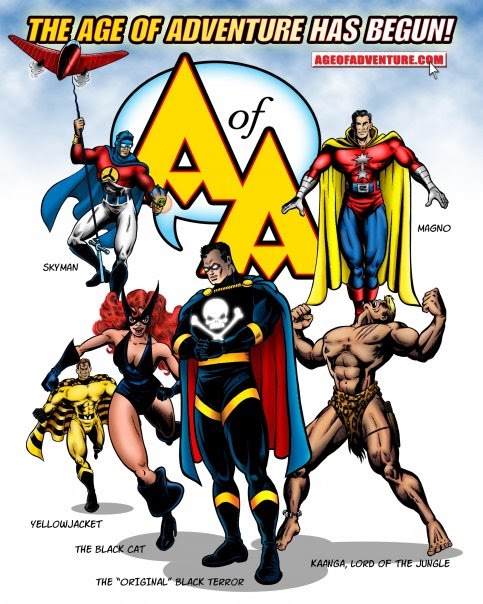
AP: You are also a publisher. Can you tell us about how you started Age of Adventure, what your company produces, and the mission and purpose of Age of Adventure?

WS:  Age of Adventure (AofA for short) started out putting together collected editions of Public Domain Comic book material.  Basically it was stuff I wanted on my shelf in a nice format that didn’t cost too much.  Others seemed to agree and sales were good.  It quickly grew into what it is now.  We publish 3 ongoing magazines as well as the odd Pulp anthology, collection or novel.  You can check out our storefront at:  http://stores.lulu.com/goldenage1
We try to keep costs as low as possible so that more people can afford to enjoy them.  Our goal is simply to put out material that the fans want to read!

AP: Age of Adventure covers several sub genres within pulp, but two in particular have been prominent from you in the last year or so. What appeals to you about the western story and about war stories?

WS:  I don’t know if War stories are big from us, but I love a story that embraces adventure combined with brotherhood and often thats the core element of a good War story.  Our Westerns have been selling gangbusters!  I grew up watching Western movies and TV shows and have always been a big fan of John Wayne, Chuck Connors, Clint Eastwood, etc.  I feel that Western stories are so appealing due to the fact that its an American take on the classic Knight Errant.  Wandering hero, codes of honor, tin stars in place of armor and six guns instead of swords.  Plenty of damsels in distress too.  Whats not to love?  Every story is like re-visiting a Saturday morning of my childhood.

AP: You also are the organizer/creator of your very own convention? Can you tell us about that, what it’s called, its history, that sort of thing?

WS:  I run “Savage Con” once a year in St. Louis.  This will be the second year under that name, there were 3 prior which were known as the “LaPlata Doc Con” due to the fact that they were held in LaPlata, Mo.  The hometown of Doc Savage scribe Lester Dent.  It started as a simple gathering of Doc Savage friends and while we’ve kept our original crew of attendees its blossomed into something a bit bigger than it originally was.

AP: Doc Savage is definitely a well known character and has influenced many fans, writers, and artists? What goes into building a convention around a single character? Is there enough about Doc to warrant that much attention over a two or three day period?

WS:  Our get together is a day and a half and there is definitely enough Doc to fill that.  He’s the archtype for so many heroes today and has such a rich history and catalog of stories.  Doc fandom is very much a brotherhood all its own.  From buying, selling, and trading, to fanmade original swag, discussions and trivia.  One of our brotherhood, Matt Hiebert, put together a really wonderful “DOC”umentary even.

AP: What about this year’s Con? What’s the agenda for those who attend?

WS:  The typical Trading, Buying, Selling, and comradarie.  A silent auction for some original Doc Art, Trivia contests with prizes, and various pulpy films to be shown.  We may even have a book signing or two.  One of our regulars is Dr. Art Sippo who wrote “Sun Koh: Heir of Atlantis” released through AofA.  Art is one of the nicest and most knowledgeable guys you could ever meet.

AP: What are your long term plans for Savage Con?

WS:  I’m hoping to start attracting comic fans as well as pulp fans, and possibly expand some content that is still high adventure, but not nec. Doc-specific.  Just to add to the fun.AP: All right, now on to for what is probably for some the most interesting aspect currently of your relationship to pulp. You are a chef by trade. And now you own a restaurant. Can you describe the Raygun Café’ for us?
WS:  Absolutely!  Raygun Cafe’ was born in part out of my attempts to get some kind of Pulp Museum going.  Things didn’t work out in LaPlata to that end, though I and some other fans did get a nice, permanent Dent/Doc display established at the Library in his hometown.  Raygun is basically the pulp and comic version of a Hard Rock cafe’.  Pulp, comic, and Sci-Fi art and memorabilia, Serials, OTR, etc.  Thats the atmosphere and the food is second to none!  Italian beef, Gourmet Hotdogs, Panini’s, fresh, seasonal soups and stews and local micro brews and artisan beers.  A lot of positive buzz locally so far!

AP: Pulp is definitely a genre that is on the upswing, experiencing a renaissance. Is there a market for a pulp themed restaurant and if so, what market are you targeting?

WS:  We’re targeting not only fans who know the genre, but fans of adventure and nostalgia buffs as well.  I think the market for such an endeavor is ready to be tapped.  Who doesn’t love action and heroic imagery?  Who doesn’t love to eat!?  Its got a big eye appeal factor, its family friendly, and I plan to try and sneak a little pulp history lesson in here and there to help create a new generation of fans.

AP: Now, this is much more than a restaurant for you. You’ve been quoted as describing it as an educational experience as well. Would you mind elaborating on that?

WS:  The artwork, pulps, and comics on display naturally lend themselves to discussion and people asking questions.  I’m working up info-cards with pulp and creator history tidbits to display as well as just being available and encouraging questions and discussion on the decor and exhibits.  “Who is that guy?” will be something a person asks once and winds up answering for others later.

AP: Can you tell us what patrons can expect to be on the menu at the Raygun Café? Also, what artifacts/displays they might expect to see from the world and history of pulp?

WS:  Well, as I said before on the menu, we’ll have Italian Beef (Art Sippo will vouch for how good that is!) French Dips, Deli style sandwiches and sides, Various gourmet Hotdogs, Panini’s, fresh soups, stews, and chowders, and when weather permits, we have a grill out back for BBQ specials. Just don’t touch the art!!
As for displays we have original pulps and vintage comics, Pulp and Sci-Fi artwork enlarged to gigantic size, Retro space toys, and original genre related artwork from local artists (including some amazing stained glass).  I’ll be constantly rotating the actual pulps and comics that are displayed and will likely have “Gallery Talk” sessions when I do so.

AP: What are the future plans for the Raygun? In ten years, will there be one in every major city in America, if you have your way?

WS:  …gah!  One is enough stress right now!  I’m certainly not against franchising, but we need to get this one going strong first.  Right now the goal is to excite the masses and provide an income for my family!

AP: Let’s back up and talk about your writing a bit more? What particular process do you go through to create a character and write a story? Do you just sit and let the words flow from your fingers or do you follow a particular pattern?

WS:  I’m very much comic book inspired, I tend to think very visually and i’ve been told I write that way as well.  Someone once told me “Your stories are too comic book!”  They meant that as an insult, I took it as a compliment. I never outline anything to be honest.  Usually I’ll get an idea for a scene or a story and let it evolve in my head for a few days, after that I sit down and hammer it out.  Once I get going with a character they pretty much write themselves, I just provide a situation they have to deal with and they act accordingly.  I don’t obsess with daily wordcounts and such, that simply builds frustration.  If I have a story to tell I tell it.  If it takes me a day or a month to write it then thats what it takes.  I basically write stories I myself would like to read.

AP: What sort of stories and writers is Age of Adventure interested in?

WS:  Right now we’re taking open submissions for our Western Magazine (short stories).  We also look for good, solid action and adventure in any setting, from pulp era to contemporary.  I like working with writers I’m familiar with, but if you have a good story to tell, I’m happy to give it a shot.  I’ll be honest, being a publisher, even a small press one, you get your fill of big egos pretty quick.  Politeness and humility go a long way towards getting anything you want in this world!

AP: What’s in the future for Age of Adventure?

WS:  We have our ongoing Western Mag issue 3 of which is due out later this month, and a really fantastic anthology which will be hitting the stands by the 20th titled “Vampires Vs. Werewolves”.  Great cover art by Rob Moran on that one.  Thrilling Adventures is gearing up to return along with Super Heroic Tales (our other two magazines).  We have a collection of Barry Reese’s stories in a variety of pulpy genres titled “Dangerous Worlds”, and Art Sippo is busy working on Sun Koh 2…

AP: What about Wayne Skiver, the writer? Anything coming down the pike you want the public to know about?

WS:  Actually i’ve been hard at work scripting a comic series with some original characters.  Can’t say too much about that right now, but its going to be a lot of fun and I’m working with some really amazing like-minded cohorts.  The next issue of Comic Fan! from Main Enterprises has an article on the history of the Charlton Action Heroes from me as well.

AP: Wayne, it’s been awesome to spend some time with you. Anytime you want to push Age of Adventure, the restaurant, the convention, or what you’re writing, let us know!

WS:  Thank you, it was good to talk with you.  The pulp community is a close niche, its good to have a site to get a glimpse of whats going on in various aspects of all things pulp, print and non!
                                                                  _____________________

THE LONG MATINEE – Movie Reviews by Derrick Ferguson

THE LEAGUE OF EXTRAORDINARY GENTLEMEN

2003

20th Century Fox
Produced by Trevor Albert and Don Murphy
Directed by Stephen Norrington
Screenplay by James Robinson
Based on the graphic novel by Alan Moore and Kevin O’Neill

       The concept of THE LEAGUE OF EXTRAORDINARY GENTLEMEN is so simple that I’m honestly surprised nobody before Alan Moore thought of it. Here it is in a nutshell: From time to time many of the great fictional heroes (and sometimes villains) of the past and present have found it necessary to come together to form an alliance against evil so overwhelming that it threatens to conquer or destroy the world. They do so under the authority of a special Branch of The British Secret Service, under the direction of a mysterious figure known only as M. This alliance is known as The League of Extraordinary Gentlemen. It is rumored that members of Leagues past and present have included Dr. Syn, Sherlock Holmes, Captain Blood, Lemuel Gulliver, Robin Hood, Tarzan, Doc Savage, The Shadow, James Bond, and many, many others. But for the purposes of this review we’re going to look at a particularly unique grouping of The League, one led by the world famous adventurer Allan Quatermain (Sean Connery)

Allan Quatermain is an old man, living in Africa, drinking his days away and only wanting to be left alone. However, events in the rest of the world bring him back into action. A mysterious man known only as The Phantom is threatening the governments of the world into a global confrontation and there is seemingly no way to stop him since he has advanced weapons such as automatic weapons, body armor and tanks. Quatermain is brought to London where he is introduced to M (Richard Roxburg), The current head of the British Secret Service who informs Quatermain that he has been chosen to lead the newest incarnation of The League Of Extraordinary Gentlemen whose membership includes Captain Nemo (Naseeruddin Shah), The Invisible Man (Tony Curran) and Mina Harker (Peta Wilson) who has the benefit of vampiric powers due to he relationship with an infamous Transylvanian count. Quatermain and his team quickly acquire the grown up Tom Sawyer (Shane West) who is now an agent of The United States Secret Service. Dr. Henry Jekyll (Jason Flemyng) and his monstrous alter ego Mr. Hyde as well as the immortal Dorian Gray (Stuart Townsend) also join up and they’re all off an adventure that takes them all over the world from London to Paris to Venice to a final confrontation at the top of the world in the frozen Artic where the secrets of The Phantom are revealed and the destiny of a new century will be decided as The League Of Extraordinary Gentlemen make their final stand.

You’re going to have a lot of comic book fans that will tell you not to see THE LEAGUE OF EXTRAORDINARY GENTLEMEN as they feel that the movie bastardized Alan Moore’s concept. I’ve given the trade paperback of the comic to several people whose opinions I trust and they have told me that while they like the comic and appreciate it for what it is they wouldn’t have gone to see a movie that was strictly based on the comic book. However, those people have also said that the greatly enjoyed the movie version and I think that’s because the movie version does exactly what it’s supposed to do: provide us with two hours of thrills, adventure and excitement. Yeah, yeah, yeah, it’s not the comic books but it is a great piece of outsized, overblown, pulp action/adventure taken to the extreme and part of the reason I had so much fun watching the movie was that I could see the directors, actors and special effects guys just saying “the hell with it” and allowing themselves the room to have fun with the concept and just working with the material they were given and making sure they delivered.
THE LEAGUE OF EXTRAORDINARY GENTLEMEN is a movie I loan out to friends and family often when they ask me what’s a good Saturday night movie. First off, you’ve got Sean Connery who’s simply great. When he made this movie he was 75 years old and he’s the only 75-year-old actor in the world who can get away with beating the snot out of actors half his age and look totally convincing doing it. Other actors look embarrassingly silly in their older years trying to do action scenes but somehow Connery can still pull it off and look convincing. There’s a bunch of great scenes he has with Shane West’s Tom Sawyer where the characters obviously build a father/son type of relationship, especially in the scenes where Allan Quatermain and Tom Sawyer are chasing down Mr. Hyde across the rooftops of Paris and a later scene aboard Captain Nemo’s Nautilus where Quatermain teaches Tom how to shoot. Peta Wilson is terrific as Mina Harker who shows a delightfully dark side to her character and I really liked how Naseeruddin Shah played Captain Nemo. As far as I know this the first time the character of Captain Nemo has been played racially correct in a movie and he supplies the team with their technological/transport support. And his fight scenes are among the best in the movie as he gives Captain Nemo a distinctive martial arts style. He plays Captain Nemo in a way unlike any other actor that’s ever played before and I think he’s probably the only actor who might have read the graphic novel the movie was based on. There’s a certain way he carries himself and the way he says his lines that make you sit up straighter and pay attention and his fight scenes are among the best in the movie. Listen to how he says: “Behold Nautilus…The Sword of The Ocean” and tell me that ain’t downright cool.

      That’s not to say that the movie is without its flaws. I really didn’t like how the CGI guys went nuts on the effects. Especially when it came to Mr. Hyde and The Nautilus. In this movie, Dr. Jekyll and Mr. Hyde are more like the Marvel Comics version of Dr. Bruce Banner and The Hulk than the Robert Louis Stevenson original. And Captain Nemo’s Nautilus is huger, bigger and more technologically advanced than any modern day aircraft carrier. And the scenes in Venice make absolutely no sense whatsoever. There’s a whole lot of yelling and chasing around and fighting and shooting but when it’s all over you’re wondering: “What was that all about?” Not to mention that there’s absolutely no mollyfoggin’ way something as big as The Nautilus could navigate the canals.

     But there are a lot of little nice touches. The obvious one is where Quatermain is receiving his assignment to assemble The League from M. And if you don’t appreciate the humor of Sean Connery once again getting orders from M then you really need to go back to Basic Film School. And pay attention to the scene between M and Quatermain because in the background are huge portraits of former Leagues. I also liked how Captain Nemo’s First Mate has a running joke in the movie where he has to keep introducing himself: “Call me Ishmael”

     There’s some incredible fight sequences and plot twists that I honestly didn’t see coming and even though I felt the final fight between Mr. Hyde and The Phantom’s main big bad who has ingested a near lethal dose of the Hyde formula was yet another reason for the CGI boys to go wild I liked the relationship between Mr. Hyde and Captain Nemo as they struggled to find a way to defeat their foe as well as the ending scenes between Allan Quatermain and Tom Sawyer.

    
     So should you see THE LEAGUE OF EXTRAORDINARY GENTLEMEN? I see no reason why you shouldn’t. Don’t listen to your comic book reading friends who’ll tell you that it’s nothing like the comic book. Of course it isn’t like the comic book. It’s a movie and a pretty damn good entertaining one. Go ahead and watch it and have fun for what it is: it’s purely pulp action/adventure designed to get you interested in reading the source materials and characters it’s based on. No more and no less. But that doesn’t mean you can’t have a good time watching THE LEAGUE OF EXTRAORDINARY GENTLEMEN before you read the material it’s based on.

110 minutes

Rated PG-13


THE LEAGUE OF EXTRAORDINARY GENTLEMEN

2003

20th Century Fox

Produced by Trevor Albert and Don Murphy

Directed by Stephen Norrington

Screenplay by James Robinson

Based on the graphic novel by Alan Moore and Kevin O’Neill

The concept of THE LEAGUE OF EXTRAORDINARY GENTLEMEN is so simple that I’m honestly surprised nobody before Alan Moore thought of it. Here it is in a nutshell: From time to time many of the great fictional heroes (and sometimes villains) of the past and present have found it necessary to come together to form an alliance against evil so overwhelming that it threatens to conquer or destroy the world. They do so under the authority of a special Branch of The British Secret Service, under the direction of a mysterious figure known only as M. This alliance is known as The League of Extraordinary Gentlemen. It is rumored that members of Leagues past and present have included Dr. Syn, Sherlock Holmes, Captain Blood, Lemuel Gulliver, Robin Hood, Tarzan, Doc Savage, The Shadow, James Bond, and many, many others. But for the purposes of this review we’re going to look at a particularly unique grouping of The League, one led by the world famous adventurer Allan Quatermain (Sean Connery)

Allan Quatermain is an old man, living in Africa, drinking his days away and only wanting to be left alone. However, events in the rest of the world bring him back into action. A mysterious man known only as The Phantom is threatening the governments of the world into a global confrontation and there is seemingly no way to stop him since he has advanced weapons such as automatic weapons, body armor and tanks. Quatermain is brought to London where he is introduced to M (Richard Roxburg), The current head of the British Secret Service who informs Quatermain that he has been chosen to lead the newest incarnation of The League Of Extraordinary Gentlemen whose membership includes Captain Nemo (Naseeruddin Shah), The Invisible Man (Tony Curran) and Mina Harker (Peta Wilson) who has the benefit of vampiric powers due to he relationship with an infamous Transylvanian count. Quatermain and his team quickly acquire the grown up Tom Sawyer (Shane West) who is now an agent of The United States Secret Service. Dr. Henry Jekyll (Jason Flemyng) and his monstrous alter ego Mr. Hyde as well as the immortal Dorian Gray (Stuart Townsend) also join up and they’re all off an adventure that takes them all over the world from London to Paris to Venice to a final confrontation at the top of the world in the frozen Artic where the secrets of The Phantom are revealed and the destiny of a new century will be decided as The League Of Extraordinary Gentlemen make their final stand.

You’re going to have a lot of comic book fans that will tell you not to see THE LEAGUE OF EXTRAORDINARY GENTLEMEN as they feel that the movie bastardized Alan Moore’s concept. I’ve given the trade paperback of the comic to several people whose opinions I trust and they have told me that while they like the comic and appreciate it for what it is they wouldn’t have gone to see a movie that was strictly based on the comic book. However, those people have also said that the greatly enjoyed the movie version and I think that’s because the movie version does exactly what it’s supposed to do: provide us with two hours of thrills, adventure and excitement. Yeah, yeah, yeah, it’s not the comic books but it is a great piece of outsized, overblown, pulp action/adventure taken to the extreme and part of the reason I had so much fun watching the movie was that I could see the directors, actors and special effects guys just saying “the hell with it” and allowing themselves the room to have fun with the concept and just working with the material they were given and making sure they delivered. THE LEAGUE OF EXTRAORDINARY GENTLEMEN is a movie I loan out to friends and family often when they ask me what’s a good Saturday night movie.

First off, you’ve got Sean Connery who’s simply great. When he made this movie he was 75 years old and he’s the only 75-year-old actor in the world who can get away with beating the snot out of actors half his age and look totally convincing doing it. Other actors look embarrassingly silly in their older years trying to do action scenes but somehow Connery can still pull it off and look convincing. There’s a bunch of great scenes he has with Shane West’s Tom Sawyer where the characters obviously build a father/son type of relationship, especially in the scenes where Allan Quatermain and Tom Sawyer are chasing down Mr. Hyde across the rooftops of Paris and a later scene aboard Captain Nemo’s Nautilus where Quatermain teaches Tom how to shoot.

Peta Wilson is terrific as Mina Harker who shows a delightfully dark side to her character and I really liked how Naseeruddin Shah played Captain Nemo. As far as I know this the first time the character of Captain Nemo has been played racially correct in a movie and he supplies the team with their technological/transport support. And his fight scenes are among the best in the movie as he gives Captain Nemo a distinctive martial arts style. He plays Captain Nemo in a way unlike any other actor that’s ever played before and I think he’s probably the only actor who might have read the graphic novel the movie was based on. There’s a certain way he carries himself and the way he says his lines that make you sit up straighter and pay attention and his fight scenes are among the best in the movie. Listen to how he says: “Behold Nautilus…The Sword of The Ocean” and tell me that ain’t downright cool.

That’s not to say that the movie is without its flaws. I really didn’t like how the CGI guys went nuts on the effects. Especially when it came to Mr. Hyde and The Nautilus. In this movie, Dr. Jekyll and Mr. Hyde are more like the Marvel Comics version of Dr. Bruce Banner and The Hulk than the Robert Louis Stevenson original. And Captain Nemo’s Nautilus is huger, bigger and more technologically advanced than any modern day aircraft carrier. And the scenes in Venice make absolutely no sense whatsoever. There’s a whole lot of yelling and chasing around and fighting and shooting but when it’s all over you’re wondering: “What was that all about?” Not to mention that there’s absolutely no mollyfoggin’ way something as big as The Nautilus could navigate the canals.

But there are a lot of little nice touches. The obvious one is where Quatermain is receiving his assignment to assemble The League from M. And if you don’t appreciate the humor of Sean Connery once again getting orders from M then you really need to go back to Basic Film School. And pay attention to the scene between M and Quatermain because in the background are huge portraits of former Leagues. I also liked how Captain Nemo’s First Mate has a running joke in the movie where he has to keep introducing himself: “Call me Ishmael”

There’s some incredible fight sequences and plot twists that I honestly didn’t see coming and even though I felt the final fight between Mr. Hyde and The Phantom’s main big bad who has ingested a near lethal dose of the Hyde formula was yet another reason for the CGI boys to go wild I liked the relationship between Mr. Hyde and Captain Nemo as they struggled to find a way to defeat their foe as well as the ending scenes between Allan Quatermain and Tom Sawyer.

So should you see THE LEAGUE OF EXTRAORDINARY GENTLEMEN? I see no reason why you shouldn’t. Don’t listen to your comic book reading friends who’ll tell you that it’s nothing like the comic book. Of course it isn’t like the comic book. It’s a movie and a pretty damn good entertaining one. Go ahead and watch it and have fun for what it is: it’s purely pulp action/adventure designed to get you interested in reading the source materials and characters it’s based on. No more and no less. But that doesn’t mean you can’t have a good time watching THE LEAGUE OF EXTRAORDINARY GENTLEMEN before you read the material it’s based on.

110 minutes

Rated PG-13