And for thoughtful discussion, I’ve been really enjoying John Siuntres’s Word Balloon Podcast. John’s an incredibly passionate interviewer with a deep knowledge of and respect for pop culture and comics. Each week, he sits down to have an extended conversation with a creator. John has the uncanny talents of getting people to open up (often a creator will say “I haven’t told anyone this before”) and for making the listener feel like he or she is part of it all too. When I listen to Word Balloon, I feel like I’m sitting right there with them, but just can’t get a word in edgewise.
Recent interviews have included:
Tom King – one of the industry’s hottest writers, talking about his recent work on the Vision and Batman, and all the while framing it against his real life as a husband a father of young kids.
Danny Fingeroth – talking about Spider-Man and Will Eisner Week. It was so compelling, that I’m now working with my local librarian on an Eisner Week event. (More on that soon!)
Rob Liefeld – a polarizing figure who provides great insight into his creation Deadpool and the box office success of the movie. No longer a “young punk creator,” Rob is now able to offer a unique perspective to his success and the marketplace’s wants and needs
Ryan Browne – on Image’s new Curse Words Normally, I have passed over this series, but the passionate discussion and insights on the Word Balloon Podcast got me excited enough to give it a try.
Paul Dini – providing great insights into his new animation work on Justice League Action and his Jingle Belle character.
I’ve been doing more writing, and I just finished my first article for TwoMorrow’s Back Issue! magazine. Editor Michael Eury asked me to write about the 80s comic series from DC called Thriller. Created by Robert Loren Fleming and Trevor Von Eeden, Thriller was one of those innovative series that DC launched during the excitement of non-traditional comics like Frank Miller’s The Dark KnightReturns & Ronin, Barr and Boland’s Camelot 3000, and Howard Chaykin’s The Shadow. During my research, it was amazing to find out how many fans fondly remember Thriller too.
Maybe it was the tagline. Fans vividly remember how the series announced, “She has seven seconds to save the world!” This actually had a double meaning. On one hand, Trevor Von Eeden’s innovative page layouts pushed the reader along the page with a real sense of urgency. And we were all soon to find out that the main character had seven agents, called “seconds” that she guided on her Mission: Impossible-like adventures.
Maybe it was characters. Robert Loren Fleming packed Thriller with so many unique characters. Most series would build a story around one fresh new protagonist. Fleming had eight heroes, two villains and another half-dozen supporting characters that the reader was dying to learn more about. And that was just in the first story arc.
Maybe it was the creative risks the creators took. Robert Loren Fleming and Trevor Von Eeden were trying something new and different. They took risks on a very public stage. They didn’t play it safe. They gave it 110% and left it all onstage. We all can applaud that. And even after all these years, that’s just so very impressive.
And I was able to dig up some fantastic insights and track down the startling truth behind a secret Thriller rumor. Back Issue! #98, focusing on DC in the 80s, will be on sale this July, just in time for San Diego Comic-Con. It should be a lot of fun.
After what seems like decades of waiting (oh wait: it was actually about 10 years!) the Deadpool movie finally opened in theaters this past weekend to the tune of a record-shattering $135 million at the box office; and it was everything I’d hoped for. It was exactly the Deadpool movie that we needed at this point to get the franchise rolling – a dynamic R film that pulls no punches about who Deadpool is and why he’s not a traditional hero, yet invests us in his unorthodox character and worldview and gets us rooting for him anyway. And as I walked out of the theater, despite any minor critiques I may have, I felt distinctly the warm, zen-like glow of happiness from having just experienced the fulfillment of longtime hopes I’ve cherished for the manifestation of just such a Deadpool film.
Anyone who knows me or reads my work will be well aware that I’ve been a huge Deadpool fan for years and have written all kinds ofthings about the character, including a journal and Twitter as Deadpool and several webcomics featuring Deadpool for Reelz.com and MTV Splash Page. I’ve also advocated for Ryan Reynolds playing the title role in a Deadpool movie since 2010, and have covered the movie as it developed as well. Perhaps that’s why a whole several people are very excited to hear my opinions on the Deadpool movie.
Well, friends and internets – My opinions: let me tell you them.
(Warning: spoilers ahead!)
Deadpool is a crazy, hilarious, action-packed, totally inappropriate, slightly heartwarming, somewhat horrifying, gleefully violent, fourth-wall-breaking, satisfyingly mixed-up bag of awesome that makes way more sense than that sounds. It’s a welcome addition to the universe of comic book movies, and one with the potential to add both more fun movies to its own franchise, and bring some levity to upcoming X-Men ensemble movies. It’s also a take on the early Joe Kelly issues of the Deadpool comic, issues I’ve always loved and that did a lot to define the character, including establishing his incessant, pop-culture heavy banter, his work as a mercenary for hire, his romance with Vanessa Carlysle, and his relationship with supporting characters Weasel and Blind Al. The movie pulls heavily and, despite some necessary screenplay alterations, pretty faithfully from Deadpool’s origins as told in Kelly’s 1998 Deadpool & Death Annual, which establishes the backstory of Wade Wilson getting cancer and being given Wolverine’s healing factor by a shady Canadian government program in an attempt to cure him so he could work for them, his manifesting his mutate powers and in the process the ugly cancer tumors and scars we know so well, and his creating the Deadpool persona after his transformation.
Deadpool is an origin story that makes you forget it’s an origin story; a uniquely off-kilter flash back-and-forth plotline that manages to interweave the frenetic fight scenes and scattered behavior and commentary of post-op Deadpool with the more straightforward backstory of Wade Wilson in a way that keeps both interesting and interlocked, and allows for a story beyond his origin. This fits the character to a T; and also makes it possible for a movie starring a character known for random comments and wacky unpredictability to include a lot of heart in the form of a sweet (and salty) love story (the Deadpool marketing people weren’t completely pulling your chain on that one) as well as moments of gravitas and even desperate sadness. And that’s important, because although you won’t often see Deadpool crying into his beer, his origin is a damn sad story, and the dark undercurrents beneath the wisecracking guy in the red-and-black suit are what make him so interesting.
To portray that character, they couldn’t have found a better actor than Ryan Reynolds. Not only has Reynolds got the physique and athleticism for the role, but he also is a master of quick, snarky or sardonic comedic timing and delivery. However, as with the comics character, the over-the-top action and comedy are only two facets of a subtly complex character. The success of Reynolds as Deadpool comes from his ability to marry the snarky persona believably to the darker aspects of Deadpool’s personality, and deftly convey both Deadpool’s genuinely bizarre sense of black humor, and the manner in which the character also uses humor as his armor and as a mask for his pain and despair. Reynolds moves seamlessly from sight gags to exuberantly violent fight scenes to tender moments to intense anger to desperate sadness, and the undercurrents of strong emotion he manages to convey beneath gags and lightning-quick comments are what keep this from being just another ultraviolent comedy. I don’t know that there is another actor out there who could break our hearts during the scene in which Wade cries quietly in the bedroom as he decides to leave Vanessa; and a few beats later, have us roaring with laughter along with Deadpool at the sheer absurdity of a man being murdered via a slow-moving Zamboni.
Of course, in real life, we wouldn’t think any of that violence so funny; but Deadpool’s moral compass is so far off that if we tried to follow it, we’d end up (knowing him) somewhere on Uranus. Reynolds gets that, and plays the character with a charismatic, exuberant energy that pulls us fully into Deadpool’s worldview and makes us forget we’re laughing at, e.g., someone being “skewered like a fucking kabob.” As a passionate fan of Deadpool, Reynolds is wholly invested in this character, and has been wanting to play him in a movie for years (and actually got to play Wade Wilson for a good 15 minutes of X-Men Origins: Wolverine, but we won’t say any more about how that turned out). The Deadpool of the comics has, in fact, compared his appearance to “Ryan Reynolds crossed with a Shar-Pei” – and the movie cleverly acknowledges that (as well as Spider-Man’s origin) when Ryan Reynolds as Deadpool says he was “bitten by a radioactive Shar-Pei.” (Other fun facts: both Deadpool and Reynolds hail from Canada, and both have thrice alliterative names – Wade Winston Wilson and Ryan Rodney Reynolds. It’s like he was made for the part!)
Reynolds as Deadpool drives this movie; but it also succeeds in the realm of pulling the character’s look and fighting style from the comics onto the screen. The red and black costume is Deadpool to the last detail, including the inevitable pouches (which are sent up subtly in the movie when Deadpool puts a pamphlet from the cab into a pouch, then minutes later when it’s time to pay says he never carries a wallet when he’s working because it ruins the lines of the suit. There have been many jokes in the comics about what on Earth he keeps in all those pouches). And because the choreography of Deadpool’s completely badass fighting style (a parkour-like mix of elegance, economy, humorous distraction, efficiency, and brutality) was done so well that it was like seeing his comic book fight scenes come to life, Deadpool is the only action movie about which I’ve said, “I would have been happy to sit through more fight scenes.” I’ve always liked the mixture of fighting styles portrayed in the comics, and seeing them on the big screen reminded me of all the comics storylines that have established just what a powerhouse fighter Deadpool is. Sure, he’s not a tank like Colossus; but with his level of precision and skill, his unorthodox and unpredictable but successful tactics, and his healing powers, there’s a reason Deadpool stands above pretty much every melee fighter in the Marvel universe (bucking for first with Wolverine).
Although I say I’d be happy to see more fight scenes in theory (and in future Deadpool movies!), of course in reality too many fight scenes can overwhelm the story. The screenwriters struck the right balance here, devoting enough time to the establishment of Wade’s prior character and relationships to give them meaning alongside his transformation into Deadpool and into his action-heavy revenge scheme. They also did a good job introducing a roster of interesting character relationships without an excess of heavy-handed exposition; and when exposition was needed, cleverly used Deadpool’s fourth-wall-breaking trait to help things along. I do think that the main villains (Ajax and Angel Dust) are fairly opaque, and we don’t learn much about their motivations, but they are well acted and delineated enough to be effective in the story; and Ed Skrein’s Ajax, while he may not be the most horrifying villain I’ve ever seen on screen, is definitely one of the ones I’d most like to punch in the face.
Deadpool’s allies fare a bit better in the development category. T.J. Miller is excellent as Wade’s buddy Weasel, serving as a sort of loyal sidekick who prefers not to actually be around when the action goes down. In character, he’s very like the Weasel of the later comics (Cable & Deadpool era, because in the earlier comics Deadpool was much harsher to him), despite some differences in detail. Miller’s dry delivery makes him memorable, and Miller and Reynolds have a great rapport on-screen, which makes their friendship believable and their banter very amusing. Blind Al (Leslie Uggams) is great in her roommate role, and despite the movie losing some of the weirder, darker aspects of the Wade/Al friendship (see DeadpoolVolume 1 Issue 14), manages to nail the bickering but weirdly caring dynamic they have in the comics. (“Listen Al, if I never see you again, I want you to know that I love you very much,” says Wade as he leaves for the big showdown. “I also buried 1,600 kilos of cocaine somewhere in the apartment – right next to the cure for blindness. Good luck.”) Even the cabbie, Dopinder (who is not featured in the comics) has his moments and his own little difficult romance going on, which results in a pretty damn funny scene with “Mr. Pool.”
Although X-Men ally Colossus (voice, Stefan Kapicic; facial performance, Greg LaSalle) isn’t given much dimension, he does well as a moral foil for Deadpool, and is endearing in his patient attempts to convince Deadpool to be a hero. And his superhero speech and Deadpool’s ensuing choice at the climax of the movie make for the most morally thought-provoking moment of the film. Negasonic Teenage Warhead (Brianna Hildebrand), the other X-Men character and Colossus’s trainee, doesn’t get a ton of dialogue, but Hildebrand manages to do a lot with her screentime and I love what the writers have done with both Negasonic’s character and her powers thus far (which they’ve changed from the comics, but given she’s barely in the comics, I don’t foresee any fan rage). In outward character she is the quintessential moody teen (as per the hilarious opening credits), which Deadpool instantly calls her on; but that interaction establishes an immediate mocking rapport between the two, and by the final fight scene, they are working together as a better team than he and Colossus ever do. And of all the superpowered characters in the film, her powers are undoubtedly the most bombastically badass, as she can basically be a human bomb (slightly similar to Nitro). Negasonic is also a cool choice because she’s previously unexplored in the X-Men movie realm, and would make a good possible addition to the roster of characters that orbits Deadpool for a sequel, or could be explored further in other X-Men movies.
Of course, the driving force for much of the movie’s plot is Wade Wilson’s love story with Vanessa Carlysle (Morena Baccarin). And if Vanessa and that relationship had not been completely believable, the movie would have fallen apart. Kudos to the writers for penning one of the weirdest, but also possibly most human and authentic, big screen romances I can think of; and to Baccarin (and Reynolds) for making it feel entirely credible and natural. As the lovers note in the movie, they work not because they look like they should on paper, but because their individual quirks fit perfectly together, “like the weird curvy edges of jigsaw puzzle pieces” to form a whole picture. Although Baccarin unfortunately has to fill the damsel in distress role for a while in order to further the plot, there is enough substance built into her character and the romance prior to that point that she transcends that role because we already know her as a whole person, and their relationship as a solid, real thing. Plus, Vanessa does get to do a little ass-kicking of her own, getting in at least one solidly impressive blow on Ajax. And although I was slightly sad she’s not Copycat simply because I would have liked to see it, its canon and it works much better at this point in the movie franchise’s story to have her be a non-mutant. At least we got a little nod to Copycat in Vanessa’s white-streaked hair; and it’s possible that if she shows up again, we’ll get to see her in her full mutant glory.
Although we didn’t get to see Copycat, Deadpool gave us plenty of other references to the comic outside of, obviously, the main cancer and Ajax/Workshop storyline and key supporting characters Vanessa, Blind Al, and Weasel. Along with things I’ve mentioned like the pouches, Vanessa’s hair, and the Shar-Pei bit, other favorites of mine include:
Deadpool running into Bob amongst the faceless lackeys hired by Ajax (and although in the comics Bob’s wife is named Allison, I’m assuming in the movie she’s Gail for Gail Simone, a fantastic comics writer who wrote some great Deadpool comics);
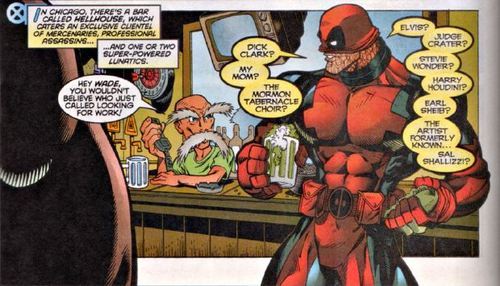
The Hellhouse, a.k.a. Sister Margaret’s School for Wayward Children, in all its seedy glory;
A revenge plot flipped from the early Deadpool issues, in which Ajax is hunting down Deadpool via tracking his former Weapon X buddies (who did time with him in The Hospice/Workshop) and then killing them after they’ve given him the information he needs;
The heel-face turn plot point of Ajax telling Wade the “superhero” program was never meant to turn him into a hero, but was intended to turn him into a super slave (in the comics origin story, Wade did have a chance at being permitted to be Weapon X’s version of a superhero, but the cancer cure didn’t take, which is how he ended up in The Hospice). This echoes the Landau, Luckman, and Lake comics storyline wherein Deadpool signs on to save the world and then discovers that they never actually intended for him to be a hero in the sense he thought, because LL&L’s idea of “saving” the world is allowing an alien being to bring “peace and bliss” to Earth by robbing everyone of free will, leaving inhabitants in an inert stupor).
Deadpool seeking a fix for his ugly face. There are actually several stories in which Deadpool temporarily becomes handsome again/loses the ugly mug, but none of them end well (except, arguably, that thing with the One World Church, since it kicked off Cable & Deadpool, the most awesome reluctant buddy comic ever).
Deadpool bonding with Worm. Although not referred to as Worm in the movies, Deadpool’s Workshop friend David Cunningham has something subtly wrong with his right eye and side of his face, which echoes the cybernetic implant on Worm’s face in the comics, and Worm’s last name in the comics is Cunningham. The two become friends, and as in the comics, Cunningham dies near the time of Deadpool’s escape (although in the comics he’s lobotomized by Ajax, and Deadpool kills him in a mercy killing. This is itself likely an homage to One Flew Over the Cuckoo’s Nest, which Deadpool’s comics origin echoes in many ways).
Several references to Fabian Nicieza and Rob Liefeld, creators of Deadpool, including Liefeld’s name on a coffee cup and one of the characters in the Hellhouse being named Liefeld; and both names appearing on freeway exit signs. There’s also a line in the credits that thanks Liefeld and Nicieza “(With Tongue).” Oh, and let’s not forget the waitress in the Hellhouse, Kelly, who I assume is a reference to writer Joe Kelly;
Deadpool with a knife in his skull, à la oh-so-many of Deadpool artist Reilly Brown’s awesome Deadpool sketches, in which he loves depicting the merc as a literal human pincushion stuck full of things, being gnawed by rats, or even on fire. (The scene also references Daniel Way’s Pool-o-Vision, but I hate that in the comics, so pffft. It’s excusable in the movie because of the knife in the brain, though. Speaking of Daniel Way, the pizza guy scene echoes one in his run on the comics.)
Wade’s Bea Arthur shirt (in the pizza scene). Deadpool in the comics has an obsession with Bea Arthur, who he thinks is uber sexy.
Deadpool breaks his limbs to escape shackles in Issue 9 of the Joe Kelly run, when he’s escaping from Deathtrap. (I love that issue so: “Die, Teddy Ruxpin, Dieee!”) The broken limbs he gets during the Colossus movie fight, and then sawing off his hand to escape the handcuff, both echo that scene. Also, the baby hand growing back in the movie echoes a plotline in Issue 3 in which his finger had been cut off, and he’s trying to grow it back but only grows back a tiny stub at first.
The Dead Pool. Although in the comics Wade names himself after the Dead Pool run by Worm in The Hospice, and in the movie it’s run by Weasel at the Hellhouse, the inspiration is at least similar. The reference to Captain Deadpool is also great.
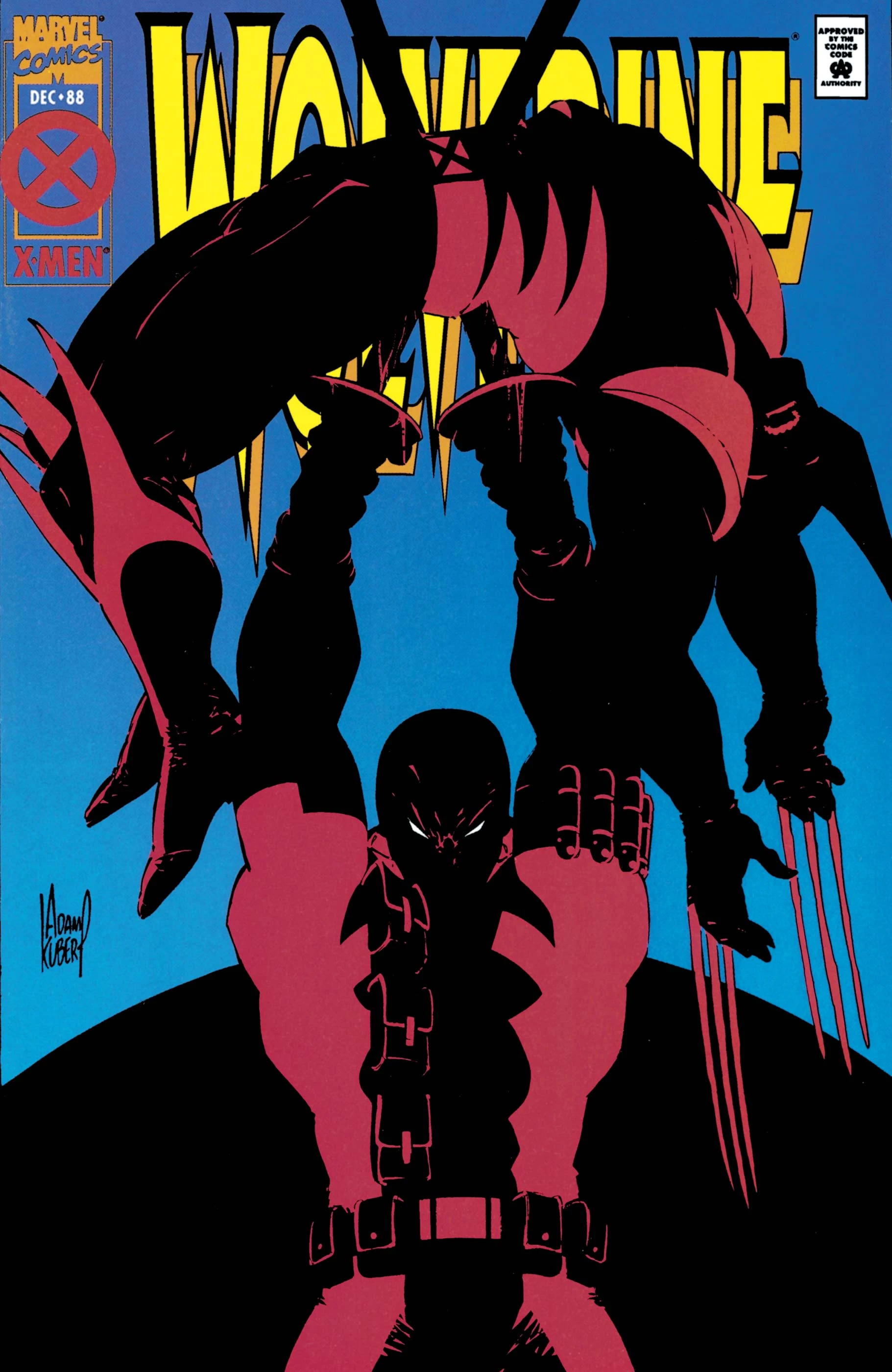
The way Deadpool impales one of the guys on the freeway with two katanas echoes the cover of Wolverine Issue 88, the issue where Deadpool and Wolverine first meet.
The way Vanessa touches Wade’s face after seeing his scars for the first time is reminiscent of Siryn’s gesture in the comics when she first sees him without his mask.
Meta fourth wall-breakage. Deadpool references the fourth wall a number of times in the movie, as in the comics, but the Blind Al bit where he breaks “sixteen walls” was probably my favorite allusion to it.
When Wade and Vanessa are finally together again and about to kiss, he says, “And now, the moment I’ve all been waiting for.” I’d take that to be a subtle reference to the multiple voices/speech boxes he deals with in the comics.
The little Deadpool bust on the shelf in Wade and Al’s apartment is a nod to how into his own brand and merchandise Deadpool is. (I was honestly surprised not to see the Deadpool boxers and the boots with the Deadpool symbols on the soles!)
The flipped running joke about Deadpool joining the X-Men is great. For some time in the comics, Deadpool liked to refer to himself as part of the X-Men team, and the team continually told him with great exasperation that he’s not a part of the team. Of course, I assume this is also set-up for bringing him into the greater X-Men movie universe, as he eventually does work with the X-Men in the comics.
And speaking of the X-Men universe and the future of Deadpool, now that we have this movie in theaters and it’s doing so well, naturally everyone is speculating about what comes next (besides the release of the soundtrack with that hilarious Deadpool theme song. Of course Deadpool gets his own theme song, along with the best Stan Lee cameo to date). The sequel was greenlit a few days before Deadpool opened; and in the fantastic end credits scene, Deadpool confirms (if you can believe him) that we’ll be seeing Cable in the next film. Given I’ve been saying since the moment Deadpool was a reality that the next logical step is filming the best messed-up bromance ever, a.k.a. Cable & Deadpool, I’ll be overjoyed if that’s the case. And it makes so much sense. Now that the character in both tone and origin is established, it will be easy to introduce Deadpool, e.g. through an X-Force movie (which <a href=”
Reynolds wants to see happen), to the larger ensemble franchise; and then to roll from that into Cable & Deadpool, a storyline that again primarily focuses on Deadpool (and Cable), but also involves a number of other mutants and has a much grander scale, since Cable is literally trying to save the world before he dies.
Going next to Cable & Deadpool will allow for further development along the lines of the absolute funniest moments in the film, which are when Deadpool is mocking others (particularly Colossus, Negasonic, and “Agent Smith”), skewering the X-Men franchise and superhero movies (“McAvoy or Stewart!?” killed me, and his excitement at the “Superhero Landing!” was a riot) and engaging in or laughing to himself at gallows or black humor (the aforementioned Zamboni scene, spelling out FRANCIS, and the T-Rex joke being good examples of this). Yes, a surprising amount of the crass humor in this movie does land (and Deadpool’s creative cursing is pretty good, his reference to Ajax as a “shit-spackled Muppet fart” being the best), but I’d love to see the sequel really keep focus on the satire and the more complex humor; and bringing Deadpool into the larger X-Men universe or pairing him with Cable (a man who he grudgingly respects, even when he doesn’t always like him) will allow for that. (Side note: I’ve seen some speculation already that maybe other superhero movies should up their ratings to R, considering that Deadpool is doing so well; but I think that would be a mistake. The smartest move, for both future Deadpool movies and other superhero movies, is to stay true to the character(s), and base both content and choice of rating on that. Deadpool being what he is, I had no issue with this film being R, and think future R-rated Deadpool films would be perfectly appropriate – but I also hope the most important goal remains making movies that capture the tone and essence of the character.)
Moving to the Cable & Deadpool storyline will also create an opportunity for another story that will hold together underneath all the jokes, and a more thorough exploration of morality through Deadpool’s eyes. In this film, Colossus’s speech as Deadpool is about to shoot Ajax in the head, and Deadpool’s reaction, which is hilariously and typically Deadpoolian, are also a pointed commentary on the superhero world and the way superheroes’ choices to rise above the villains they fight can be seen as noble and heroic, but could also be viewed simply as an unwillingness to be the one to rid the world of their evil. Of course, taking that final step is also problematic, as it gives rise to the concerns that started Marvel’s Civil War storyline, about having superpowered beings running around accountable to no one. The majority of the superpowered need to walk the line to remain in the good graces of the public; whereas Wade simply does not care and follows his own skewed code.
But examining that code, and Deadpool’s struggles in the comics with making the right choices and being a hero, could make for a great and complex movie sequel, and the Cable & Deadpool storyline has the moral questions and hard decisions built right in. Now that Deadpool has been established, I want to see the sequel delve even deeper into what’s underneath the wisecracks and the crazy now that he’s post-op Deadpool. I want to see Cable developed into a three-dimensional and perfect foil for Deadpool, and I want to see Deadpool forced to make hard choices in his own unique way. And, of course, I want them to showcase more of that crazy elegant fighting style, because it is badass. And, and, and…is there anything else I want? Well I would say a Deadpool unicorn, but I already have one. So I guess all that’s left to say is, OMG Deadpool was super awesome and I want to see it again; and…
Okay, let me see if I have this straight. From Rich Johnston:
Rob Liefeld will be putting out a "SMASH! Extreme!" #0 re-printing of Smash’s previous appearances by Jeph Loeb and Liefeld from Image in April.
Rob says, "This will contain a new story which frees Smash! from his bonds and lead into the multi-part SMASH! storyline told in a series of specials pitting SMASH! against the Extreme universe. Then in May, we get ‘Smash! Brigade’ from Marat Mychaels and ‘Smash! Youngblood,’ ‘Smash! Prophet’ and ‘Smash! Supreme’ to follow through the year."
Smash! apparently is this big, shall we say, hulking individual pictured to the right who has been in exile for a good long time after stealing Elliot S. Maggin’s exclamation point, but he returns to wreak havoc on the entire universe in a company-wide crossover– waging war on the world, as it were.
Psst. Rob. The pants are what’s supposed to be purple, not the skin.
Oh, and eventually, it’ll end in a book called SMASH ASSEMBLED! where presumably an SOS goes out to Doom’s 4, but some mischevous individual reroutes the call to a bunch of other heroes who band together and fight him.
And some other even more mischevous individual reroutes the call to Marvel’s legal department. Which won’t be a problem because as we all know, Rob Liefeld is a stickler for credit.
Part of me really just wants to post the image here and leave it at that, but there probably should be some explanation. Over at the San Diego Reader, former Rock n’ Roll Comics co-creator Jay Allen Sanford has put together an illustrated history of the "The Birth of Image Comics" as part of a recurring feature spotlighting some of the local comics talent in the run-up to San Diego Comic-Con. Seen below is Sanford’s interpretation of the reaction from Stan Lee when Rob Liefeld decided to break from Marvel.
See? The explanation wasn’t nearly as entertaining as the illustration now, was it?
We use cookies to improve your experience on our site. By using our site, you consent to cookies.
Cookie Preferences
Manage your cookie preferences below:
Essential cookies enable basic functions and are necessary for the proper function of the website.
Name
Description
Duration
Cookie Preferences
This cookie is used to store the user's cookie consent preferences.
30 days
These cookies are needed for adding comments on this website.
Name
Description
Duration
comment_author_url
Used to track the user across multiple sessions.
Session
comment_author
Used to track the user across multiple sessions.
Session
comment_author_email
Used to track the user across multiple sessions.
Session
WP Consent API is a plugin that standardizes the communication of accepted consent categories between plugins.
Name
Description
Duration
wp_consent_{category}
Stores your consent preference for a specific cookie category (e.g., functional, marketing). It ensures consistent consent management across WordPress plugins supporting the WP Consent API.
30 days
Statistics cookies collect information anonymously. This information helps us understand how visitors use our website.
Google Analytics is a powerful tool that tracks and analyzes website traffic for informed marketing decisions.
Used by Google Analytics to determine which links on a page are being clicked
30 seconds
_ga_
ID used to identify users
2 years
_gid
ID used to identify users for 24 hours after last activity
24 hours
_gat
Used to monitor number of Google Analytics server requests when using Google Tag Manager
1 minute
__utmx
Used to determine whether a user is included in an A / B or Multivariate test.
18 months
_ga
ID used to identify users
2 years
__utmt
Used to monitor number of Google Analytics server requests
10 minutes
__utmb
Used to distinguish new sessions and visits. This cookie is set when the GA.js javascript library is loaded and there is no existing __utmb cookie. The cookie is updated every time data is sent to the Google Analytics server.
30 minutes after last activity
__utmc
Used only with old Urchin versions of Google Analytics and not with GA.js. Was used to distinguish between new sessions and visits at the end of a session.
End of session (browser)
__utmz
Contains information about the traffic source or campaign that directed user to the website. The cookie is set when the GA.js javascript is loaded and updated when data is sent to the Google Anaytics server
6 months after last activity
__utmv
Contains custom information set by the web developer via the _setCustomVar method in Google Analytics. This cookie is updated every time new data is sent to the Google Analytics server.
2 years after last activity
_gac_
Contains information related to marketing campaigns of the user. These are shared with Google AdWords / Google Ads when the Google Ads and Google Analytics accounts are linked together.


 I’ve been driving a lot more since my move to the Finger Lakes and I’ve been trying to use my time wisely. For music, I catch up on Pete Fornatale’s Mixed Bag from WFUV and ComicMix’s own Mike Gold’s Weird Sounds Inside the Gold Mind from The Point Radio. Both offer great tunes and insightful, thoughtful commentary.
 Recent interviews have included:
 Ryan Browne – on Image’s new Curse Words Normally, I have passed over this series, but the passionate discussion and insights on the Word Balloon Podcast got me excited enough to give it a try.
 Maybe it was the tagline. Fans vividly remember how the series announced, “She has seven seconds to save the world!” This actually had a double meaning. On one hand, Trevor Von Eeden’s innovative page layouts pushed the reader along the page with a real sense of urgency. And we were all soon to find out that the main character had seven agents, called “seconds” that she guided on her Mission: Impossible-like adventures.


 It’s 2010 now–
 Okay, let me see if I have this straight. From