Tagged: Sci-Fi

TARZAN NEWS!

Art: Joe Jusko

Edgar Rice Burroughs’ Tarzan turns 100 this year, but don’t think celebrating his centennial has slowed down the Lord of the Jungle. Quite the opposite. Here are a few odds and ends from Tarzan’s world happening in 2012 and beyond.

Art: Tom Grindberg
Art: Tom Grindberg

 EDGAR RICE BURROUGHS COMIC SERVICE-
By signing up for the new Edgar Rice Burroughs Comic Service, you will be able to view New and Coming Tarzan comics as soon as they leave our artist’s desk!

Read the recent All Pulp interviews with Tarzan 2012 comic strip writer Roy Thomas and artist Tom Grindberg.

Art: Sterling Hundley

TARZAN ART TO APPEAR ON NEW USPS POSTAGE STAMP-
CHESTERFIELD, VA – Edgar Rice Burroughs, the author who created Tarzan and a host of other sci-fi heroes a century ago, didn’t get much respect for what was considered pulp fiction at the time. Now, the work of a Chesterfield artist commemorating the prolific author is taking a licking literally.

A brand-new postage stamp showing Burroughs and Tarzan is set to take off around the world. It’s the second U.S. Postal Service stamp drawn by Sterling Hundley, an artist, illustrator and Virginia Commonwealth University art professor. (His first was Oveta Culp Hobby, the first woman to hold a presidential cabinet position.)

Learn more about Sterling Hundley and the new Tarzan stamp here.

OFFICIAL TARZAN STATUES NOW AVAILABLE FOR PRE-ORDER-
Details here.

Art: Joe Kubert

JOE KUBERT’S TARZAN OF THE APES: ARTIST’S EDITION COMING IN SEPTEMBER-

Art: Joe Kubert

Joe Kubert is one of the most lauded artists in the history of comics, a true living legend. He has been a vital creative force since the 1940s and remains so to this day. He has had defining runs on Hawkman, Enemy Ace, Tor, Sgt. Rock, and many others. Among his career highlights is Tarzan of the Apes, and Kubert’s rendition could arguably be called the definitive comic adaptation of the Ape-man.

“To have the Tarzan stories I drew commemorate the 100th anniversary of a strip I fell in love with as a kid is the thrill of a lifetime,” said Joe Kubert, writer and artist of all the stories in this Artist’s Edition.

This Artist’s Edition collects six complete Kubert Tarzan adventures, including the classic four-part origin story. Each page is vividly reproduced from the original art and presented as no comics readers have seen before. For fans of Kubert and Tarzan, this new entry in the Eisner-winning Artist’s Edition line must be seen to be believed!

2012 is the centennial year for Tarzan. Created by master storyteller Edgar Rice Burroughs, Tarzan is instantly recognizable to countless fans around the globe. Other notable creations of Burroughs’ include John Carter of Mars, Korak, Carson of Venus, and At the Earth’s Core.

“I first read these comics when I was 10 years old, and they remain some of my favorite stories ever,” said Editor Scott Dunbier, “this is Joe Kubert at his absolute best.”

What is an Artist’s Edition? Artist’s Editions are printed the same size as the original art. While appearing to be in black & white, each page has been scanned in COLOR to mimic as closely as possible the experience of viewing the actual original art—for example, you are able to clearly see paste-overs, blue pencils in the art, editorial notes, and art corrections. Each page is printed the same size as drawn, and the paper selected is as close as possible to the original art board.

JOE KUBERT’S TARZAN OF THE APE: ARTIST’S EDITION ($100, hardcover, black and white, 156 pages, 12” x 17”) will be available in stores September 2012.
Visit IDWPublishing.com to learn more about the company and its top-selling books. IDW can also be found at http://www.facebook.com/#!/idwpublishing and http://tumblr.idwpublishing.com/ and on Twitter at @idwpublishing.

Art: Tim Burgard

SEQUENTIAL PULP/DARK HORSE COMICS PRESENT TARZAN AT THE EARTH’S CORE-
Coming 2013 – TARZAN AT THE EARTH’S CORE Adapted by Martin Powell and illustrated by Tim Burgard. Tarzan At The Earth’s Core © Edgar Rice Burroughs Inc., Tarzan ® TM owned by Edgar Rice Burroughs Inc. and used by permission. Coming soon from Sequential Pulp/Dark Horse Comics.

Not bad for a guy turning 100, eh?

FORTIER TAKES ON ‘HAWK:HAND OF THE MACHINE!

ALL PULP REVIEWS by Ron Fortier
HAWK
Hand of the Machine
By Van Allen Plexico
White Rocket Books
350 pages
Space Operas have been around since Flash Gordon and Buck Rogers first burst forth in America’s funny pages. They certainly had their pulp counterparts from E.E. Smith’s Lensmen series to Edmond Hamilton’s Captain Future series and many others.  Then with the advent of television American children were inundated with such TV series as Tom Corbett – Space Cadet, Space Patrol and dozens of others all culminating in the 1960s with Gene Roddenberry’s “wagon train in space,” Star Trek.  Of course the eventual jump to the big screen was never far off.  Sci-fi space operas had been around since the serials but none were so audacious and clearly proud of their comic and pulp roots as George Lucas’ Star Wars franchise.
Which brings us full circle to the advent of New Pulp Fiction and a classic genre that never really went away thanks to likes of Frank Hebert, Jack Vance and E.C. Tubb.  Now you can add another name to that list of extraordinary space opera creators in Van Allen Plexico.  From his ground breaking comic inspired Sentinels series to the Vance inspired, “Lucian – The Dark God’s Homecoming,” this writer has jumped into the deep end of the imagination pool with no hesitation as this new novel proves.
Long ago, in a galaxy far, far away (sorry, I just couldn’t stop myself) the known universe was looked after by a computer intellect that spanned space and was called The Machine.  To enforce justice and order it created, via cloning, a small group of unique warriors to command its military forces.  They were known as the Hands and chief amongst these were Eagle, Falcon, Condor, Raven and Hawk.  When an insidious evil appeared from nowhere to threaten the peace and security of the universe, the Hands were deployed to battle this mysterious foe known simply as the Adversary. Although the Hands were successful in thwarting their enemy, they did so at a tremendous cost none of them could have foreseen.  One day The Machine suddenly went silent and the elite members of the Hand were found cut off and isolated for the first time in their existence.  Some were betrayed, captured and destroyed while others vanished without a trace.
The universal empires began to collapse and a new Dark Ages descended throughout the realms of mankind.  Thus it would remain for nearly a thousand years until one day, on a distant space station, a new Hawk was awakened.  Unfortunately the process was interrupted before all memories could be downloaded and the revived warrior found himself suffering from amnesia while at the same time thrust into combat on a space station combating bug-like alien invaders.
Hawk manages to escape aboard a small space programmed to respond to his commands and during his flight the craft’s artificial intelligence attempts to fill-in the missing gaps to his actual identity.  As if doesn’t wasn’t trouble enough, Hawk’s travels soon bring him to the aid of yet another awakened Hand; this one a Falcon whose damaged body has been augmented with cybernetic parts.  Upon being rescued by Hawk, Falcon is at first suspicious of his savior unwilling to believe a “new” Hawk has been allowed to be cloned.  This particular attitude only piques Hawk’s curiosity all the more and he begins to pester his former ally about his mysterious past.
Soon the two become aware that Hawk’s rebirth is tied to various alien confrontations throughout this sector of the space all indicative that the once defeated Adversary is back and once again and eager to pick up with his quest for domination.  Mysteries continue to pile on while our duo attempt to piece together the secrets of the past in hopes they will somehow provide a solution to the threats now facing them.
Plexico’s ability to drive a narrative at light-speeds is unquestioned and even though the book comes in at a whopping page count, its pacing moves the reader along fluidly with each new chapter adding to both the plot and its inherent suspense all leading to a very satisfying climax.  An ending, by the way, with ample potential for sequels starring this great cast of characters. 
Still, the amnesia-plagued-hero seeking his identity is a plot Plexico has now used in several of his titles and is quite frankly becoming a bit too familiar.  As much as I admire his work and look forward to each new book, it is this reviewer’s hope that his next protagonist won’t be saddled with this same repetitive ploy.  That would be a real misstep in a stellar writing career thus far.  That said, “HAWK – Hand of the Machine,” is a solid space opera that is guaranteed to entertain you.

FORTIER TAKES ON ‘WRITTEN IN TIME’!

ALL PULP REVIEWS by Ron Fortier
WRITTEN IN TIME
By Jerry & Sharon Ahern
Baen Science Fiction
Trying to decide what book I wanted to take with me when traveling to the Pulp Fest Convention in Columbus, several weeks ago, I grabbed a paperback that had been sitting on my To-Read stack for a few months.  It was “Written in Time,” by Jerry & Sharon Ahern and appeared to be an action-adventure science fiction novel dealing with time travel; a favorite sub-genre of mine. While packing the book away in my backpack, a niggling memory surfaced in my mind about a particular post I’d seen recently on Facebook concerning a writer’s recent passing.  For whatever reason, Ahern’s name was the one I remembered.  Sadly my memory proved to be working just fine because, after finishing this truly excellent novel, I discovered that Jerry Ahern, age 66, had indeed passed away only last month, 24th July, 2012.
From what I gathered, he and his wife were best known for their sci-fi series called, “The Survivalist,” about an American family surviving in a world ravaged by a nuclear war.  One of the hallmarks of Ahern’s writing was his expert descriptions of hand weapons employed in his fiction as he was himself an authority on handguns and contributed to many well known magazines such as “Guns & Ammo.”
“Written In Time” mirrors the Aherns a great deal as the protagonists are Jack and Ellen Naile, a popular husband and wife sci-fi writing couple.  One day they receive a photo in the mail sent to them from a fan in a small Nevada town.  The picture, a clipping from the local newspaper dated 1904 shows Jack, Ellen, their daughter Elizabeth and son David all wearing western garb and standing before a general store bearing their name, “Jack Naile – General Merchandise.”  After several tests the two come to believe that the photo in the clipping is authentic and not a hoax; meaning sometime in the near future some bizarre event is going to hurl them almost a hundred years into the past.
From this point forward, the Nailes set about planning for the event and doing their best to prepare themselves for their new life in the past.  Eventually the freakish event occurs and our cast is sent back in time.  There they slowly begin to adapt to turn of the century living and the challenges it presents them while being careful not to affect any changes that may alter the future itself. 
Unfortunately the Nailes’ nephew, Clarence, having been told of their coming time travel adventure becomes obsessed with duplicating the phenomenon and joining them in the past.  In the process of successfully achieving this goal, he inadvertently sets into motion actions that ultimately expose their experience to an unscrupulous businesswoman.  Being immoral, she sees the potential for riches and power to be won by shaping time to her own will.  When Jack and Ellen become aware of this new faction that is about to invade the past to control the future, they scramble to find allies to help them thwart her deranged plans and save history.  The person they recruit to their cause is none other than Vice-President Theodore Roosevelt.
The true fun of this book is that it really is two books in one; a fantastical science fiction adventure and a bona fide western actioner.  The Aherns pull this off seamlessly and after finishing the book, this reviewer had to wonder if in the writing, both of them saw it as a very special, intimate dream fulfillment to cap their writing careers.  That it would be their last book together lends a poignant credibility to that idea.
Sixty-six in our age is not a long time and yet Jerry Ahern seems to have filled it to overflowing with living a life of love and creativity.  After reading, “Written In Time,” it is clear we’ve lost a truly gifted and original voice.  R.I.P. Jerry Ahern and thanks.

Dennis O’Neil: Modern Times

oneil-art-120816-4855880Don’t believe the trash talk. I am really a religious guy. Let me elucidate.

It began with long phone conversations. Very, very long. Several of them. How many technical support people did I talk to over the last three days? Five? Six? I lost track. And then there were the trips to the computer store in the mall. Two of those. The first had us at the “genius bar” for two hours-plus. The second – today’s – went much quicker. Home again, home again, lickety split.

The weekend shot. Maybe I’ll get this column to Mike Gold reasonably promptly (and maybe not) but the book proposal I’d hoped to finish? Forget about it.

What was wrong? Good question nobody seems able to answer. A virus? Could be. Something else? Wouldn’t rule it out. Anything I can do to prevent recurrences? Well, if I don’t know exactly what the problem was…

I wish there was such a thing as an anxiety-o-meter and I wish I could buy one. At the mall, maybe. (Doesn’t the mall have everything?) Because I’m curious; I’d like to calibrate the amount of angst dealing with this, ahem, labor saving technological miracle has produced since Friday the way the MD calibrates my blood pressure. (And while we’re at it, can we have measurements for frustration, anger, and feelings of helpless inadequacy, too?) Bet the reading would be off the chart – depending, f course, on the chart

I used to write my comic book scripts on portable typewriters and once in a while, one of them would break down. Plenty annoying, let me tell you. But I don’t recall these mishaps causing much anxiety, maybe because I could understand them. I could wrap my primitive brain around the problem. I could see it. The little thingy that attached to the other thingy’s come loose. Or: my gosh, the letters on the page are blurred because the keys are so dirty… The dirty keys I could, me, myself, fix, with a toothpick. The other stuff would probably require a trip to the typewriter shop. But I knew what the problem was and I knew there was an algorithm that would right the wrong. (Step 1: Take the machine to the repairman. Step 2: Come back in a day or two and give the nice man some money. Et cetera.)

I spent much of the past weekend doing…I don’t know what. Phone pressed to (slightly defective) ear, or looking at a pleasant young man across a counter, I obeyed instructions. I had no idea why I was doing what I was doing, or what it was, or what to expect from it, or if it would solve anything. Finally, the pleasant young man did a cyberversion of Sherman’s march to the sea: offloaded, uploaded, reinstalled and home again, home again…

And back, when I couldn’t download the app the pleasant young man suggested I use. Stand. Wait. Another pleasant young man who seemed eager to help, and did. And now, having just watched a brilliant episode of Newsroom on HBO, I’m at the keyboard trying to honor a commitment.

Am I angry/bitter/frustrated? Do I feel I didn’t deserve this grief and that maybe, just maybe, we were all better off back in the day when electronic brains were the stuff of pulp sci-fi?

Or how about going back further, to when hunters and gatherers offered sacrifices to the beings – call them gods – that they knew must be out there because their lives were constantly disrupted by things they couldn’t understand, much less control and somebody had to be responsible. So they gave the gods livestock or grains or maybe cousin Matilda, the one who smelled bad. The calamities didn’t stop happening, but at least the sacrifices gave the tribesman a feeling of doing something.

Okay. So what I’ve been up to, recently, is offering sacrifices. There’s not a lot of livestock or plant food lying around the house, and heaven only knows where Matilda has got to, so I’ve sacrificed commodities I do have: patience and time.

Told you I’m religious.

(Editor’s Note: As usual, Mr. O’Neil delivered this column right on time, despite the technological distractions.)

FRIDAY: Martha Thomases Talks Dirty


REVIEW: “Redshirts” by John Scalzi

redshirts-by-john-scalzi-9903213It is simply impossible to declare a novel “not funny.” Humor is so personal that all any person can really do is declare whether he laughed or not.

And so I’ll say this: John Scalzi‘s new novel, Redshirts, has four quotes on the back cover (from luminaries Melinda Snodgrass, Joe Hill, Lev Grossman, and Patrick Rothfuss), all of which make a point to note how funny this book is. On the other hand, I didn’t laugh or smirk before page 120 out of 230 pages of the novel proper [1], and, even after that point, there were only a couple of wan smiles and some light chuckles. This reader must then humbly submit that Redshirts did not strike him as funny as it did the blurbers, and that will inevitably color the rest of this review. Please set your expectations accordingly.

I’ve read all of Scalzi’s novels to date, and grumbled about all of them, which proves something, I suppose. (Probably about me, and probably nothing good, either.) I’ve come to realize that I’m engaging in the common but fruitless effort of wishing that Scalzi was a different writer — or that he were interested in writing different kinds of books — than is actually the case. He clearly has it in him to write “serious” SF of weight and rigor — the mostly-successful novella The God Engines (see my review) shows that, as does his best novel, The Ghost Brigades (which I covered in a more cursory manner) — but it’s also becoming clear that he doesn’t want to be a “serious SF writer,” that he’s more in the vein of Keith Laumer, James H. Schmitz or H. Beam Piper, writing zippy novels set in mildly generic universes with wisecracking heroes who always win out in the end. (I didn’t review his first novel, Agent to the Stars, but I did also cover Old Man’s War, The Last Colony — and then a follow-up on the Old Man’s War-iverse in general — The Android’s Dream, Zoe’s Tale, and then last year’s Fuzzy Nation, so the really devoted reader can trace my history of looking for things in Scalzi novels that I should not expect to find there.) Thus, Redshirts — a novel set in a deliberately generic medium-future setting, with plenty of elbows to the reader’s ribs and references to SF media properties that we are all already familiar with [2], that almost but not quite turns into a giant fuzzy-dog story along the way — is exactly the novel we should have expected from Scalzi, and the reaction to that novel (it’s already hit the New York Times bestseller list) bears that out.

Which is all a long way around saying that Scalzi’s work is deeply resistant to criticism (if not entirely invulnerable to it) and that I, personally, am not well-placed as a critic to do justice to Redshirts in the manner it deserves. (Which would either be an excoriating attack on its flabby second-handedness — though that would also be entirely missing the point; it’s second-handed on purpose — or a loving appreciation written either entirely in Klingon or in quotes from famous TV sci-fi shows, a la Jonathan Lethem’s “The Anxiety of Influence.”)

Redshirts is a slobbery sheepdog of a novel, eager to show off its good nature — it’s a quick, easy read, full of snappy dialogue delivered by characters without too many attributes to confuse the reader and delivered, for the most part, in little-described interior spaces, so as to keep the narrative from being cluttered up by action or description. It’s set in a very Star Trek-y future — very original series Trek, to be precise, for maximum audience identification with the premise and the least amount of friction for Scalzi’s few twists in the tale.

The year is 2456, and the Federation Universal Union has just assigned young Ensign Andrew Dahl to the flagship, Enterprise Intrepid, where he soon learns that junior and low-ranked crew members — whom we know as “Redshirts,” though Dahl doesn’t — die at an unusual rate, and because of exceedingly unlikely events, during “Away Missions.” Dahl, and his fellow not-terribly-well-characterized Ensigns [3], do not want to die, and so they try to figure out why this is, eventually turning to the creepy loner Jenkins (who lives, alone and hidden, in the Jeffries tubes cargo tunnels deep within Intrepid), who has a theory So Crazy that it just might be true.

That theory is amusing, and would be even more amusing at about 2 AM in some convention party, anytime in the past forty years. But it doesn’t lead — in my opinion, of course — to anything really funny afterward, just another succession of scenes of not-well-characterized people shooting mildly-witty dialogue at each other in some more undescribed rooms for another hundred pages until the novel ends. The first half of Redshirts isn’t frightening or ominous enough — and God Engines is proof that Scalzi can do really ominous danger-on-a-starship, when he wants to — and the second half isn’t as big or funny as it should be, either. (It resembles, more than anything else, a rewrite of one particular Star Trek story.)

Redshirts is content to be amusing and pleasant, rather than digging any deeper. It is not a failure in any possible sense of the term, but it may leave some readers wanting more, particularly if they’re long-time SF readers who have seen Redshirt‘s Phildickian premises used more evocatively and subtly by other writers. If you just wondered what a Trek redshirt might have thought about his predicament, and aren’t expecting much, you will enjoy Redshirts. If you hoped for a more complicated, interesting answer to the predicament of high-casualty crewmen, I’d suggest instead looking for the excellent (and mostly ignored) novel Expendable by James Alan Gardner.

[1] There are also three “codas” — related short stories — which add another 90ish pages to the book. They’re in different modes, though, and none of them are funny — none of them seem to aim at being funny, either. They’re the best writing Scalzi does in this book, and that plus the example of God Engines implies that Scalzi is deliberately tuning his novelistic output to a particular market.

[2] My reaction to the use of these as “jokes” is approximated by this T-shirt.

[3] Scalzi eventually has a clever in-universe explanation for this; Redshirts is quite cleverly designed to be precisely the way it is, though one must wonder if spending that much energy emulating mediocrity is really worthwhile.

Ray Bradbury U.S. Stamp Campaign

bradbury-7388157

All Pulp has been informed of a petition to commemorate the life of noted author, Ray Bradbury (who passed away on June 5, 2012) on a stamp from the United States Postal Service.

In a career spanning more than seventy years, Ray Bradbury has inspired generations of readers to dream, think, and create.

A prolific author of hundreds of short stories and close to fifty books, as well as numerous poems, essays, operas, plays, teleplays, and screenplays, Bradbury was one of the most celebrated writers of our time.

His groundbreaking works include Fahrenheit 451, The Martian Chronicles, The Illustrated Man, Dandelion Wine, and Something Wicked This Way Comes. He wrote the screen play for John Huston’s classic film adaptation of Moby Dick, and was nominated for an Academy Award.

He adapted sixty-five of his stories for television’s The Ray Bradbury Theater, and won an Emmy for his teleplay of The Halloween Tree.

You can learn more about, and sign if interested, the petition at http://www.gopetition.com/petitions/ray-bradbury-us-stamp-campaign.html

REVIEW: Comic-Con and the Business of Pop Culture

[[[Comic-Con and the Business of Pop Culture]]]
By Rob Salkowitz
McGraw-Hill, 304 pages, $27.00

51f1xufe7ql-_sl500_aa300_-8370781Comic book fandom was a natural outgrowth of science fiction fandom, splintering off in 1961 as the revival of superhero comics was clearly here to stay. In that year, sci-fi fan and future author Richard Lupoff published Xero, the first comics-only fanzine. Just a few years later, in 1965, the first comic convention occurred in New York City, birthplace of the first science fiction con back in 1939. The success of the zine and the con inspired others to produce their own tributes to the comics of their youth and comics fandom spread rapidly, fueled by the nationwide furor ignited by ABC’s Batman in 1966.

Interestingly, the first to write about comic conventions and its attendees was Fredric Wertham, the very man pilloried for almost single-handedly destroying the field with his poorly researched Seduction of the Innocent. Since then, fans and the ways they display their affection have been usually relegated to footnotes in other histories about the field or pop culture. One of those fans, Rob Salkowitz, has changed that with his new book, Comic-Con and the Business of Pop Culture. Coming from McGraw-Hill and billed as a glimpse into this world for the business reader, it breezily takes us through the 2011 Comic-Con International experience. (more…)

Challenging the Storm with Don Gates

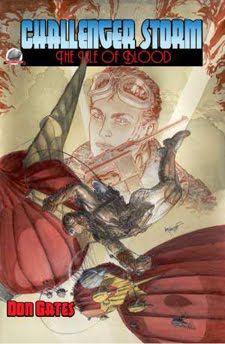
Florida native Don Gates has produced one of the outstanding New Pulp novels of 2011, with “Challenger Storm: Isle of Blood.” Published by Airship 27, with cover and interior illustrations by legendary artist Mike Kaluta, this is non-stop action in the traditional pulp mold. Gates has his pulp chops down, but he brings to these characters a depth that was absent in the early days. He recently took some time to tell us about his inspirations, his new novel, and his plans for future projects.
All Pulp:  How long have you been writing, and at what point did you decide you wanted to write a book?”
Don Gates:  Writing is actually pretty new to me. I did a LOT of creating in my head- daydreaming and stuff like that- but I usually never got things on paper beyond just a rough outline. Before working on this book, I’d start to write things that usually fizzled out before chapter 3. I always loved pulps and always wanted to do a pulp-style story or series, I just never felt I had the right mix of elements, characters, etc. I asked some friends online to let me bounce some ideas off of them, and after finding out what worked and what didn’t I had a handful of ideas that I wanted to try my hand at, all existing in the same pulp “universe”. Challenger Storm is the first of those ideas.
AP: What do you like to read, and how did it lead you into wanting to do it yourself?”
DG: I like to read the classic pulps (of course) along with newer pulp-like fiction like the Dirk Pitt novels and the Agent Pendergast series, and I love the Destroyer series of paperbacks. Outside of that, I like classic sci-fi & adventure like Jules Verne and HG Wells, and I absolutely love William Gibson’s earlier cyberpunk novels. I’m a huge fan of HP Lovecraft, and in the last few years I’ve come to enjoy JRR Tolkien as well. And of course, I try to read as much of the “New Pulp” crop of authors as possible… there’s a LOT of really amazing work out there!
As far as being led to create my own pulp, I can sum that up in one instance: the first time I read Doc Savage. I was home sick from junior high school, laid-out on the couch with the Doc Omnibus #6. Even though I know now they’re kind of sub-par Doc Stories when compared to the earlier ones, I didn’t know that at the time. All I know is for a few hours I was transported away from home and into an incredibly fun adventurous world. If I can bring any of that feeling to my work, I’m happy.
AP: What were some of your inspirations for Challenger Storm? In some ways, he is a very conventional character, and in other ways he is not.”
DG: A lot of the major influences came from Doc Savage of course, but I wanted him to be more human and less godlike. As much as I enjoy infallible heroes like The Shadow, I always appreciate when a series’ hero is more vulnerable, and even though you know they’re going to win in the end you still worry about them getting into scrapes. I also wanted him to have a motivation beyond the simple pulp-hero credo: “I’m rich, smart, and fit… let’s get the bad guys!” I wanted it to be about redemption with Storm: he wants to make up for a past in which he was an awful, selfish, and self-important jerk. The three scars on his face aren’t just there as a visual-cue to make him stand-out from other square-jawed adventurers, they’re also tied in with his “origin” and serve to remind him of where he comes from and what he went through to change his life.
AP:  It’s obvious that you have more than a passing interest in aircraft. Tell us a little about that, and how it informs your work.
DG:  I am interested in vintage aviation, and it’s something that I’ve always been into for some reason. Now I’m not so into it that I can tell you what kind of horsepower the engines on a B-17 Flying Fortress had, but I love the look and elegance of pre-war and WWII-era aircraft. It was a national and worldwide fad during those days, a relatively new science. It’s so fascinating to compare that era’s air-travel with ours. In those days, they were focusing on comfort, designing airplanes and airships that were like ocean liners in the sky… these days, they pack as many people possible into a cramped, over-sized tin can and shoot you across the country. Sure it’s faster, but it’s lost a lot of the personality that the golden era of aviation had.
It was during the art process of the book that I found out that Michael Kaluta, who is the legendary artist who did the cover and interior illustrations, is a bit of an aviation-nut too, even more so than I am. I’ve always been a huge fan of his, and when I found this out it was just another example of a perfect fit for the book. It’s funny: when I had come up with the MARDL pursuit-plane (the Witch), I was inspired partially by an old racing plane, the De Havilland DH-88 Comet, but never mentioned this to anyone. Later when I wrote to Michael and asked what he had in mind for his version of the Witch, he emailed me back and told me his design was influenced by the Comet too. It was pure synchronicity, hahaha.
AP: How did “Isle of Blood” come about? Did you write the whole thing and submit it to publishers? What brought you and Airship 27 together?
DG:  I had the cast of heroes created and ready before I had their first story. “Isle of Blood” evolved from 2 things: an idea I had about a lost valley of floating rocks and an old photograph of a wealthy-looking man and his daughter that I found in an antique store. Those elements came into play as plot points A through Z, then it became a matter of coming up with B through Y to bring them together. I wrote the book off and on from mid 2007 through the end of 2009, experiencing the longest setback after my father was diagnosed with terminal cancer. He died before the book was completed, and of course the book is partially dedicated to him.
As far as publishing it through Airship 27, I’d actually wrote the book with them in mind. I really like their books and their production values, and so they were on the “short list” of potential publishers. I sent them the book a few days before Christmas of 2009, and it was accepted shortly thereafter.
AP:  What do you have in mind for the future of Challenger Storm? Do you have any other characters or comcepts you’re working on?
DG:  I have quite a few Challenger Storm stories in the works, all in various stages of outlining and plotting. I’m working on the second book now, “The Curse of Poseidon”, and had a major idea for a new book that will probably become the third novel. Without giving too much away, it’s going to play in H.P. Lovecraft’s funhouse a little bit, and if I can pull it off it’s going to be kind of epic.
I have lots of other series and characters I’d like to work on. One is a vigilante series called The Cipher and has a secret-identity hook that I hope will grab people, and another is a character I’ve had in my head since I was about 13: a man-of-mystery character called Codename: Shanghai. There’s also a one-shot story told from a Challenger Storm villain’s point of view, as well as a stand-alone lost-world adventure. Challenger Storm’s legacy involving his son and grandchildren is another thing I’d like to work on a bit also, along with a sword & sorcery book… Like I said, I have a lot of ideas. Finding the time to do all that writing is the thing I have issues with, but I’m trying.
AP:  When did you first learn that Michael Kaluta would be doing the illustrations, and how did that make you feel? That’s a pretty big deal.
DG:  The Kaluta thing was something absolutely crazy… I’m still shocked that it happened. I’d been a fan of his for years, ever since discovering his work on The Shadow. My wife Annie contacted him a few years ago with questions about commission work and something about their personalities just clicked and they became email-acquaintances. When Airship 27’s Ron Fortier was trying to find an artist to do “The Isle of Blood”, Annie said to me “Why don’t you ask Mike Kaluta to do it?” at which point I seriously began doubting her sanity. She’s not a fangirl, though, and to her he’s just a regular guy so she had no trepidation about asking him. Long story short, he said “yes” and he and Ron hammered an agreement out with regards to fitting it into his busy (and I mean BUSY) schedule, and here I am with not one but two dreams fulfilled in a single swoop.

Universal Picking Up Charlize Theron Sci-Fi Project ‘Agent 13’

The Hollywood Reporter reports that “Rise of the Planet of the Apes'” director, Rupert Wyatt is attached to the Charlize Theron Sci-Fi Project ‘Agent 13’.

Universal is finalizing a deal to pick up Agent 13, a sci-fi project that sees Charlize Theron attached to star and Rise of the Planet of the Apes director Rupert Wyatt attached to direct.

T.S. Nowlin  is the writer behind the pitch, which is based on a little known comic book from 1988. It was created by G.I. Joe and Transformers cartoon writer Flint Dille and David Marconi, who went on to pen the Will Smith thriller Enemy of the State as well as Live Free or Die Hard. 

The comic had post-modern pulp overtones, replete with femme fatales and explosive cliffhangers. The main character is male and despite Theron’s involvement, will remain that way. (The actress is attached to play another part.)

Sean Daniels, one of those behind Universal’s Mummy franchise, discovered the comic and has been developing since at least last year, is one of the producers along with Jason Brown. Theron is also producing via her Denver and Delilah banner as is Union Entertainment.

For more information on Agent 13, check out All Pulp’s interview with Flint Dille and David Marconi from December 2010 at http://allpulp.blogspot.com/2010/12/all-pulps-flint-dille-and-david-marconi.html

FORTIER TAKES ON ‘GIRL GENIUS’!

ALL PULP REVIEWS- Reviews by Ron Fortier
GIRL GENIUS
(Agatha Awakens)
By Phil & Kaja Foglio
A 319 pg graphic novel.
Tor Books
One of the things I bemoan as a professional reviewer is the lack of graphic novels I’m sent to look at.  Note I did say, “look at.”  The fun of such material is that, when well done, it becomes both a literary and visual feast; a narrative told with both words and art.
The problem is that, even in our supposed enlightened times, most major publishers still do not appreciate or acknowledge graphic novels as legitimate and thus are not receptive to publishing them.  Those pioneer publishers who do are few and far apart.  Happily Tor Books is one of the leading pioneers in this acknowledgement and they deserve credit for not only publishing books such as the Foglios’ “Girl Genius” but also promoting them so heavily.
Since its inception as a webstrip many years ago, this manga inspired sci-fi steampunk comic about airships, monsters, half-humanoid beings and a magical talent called “the Spark,” has won three Hugo Awards and been nominated for both the Eisner & Eagle Awards; the best for American and British strips respectively.  It is a grand, over-the-top tale that showcases a world where machines are looked upon with fear by the average citizen and those scientist who can master them considered heroes of mythic proportions.
Agatha Clay, an orphan college student in Transylvania, is being raised by her aunt and uncle and has no knowledge that she possesses the Spark.  Her only clue being that she often awakens from deep sleeps in her uncle’s workshop surrounded by tools and bizarre, unfinished, “cranks.”  These are robot-like inventions that come in all sizes and shapes with a variety of functions.  Eventually, her secret ability begins to assert itself and she comes under the scrutiny of Baron Wulfenbach, one of the most powerful political scientist in all the world.  He ultimately brings her aboard his city-size airship and there she meets an assortment of characters, both human and half-human, along with a talking cat with attitude and the Baron’s handsome young son, Gilgamesh. 
The boy is keen enough to realize Agatha has the Spark and suspects her talents are greater than most others known to his father.  At the same time, the great ship is coming other attack by an alien entity from another dimension and in the end, there is a climatic battle wherein Agatha, using her gifts consciously for the first time, helps Gilgamesh save the day.  But not before she uncovers other mysteries of her past and her parents.  In the end she is forced to steal an airship and along with her pal, the feisty talking cat, makes good her escape, thus ending the first part of her saga.
At 319 pages, “Agatha Awakens” is a whopping chunk of madcap, graphic fun and action galore.  Although the first hundred pages display a roughness to the depiction of the characters, it is easy to reconcile this was the first year’s worth of pages and the artists were gradually beginning to know their characters.  By the second hundred pages, the art settles into an easy, cartoony style that is part manga, without being overly exaggerated, and typical Saturday morning fare.  I particularly liked the use of coloring, which has been redone for this collection.  It shifts from the duotone and sepia when detailing earthbound city scenes and then explodes with a vibrant rainbow palette upon arriving at the giant airships that cruise majestically through the sky.
Agatha and her supporting cast of characters are fresh, original and fun.  This beautifully produced hardcover is like nothing else I’ve read in graphic form and it truly impressed me a great deal.  If you are a fan of American manga, sci-fi or steampunk, you are going to love “Girl Genius – Agatha Awakens.”  Take my advice; get two copies, one for yourself and another for your pre-teen kids or grand kids. They’ll eat it up.