
REVIEW: The Dissidents
The Dissidents: Autocrats! Vigilantes! Communists! And Cartoonists!
By Derf Backderf
344 pages/Abrams ComicArts/$29.99 (hc)
 A common comment is that the past is prologue, and that is so true after reading Derf Backderf’s fascinating The Dissidents. The echoes between events in the years before and during World War I and today are chilling in many ways. It’s a wonderful piece of storytelling, illuminating people, groups, and events that rarely are covered in history classes (frankly, the early 20th century usually gets short shrift in a rush to WW II).
Political cartoons have been around for centuries and have allowed the less literate to stay somewhat current on the major issues of the day. They mock, skewer, and call attention to the extremes, often among politicians and businessmen. In the turbulent years of the early 20th century, new political thought arose and the left-wing political cartoonists came together and shared their articles and visions in the small circulation The Masses.
Joe Hertle, Backderf’s creation, shares their beliefs and leaves Akron, Ohio, to join them in New York City in 1916. Through his eyes, we see the struggles of the day’s great names— Cornelia Barnes, Henry Glintenkamp, and Art Young, among others—as they keep their publication afloat while political tides push America toward involvement in World War I. The cast includes other free thinkers of the day, such as Emma Goldman, John Reed, Max Eastman, and Eugene V. Debs, as we see their closely aligned views make them comrades in arms.
The revelation to me was the existence of the American Protective League, a band of vigilantes the government used to violently quash those voices, among others, to serve President Woodrow Wilson’s agenda. Their attitudes and tactics are reminiscent of ICE, while the racist, thin-skinned Wilson has more in common with President Trump than I realized.
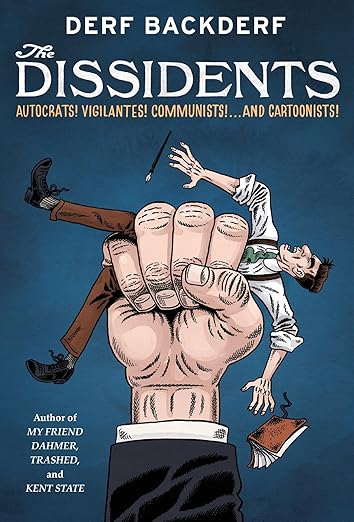
This was an America where women still wanted the right to vote and the push toward prohibition was a constant background sound. This was a country whose melting pot is fondly recalled today, but as we neared war, any of the “hyphenates” were suspect and targeted by a xenophobic society. Once we entered the conflict, Wilson had little tolerance for freedom of the press, especially these cartoonists, and his autocratic fist became a hammer.
A trained journalist, Backderf enriches his pages with visual and verbal details that bring the era to life in chilling ways. We watch the fortunes of these people crumble, forcing some to flee conscription or prosecution. Others are rounded up and tried under the Espionage Act, and those scenes are rare moments of levity in this dark story.
Backderf’s artwork is supplemented with actual examples of the magazine’s covers in addition to the offending political cartoons, bringing a nice context to the issues being covered. He also nicely provides capsule portraits of the real-life players along with detailed notes on his research in the final 35 pages.
Given the state of America, this is an illuminating work that I hope finds an eager audience.