Category: Columns

Michael Davis: A Hard Day’s Night

davis-art-131001-4365445When I was around six, I was asked what kind of haircut I wanted.

This was big deal because up until then I had no say over anything in my life. This was my very first grown up decision and I had to weigh it carefully.

Even at six I knew this was a life changing moment. My mother told me to think about it while we were on the bus going to the barber shop. We lived in South Jamaica Queens at the time and except for church there was no place, no place as honored in the black community.

For me there were no two places I hated going to more than church and the barbershop.

What was there to like at the barbershop?

It smelled horrible from all the cigarette and cigar smoke mingled with the distinct smell of snuff being spat into a spittoon. For all of you not familiar with snuff, it’s a type of tobacco. People would put that gross shit in their mouths between their gums and lips and suck on it until the flavor was gone then spit it out before they popped in another jaw full.

Gross with a capital GROSS.

I know some people still do that and with all due respect-that shit is freakin GROSS.

A trip to the barber shop for me was a hellish journey to a smoke filled, snuff smelling spit fest. Oh,and least I forget, when snuff is spat it’s a dark brown / almost black liquid which had a good chance of missing the spittoon and landing on the six-year old sitting in the barber’s chair at the time.

That happened…to me…a lot.

So yeah, the barber shop was horrible and in retrospect, I must have liked church better. At church I was merely threatened with Hell if I wasn’t good. At the barbershop I was spat upon with black ooze, strapped to a chair while some creature took a motorized knife to my head.

The day I walked into the barbershop ready to answer my mom’s question as to what kind of haircut I wanted that particular Hell became Heaven to me for I was no longer a child I was no longer a kid, I was, heck, I don’t know what I was but I know I had respect.

Just when I thought my day couldn’t get any better, it did. The barber did not; I repeat did not sit me in the damn kiddy contraption that boosts the height of the child.

Nope.

Instead I sat (aided only by a telephone book which in my mind was no aid at all) in the barber’s chair all by myself.

But wait, there’s more!

When asked by the barber what kind of haircut was I to receive my mother told him to…wait for it…wait for it…wait for it…ask me!

At that moment I knew what I was, I was a man! A fact that was underscored by the barber when he looked at me (with what I could tell was a new respect) and asked, “Well little man, what kind of haircut would you like?”

The day kept getting better. Why? Because the entire barbershop, that to me looked like hundreds of people, heard him ask me and then heard my answer…“I’d like a Beatles haircut.”

The barbershop erupted in laughter…and just like that I was back in Hell.

“Little man, you’re black, didn’t anyone tell you?”

More laughter.

I knew I was black, but why that should stop me from getting a Beatles haircut was beyond me. So like the man I was I asked and then the laughter became physically painful to me and I started to cry.

Never again did I ask for a Beatles haircut and, in fact, I started asking questions before I made statements or asked certain things.

Yeah, I was six, but I wasn’t stupid.

What, pry tell does any of this has to do with comics?

Many, and I mean many “artists” have submitted work for a show I’m curating. Some of the art is just bad that’s OK compared to people just not reading or worst even not understand what they read in the call for entries instructions.

I’m just sick to death of aspiring artists and writers who refuse to do anything but draw or write. Their work, attitudes and professionalism need major overhauls and no matter how many times or how many ways you try and tell them they still assume they can get work in the fucking comic book industry.

Or they assume they can send you entire comic books (drawn in ball point pen) when the instructions call for no more than five submissions.

Learn your goddamn craft, people. Learn what you can and cannot do. Until you do you have as much chance of getting in this show or having a career in comics as you do getting a Beatles haircut in the hood.

WEDNESDAY MORNING: Mike Gold

THURSDAY MORNING: Dennis O’Neil

THURSDAY AFTERNOON: Tweeks!


Martha Thomases: Cosplay Everyday

thomases-art-130927-146x225-3832893I don’t know about where you live, but where I live, it’s Comic-Con everywhere. I’m not just talking about the crowds of people from out of town, the ones who don’t know how to walk down an aisle (or street) in a way that allows for the existence of other pedestrians.

I’m talking about the outfits.

The way I figure, it all started out at Disneyland. First, and from the beginning, it was a place where seemingly mature adults would wear hats that made them look like giant mice. More recently, they have this deal where little girls can spend the day in princess outfits. A little girl arrives in shorts and a t-shirt, complains for a while and gets to change into royal gear. She spends the day on rides, in her gown, and then changes back to her civvies when it’s time to go home.

Once we’ve seen people in formal wear on roller-coasters (and before 6 PM!), what else is there shock us? The geek have inherited the earth.

We control the eyeballs that Hollywood most wants. Look at the fall television line-up. I think most of the new shows have an element of the fantastic, whether it involves witches or zombies or believing Robin Williams could have fathered Buffy, the Vampire Slayer.

I don’t particularly want to dress up in a costume. I mean, I wore a uniform in boarding school for four years, so every day, when I get dressed, and I get to choose my own outfits from clothes that weren’t selected by Episcopalians, it feels like a costume. I just went shopping for a dress to wear to a formal event next month, when I will be in costume as a responsible adult, maybe even one with a little skin in the game. That’s enough fantasy for me, thanks.

Cosplay is everywhere, and it’s not just for kids anymore. It’s not even just for nerds anymore. There are reality shows starring cosplayers. There are major Internet arguments about who is and who isn’t the real deal.

So cosplay has gone mainstream. Maybe no one is going down the street dressed like Wonder Woman, but the stuff designers are offering for sale are just as unrealistic. Actually, I take that back. I think Seventh Avenue (the New York fashion industry) and the magazines that rely on Seventh Avenue would go bankrupt if women were encouraged to find our inner Amazon.

Still, at least in New York, people walk down the streets in all kinds of outfits. I’m not surprised that Fox had trouble attracting attention to one of their new shows if this was how they thought they would get attention. A headless horseman? As long as he isn’t wearing a backpack, he’d get no attention at all.

SATURDAY: Marc Alan Fishman

SUNDAY: John Ostrander


Michael Davis: It’s Not Personal, It’s Business

davis-art-130924-150x120-5128234I ran this on my Michael Davis World website. I was writing another version for ComicMix because the response was so strong. Then like an idiot (which I’ve been more often than not) I realized I should just run what I wrote as is.

So…

The following email was sent to my Linked-In mailbox:

Hey Davis, I’m a comic creator trying to break into the industry was hoping you could help a brotha out with that my big fan of your work and bring back The Crush!

I am one hundred percent sure the writer wrote and sent this email with positive intentions and respect. But as they say, the best laid plans of mice and men often go awry.

This certainly did.

Here’s a hard and cold fact, many young African Americans are under the impression that being black gives them a pass on professionalism. The case can be made that my less than professional attitude in my public persona gave this young man leave to address me in such a way.

Err, nope.

My public persona is my real life persona. In real life I have a certain swagger and attitude that I portray to the world. That’s just who I am. In anyone’s life there is a time and a place for everything in my professional dealings there is never and I repeat never a time not to be professional.

There is no other way to say this; anyone who thinks they “know” you because you project a certain image to the world is most likely in for a rude awakening. Even worst-they may never get that rude awakening because emails and any other inquiries will simply be ignored.

I don’t do that.

Any chance I get to enlighten someone as to the error of their ways I do so, up to a point. I’m not wasting any time on someone I give advice to and they keep defending that ghetto bullshit way of thinking.

The following is my reply to the young man. As of yet I’ve heard nothing back from him in the two week since I’ve sent this:

I say this with love, my brother. “Hey Davis” is not a level I operate on. That is not just unprofessional, it’s disrespectful. The rest of your email was poorly worded as well.

Now considering you sent this to a Linked-In, a professional networking site, you are very lucky my executive assistant didn’t see this first. If he had your access to me through this site or anywhere else would have been terminated.

That said, I sense your enthusiasm and as such I’m going to give you a pass.

If you would like to send me another email which states clearly what it is you do (artist, writer) what it is you would like to talk to me about (portfolio, writing samples) and what sort of advice you are seeking (craft critique, career opportunities) I will see rather or not I can help you in any way-IF you have the talent and motivation that warrants my help. If your work is in presented in the same manner as your email then we have nothing to talk about.

I hope this response is received by you as what it is, a reality check. This is in no way a put down.

‘Who wrote this letter? Stevie Wonder?” That’s a put down.

I took time out of my day to write this. This is not a form letter; this is I writing to you with respect for your enthusiasm and a desire to see you succeed. If you think that’s something anyone in a position to help you will do then you have a seriously unrealistic view of the entertainment industry and you are not ready for a professional career within it.

Calling me “Davis” is just ghetto. If you were my boy and we were back in my hood South Jamaica or Rockaway Queens you could call me “Davis” all day long. You’re not my boy. I don’t know you…yet

You know what they call me when I walk into a meeting? Michael, Mr. Davis or Dr. Davis depending on whom I’m meeting and why I’m meeting with them.

“Davis.” Come on man!

There’s a saying, “you get one chance to make a first impression. “Well, I just gave you another. What you do with it is up to you my friend.

Again, I say this with love.

I hope I hear back from the young man and I hope if I can, to help him. That’s my plan but its up to him and like I said earlier, the best laid plans…

WEDNESDAY: Mike Gold

THURSDAY MORNING: Dennis O’Neil

THURSDAY AFTERNOON: The Debut Of… The Tweeks!


Mindy Newell: It All Gives Me A Headache – Part Three

newell-art-130916-150x142-7901607“And in each universe, there’s a copy of you witnessing one or the other outcome, thinking – incorrectly – that your reality is the only reality.”

– Brian Green, The Hidden Reality: Parallel Universes and the Deep Laws of the Cosmos.

•     •     •     •     •

Who are you?

Are you sure?

•     •     •     •     •

Are you Buffy Summers, the Slayer, the chosen one of her generation who stands alone against the vampires, monsters, and demons who threaten the world? Or are you Buffy Summers, a schizophrenic patient in a psychiatric hospital battling the unleashed horrors of your own id?

Doctor: Do you know where you are?


Buffy: Sunnydale.


Doctor: No. None of that’s real. None of it. You’re in a mental institution. You’ve been with us now for six years.

Spike: Put a little ice on the back of her neck. She likes that.


Buffy: Some kind of gross, waxy demon-thing poked me.


Xander: And when you say “poke”…?


Buffy: In the arm!


Buffy: They told me that I was sick, I guess crazy, and that Sunnydale and all of this — none of it was real.


Xander: Oh, come on. That’s ridiculous. What? You think this isn’t real just because of all the vampires, and demons, and ex-vengeance demons, and the sister that used to be a big ball of universe-destroying energy…?


Willow: Okay, all in favor of research? Motion passed.


Doctor: In her mind, she’s the central figure in a fantastic world beyond imagination. She’s surrounded herself with friends, most with their own superpowers.


Doctor: Together they face grand, overblown conflicts against an assortment of monsters, both imaginary and rooted in actual myth.


Doctor: Buffy, you used to create these grand villains to battle against. And now what is it? Just ordinary students you went to high school with. No gods or monsters, just three pathetic little men… who like playing with toys.


“Normal Again”

Buffy The Vampire Slayer

Season Six, Episode 17

•     •     •     •     •

Who are you?

Are you sure?

•     •     •     •     •

Are you Buddy Baker, married to Ellen Frazier, father to Cliff and Maxine, and living in San Diego? Or are you a character in a comic book called Animal Man, which was written by Grant Morrison and published by DC Comics?

newell-art-130916-21-146x225-9010309


(to read this page at full size, double-click on the image)

•     •     •     •     •

Who are you?

Are you sure?

To be continued…

At least, in this universe!

(citations copyrighted by their respective owners)

TUESDAY MORNING: Emily S. Whitten

TUESDAY AFTERNOON: Michael Davis


pasko-art-130912-150x186-1980249

Martin Pasko: You’ve Got Mail! We Just Don’t Know Where It Is…

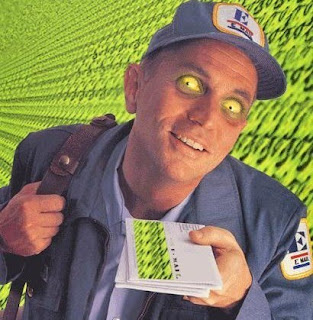
pasko-art-130912-150x186-1980249Please believe me, as I conclude last week’s well-reasoned and temperate dissertation on why comics fans should care – maybe – about the future of the US Postal Service, when I say I’m trying hard to wrap up this little opus before the USPS goes out of business.

But I’m not working as fast nor concentrating as well as I’d like because I’ve just been distracted by another “gotcha” courtesy of my BMK – Bad Mail Karma. It illustrates one of the more interesting by-products of the USPS’s ongoing effort to modernize, simplify and streamline its products and services even as Congress calls for a postal austerity program:

When a customer confused by the ever-changing policies (that would be moi) makes a minor mistake, the USPS’s systems will helpfully turn it into an exhausting, nerve-wracking Major Hassle by preventing it from being corrected.

In my recent move back to Southern California, I managed to outsmart myself by sending ahead of me a USPS Priority Mail box of important items that I’d need before the moving van arrived with my everyday stuff. It has yet to arrive, some eight weeks later. It seems I used Priority Mail packaging that was not a flat rate box, but to which I incorrectly affixed flat rate postage generated online. OK, my bad.

That does not explain, however, why it took the P.O. four weeks to determine that that was the problem; why its online tracking system kept giving me information that contradicted the tracking data in the main USPS computer; nor why the package has now crossed the country four times, having been shipped back and forth between my old address and the new, each time being flagged in the system as undeliverable” or sent to “no such address.”

The helpful people I’ve dealt with at my local P.O. – six of them now, because the same people don’t seem to work there for more than five days in a row – can’t seem to figure it out, either. One “Letter Carrier Supervisor” told me, “I’ve been working here 30 years and I’ve never seen anything like this.” Of course, that may be because she apparently takes 147 coffee breaks a day.

This might also explain why she can’t get her direct reports to do what the three other supervisors have told me they will: When the package ricochets back here to Pasadena, they’ll call me so I can come pay the extra postage and pick it up. When last heard from, the package was at some “claims resolution” facility in Atlanta, but was supposed to be on its way back here. That was two weeks ago.

Now, imagine that this box had been, say, a shipment of comics from a private eBay seller for which you were waiting breathlessly. (Yes, small, private sellers often make honest mistakes. I hasten to add, though, that as someone who sells on eBay, I’ve been lucky – so far – not to make this kind of mistake with a customer’s package. And you can be sure I’m doubly careful now.)

This is a microcosmic example of the kind of thing comics fans will probably be saying good-bye to soon, mournfully or otherwise, having been left to the tender mercies of those even bigger screw-ups, UPS and DHL. The macrocosmic version is what I described last week: A stamp-related custom comic project that was extraordinarily successful for DC Comics (the aggregate print run for the nine CTC books I discussed added up to over 10 million) turned out to be a dismal failure for the USPS. This, only because the agency couldn’t secure the content approval from its licensors – the owners of several of the stamp subjects’ IT – in time to get the books out, to serve as collectors’ albums for the CTC series, at the same time as the stamps themselves.

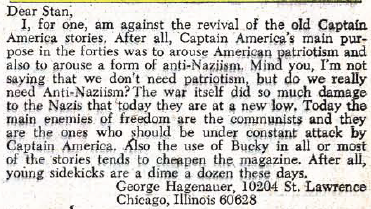
And it’s too bad, really, this suicidal ineptitude, since comics fans once had a friend in the postal service. It was tangentially responsible for the creation of letters columns which, in the earliest days of comics fanzines and well before web sites and comment forums, became the principal means by which comics fans exchanged opinions about talent and continuity developments and, from the addresses printed, gained the means to interact and organize. These “LOC” pages came about because postal regulations required comics to have at least a page of text to qualify for their mailing rate. When the previous practice of hiring writers to create original prose fillers became prohibitively expensive, the “lettercols” were born.

Soon, those who self-identified as serious fans and collectors became the only readers who were so hell-bent on getting their monthly “fix” that they’d be willing to subscribe. But they were dissuaded from doing so because they didn’t want their mint-condition comics given a permanent vertical crease by being folded lengthwise to fit into a narrow wrapper, which was the only cost-effective way to send comics through the mail. So you can thank USPS, then, for killing this in favor of what took another decade to develop, with the growth of specialty retail shops: the pull-and-hold service.

Today, the Postal Service searches for new services it can provide http://www.informationweek.com/government/security/postal-service-pilots-next-gen-authentic/240145559, to replace the ones it has screwed up so badly that they’ve become obsolete. One of its ideas is to get itself into the “identity management business.” The fact that the average citizen can’t figure out what, in fact, “identity management” is should in no way deter the USPS from this worthy goal. It might keep them occupied so that other companies will have to deliver all the packages, and our paychecks will all be issued by Direct Deposit and have no trouble finding their way into our bank accounts.

Of course, thereafter we’ll be unable to access our funds, because our identity will have “managed” to change – to that of someone we’ve never heard of in a zip code that hasn’t been invented yet. (Remind me not to tell you about how my previous address in Pennsylvania, a rural route which was given a normal house-number in “The Monroe County Readdressing Project”  … with the result that my online change-of-address form couldn’t be processed properly because the old address wasn’t in the USPS database.)

Meanwhile, I’ve decided to stop oiling my old spinner-rack and instead donate it to a nursing home. I’m going to shop for comics via ComiXology exclusively, and work on figuring out how to get my new tech for promoting pacifism and conservation of labor, to make plastic staples. Once everyone on eBay is shipping via UPS, and we have the technology to totally recreate “floppies” in our own homes, the world’s Geeks – comic book division – won’t have anything to fear from the P.O. anymore, whatsoever.

FRIDAY MORNING: Martha Thomases

FRIDAY AFTERNOON: Michael Davis (honest)


Mindy Newell: The Doctor Who Dream Of Isabel Sofia Newell

tumblr_lndbs5xmxp1qfnnjko1_500-5198772

It All Gives Me A Headache: Part Three (otherwise known as Multiverse University) is pre-empted this week to present a column by a special guest.

A few months before her birthday, Isabel asked me if I watched Doctor Who.  Oh, yeah, I said.  Do you?  She hadnt, but all her friends were raving about Matt Smith.  Tell you what, I said.  Ill get you the DVD set of Doctor Who.         

But I made a mistake.  I only got her the 11th Doctors series.  I figured that if she liked Matt, I would backtrack and get her the Chris Eccleston and David Tennant series.           

But my brother thought it would be best to start at the beginning plus I think he was curious about the whole Whovian phenomenon so, using Netflix, Isabel and he have been binging on the Time Lord, starting with the 9th Doctor.     

Theyre both hooked. 

And Isabel had a dream.        

This to cop a phrase from Law & Order is her story.


You think you have had the best dreams about the Doctor and his TARDIS?  You might want to think twice.

It started like this. I got on a bus to Hogwarts.  I knew something was wrong because you take the train to Hogwarts, not a bus.  I had just put my luggage away when I looked out the window of the bus and saw the Doctor standing there watching me.  Before I could do or say anything the bus took off and then just as suddenly stopped.  I got off the bus.

We were at Hogwarts, and…

…it was in the middle of town.

Again I knew something was wrong.  And no way was I going to go into Hogwarts if it was so public.

Then I saw the Doctor walking right towards me, but something was wrong again, because right in front of my eyes he suddenly split into the 9th, 10th, and 11th Doctors!

“This is crazy!” I thought to myself, and started running.

And ran smack into two metal things.

I fell down and looked up.

I was staring at a Cyberman and a Dalek.

“Exterminate!” said the Dalek.

“Delete!” said the Cyberman.

Suddenly I had a sword in my hand.

I swung, striking the Dalek in its eye.  I swung again, and exposed the Cyberman’s emotion-blocking chip.  I reached in and pulled it out.  Both the Dalek and Cyberman exploded into tiny bits of metal that rained down upon me.

I stood up, searching for somewhere to hide.

The TARDIS!

I ran to it, but I couldn’t open the door.

I saw the three Doctors coming towards me.  I knew that I had to get away from them.  I knew they couldn’t all be together at one time.  That they were not my friends.

I ran into a darkened theater.  I looked back.  The three Doctors were still on my tail.

I kept running until I couldn’t run anymore.  I collapsed.  The three Doctors were almost upon me.  I had lost my sword.

Then all of a sudden the three Doctors merged into one, and it was the 10th Doctor.  He picked me up, brought me into the TARDIS, laid me down on a bed, and gave me a kiss on the forehead.

And I knew that I was safe.

•     •     •     •     •

Isabel Sofia Newell is a vivacious 13 year-old who I have known since she was born.  A young woman of many talents, she is an accomplished blue-ribbon equestrienne on the show circuit, a cellist with PhilOrchKids the Philadelphia Orchestras young musician program and the Symphony in C Orchestra intensive summer camp based at the Gordon Theater at the Rutgers-Camden Center for the Arts in Camden, New Jersey.  She is also a gifted singer, who has wowed audiences with her performance as everybodys red-haired orphan, ANNIE, in junior summer stock.

Isabel is also a voracious reader, a fan of, among other things, Bone by Jeff Smith, the Archie family of comics, Percy Jackson, and, of course, Harry Potter.         

And just recently, Isabel has become a Whovian. 

TUESDAY MORNING: Emily S. Whitten

TUESDAY AFTERNOON: Michael Davis

John Ostrander: Fashion Statements

supermaninatux-3138530My good friend Martha Thomases, as usual, wrote an interesting column this week on her way to the Baltimore Con. She wrote about choosing what to wear at the Con and that, in turn, set me to thinking and provided grist for my own essay mill. Some weeks I need a lot of grist.
Something that’s important in comics and too little discussed is the importance of clothes. The fashion choices made by a character says something about that character. What you wear makes a statement about who you are even if that statement is, “I don’t care.” As often as not, my criterion still is, “Is it clean? Is it clean-ish? Does it at least not smell? Does it not smell too badly?”

However, I can dress up. I clean up fairly well, to be honest. I’m not keen on wearing ties but I know how and when to do so. I like hats, especially fedoras, although the Irish cloth cap works well on me. One wonderful fan made me a beret like GrimJack wears and I like that a lot and can be seen at conventions with it.

Some people dress for success. Some people dress to be invisible. Choices are made even when it appears to be a non-choice. If you say, “I don’t care how I look; I don’t think it’s important,” that’s a choice. It says something and don’t bother maintaining that it doesn’t or shouldn’t matter. It does. We make up our minds about people right away depending on how they appear to us. They do the same with us. Assuming the phrase, “Dress for the job you want, not for the job you have.” Is true, why is it true? The answer is we want people to perceive us in a certain way even if our goal is not to be perceived, to blend in.

When I was working with student artists, I wanted them to look at different source materials for the way people dressed. Tony Stark and Bruce Wayne would be more likely to dress out of GQ whereas Peter Parker might dress from the Old Navy store.  Here’s an extra-points question – how would Tony Stark dress differently from Bruce Wayne? Bruce’s suits are a costume for the playboy image he plays whereas Tony’s wardrobe is who he is (and, yes, I’m including the Iron Man costume).

Certain costumes can be a short-hand to who the character is – in Westerns, it used to be the good guys wore the white hats and the bad guys wore the black hats. Made things simple – an oversimplification, really. Clothing and costumes can describe a character but they can’t be substituted for characterization itself.

Clothing can reveal character: who the individual is, how they think of themselves, how they present an image of themselves. We do it (deny it if you want) and so characters do it as well. What’s true in life should be true on the page.

A very fun aspect of this in the past few years has been the rising importance of cosplay (costume playing for those of you who don’t know the term) as part of fandom. Fans become the characters they see in the comics or on the screen. The costumes can be elaborate or silly or elaborately silly or anywhere in that spectrum. They’ve become fixtures at most conventions these days and are often stunning. They’re a merger of the person who is wearing the costume and the character they represent.

Whether it’s in a drawing or in prose, clothes can make the character and if you want to work as an artist or a writer, you’d do well to remember that.

MONDAY MORNING: Mindy Newell

TUESDAY MORNING: Emily S. Whitten

Mike Gold’s Big Fanboy Geek Out

Gold Art 130904Sometimes writing this type of column requires the skills of an experienced curmudgeon – which, lucky for me, is how I got the job. But only a child with a weak bladder pisses over everything he likes, and I am not a child. I am an adult. With a weak bladder, but hey, I’m staring Medicare in the face.

Unlike some of my ilk, I still read comic books – not exclusively, but I read a lot of ‘em. I read a few out of curiosity and a few others just to see what my friends are up to. But I focus on the comics I actually enjoy (hence my annual “Top Nine” list). With comics characters and adaptations proliferating all across the media, the same is true with comics-based movies and teevee shows. And what’s making my little fanboy heart go pitter-patter? Spoiler Alert: look at the artwork up by the headline.

I have enjoyed Nick Fury: Agent of S.H.I.E.L.D. ever since its debut in Strange Tales #135. This comic book came out in the early summer of 1965. An endless sea of masterful writers and artists succeeded Stan Lee and Jack Kirby (for the record, Kirby plotted those early stories) and the most significant, the most interesting, the most awe-inspiring, was from a relative newcomer named Jim Steranko. He imbued the property with so much raw energy and skill that the property is still running off of the momentum he provided some almost a half century ago.

I love the way S.H.I.E.L.D’s been handled in the movies. It’s so… Marvelesque. It’s been handled by people who get it. So it should come as no surprise that my fanboy anticipation is entirely invested in the new teevee series, Agents of S.H.I.E.L.D.

Of course I can be disappointed. This sort of thing has happened before. The right people get it wrong. But given how S.H.I.E.L.D. has been handled by Marvel’s movie division and the fact that Joss Whedon is the show’s overseer and Clark Gregg unsplatters himself from the movie storyline to reappear as Agent Coulson in this new series, I have every right to expect a solidly entertaining experience.

On Tuesday, September 24, nearly three weeks from today, I’ll find out.

And then I can move on to Doctor Who’s anniversary.

After all these years, it’s still fun to be a fanboy. I’ll grow up to be that old geezer at the assisted living center, completely not acting his age.

I’m looking forward to it.

THURSDAY MORNING: Dennis O’Neil

THURSDAY AFTERNOON: Martin Pasko


Martin Pasko: Actually, The Postman Never Rings At All

pasko-art-130829-144x225-7257580When I was a little kid, the original <a href=”

The Fly scared the crap out of me. Then, later, when I wrote the Star Trek and Justice League franchises in comics, I felt a morbid and uneasy fascination with the transporter idea, which I’d always thought had a greater potential for disaster than deliverance. But I never did much with it, because my early Vincent Price-induced trauma left me with zero interest in writing about steaming piles of misshapen, dying flesh. So I never thought I’d see the day when I’d write these words:

We need teleportation. Badly. And we need it now.

Why am I bending your digital ear with this?

Well, another day I never thought I’d see is the one when the number of Americans who self-identify as Geeks would outnumber Americans who give a flying rat’s ass about what happens to the US Postal Service.

The great irony of this is that many of the people who stand to lose big-time if the USPS achieves its goal of total self-annihilation are Geeks.

If this painfully slowly-approaching disaster isn’t averted, no amount of muscular adblockers will be able to Improve Your eBay Experience. And there are still some comics publishers who don’t drop-ship everything from Canada by courier service. Moreover, there still exist certain types of vendors who think DHL is an even bigger nightmare than the postal system, and a few pesky creative dinosaurs who still have the temerity to expect payment for entertaining you. And they expect it from Accounting Departments who are already resentful enough as it is about having to generate all those 1099s at year’s end. Which is why their indulgent bosses reward them for never, ever suggesting that Talent can be paid via Direct Deposit, which is obviously evil and irresponsible, in addition to being too much trouble, because that’s how the government that needs to be shrunk in the bathtub now pays The 47% all that social safety net money they don’t deserve and which is obviously a Socialist plot.

All these nice folk will feel like they live in an even more dystopian alternate universe than they already occupy if those little paper things that are redeemable for cash and prizes stop showing up in their cobweb-infested mail boxes.

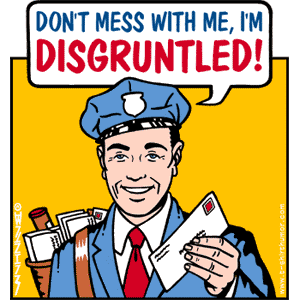
Yes, I know you know what “going postal” means. But you may not be old enough to remember why, despite the fact that many local P.O.s are named after famous people living or dead, there’s no such thing as a David Berkowitz Post Office. Which is why you may be blissfully unaware that you’re not getting half your mail because your letter carriers’ dogs talk to them and tell them what they should do with it instead of delivering it.

For you, USPS’ headlong rush to make the case for its own irrelevancy to modern life might have a greater significance, so it is my duty to helpfully call it to your attention.

In the interest of appropriate full disclosure, I should add that I’m uniquely qualified to talk about the USPS on a site that’s supposed to be about comics, and not just from having been tortured by them through a few decades as a freelancer (an old girlfriend once got so tired of hearing me bitch about the horrors they visited on me, she nicknamed me BMK, which stood for Bad Mail Karma).

Oh, no. There’s more. You see, I was once involved in creating comic books FOR the USPS, which was a little trip through Pinhead’s Lament Configuration all by itself.

Have I hooked you? Good. Then maybe you’ll come back here for that story next week. I mean, maybe you’ll deign to sample this column again. In spite of everything.

Because in that tale – from the ‘90s, mind you – lies an insight into the monumental and long-customary – and therefore ineluctably irreparable – bureaucratic ineptitude that will inevitably result in USPS’s demise. This, despite a Congress that, while having done nothing else of substance, has managed to reinstate the possibility of its remote mail centers receiving Ricin-laced envelopes on Saturdays.
Hmm. The dogs I live with are barking. That must mean the mailmoron’s here. But that’s impossible. It’s not even dark yet. Must be a new person on this route. Excuse me while I go peer out at him or her suspiciously through the venetian blinds, like one of those crazy old people who’s about to run outside waving a broom to shoo the neighborhood kids out of the driveway. That’ll inspire continued excellent service, I’m sure.

Whoah.

The mailmoron has just delivered six pieces of mail, only four of which are for people who don’t live here. Plus, unlike her predecessor, she actually noticed the large banker’s box under the mailbox. The one with the sign on it reading, in 72-point type, outgoing mail. Which means she actually took the prepaid packages and stamped letters that have been sitting in it since Tuesday. And will do whatever her dog tells her to do with them.

I never thought I’d see the day.

Next week: Neither rain nor snow nor sleet nor gloom of night can possibly make anything worse.

FRIDAY: Martha Thomases

SATURDAY: Marc Alan Fishman


Mindy Newell: The Grandfather Paradox Gives Me A Headache

Newell Art 130826Is time travel possible? Can history be changed?

Imagine you had a time machine and went back into the past. While there you meet and accidentally kill your grandfather before he got married and had kids, one of them your own parent. Then you automatically wipe out your own existence, right? But if you have never existed, then how do you go back in time and kill Grandpa?

This is called The Grandfather Paradox, and it is probably the most famous example of what is termed a temporal paradox. This scenario was first described by science fiction writer Rene Barjavel in his 1943 book, Le Voyager Imprudent – translated, The Imprudent Traveler. (I didn’t know that, either. I looked it up.)

The Grandfather Paradox is not exclusive to killing Gramps. The entire plotline of Back To Future depends on Marty, um, “pre”-uniting his parents after he inadvertently interfered with his father, George McFly, being the one nursed by his mom (thus kindling their romance) after dad fell out of the tree into the path of a passing car. Because George did not marry Lorraine Baines, Marty cannot exist, and we see this principle at work as his first-born brother and then second-born sister disappear from a family photograph, until, at the prom (and the penultimate scene), Marty starts to fade away as he plays guitar. But just in time, George (who has saved Lorraine from being mauled – raped? – by Biff Tannen, the town bully) dances with her – they kiss, and suddenly Marty springs back to life and his brother and sister reappear in the photograph.
Marty inadvertently changes history in other ways, because in his efforts to bring George and Lorraine together, he has given his father new confidence in himself. When Marty returns to 1985, he discovers that his sad sack family are now examples of the American success story. George is no longer a stumbling failure, but a successful science fiction writer. Lorraine is no longer a slovenly, overweight, complaining, straight-laced mom, and they are a happy, openly loving couple. His brother and sister are happy, too, and Marty discovers his parents have bought him his long-dreamed of truck.

Is time travel possible? Can history be changed?

Another example of the Grandfather Paradox is Star Trek’s “The City On The Edge Of Forever.” Written by Harlan Ellison, and winner of the 1968 Hugo award for Best Dramatic Presentation, City is the story of Jim Kirk and Edith Keeler, a social worker in Depression-era New York City.

It begins with the Enterprise investigating “disturbances in time” emanating from an unknown planet. Dr. Leonard “Bones” McCoy, sick and paranoid from an accidental overdose of cordrazine, transports down to the planet, and a landing party follows him, led by Kirk and Spock. While searching for Bones, the team discovers the Guardian of Forever, a self-aware portal into the time stream. Still delusional, Bones jumps into the portal. Uhura tells Kirk that she was talking to the Enterprise, and now, suddenly, there is nothing, not even static. The Guardian tells them that the past has changed and the Enterprise, indeed the entire Federation, no longer exists. The landing party is stranded and alone in a universe that is no longer theirs.

Kirk and Spock determine that McCoy somehow changed history, and they realize they must follow Bones and stop him from doing whatever it is he did that changed history.

The portal lands them, as I said, in a New York City circa 1933. Kirk and Spock meet Edith Keeler, who runs a soup kitchen for the down-and-out. While Spock puts together a rudimentary tricorder (“I am endeavoring, ma’am, to construct a mnemonic memory circuit using stone knives and bear skins.”), Jim and Edith fall in love. And meanwhile, unknown to both men, Bones is being nursed back to health in Edith’s soup kitchen.

Spock discovers that Edith is a focal point in time. His machine shows two possible futures for her. Either Edith, a determined pacifist, leads a movement that delays America’s entry into World War II, which allows the Nazis time to perfect the atom bomb and win the war, or she dies in 1933 in a car accident. Kirk realizes that Edith Keeler, the woman he loves, must die.

Jim and Edith are on their way to a movie – “A Clark Gable movie. Don’t you know? You know, Dr. McCoy said…” – Jim tells Edith to “stay right there” and runs back across the street to the mission, calling for Spock. Spock comes out, and so does Bones. Edith, curious and watching this reunion, starts to cross the street; her eyes on the three men, she doesn’t see the truck. Kirk instinctively moves, but Spock stops him, and instead of saving Edith, Kirk restrains McCoy from acting as well. Edith is killed. “Do you know what you just did?” Bones says in disbelief. Spock answers for Kirk. “He knows, Doctor. He knows.

With Edith’s death, history is back on track, and the three men are returned to the Guardian’s planet. Uhura tells them that the Enterprise is there and awaiting instructions.

“Let’s get the hell out of here.”

Is time travel possible? Can history be changed?

The Novikov Self-Consistency Principle, theorized by Russian physicist Igor Dmitriyevich Novikov and American theoretical physicist Kip S. Thorne’s work on wormholes and other astronomical data – can the laws of physics actually permit space and time to be “multiply connected,” as Thorne put it, so that time travel through machines or via wormholes is actually possible? – both rely on the same hypothesis, i.e.,

there is no danger of temporal paradoxes because anything that a time traveler does in the past is (was?) an established and predetermined part of history.

In “Assignment: Earth,” a second season episode of Star Trek: TOS, Kirk and Spock discover that the Enterprise and its crew were actually part of the events of 1968 which led to the failed launch of a nuclear warhead platform into orbit by the United States. If they hadn’t travelled back in time, if they hadn’t interfered, then history (from the 23rd century perspective) would have been changed. But history couldn’t be changed, according to the Novikov Self-Consistency Principle and Thorne’s hypothesis; the Enterprise’s presence was an established and predetermined historical fact.

Can history be changed? Is time travel possible?

In 1937, physicist Willen Jacob Van Strickum proposed an idea he called the “Closed Timelike Curve.” He theorized that if time is linear, you should be able to fold it in on itself, making time travel possible between any points touching each other.

This was the basis of Quantum Leap, although Dr. Sam Beckett, the time traveler in the series, used the term “string theory.”

From the episode “Future Boy”:

Moe: Time is like a piece of string. One end of the string is birth, the other is death. If you can put them together, then your life is a loop.

Al: Hey! Sam, that’s your theory!

Moe: If I can travel fast enough along the loop, I will eventually end up back at the beginning of my life.

Al: He – He’s got it!

Sam: Well, let me ask you what would happen if you would ball the string, right? And then each day of your life would touch another day. And then, you could travel from one place on the string to another, thus enabling you to move back and forth within your own lifetime. Maybe.

Moe: That’s it! That’s it! Then I could actually…

Sam: Quantum leap.

So, according to Quantum Leap, you can time travel, at least within your own lifetime.

But can history be changed?

In Quantum Leap, the only way that Sam Beckett could move on and try to find his way home was to “put right what once went wrong.” Which of course he did. So Sam was changing history.

Or was he simply creating alternate histories?

Alternate histories that led to whole new universes.

Parallel universes.

Parallel universes within the multiverse.

To Be Continued…

TUESDAY MORNING: Emily S. Whitten

TUESDAY AFTERNOON: Michael Davis