Remember that movie Derrick reviewed? Or that series Barry called ‘one of the best out there’? No? Well, below you will find reviews from our first month in our continuing effort to save our work and revamp our little home here!! Re-read them as if it were the first time!!
REVIEWS FROM THE 86TH FLOOR – Book Reviews by Barry Reese
FIRST WAVE #4
DC Comics
Brian Azzarello & Rags Morales
The fourth issue in the First Wave “kick-off” limited series is finally here, despite the fact that the line has progressed far beyond it at this point. As with the first three issues, the art is stellar — Rags Morales is one of the best working in comics today and I enjoyed his interpretations of Doc Savage, The Spirit, Rima and The Bat Man quite a bit.
Unfortunately, the story is still a bit of a mess, with an unclear plot-line and some unlikeable characterization along the way. How does Doc Savage know the Golden Tree is evil? Because they claim to be interested in promoting peace but they haven’t invited him to be a member, and he’s practically the face of fighting for peace! I’ve seen some reviewers online who seem to like that reasoning but it stopped me in my tracks and made me wonder just how big Doc’s ego is supposed to be. They must be evil because they didn’t invite me to join? What?
I did enjoy The Bat Man’s internal narration at the end and there is an undeniable thrill to seeing Doc alongside The Spirit and Bat Man but if this is the best DC can do with these characters, I think the First Wave isn’t going to be around much longer.
REVIEWS FROM THE 86TH FLOOR – Book Reviews by Barry Reese
THE EVIL IN PEMBERLEY HOUSE
Written by Philip Jose Farmer & Win Scott Eckert
2009
ISBN 978-1596062498
First, let me quite honest about something: while I enjoy a little bit of the Wold Newton stuff, there are times that I think it goes overboard and ruins my enjoyment of certain stories. It’s neat to see crossovers but exhaustive attempts to fit every fictional character into the Wold Newton framework makes my eyes glaze over in the same way that listening to someone tell me all about their family tree does.
So, having said that, let me also point out that I have enjoyed a number of works by Philip Farmer over the years, including A Feast Unknown, his over the top erotic interpretation of Doc Savage and Tarzan. I mention Feast here because The Evil in Pemberley House exists in that same sort of world: a world where everyone has deep-seated sexual neuroses and the authors aren’t afraid to continually point out the size of the bulges in every man’s pants.
The Evil in Pemberley House is an homage to the Gothic horror tradition. Patricia Wildman, daughter of the world-renowned adventurer Dr. James Clarke “Doc” Wildman, is all alone in the world when she inherits the family estate in Derbyshire, England. The estate is old, dark, and supposedly haunted. Along the way, Patricia engages in much worry over her incestuous desires for her father (who is missing when the story begins and believed dead). She’s sexually victimized by another woman early on but recovers enough to go forward on a journey that’s as much about her sexual exploration as it is the hauntings that have made Pemberley House infamous. There are direct ties to a classic Sherlock Holmes tale and the setting is straight out of Pride and Prejudice. The Wold Newton elements weren’t particularly intrusive early in the book but towards the end, there were parts where I wondered how much stronger this story would have been if the focus had been a little tighter on the story at hand.
The writing is quite fluid and feels very Farmer-esque. I’m not sure how much rewriting or original writing that Eckert had to do but the fact that I can’t pick out which parts are his is a credit to his work.
I liked Patricia’s character quite a bit and the overall Gothic trappings really worked when she first arrived at Pemberley and the mystery was first unveiled. I wasn’t completely pleased with the way things played out but it was still fun seeing Pat Savage — er, I mean Pat Wildman — adventuring on her own in Pemberley. The ending screams sequel and I hope that Win Eckert (who finished this story based off Farmer’s work and notes) picks up the pieces and takes us further with Pat. This was a lot of fun, though as I’ve said, I always think Wold Newton pieces would be stronger stories with more focus and less attention to tying things together.
The Evil in Pemberley House gets 3.5 out of 5 stars from me.
THE LONG MATINEE – Movie Reviews by Derrick Ferguson
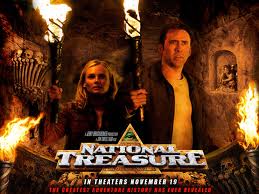
NATIONAL TREASURE
2004
Walt Disney Pictures
Directed by Jon Turtletaub
Produced by Jerry Bruckheimer
Written by Jim Kouf, Oren Aviv & Charles Segar (story)
Jim Kouf, Cormac Wibberley & Marianne Wibberley (screenplay)
I had heard a lot about NATIONAL TREASURE before I saw it. Friends of mine told me to see it because it reminded them of something that I would write. Roger Ebert just about called it an out-and-out rip off of “The DaVinci Code”. Other people said it was boring, stupid, trite, a rip-off of this or that movie or character, mostly Indiana Jones or Clive Cussler’s Dirk Pitt
I saw it for myself and you know what was the most surprising thing to me about the movie was? That this was a Jerry Bruckheimer/Nicolas Cage collaboration that didn’t have any of the qualities that were evident in their other films together such as “Con Air” or “The Rock”. This is an action movie, yes. But when you compare it to what we call action movies today, it’s practically a throwback. There is only one explosion, one car chase, one shootout, one death and even that is due to the poor dumb bastard who gets killed making a wrong step. NATIONAL TREASURE is a movie that plays as if Cage and Bruckheimer had deliberately sat down and said: “let’s do an action movie that’s totally different from what we’ve done before.” and in doing so, they’ve given today’s audience what amounts to an updated version of my beloved pulp adventure serials from the 1930’s/1940’s.
Benjamin Franklin Gates (Nicholas Cage) has spent his entire life looking for a treasure that has passed from Emperors to Kings to Pharaohs and finally to The Founding Fathers of The American Government. The treasure has grown to such enormous wealth that supposedly it’s “too large for any one man or nation to own” and The Knights Templars protected it in Europe for hundreds of years until it was moved to America along with The Knights Templar who became The Freemasons. The Freemasons counted among their members such notable Founding Fathers such as George Washington, Thomas Jefferson, Paul Revere and Benjamin Franklin who left clues scattered among the various works they left behind as to where this fabulously immense treasure could be found.

Gates has discovered that the map to where the National Treasure is located is on the back of The Declaration of Independence. What is unfortunate is that he can get nobody to believe him, especially The FBI or Dr. Abigail Chase (Diane Kruger), who is a curator at The National Archives. When Gates tells her about the invisible map that is on the back of The Declaration of Independence and has been there for hundreds of years undetected she asks him quite seriously: “Who wrote it there? Bigfoot?”
Gates doesn’t have much time to try and change the minds of the FBI or Dr. Chase since his former partner Ian Howe has double-crossed him and intends to steal The Declaration and find the treasure. Gates decides that the only thing to do is steal The Declaration of Independence himself, along with his brilliant tech-savvy sidekick Riley Poole and find the treasure before Ian does.
NATIONAL TREASURE has a lot going for it in the way it handles the characters and the motivations behind what they’re doing. Gates is not a treasure seeker in the conventional sense and indeed, he keeps telling people that he’s a ‘treasure protector’. He’s looking for the National Treasure to vindicate his family name since The Gates Family are looked upon as crackpots by the historical/archeological community for believing that the treasure is real. And he’s got a diverse and interesting background as shown by a scene where the FBI Agent assigned to catch Gates (played by Harvey Keitel) reads Gates’ file. Gates has degrees in a whole bunch of diverse fields, which leads Keitel to muse; “I wonder just what this guy wanted to be when he grew up”.

And the relationship between Gates and his rival Ian is interesting and well handled as well. For once, the bad guy in a movie isn’t a bloodthirsty maniac out to kill everybody in his way. In fact, Ian tries to go out of his way not to kill anybody because as he sensibly explains to one of his gun happy henchmen: “The authorities tend to want to find out why dead bodies have bullets in them and who put them there” As a matter of fact, NATIONAL TREASURE is one of the few action/adventure movies I’ve seen recently where the bad guy actually has good reasons for why he doesn’t kill the hero when he has a chance to, especially in a scene near the end where Ian leaves Gates and his sidekicks alive in a secret tomb underneath New York’s Wall Street when he certainly would have reason not to. It surprised me and that’s not easy for movies nowadays to do.
I liked a lot of the performances here. Nicholas Cage looks more at home playing Benjamin Franklin Gates than any of the other characters in his other action movies he’s done with Bruckheimer and maybe that’s because Gates isn’t an Indiana Jones, despite what you may have read or heard. Gates isn’t a super martial artist or expert gunman or daredevil adventurer. He’s an historian searching for vindication of his family’s dream and he plays it that way. When he’s confronted with bad guys brandishing automatic weapons he runs like his ass is on fire and he only stops to fight when he has no other way out. What makes him dangerous is his brainpower: he sees connections and can make them faster than anybody else and he’s smart enough to know that about himself and use it to his advantage.
Sean Bean is absolutely great as Cage’s rival in the race for the treasure and you get the sense that a lot of the reasons why he doesn’t kill Gates is that he really admires and respects Gates’ knowledge and resourcefulness. Jon Voigt has a lot more to do here as Patrick Henry Gates, the father of Cage’s character than he had to do as Lara Croft’s father in “Tomb Raider”. Justin Bartha as Riley Poole is one of the best sidekicks I’ve seen in recent moves and he has a wonderful scene where he proves just how much that a sidekick can enhance the hero’s character.
The main selling point for me with NATIONAL TREASURE, that it isn’t an Indiana Jones type of cliffhanging-thrill a minute-claw your date’s arm-type of movie. It’s more in the nature of a scavenger hunt and the fun comes from seeing Cage’s character and his sidekicks put together the clues and piece them together. Not that to say that there aren’t thrills aplenty: this is an exciting movie with fights, captures, chases and plot twists. It’s just that it isn’t packed with explosions, car chases and deaths every five minutes

Having said all that let me say that I recommend NATIONAL TREASURE wholeheartedly. I had an excellent time with the story and characters and I don’t even think you’ll miss the usual mayhem that we expect from a Bruckheimer/Cage action movie. Are there holes in the plot holes and flaws? Sure there are. Cage and his crew find a ship that has supposedly been buried in the Arctic ice for hundreds of years far too easily. And would gunpowder burn after being buried under the ice for that long a time? And there’s another scene later on where Cage and his crew just happen be standing at the tower where The Liberty Bell is kept so that the shadow of the sun will be cast at just the right moment at just that right moment so they can find another clue to the treasure. But by that time I had been so captivated by the performances and the sheer audacity of the story’s premise I was just watching and saying to the movie; “what the hell, let’s go.” And I suppose that’s the best way I can tell you to take your viewing of NATIONAL TREASURE: sit back in your seat with your soda, popcorn, candy and say: “what the hell, let’s go.” Movie studios don’t make Saturday Morning Serials anymore but every so often they do make movies like NATIONAL TREASURE to remind us that once upon a time they did.
Rated: PG
131 Minutes
THE LONG MATINEE-Movie Reviews by Derrick Ferguson
THE LEAGUE OF EXTRAORDINARY GENTLEMEN
2003
20th Century Fox
Produced by Trevor Albert and Don Murphy
Directed by Stephen Norrington
Screenplay by James Robinson
Based on the graphic novel by Alan Moore and Kevin O’Neill

The concept of THE LEAGUE OF EXTRAORDINARY GENTLEMEN is so simple that I’m honestly surprised nobody before Alan Moore thought of it. Here it is in a nutshell: From time to time many of the great fictional heroes (and sometimes villains) of the past and present have found it necessary to come together to form an alliance against evil so overwhelming that it threatens to conquer or destroy the world. They do so under the authority of a special Branch of The British Secret Service, under the direction of a mysterious figure known only as M. This alliance is known as The League of Extraordinary Gentlemen. It is rumored that members of Leagues past and present have included Dr. Syn, Sherlock Holmes, Captain Blood, Lemuel Gulliver, Robin Hood, Tarzan, Doc Savage, The Shadow, James Bond, and many, many others. But for the purposes of this review we’re going to look at a particularly unique grouping of The League, one led by the world famous adventurer Allan Quatermain (Sean Connery)
Allan Quatermain is an old man, living in Africa, drinking his days away and only wanting to be left alone. However, events in the rest of the world bring him back into action. A mysterious man known only as The Phantom is threatening the governments of the world into a global confrontation and there is seemingly no way to stop him since he has advanced weapons such as automatic weapons, body armor and tanks. Quatermain is brought to London where he is introduced to M (Richard Roxburg), The current head of the British Secret Service who informs Quatermain that he has been chosen to lead the newest incarnation of The League Of Extraordinary Gentlemen whose membership includes Captain Nemo (Naseeruddin Shah), The Invisible Man (Tony Curran) and Mina Harker (Peta Wilson) who has the benefit of vampiric powers due to he relationship with an infamous Transylvanian count. Quatermain and his team quickly acquire the grown up Tom Sawyer (Shane West) who is now an agent of The United States Secret Service. Dr. Henry Jekyll (Jason Flemyng) and his monstrous alter ego Mr. Hyde as well as the immortal Dorian Gray (Stuart Townsend) also join up and they’re all off an adventure that takes them all over the world from London to Paris to Venice to a final confrontation at the top of the world in the frozen Artic where the secrets of The Phantom are revealed and the destiny of a new century will be decided as The League Of Extraordinary Gentlemen make their final stand.

You’re going to have a lot of comic book fans that will tell you not to see THE LEAGUE OF EXTRAORDINARY GENTLEMEN as they feel that the movie bastardized Alan Moore’s concept. I’ve given the trade paperback of the comic to several people whose opinions I trust and they have told me that while they like the comic and appreciate it for what it is they wouldn’t have gone to see a movie that was strictly based on the comic book. However, those people have also said that the greatly enjoyed the movie version and I think that’s because the movie version does exactly what it’s supposed to do: provide us with two hours of thrills, adventure and excitement. Yeah, yeah, yeah, it’s not the comic books but it is a great piece of outsized, overblown, pulp action/adventure taken to the extreme and part of the reason I had so much fun watching the movie was that I could see the directors, actors and special effects guys just saying “the hell with it” and allowing themselves the room to have fun with the concept and just working with the material they were given and making sure they delivered.

THE LEAGUE OF EXTRAORDINARY GENTLEMEN is a movie I loan out to friends and family often when they ask me what’s a good Saturday night movie. First off, you’ve got Sean Connery who’s simply great. When he made this movie he was 75 years old and he’s the only 75-year-old actor in the world who can get away with beating the snot out of actors half his age and look totally convincing doing it. Other actors look embarrassingly silly in their older years trying to do action scenes but somehow Connery can still pull it off and look convincing. There’s a bunch of great scenes he has with Shane West’s Tom Sawyer where the characters obviously build a father/son type of relationship, especially in the scenes where Allan Quatermain and Tom Sawyer are chasing down Mr. Hyde across the rooftops of Paris and a later scene aboard Captain Nemo’s Nautilus where Quatermain teaches Tom how to shoot. Peta Wilson is terrific as Mina Harker who shows a delightfully dark side to her character and I really liked how Naseeruddin Shah played Captain Nemo. As far as I know this the first time the character of Captain Nemo has been played racially correct in a movie and he supplies the team with their technological/transport support. And his fight scenes are among the best in the movie as he gives Captain Nemo a distinctive martial arts style. He plays Captain Nemo in a way unlike any other actor that’s ever played before and I think he’s probably the only actor who might have read the graphic novel the movie was based on. There’s a certain way he carries himself and the way he says his lines that make you sit up straighter and pay attention and his fight scenes are among the best in the movie. Listen to how he says: “Behold Nautilus…The Sword of The Ocean” and tell me that ain’t downright cool.

That’s not to say that the movie is without its flaws. I really didn’t like how the CGI guys went nuts on the effects. Especially when it came to Mr. Hyde and The Nautilus. In this movie, Dr. Jekyll and Mr. Hyde are more like the Marvel Comics version of Dr. Bruce Banner and The Hulk than the Robert Louis Stevenson original. And Captain Nemo’s Nautilus is huger, bigger and more technologically advanced than any modern day aircraft carrier. And the scenes in Venice make absolutely no sense whatsoever. There’s a whole lot of yelling and chasing around and fighting and shooting but when it’s all over you’re wondering: “What was that all about?” Not to mention that there’s absolutely no mollyfoggin’ way something as big as The Nautilus could navigate the canals.
But there are a lot of little nice touches. The obvious one is where Quatermain is receiving his assignment to assemble The League from M. And if you don’t appreciate the humor of Sean Connery once again getting orders from M then you really need to go back to Basic Film School. And pay attention to the scene between M and Quatermain because in the background are huge portraits of former Leagues. I also liked how Captain Nemo’s First Mate has a running joke in the movie where he has to keep introducing himself: “Call me Ishmael”
There’s some incredible fight sequences and plot twists that I honestly didn’t see coming and even though I felt the final fight between Mr. Hyde and The Phantom’s main big bad who has ingested a near lethal dose of the Hyde formula was yet another reason for the CGI boys to go wild I liked the relationship between Mr. Hyde and Captain Nemo as they struggled to find a way to defeat their foe as well as the ending scenes between Allan Quatermain and Tom Sawyer.
So should you see THE LEAGUE OF EXTRAORDINARY GENTLEMEN? I see no reason why you shouldn’t. Don’t listen to your comic book reading friends who’ll tell you that it’s nothing like the comic book. Of course it isn’t like the comic book. It’s a movie and a pretty damn good entertaining one. Go ahead and watch it and have fun for what it is: it’s purely pulp action/adventure designed to get you interested in reading the source materials and characters it’s based on. No more and no less. But that doesn’t mean you can’t have a good time watching THE LEAGUE OF EXTRAORDINARY GENTLEMEN before you read the material it’s based on.
110 minutes
Rated PG-13
THE LONG MATINEE – Movie Reviews by Derrick Ferguson
KING KONG
2005
Universal Pictures
Produced by Jan Blenkin, Carolynne Cunningham, Fran Walsh and Peter Jackson
Directed by Peter Jackson
Screenplay by Fran Walsh, Philippa Boyens and Peter Jackson
Based on a story by Merian C. Cooper and Edgar Wallace
Friends of mine will often ask me how I feel about remakes of movies. They’re actually surprised when I say that I honestly don’t mind when movies are remade. Broadway does remakes all the time. Except they call them revivals and they’re usually greeted with open arms and much love. They expose a whole new generation of theatergoers to the experience of seeing classic musicals performed live on stage. So why not do new versions of classic movies? Either people will go see it or they won’t. And if the writers, producers, actors and crew treat the source material with respect and stay true to the spirit of the original, that will be apparent to those fans of the original and even though they love the original to death, they will embrace the remake for what it is.
What I do object to however are lousy remakes that do a disservice to the original film or remakes of movies that actually don’t need to be remade. The classic 1933 “King Kong” is a perfect example of a movie that was done a disservice when it was remade in 1976. It took Jessica Lange’s career five years to recover from that bomb (she wouldn’t get a decent break until she co-starred with Jack Nicholson in “The Postman Always Rings Twice”) and poor Jeff Bridges fared even worse. The next five movies in a row he did flopped miserably (including Michael Cimino’s horribly underrated “Heaven’s Gate”) and he really didn’t bounce back until 1982’s “Tron” As for the director of 1976’s “King Kong”…well, you tell me…when was the last time you went to a movie that was directed by John Guillermin?
However, when it was announced that Peter Jackson was going to direct a new version of “King Kong” just about everybody who is a fan of the original sat back and sighed in relief. Like Ray Harryhausen, George Lucas, George Romero, and Steven Spielberg, Peter Jackson had proven he was able to employ the medium of film in such a way that he created an entire universe on screen and for the running time of his films, he transported us to a completely other reality and made us believe it existed.
Peter Jackson’s KING KONG is one of the most amazing movies I’ve ever seen in my life and if you can possibly see it on HD DVD on a big screen television as I did (I watched it at my brother-in-law’s house on his 60-inch HDTV) trust me…you’re going to see a picture quality that actually is better than the quality of the movie you saw in theatres. At least I think so. We watched “Van Helsing” before we watched KING KONG and even though I think “Van Helsing” is a pretty lousy movie, in HD it looks so damn good I found that I didn’t even mind watching a lousy movie. But I digress.
It’s 1933 and the country is in the grip of The Great Depression. But even though breadlines are plentiful and work is scarce, people still crave their entertainment. Either through vaudeville or the movies. Which is what brings together struggling actress Ann Darrow (Naomi Watts) and maverick director Carl Denham (Jack Black) Denham needs an actress quick for his new movie which he’s shooting on location. Ann’s not too sure as Denham is sorta reluctant to specify where they’re going but he promises riches, adventures and a chance for Ann to work with the writer Jack Driscoll (Adrian Brody) who she idolizes.
It isn’t until Ann and Jack are aboard the tramp steamer Venture, captained by Captain Englehorn (Thomas Kretschemann) and crewed by a rag-tag gang of sailor/mercenaries that everybody realizes they’ve been conned by Denham into this expedition to an island that may not exist. Denham insists he has a map. And the map does lead them to an island. And what an island it is. A time-lost island on which a towering stone wall is decorated by skeletons and guarded by a vicious, savage tribe that worships a god they call…Kong. Ann is kidnapped by these savages and offered up as a sacrifice to Kong who is a 25-foot gorilla. He takes Ann into the jungle where he is pursued by Jack, a camera-toting Denham, square –jawed leading man and movie idol Bruce Baxter (Kyle Chandler) and the sailors of the Venture, determined to save her from her fate worse than death. I give them guys credit. What they go through on Skull Island would have had Indiana Jones pissing in his pants. Not only do they have to deal with Kong but also Skull Island which is a Lost World That Time Forgot of prehistoric creatures that shouldn’t exist. There are Tyrannosaurus Rexes, Brontosaurus, insects that can eat a case of Raid for dinner and have your head for dessert. Leeches the size of Buicks. Vampire bats big enough to bring down fighter jets. And that’s just the beginning.
Our hardy band of adventurers manages to survive the island’s many dangers, rescue Ann and is barely able to subdue and capture Kong. They take him back to New York where Carl Denham puts him on exhibition in a Times Square theatre. You know the rest of the story.
KING KONG is really a superior example of what can be done with such fantastic material when it’s treated with respect for its own reality. Peter Jackson had the good sense to set the movie in period (1933 was the actual year the original “King Kong” was made) since it’s a lot easier to believe that there could be a Skull Island in 1933 rather than in 1976. The 1930’s was such a rich period of high adventure that when you see hard-bitten guys stalking through a dinosaur infested jungle with cigars in their clenched teeth, flasks of whiskey in the hip pockets and toting Chicago Typewriters, you just buy it with no reservation.

The performances are stellar. I’ve never been much of a Jack Black fan (I still don’t see what the fuss over “School Of Rock” was all about) but I really enjoyed him in this movie. He has nowhere near the energy of the original Carl Denham, (the late great Robert Armstrong) but he has a strange look in his eye that I think develops into full-blown madness during the movie’s most frightening scene where Denham, Jack Driscoll and several crewmen are at the bottom of a deep crevice and have to desperately battle for their lives against giant insects. The choice of Jack Black and Adrian Brody as the movie’s leading men is a good one since both of them look like….well, like regular guys. They’re not impossibly handsome or pretty (I’m looking at you, Orlando Bloom) and that goes a long way with me to lending realism to their characters. As Ann Darrow, Naomi Watts has to carry a lot of the movie on her shoulders since she interacts with Kong more than any other character in the movie and she pulls it off superbly. There’s a terrific scene where she goes into her vaudeville act to amuse Kong and amazingly, the big ape enjoys the show. And for me the most spectacular action sequence in the movie is the ultimate giant monster smack down where Kong proves exactly why he’s King when he takes on not one, not two, but three Tyrannosaurus Rexes in a truly epic showdown of colossal proportions.
Chances are most of you reading this have already seen KING KONG so I don’t have to sell you on it. But if by chance you haven’t yet seen it, by all means put this one on your Netflix list. KING KONG is a rare animal: a remake that is more than worthy to stand shoulder to shoulder with the original. It’s totally everything that I love about the movies. Enjoy.
187 minutes
Rated PG-13
TIPPIN’ HANCOCK’S HAT-Reviews by Tommy Hancock
FROM THE VAULT: THE PULP FILES
MOONSTONE BOOKS-THE RETURN OF THE ORIGINALS
Wow. If it were kosher to leave one word reviews, then that would be my one word. This fine compendium of fact sheets on pulp characters that will appear in Moonstone’s RETURN OF THE ORIGINALS line does not tell a story in a traditional comic sense, but it sure weaves a tale of heroes, tragedy, justice, and redemption like none you’ve ever read. From The Spider to the Green Lama to The Golden Amazon and Death Angel (Who? Why new additions to the genre of course), the breadth of pulp history that is covered in these 36 pages is astounding. The file like look of the fact sheets is awesome and the accompanying art, pretty much a pin up with each fact sheet, makes me not only want to see this line of books, but wants Moonstone to tackle ALL the pulp heroes AND villains in this format, just for informational purposes for us writers!
Five out of Five Tips of Hancock’s Hat-and if you didn’t hear me the first time…wow.
TIPPIN’ HANCOCK’S HAT-Reviews by Tommy Hancock
THE SPIDER-CITY OF THE BLEEDING SNOW (11 PAGE STORY)
Writer-Martin Powell
Artist-Tom Floyd
Although this story is not newly published, it is one that bears reviewing, primarily because several people have mentioned it to me as ‘a story you just have to read’ or ‘the best Spider story ever.’ With praise like that, I had to look for myself.
Is it the best Spider story ever? Maybe, maybe not, but it’s close. Did it turn out to be something I just had to read. You bet your pointed teeth and spider ring it did!
In ten pages, Martin Powell twists a tale that in all honesty comes in at the middle. It’s a typical Spider and pulp type tale, Bad guy has the Spider’s beloved captured and is delivering chemical vengeance on the city and it’s up to the Spider to stop him. But what Powell works into this in a short space is pathos, action, romance, and character education as well as development. If you read this story and know nothing of the Spider, this ten pages gives you enough to say you know something about the character.
The art of Tom Floyd blends well with the storytelling in this tale. It’s classic art on one hand, yet disturbing on the other. The reason it’s disturbing is even though the Spider’s world is dark and scary, Floyd’s art makes it look very much like..our world. This story because of its art and its human portrayal of this most inhuman acting character hits a really poignant note of realism.
Five out of Five Tips of Hancock’s Hat-Good show, gentlemen and Moonstone. Good show.
TIPPIN’ HANCOCK’S HAT-Reviews by Tommy Hancock
BLACK BAT DOUBLE SHOT REVIEW-PART TWO
Writer-Mike Bullock
Artist-Michael Metcalf
(NOTE-This review is for the second of two stories in this issue. A review of the first story has already appeared on ALL PULP! Just click REVIEWS and scroll down!
Death Angel
Pulp writers today walk a multitude of slippery slopes and fine lines. They have to be careful when dealing with established characters not to tick off hardcore fans and also not to alienate new readers. It’s even more hazardous when introducing a new character into the Pulp genre. Writers run the risk of being accused of being derivative if their creation is too similar to a pulp icon or, even worse, they get accused of not knowing what in the tommy guns they are doing, trying to shoehorn a modern idea into the pulp world.
The creators behind the DEATH ANGEL story in the second half of Black Bat: Double Shot, Moonstone Books, walk that slope. And they do it really, really well.
Death Angel, an original creation of the book’s creative team, Bullock and Metcalf, is a vigilante with a horrible visage and a dedicated mission to see justice done. As violently and as bloodily as possible. Although some would argue that the character looks to be more modern in appearance than some might like their pulp characters, make no mistake. If artists of the past could have gotten away with it (and some arguably did), then there would have been some really scary lookin’ good guys back in the day.
The story is very fast paced, dealing with a new drug on the scene that essentially drives the user insane. Death Angel encounters a couple of these junkies and deals with them swiftly and savagely, but Bullock works in character development in this cyclone of a tale as well, with a literal ‘behind the mask’ moment, one that may surprise people who didn’t read the Angel’s debut.
The art is solid, stark, and insane. The line work is tight, yet at times, particularly when Death Angel uses some of her devices, the word ‘psychedelic’ could be used. The story moves along like a freight train out of control and out of track. It’s hindered a little by its own speed, moving almost too fast to be understood and enjoyed in a single reading. Overall, however, Death Angel’s story in this double shot stands up well against her companion, The Black Bat, and is a welcome denizen of the night seeking justice in the pulp genre!
Four out of Five Tips of Hancock’s Hat (usually reserved for heads of state, arresting officers, and little old ladies, which is pretty darn good.)
ALL PULP REVIEWS by Ron Fortier
 REVIEW – GREEN HORNET – YEAR ONE
 Dynamite Comics
Writer Matt Wagner
Artist Aaron Campbell
Okay, so the Green Hornet was never a pulp hero, having been born on the radio along about the same time as the Shadow and other great melodramatic heroes. He would also make the jump to the movie serials and comics casting him clearly in the same mold as the glorious pulp characters of his day.
Earlier this year Dynamite opened the Green Hornet floodgates and inundated the comic world with more Green Hornet titles than ever put by a single publisher before. There was Kevin Smith’s supposed old unused movie script and individual books featuring the various Katos etc.etc. For the most part most of these are lackluster affairs truly not worth any fans time or hard earned coins.
Almost lost amongst this plethora of mediocre fare was one singular gem, GREEN HORNET – YEAR ONE. Conceived and written by veteran scribe Matt Wagner, it tells the story of the original verdant clad avenger and his Asian side-kick in a historically accurate time frame. It is the late 1930s and Germany and Japan are dicing up the world map to their own gratification and dreams of empire building. Against this background, Britt Reid, the bored, educated son of a Chicago newspaper publisher, decides to answer the call of wanderlust and go traipsing around the globe. He wants to have one big glorious adventure before he resigns himself to filling his father’s shoes and spending the next twenty years of his life behind a desk.
Meanwhile in the Land of the Rising Son, Hiyashi Kato has been raised by his noble sire to be a modern Samurai and live by their strict code of martial honor. When he is summarily drafted into the Japanese Imperial Army and becomes part of the invasion of China, he witnesses acts of brutal atrocity that challenge his very moral core. He deserts, choosing in the course of right and ultimately crosses paths with the young American, who saves his life in a freakish accident. Kato vows to accompany Reid and be his companion until his debt his repaid.
Wagner, realizing today’s audiences need action, jumps back and forth between these events and those occurring after the duo’s return to Chicago. Here they discover Reid Senior has died and left the running of the Daily Sentinel to his son. Once in this lofty position, Britt will come to understand the dept of the corruption infecting his beloved city by the criminal gangs, all of which will lead him to become a masked crime fighter with his loyal Kato ever at his side in the livery of a masked chauffeur.
Aaron Campbell’s art is so evocative of the times this story unfolds in, one has to wonder if he doesn’t spend every waking second in a library reference hall. His work captures not only the look but the atmosphere of these unsettling days when America, having just survived the Great Depression is on the brink another world conflict, unsure if the future spells doom or glory for the brash young country.
GREEN HORNET – YEAR ONE is a terrific comic series and does justice above and beyond to one of the great classic radio heroes of all time. Any pulp fan worth his fedora would be wise to pick it up.
ALL PULP REVIEWS By Ron Fortier
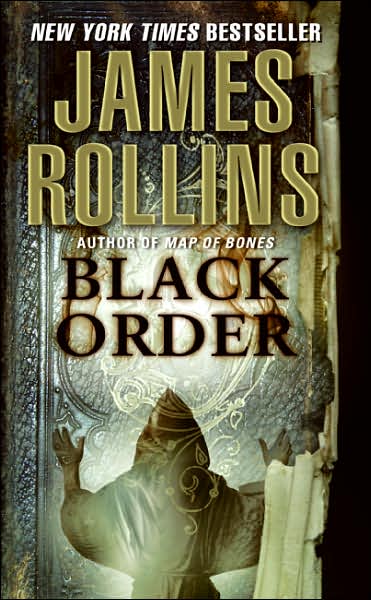
BLACK ORDER
By James Rollins
Harper Books
506 pages
When a book mixes science, religious philosophy and secret societies dating back to the Nazis, you can expect a real spicy pulp stew. Veterinarian turned thriller novelist James Rollins delivers just that and the meal is absolutely scrumptious for the first page bite to the last closing line morsel. Easily one of the best modern pulp adventures I’ve ever had the pleasure of reading.
The adventure opens during the closing days of World War II when allied forces are racing against each other to lay claim to Germany’s scientific innovations developed during the war to include everything from rocket propulsion to medical experimentation.
Amidst this chaos, one German commando unit is attempting to flee the invaders and smuggle out the results of an amazing breakthrough in quantum physics that could alter the shape of mankind forever. Along with these papers and artifacts is a baby unlike any other in the world; the first of a race of true supermen.
Like any good thriller writer, Rollins then jumps ahead in time to the present where members of a special Washington based group known as Sigma Force are involved with what they believe to two distinct missions. The first is an antique book auction being held in Copenhagen and the second is a distress call from a Tibetan monk residing in a monastery located deep in the Himalayas. Commander Gray Pierce follows the European case which centers around a group of killers eager to get their hands on Darwin’s Bible. It supposedly contains secret runes put their by a former German scientist involved with a secret project known only as the Bell. At the same time, Sigma Director Painter Crowe arrives in Tibet, only to find the monks have somehow gone insane and murdered each other. No sooner does he uncover this horror then he is captured and taken to a hidden mountain lair operated by the descendants of the very same German researchers who developed this mysterious Bell.
Rollins’ genius is that he keeps both plot threads moving at breakneck speed, constantly putting Pierce and Crowe in cliffhanger perils and then deftly jumping from one to the other. Thus the action seems to flow non-stop, scene after exciting scene. He also glues these action set pieces with thought provoking debates on what is evolution and where do science and religion meet in its process. Is there a grand design and will quantum physics someday open the blueprint to creation? That these weighty dissertations occur while men are being shot at, mountains exploding and mutated monsters roam the jungles of South Africa is all part of the roller-coaster ride BLACK ORDER delivers.
Recently a friend wrote asking me to passing along names of people I considered to be top-notch modern day pulp writers. James Rollins was at the top of the list I passed along and BLACK ORDER reaffirms that choice beautifully.
THE LONG MATINEE– Movie Reviews by Derrick Ferguson
 DICK TRACY
1990
Directed and Produced by Warren Beatty
Written by Jim Cash and Jack Epps, Jr.
Based on the characters and comic strip created by Chester Gould
So I’m at home taking care of some chores since Patricia and I are trying to get the house in order for Labor Day Weekend. I take the opportunity to burn some movies from one of my DVRs to DVD and free up some recording space and two of those movies happen to be the Tim Burton “Batman” and DICK TRACY. Patricia is curious as to why I put the both of them on the same DVD. I shrug. I dunno. Just worked out that way.
She has a different theory. “Maybe because your subconscious made the connection that if Bruce Wayne had decided to be a cop instead of Batman he’d be Dick Tracy?”
Actually, I think it had more to do with the fact that both movies together had enough running time to fit on one four hour DVD but I have to admit that Patricia may just have a point. Batman and Dick Tracy have an awful lot in common. Both men have sacrificed normal lives to wage an unending war on crime. Both fight bizarre villains with outrageous physical and psychological deformities. Both utilize advanced technology in their work and both wear distinctive outfits that identify them immediately so you have no doubt whom you’re dealing with.
This is never more apparent than in the scene where we first see Dick Tracy (Warren Beatty) clearly when he steps out of a police car wearing a black suit, white shirt, red tie and yellow trench coat with matching hat. Now no self-respecting cop in the real world is going to wear a getup like that but hey, this is DICK TRACY we’re talking about and the way Warren Beatty wears the clothes and plays the character, we buy into it with no problem. He’s Dick Tracy.
Dick Tracy has been summoned to a massive mob rubout. Big Boy Caprice (Al Pacino) has made his move to take over The City. He’s rubbed out his major rival Lips Manliss (Paul Sorvino) and seized all of his assets, including his sizzling hot girlfriend Breathless Mahoney (Madonna) who’s also the best singer in The City, backed up by her master pianist 88 Keys (Mandy Patinkin)
Dick Tracy isn’t able to get the goods on Big Boy, not even after sweating Big Boy’s stooges Mumbles (Dustin Hoffman) Flattop (William Forsythe) and Itchy (Ed O’Ross). But he’s not about to let Big Boy have his way in his town and he goes on a crime busting crusade that would make The Dark Knight himself envious. While Dick Tracy is cleaning up the town against such miscreants such as The Brow (Chuck Hicks) Pruneface (R.G. Armstrong) and Spud Spaldoni (James Caan). He’s also got to deal with other matters such as his relationship with his longtime girlfriend Tess Trueheart (Glenne Headley) who’s starting to think that maybe there’s not much future in being involved a man whose true love is fighting crime. And then there’s The Kid (Charlie Korsmo) a street urchin who comes to live with Dick Tracy after Tracy catches him stealing a watch and maybe is awakening in him paternal instincts Tracy never had before. And Breathless Mahoney starts coming after Tracy for reasons of her own and the feelings she’s awakening in him had best not be mentioned if we’re to keep this review family friendly.
DICK TRACY originally showed up in theatres the year after the wildly successful Tim Burton “Batman” and it was pretty obvious that Touchstone Pictures/Disney was trying to generate the same kind of hysteria “Batman” had generated and they came pretty close. The DICK TRACY logo was almost as ubiquitous as the Bat symbol had been the summer before and the media hype generated was at a fever pitch, fueled mostly by the Madonna/Warren Beatty romance that had begun while they were filing this movie. But despite all the hoopla that DICK TRACY would be another “Batman”, it stands up as a unique interpretation of the character. I like how everything in this world has only primary colors and most of the time everything is staged as if the action is supposed to be in individual comic panels. And there’s no product placement at all here. When Tracy opens a can of beans the label simply says ‘Beans’. The police cars simply say ‘Police’. A tube of toothpaste simply says ‘Toothpaste’. It’s a comic book world these people inhabit and as a director, Warren Beatty does an excellent job of translating a comic book world into a real life language we as an audience can get a hold of and accept with batting an eye. I love the look of DICK TRACY and I don’t think another movie until “SinCity” would so accurately capture the look of the comic book it was adapting.
That’s not to say that there’s not things about the movie I don’t like. Much as I love Madonna I wish the movie had spent less time with her trying to vamp Dick Tracy and more time with him going toe-to-toe with the various bizarre crime bosses of The City in tommy-gun shootouts. I mean, this movie has great visual bad guys like Littleface, The Brow, Influence and Mumbles and most of them we see only enough of to get us interested in and then they’re either bumped off or we never see them again. I also don’t like the music by Danny Elfman. He’d just done the soundtrack for “Batman” the year before and indeed, a lot of the music in DICK TRACY sounds like music left over from “Batman”
But then there’s the extraordinary visual style of the movie, which suckers me in every time. And the performances of Warren Beatty and Al Pacino. Warren Beatty really seems to be having fun playing Dick Tracy and I wished he could have made a sequel. He manages to be unbearably square and awfully cool at the same time and as I said earlier, I don’t think there’s another actor who could wear a bright yellow coat and hat while looking cool. Glenne Headly as Tess Trueheart is really good. I like how she lets Tracy knows that she knows what kind of man he is and what life would be like as his wife and it’s cool with her. It’s Tracy that’s too busy cleaning up crime in The City to pick up on the signals.
And there’s a remarkable amount of talent in DICK TRACY. You oughta see it just for the cast alone. You’ve got Warren Beatty, Al Pacino, James Caan, William Forsythe, Ed O’Ross, Glenne Headly, Seymour Cassel, Charles Durning, Allan Garfield, John Schuck, Charlie Fleischer (we all love him as the voice of Roger Rabbit) Mandy Patinkin, Madonna, Paul Sorvino, James Tolkan, Dustin Hoffman, Kathy Bates, Dick Van Dyke, fer crying out LOUD! Colm Meany (from Star Trek: Deep Space Nine) Catherine O’Hara, Henry Silva, Mary Woronov, Michael J. Pollard (Warren Beatty’s co-star from “Bonnie & Clyde”) and Mike Mazurki….whew….and that’s not even half of the cameos you can spot when you really try.
So should you see DICK TRACY? Sure. I don’t see why you wouldn’t. Yeah, it may not have a lot of over-the-top violence and sex and cussing and all of those things. But it’s just plain old fun to watch. It’s a movie you can pop into the DVD player, sit back with your beverage and snacks of choice and just have a good time watching. And it’s for that reason that I suspect it’ll be a favorite of many for a long time. I know it’ll be one of mine. Enjoy.
RATED PG
103 minutes

Tippin’ Hancock’s Hat-Reviews by Tommy Hancock
THE PHANTOM UNMASKED, Moonstone Comics
2010
Story by Martin Powell
Art by Hannibal King
Colors by Andrew Dalhouse
Letters by Tom Floyd
Covers by Franchesco
Some characters have such rich, colorful histories, such wonderfully woven continuities, that they simply invite writers and artists to play with them. The enchantment of a particular hero, the draw of a lost land or hidden sanctuary, the siren’s call of a mythology has summoned many a creator to try their hand at established characters with such glorious baggage. Lee Falk’s Phantom is one such character and after reading THE PHANTOM UNMASKED, a two issue miniseries from Moonstone Comics, I for one am ecstatic that Martin Powell, Hannibal King, et al. did not ignore the pull toward Falk’s creation. In fact they embraced it much like The Ghost Who Walks himself might embrace a savage lion.
THE PHANTOM UNMASKED is a very complex, yet very fast tale. The Phantom, although it is about him, plays more of a backseat role initially to the quest for information about him. An old enemy desires to know all he can of the Phantom and hires a well known lady investigator for hire to gather the information. Laughton Brice, one of the most striking female characters I’ve seen in a long time, both in artistic rendering and overall development, overlooks the holes in her employer’s story and dives into the search. Why? Not just for the money, but for her own reasons. Powell captures well the purpose of this story. It is about searching, finding oneself. Finding the good, the bad, the hero, the villain. That is done extremely well in the first issue. What is done even better in the second issue is the other half of the point. Once you find what and who you are, the hardest part is actually looking upon your true self. The second issue sees some stripped clean of any camouflage, others forced to face their own secrets, and still others refusing to understand. And the title of the series holds a very special literal meaning that was not only expected, but also angered me in a very, very positive way. You’ll see when you read it.

As concise and tight as the writing is, the art is built to match. King’s images are sleek, suggestive, and move the story along wonderfully. Both issues gallop along with the speed of a 1940s serial cast in stark bright color. The team that took Powell’s tale and drew from it these wonderful images deserves as much credit as the storyteller himself.
In no way does THE PHANTOM UNMASKED disappoint. It is a taut, revealing story that touches all the right places to make one care for or despise characters, or maybe a little of both for some.
Five out of Five Tips of Hancock’s Hat (Five tips are reserved only for those who have channeled Dent, Gibson, Page, or one of the long gone, but not forgotten greats.)
THE LONG MATINEE-Movie Reviews by Derrick Ferguson
THE PHANTOM
1996
Paramount Pictures
Produced by Robert Evans and Alan Ladd, Jr.
Directed by Simon Wincer
Written by Jeffrey Boam
Based on “The Phantom” created by Lee Falk
I have absolutely no idea why some movies become major hits and others fail miserably. Especially a movie such as THE PHANTOM which ranks right up there with “Superman: The Movie” Tim Burton’s first “Batman” “Batman Begins” “Spider-Man” “The Rocketeer” and “The Hulk” as one of the best superhero movies ever made. Hell, it’s a damn good movie, period. The cast is outstanding, the locations beautiful, the action non-stop, the music appropriately heroic and romantic. This was a movie that should have been a blockbuster hit in theatres. But it failed to find an audience. I was one of those who saw it during the original theatrical run. I went during a matinee and there was just myself and two guys in their seventies who remembered reading “The Phantom” in the newspapers as kids. We all had a great time watching the movie. Since then I’ve recommended THE PHANTOM to a lot of people who have seen it and loved it. They claim that they never saw advertisements for the movie but that may be just as well. The tagline for the movie was so colossally stupid I hope the egg roll that thought of it was demoted to Junior Washroom Attendant (What the hell was ‘Slam Evil!’ supposed to mean?)
It may be that people just looked at the ads and assumed that The Phantom was a rip-off of Batman set in the jungle. Actually, The Phantom debuted in 1936 and Batman didn’t appear until 1939. Indeed, The Phantom is credited as being the very first costumed superhero. But so many things that made The Phantom unique has been taken as adopted by creators of other superheroes that it’s not surprising that many modern day viewers dismissed the movie as being an attempt to cash in on the popularity of Batman and Spider-Man. Which is really a shame. THE PHANTOM is remarkably faithful to the source material and a movie done with a tremendous amount of respect and love for the character.
The origins of The Phantom are told to us during the credits: In 1516 a young boy named Kit Walker is serving as cabin boy aboard his father’s ship. During a routine voyage to Africa to trade goods the ruthless Singh Brotherhood, a feared band of pirates, attacks the ship. The boy Kit is the only survivor and escapes to be washed up on the shores of Bengalla. The Bandar tribe who teach them his language befriends him. Kit finds the body of his father, partially eaten by scavengers. He takes his father skull and swears an oath upon it: Kit and all his descendants will combat piracy in all its forms. And so The Phantom is born. When one Phantom dies, his eldest son takes on the role of The Phantom. As a result, there is a myth that The Phantom cannot die and is immortal. He is known the world over as The Ghost Who Walks and it is this belief that is The Phantom’s strongest weapon in his battle against evil. Only the Bandar tribe, the wives and family of the various Phantoms know the true secret.

THE PHANTOM takes place in 1936 where the current Phantom/Kit Walker (Billy Zane) finds himself up against Xander Drax (Treat Williams) a millionaire industrialist/crimelord who is searching for the Three Skulls Of Togunda: mystical artifacts that when brought together will give him ultimate power. Drax has two formidable henchmen in the mercenary Quill (James Remar) who killed the 20th Phantom (Patrick McGoohan) and female martial arts expert/pilot Sala (Catherine Zeta-Jones). But The Phantom has help from the equally formidable Diana Palmer (Kristy Swanson, the original Buffy The Vampire Slayer, yay!) who has uncovered a connection between Drax and The Singh Brotherhood. Diana’s a plucky, adventurous girl with a mean right hook that still carries a big torch for a boy she loved in college. They had thought about getting married but his father died and he had to leave The United States to take over the family business. The boy’s name was Kit Walker.
Diana and The Phantom meet after Diana’s plane is forced down by Sala and her crew of female fighter plane pilots and The Phantom has to rescue her from a tramp steamer crewed by merciless killers. From then, it’s on to New York where Diana and Kit have a reunion that’s both painful and touching. But then Diana is once again kidnapped by Drax and his crew and taken to the horrifying island fortress of The Singh Brotherhood located in The Devil’s Vortex, from which no man ever returns. But it’s there that the third skull is located, held by the bloodthirsty Kabai Sengh (Cary Hiroyuki Tagawa) the current leader of The Singh Brotherhood. And they have their own plans for the Three Skulls…a plan that will also end their 400-year-old war with The Phantom…
Anybody who knows me knows I eat up this stuff and totally choke on it. I’ve seen THE PHANTOM perhaps a dozen times and I’ll gladly watch it a dozen more. It’s simply terrific superhero stuff that has a thick layer of pulp action adventure that is presented in such a fun way that I honestly don’t see how anybody couldn’t watch this movie without a goofy grin of delight on his or her face. Billy Zane is totally perfect in the role of The Phantom/Kit Walker in the same way Michael Keaton was perfect for Batman/Bruce Wayne and Christopher Reeve was perfect for Superman/ Clark Kent.

I really like how The Phantom is presented in this movie. First of all, Billy Zane insisted that the suit not be padded. So those muscles you see are actually his. And yeah, Billy Zane wears a purple bodysuit and makes it look damn cool. But the suit isn’t a bright purple. It’s a dark, muted purple that is even darker by what appears to be black tribal markings/tattoos on the suit that brings down the purple even more. It gives The Phantom’s costume the appearance of a tribal ceremonial garb he’s adopted for his purposes which works well with the jungle background of the character. And The Phantom is wonderfully low tech. He gets around on a magnificent Arabian stallion named Hero. His enforcer is a wolf named Devil. He carries no gadgets, just two black .45 automatics that he uses with such skill that he can knock a gun out of a man’s hand with a single shot. His radio is operated by his faithful servant/boyhood chum Guran (Radmar Agana Jao) who has to pedal the electric motor to give it power. Guran also won’t let you smoke in The Phantom’s base of operations, The Skull Cave.
It makes for a terrifically physical hero who relies more on his wits, brains and athletic abilities to get out of scrapes than we’re used to in these kind of movies. The Phantom can’t pull stuff out of his utility belt to get out of trouble which makes for a lot of really tense action scenes where you’re really wondering: “How’s he going to get outta this one?”
If you don’t know that I totally love Kristy Swanson, then be advised now that I do. I remember seeing the original “Buffy The Vampire Slayer” movie she starred in back in 1992 and I immediately became infatuated with her. And I love her in THE PHANTOM. She’s a vastly underrated actress who should have had a bigger career. She deserves it. She’s gorgeous, she’s intelligent and every time she’s on screen you believe what she’s doing. James Remar and Catherine Zeta-Jones have a great deal of fun with their badguy roles. And Patrick McGoohan is wonderful as the former Phantom who might be an actual ghost coming back to advise his son on how to handle the family business or he might be a psychological quirk that Kit needs to get through his job.

So should you see THE PHANTOM? Without a doubt, yes. In my opinion it’s one of the best superhero movies ever made and should be seen just for the performances and production values alone. It’s an awesome looking movie, period. The costumes the cars, the whole 1930’s period is recreated in fantastic style. And the damn movie is just so much fun. The Phantom is a hero is actually enjoys being a hero and it’s a change to see a hero who enjoys doing what he’s born to do to. He doesn’t angst about it or moan and cry or worry about paying rent or whatever. Simon Wincer directs this movie with a great sense of style and you get the feeling that everybody had a wonderful time making this movie.
If you’ve been reading my reviews and trust my opinion at all then go get yourself a copy of THE PHANTOM this weekend, get the snacks and drinks of your choice and have yourself a great time watching a great movie. Enjoy.
100 minutes
Rated PG
____________________
Reviews from the 86th Floor by Barry Reese
DOC SAVAGE # 6 (DC Comics)
By Ivan Brandon, Brian Azzarello & Nic Klein (Doc Savage); By Jason Starr & Scott Hampton (Justice Inc.)
This series is part of DC’s First Wave line, which puts classic pulp characters alongside some re-imagined versions of DC’s own heroes on an alternate earth. The time-frame is “today” but with design elements meant to invoke the classic pulp period (zeppelins roam the skies of New York, for instance). First Wave got off to a rocky start with pulp fans after the line’s overseer, Brian Azzarello, made a handful of comments that insulted the core fans of Doc Savage and The Avenger. Why anyone would want to launch a line by insulting the people who are already engaged by the property is beyond me but I suppose I’m not as smart as Mr. Azzarello seems to think he is. Also hurting the line is the fact that the kickoff limited series (entitled First Wave, of course) still hasn’t finished, thanks to several lengthy delays.
Early on, I tried all the First Wave titles but I dropped The Spirit after one issue, realizing that all the joy of the Eisner version had been stripped out of it. I’ve kept up with Doc Savage, though, mostly out of an inability to stop buying anything with Doc on the cover. I share this shame with all of you, like an alcoholic admitting his problem.
And it is a problem. Because this series is awful.
Issue six gives us our third and fourth writers on the series. I’ll repeat that – six issues and four writers. Right away, you see that stability hasn’t been a strong point. Now, I will give Brandon and Azzarello credit here — this is the best issue so far, but that’s not really saying a whole lot.
Because Doc’s blamed for the destruction of the Empire State Building (don’t ask), the government has brought him in for questioning and is strong-arming him, implying that he’s going to be treated as a terrorist if he doesn’t agree to take on a mission for them. Now, normally the Doc I know would love to help out the government, especially if it involves a horde of weapons aimed at the West. But in this case, Doc says no. The government ropes him back in by telling him that a supposedly dead friend of his has been spotted alive and well, in the heart of the Middle East — which is where the government wants to send Doc. After a scene in which Doc beats up a bunch of guards and uses one of them as a human shield (thankfully, the poor guard was just shot full of mercy bullets), Doc and his aides take off for the Middle East, where we see the area where “The War” ended five years before. Since Doc and his gang seem to avoid anything resembling a plan, they’re quickly in hot water and Doc is left to fend for himself, whereupon he’s quickly taken prisoner. End of story.
The sad thing is, as I’ve pointed out, this is the high-water mark for the series. This book failed on several rather important levels: 1) It’s boring. Doc Savage may have been many things, but I don’t recall it ever being boring. 2) Who are these people? If you know Doc and the gang, you can mostly figure out who the aides are from the pictures but not always. The script doesn’t refer to most of them by name nor does it tell you anything about why they do these things. Back when Jim Shooter was at Marvel, he frequently pointed out that every issue was someone’s first, so you should find a way to remind people who your characters are, what their motivations are, and why people should care about them. Obviously, Azzarello and Brandon figure that you should already know these things, which is ironic given Azzarello’s stated opinion that nobody remembers Doc and his ilk anyway. Seems like he’d want to explain it all to people, then. He doesn’t.
Ah, but there’s still room for the issue to be saved — there’s a backup feature, after all. In part one of a new serial entitled “Murder and Vengeance,” we find out about Justice Inc. ‘s Smitty. To be honest, I wasn’t sure this story was about Smitty but that’s what it says on DC’s website: “And in the JUSTICE, INC. co-feature, a new story sheds light on the criminal past of Smitty, one of Benson’s most trusted detectives.” It’s funny, ’cause in the books Smitty was a giant of a man. Here, he looks like a tough guy but he’s not huge by any means. They never refer to him by name, either, which is just amazingly dumb for any writer to do. It turns out that this version of Smitty became a gangbanging killer at age 16, then was framed for the murder of his stripper girlfriend. He was sent to prison, where he murdered somebody to prove his toughness and people left him alone in the aftermath. When he was released, Benson offered him a job and we move on up to the present day. Smitty takes a job from a guy whose wife was sexually assaulted and murdered in front of him, leading the man to seek revenge on the assailant. Smitty is so incensed by the description of these crimes that he plans to find the rapist and kill him, despite Benson telling him to remember Justice Inc.’s # 1 rule: no killing.
Now, The Avenger is my all-time favorite pulp series. This backup isn’t all that bad — but it’s not The Avenger. This Smitty bears no resemblance to the original. Gone is the sweet back-and-forth patter between him and Nellie Gray (heck, Nellie isn’t even mentioned in this story). Gone is everything that made Smitty a fun character, in fact. Thankfully, the writer has dispensed the disturbing tendency for people to refer to Richard Benson as “Benny,” but that’s not much a saving grace. This story leaves you feeling dirty, like the ‘heroes’ are almost as grimy as the men they’re chasing.
It’s obvious that the people behind First Wave have read the old stories — they just simply didn’t get them. They’ve missed the heart and the soul of these characters and the fast-paced stories that they were a part of. The Avenger wasn’t noir and that’s obviously what they’re going for here. There was plenty of pathos in the old stories but it was mixed in with humor and the obvious respect between the members of Justice Inc. All of that is leeched away in this version.
I know some folks who are really enjoying the First Wave books — but almost all of them are unfamiliar with the classic versions. I can only hope they’ll be inspired to discover the real Doc Savage and the real Avenger.
Doc Savage # 6 earns a whopping 1 out of 5 on the ratings scale.
Book Reviews by Derrick Ferguson
THROUGH THE GROANING EARTH:
A TALE FROM THE CITY OF BATHOS
BY JOEL JENKINS
FROM PULPWORKS PRESS
ISBN-10: 1450505112
ISBN-13: 978-1450505116
I suspect a lot of you reading this that were around in the 70’s got turned onto the sub genre of heroic fantasy called sword and sorcery the same way I did: The re-discovery of Robert E. Howard thanks to the Lancer Conan paperbacks with the exquisite Frank Frazetta covers. I devoured all the Howard I could get and once I was through gobbling all of his stories I quickly moved onto Charles R. Saunders, Fritz Leiber, Michael Moorcock, Jack Vance and Lin Carter. Carter was a little bit too slavish in his homage’s to Howard in his Thongor series, though. But still, at that age I didn’t care. If it was sword and sorcery, I wanted it.
Never got into J.R.R.Tolkien, though. To me, Tolkien was all about the world building and creating a mythology and he’s certainly done that as “The Lord of The Rings” is still going strong to this day. Not that I have anything against that kind of fantasy. I would just rather read about working class barbarians and warriors who hack and slash their way through the day and spend their nights wenching and partying.
Which is probably why my interest in sword and sorcery dropped severely once the popularity of Tolkien style heroic fantasy seemed to me to have taken over. Nobody really was writing meat and potatoes sword and sorcery and the trend appeared to have swung over to what I call, for lack of a better way to put it; more ‘literate’ high fantasy. None of which appealed to me as I simply can’t slog through 1,000 page books that really have just enough story and plot for 150/200 pages.
Knowing Joel Jenkins as I do I think he misses that kind of straightforward, testosterone laden sword swinging tale. And Joel’s the kind of guy who doesn’t lay back and wish somebody would write the kind of story he wants to read. He goes ahead and writes it himself. And in his two books set in the legendary City of Bathos that’s exactly what he’s done: write about blue collar, working class barbarians and warriors in “Escape From Devil’s Head” and THROUGH THE GROANING EARTH.
Both books, but especially THROUGH THE GROANING EARTH aren’t ‘novel’ novels. Instead, they’re like a sword and sorcery version of that old television series “Naked City” that always started off with the narrator saying that “there are eight million stories in the naked city”. I don’t know how many inhabitants of Bathos there are but they include courtesans, thieves, disgruntled godlings, out-of-work mercenaries, farmers, innkeepers, outlaws, priests, schemers, cowards, cutthroats and they all have their own stories to tell.
And by this method of telling various stories set within this city, with some characters occasionally crossing over from one story to another, Bathos itself becomes a character in its own right. A marvelously decadent city that at once and the same time is wonderfully sleazy as well as gorgeously thrilling.
A large part of adding to the City of Bathos taking on a life of its own and becoming a character is Joel’s lush descriptions and dialog. One thing that turns me off from a lot of modern day fantasy is that the writers will have the most amazing characters populating their stories but those characters talk as if they’ve been watching MTV and CNN for the past 10 years or so. Joel’s characters have a richness to how they speak and how they phrase their sentences that immediately let you know that you’re reading about people who live in a mythical place and time.
And these are people, no doubt about it. Nobody’s going on some impossible quest to save the world from an all powerful wizard or to save the world from an ancient evil. Bathos isn’t that type of city and the people who inhabit Joel’s story are just trying to get through another day without getting killed. For the most part, a lot of the characters in THROUGH THE GROANING EARTH are minding their own business when they get caught up almost without knowing it into a wild adventure. And they rise to the challenge with an enormous amount of well written fight scenes in which Joel runs riot with the description. I strongly suspect Joel has just as much fun writing those scenes of carnage as I did reading them.
And Joel does go in for world building just as much as Tolkien or Stephen R. Donaldson or Robert Jordan. But he doesn’t give you these honkin’ huge pages and pages of back history or have characters relate what you need to know through info dumps. Joel weaves and integrates the geography, history and political dynamics of Bathos into the story and into the dialog of his characters. It’s an effective technique that I really like to see writers use. You get your world building but the story itself it’s put on hold while the writer attempts to impress with how much effort he’s put into thinking out this imaginary world. And in fact, I’m of the school of thought that says if you’ve put enough into this imaginary world then the information can’t help but find its way into the mouths of the characters. Which is where it should be in the first place.
So should you read THROUGH THE GROANING EARTH? I don’t see why you shouldn’t. If you like Old School sword and sorcery like Robert E. Howard used to make then I heartily recommend this book as well as “Escape From Devil’s Head”. Joel has a sincere love and respect for this genre and if you’ve read Joel’s other books set in the modern day then here’s an excellent chance for you to experience another aspect of the marvelous talent of Joel Jenkins.
THROUGH THE GROANING EARTH is available from Amazon.com or through Pulpwork Press http://www.freewebs.com/pulpworkpress/
Reviews from the 86th Floor by Barry Reese
IN THE SHADOW OF FALCON’S WINGS: THE ADVENTURES OF DODGE DALTON by Sean Ellis
ISBN 978-0982609927
I received this review copy from the author and was immediately intrigued when I saw that one of the quotes on the book was from Rob MacGregor, the author of my favorite Indiana Jones novels. While a positive word from an established author doesn’t always ensure you’re about to read something good, it certainly caught my eye since I’m such a fan of Mr. MacGregor. So I dove into this book with high hopes and they were richly rewarded. This is a tour de force that deserves a spot on the shelves of anyone who calls themselves a fan of pulp adventure. When it comes time for nominations for pulp awards, this one deserves a spot on each and every ballot.
The story revolves around David “Dodge” Dalton, who scripts stories about Captain Zane Falcon. These stories were initially dictated to him by an alleged associate of Falcon’s, one “Hurricane” Hurley. When Hurley’s remembrances run out, Dalton begins fabricating stories out of whole cloth and the character becomes immensely popular with the reading public. When a mysterious villain appears on the scene, threatening to kill the President unless Falcon himself comes forward, Dalton is put into a conundrum: How can he produce someone that he’s always considered a fictional construct of himself and “Hurricane” Hurley? Dalton and Hurley end up traveling around the globe in search of the true Zane Falcon and along the way Dodge becomes the kind of hero that he’d always written about. There’s tremendous humor, great characterization and the kind of by-the-seat-of-your-pants adventure that I associate with old movie serials and Indiana Jones. The ending of the book is both touching and inspirational, clearing the way for further adventures of Dodge. Thankfully, a preview of the next book in the series is included in my advance review copy, assuring us that the series will, indeed, be continuing.
From page one, I was engaged and I’m certain that you will be, as well. Highly recommended and one of the best “new” pulp novels to come along in quite awhile. 5 stars out of 5.
Reviews from the 86th Floor by Barry Reese
TUNED FOR MURDER (The Avenger # 9)
Folks who know me are well aware that The Avenger is my favorite pulp hero. I frequently break out the old paperbacks and read through them when I’m looking for something relaxing and enjoyable — the latest one that I finished going through is the ninth in the series and, while far from the best in the series, it’s still a quality piece of pulp fiction.
There are two plot lines in this one that quickly converge: a scientist has developed a mystery super-weapon that he refuses to sell. He says that he’ll only share it with small nations that are being attacked by bigger ones and then he’ll give it to them for free. In other words: it’s not so much a weapon as a deterrent to war. Meanwhile, a man whose company manufactures parts for the government (and who is also funding the scientist’s research) becomes the focus of The Avenger’s investigations when a large number of people who come into contact with the man go insane. The only clue involves the fact that any dogs in the area just before the men go insane howl in pain.
As always, the supporting cast shines but that’s actually the biggest regret I have about this one: unlike the Doc Savage series, where I sometimes gritted my teeth while Monk and Ham were given the spotlight instead of Doc, I actually really enjoy seeing Smitty, Josh, Nellie, etc. take the active role. They’re each given their parts in this story but it’s not nearly as much as in some other stories and I missed their interplay at times. The secret behind all the mischief is a bit goofy but it’s good fun and I’d recommend this one. 4 out of 5 stars!
Rank and File Reviews by Sarge Portera
PULP HEROES: MORE THAN MORTAL authored by Wayne Reinagel, published by Knightraven Studios and available at Amazon.com.
Felt like I slipped through a ripple in time when I began reading Wayne Reinagel’s PULP HEROES: MORE THAN MORTAL! Found myself in a mind blowing parallel Pulpdom that goes unparalled from beginning to end. It’s a Big Rock Candy Mountain for pulp enthusiasts with just the right blend to want to read it, again and again! If you like Fu Manchu, Indiana Jones with nefarious fascists and mummies on the loose than you will get a positive energy boost that can power up pulsars.
All crossovers, bronze and silhouette pastiches are masterfully blended together in the hands of Wayne Reinagel. Soon as you begin reading his PULP HEROES: MORE THAN MORTAL (published by Knightraven Studios and available at Amazon.com) you’ll be swept up in a frenetically paced story that pays tribute to every pulp hero that was ever published before! I’ll even dare to say that you can shove the Wald Newton meteorite out of the way for speculative fiction fresh from the imagination behind Knightraven Studios. Doc Titan, the Darkness, the Guardian and the Scorpion team up for a megadose of mayhem, menace and mystery!
You’ll not only meet Doc Titan but a fighting legion of pulp heroes in the closing days of World War II! This first entry into Wayne’s PULP HEROES trilogy is peppered with flashbacks that effectively tie together numerous plot threads that the pulp writers of yesteryear never had the time to answer in the unique way Wayne Reinagel has answered them!
Rank and File Reviews by Sarge Portera
PULP HEROES: KHAN DYNASTY was authored by Wayne Reinagel, published by Knightraven Studios and available at Amazon.com.
WARNING: This tome is riddled with danger packed alleyways, conspirational power struggles and decade spanning romance and mystery that will leave you breathless.
With its similar size and heft expect an adventure of Biblical proportions as you page feverishly through Wayne Reinagel’s KHAN DYNASTY. This rippin’ yarn was written for armchair adventurers like you and me. Wayne took me on a rollicking trip thru time without me even having to step through the portals of a time machine. Let Wayne serve you as the most capable captain with a handpicked crew that will fire your imagination as you set sail for high octane high adventure in the second volume of his PULP HEROES trilogy.
If Wayne Reinagel’s KHAN DYNASTY was required reading in high school or college there would be lot less complaining and much more applause for literature. This rollicking compilation gets an A+ as it weaves together a decades spanning tapestry of high adventure!
Reviews from the 86th Floor by Barry Reese
Sun Koh: Heir of Atlantis Volume One
Written by Art Sippo
I’m not usually one for hyperbole, but this was one of the best pulp novels I’ve read in a long, long time. The main character is somewhat controversial in that he was the “Nazi Doc Savage” and many people are hesitant to root for such a protagonist. But Art Sippo manages to make the characters both appealing and repugnant at the same time, which is quite a feat. Sun Koh’s views on the “servant races” are disturbing but it would be wrong to really dub him a Nazi — in many ways he was using Hitler’s forces to pursue his own agenda (which, again, is disturbing — he wanted to save the world for the Aryans with everyone else serving them). The first three stories … More >are the origin of Sun Koh but the last two are the most interesting because they’re Doc Savage-style adventures and we get to see the team in the field. The rape scene with Shani in the fourth tale was one of the most disturbing things I’ve seen in a pulp novel. I really can’t wait for the continuation of Sun Koh’s adventures but I do yearn to see a truly great antagonist introduced for him. In other words, Sun Koh needs his own John Sunlight character, someone worthy of combating him. Truly a great book! 5 out of 5 on the rating scale!
Reviews from the 86th Floor by Barry Reese
Ghosts of the Sargasso by Bill Craig
A small word of warning for those who might purchase this title from Amazon.com: Despite the fact that the title listing on amazon includes the words volume 1 — this is NOT volume 1 in the series! It’s actually volume four. Because of this, I ended up reading this book without having read the first three — it didn’t really hurt my enjoyment of the book, though.
I don’t think I’ve encountered someone who channels Lester Dent quite as much as Bill Craig in this book. The pacing and storytelling was very, very reminiscent of Dent. I mean that in the best of ways — though there are flaws in the style and formatting (more on that to come), the enthusiasm of the author and the great pulpy ideas (a floating ghost city of lost ships; an undersea warlord bent on destroying all life on land; etc.) more than makes up for the flaws. The characters are vibrant — Hannigan is your prototypical hero, Abigail is a wonderful girlfriend/partner who nearly stole the book and so forth. The main villain (Kraken aka The Sea Devil) is deliberately similar to Captain Nemo but that’s okay. It lends the whole affair a definite sense of the epic.
As for the flaws… the formatting of the book is really messed up. Some chapters begin on the lower third of the page with the top two-thirds blank space. Page 35 of the book is blank. I can only assume that something in the conversion process of the book went awry. It’s distracting but not so much that I couldn’t still enjoy things. About the Dent comparison: I mean that both in the good sense and the bad. Like Dent, Craig sometimes re-uses the same words and phrases a tad too much. One of the characters calls Hannigan “old friend” four times in the space of two paragraphs, for instance. And the jokes about Hannigan’s bad luck are amusing but there’s a few too times many that the joke is used.
Overall, I really liked the book. I would have given it a 4 out of 5 except for the formatting issues. As it is, it still manages a 3 out of 5.
Tippin’ Hancock’s Hat-Reviews by Tommy Hancock
2010
PULP WILL EAT ITSELF, VOL. 2, No. 1
General Jack Cosmo Productions
Writers-Robbie Hibbs, Adam M. Lahners, Jim McKern
Artists-Michael Shiroda, Apri Kusbiantoro, Mike Cody, Matthew Weldon, Carla Wyzgala, Jim McKern, and Michal Szyksznian
One of the fantastic things about the Pulp genre is just how wide its boundaries are. Multiple genres can live and prosper within Pulp Fiction. Also, Pulp is an area open to any and all willing to offer suspense, thrills, and all around good storytellin’ to the general reader. A book, comic, or story doesn’t have to come from one of the “Big Whatever” to draw a fan in and hold onto them.
The above statements are proven upon reading PULP WILL EAT ITSELF from General Jack Cosmo Productions. This is a flipbook that debuted at the 2010 Wizard World Chicago Con and is chock filled with what one of its creators, Adam M. Lahners calls “SouthernFried SuspenStories.” This description fits as the two stories involve Southern themes, culture, and characters, albeit from decidedly different directions.
Mournin’ At the Grave, the comic story in this tome, stars a character created by Lahners and McKern, a masked Southern hero known as Crawdaddy. Although this is just a short story, Crawdaddy is the type of character that I want to see more of. Part Errol Flynn/Part Clark Gable/Part Hero on a quest, he translates well both visually and within the story. This is a little Gothic ghost story of sorts and as that, stands pretty well. The only issue is that the story gets confused in the middle, making understanding what takes place a little difficult. This may be in pacing or simply in the art not being narrative enough to convey the thought. Having said that, the ending is poignant and is a fine resolution.

The other side of this flipbook moves from heroic fiction to horror fiction. O Wicked Wendy by Lahners and McKern is a prose story with some awesome illustrations provided, illustrations of lyrics of a song the story is built around. Based on a monster legend from Fouke, Arkansas, this story follows a special type of government official on his quest for music. Yes, music. This story makes good use of history and lore, mixing the two together deftly. Also, the connection made between traditional Southern music and the accompanying art adds a depth to the tale of violent love and even more violent retribution that is just awesome.
The singular issue with this tale, particularly the prose side of it, was the editing. Some of the phrasing was awkward, but the biggest problem was the punctuation, or absence of punctuation for the most part. This definitely does not affect how good the story is, but it does prove distracting to the reader, well, this reader anyway.
PULP WILL EAT ITSELF overall is an enjoyable romp through Southern culture and legends and, even though a bit uneven at times, paints a grand picture and makes me hope the crew at General Jack Cosmo will be doing even more of this sort of Deep South Pulp. The character images of what I suppose are future story subjects are intriguing and only add to the desire that PULP WILL EAT ITSELF will continue.
Three out of Five Tips of Hancock’s Hat (Three tips are generally reserved for those that I like and see potential in for more tips of the hat in the future.)
Reviews from the 86th Floor by Barry Reese
Captain Hazzard: Cavemen of New York by Ron Fortier
This series is an interesting little thing. The ‘real’ Captain Hazzard appeared in exactly one story back in the golden age of the pulps and was an obvious rip-off of Doc Savage. Veteran author Ron Fortier took that story and rewrote it for a modern audience (volume 1) and then has collaborated or written by himself three new adventures. His version of Hazzard is still heavily influenced by Doc Savage but has enough unique elements to stand on his own.
In this story, the good Captain crosses paths with Lester Dent, who created Doc Savage, while dealing with a couple of mad scientists, one of whom is a relative of the infamous Doctor Moreau. So you get weather-controlling machines and innocent people transformed into throwback cavemen… it’s a fun romp that doesn’t take itself too seriously. Unlike the old pulps, Forttier is careful to avoid anything that smacks of racial stererotyping and several of the characters in this story are refreshingly treated as equals, where in the old days this probably wouldn’t have been the case (outside of the Avenger series, where characters of all races contributed equally).
There are a few typos that stop the flow of the narrative but in the world of small press, that’s to be expected. If you love Doc Savage and the other old-school pulp heroes, you could do a lot worse than checking out these Captain Hazzard books by Ron Fortier. I’ve enjoyed them all so far, with this one probably being the second-best in the series.
In terms of things that I didn’t like so much, I’d have to say that I’d like to see more of Hazzard himself and less of the fabulous five who adventure with him — even in the old Doc Savage tales, I sometimes grew very tired of the Ham & Monk scenes and wanted more Doc!
Tippin’ Hancock’s Hat-Reviews by Tommy Hancock
September 2010
BLACK BAT DOUBLE SHOT
Writer-Mike Bullock
Artist-Michael Metcalf
(NOTE-This review is for the first of two stories in this issue. A review of the second story starring Death Angel will appear at ALL PULP soon!)
Black Bat in BLACK DEATH

It’s always tricky when a creative team tackles a character who has a strong fan following and an established history with the intent of making that character a hit with modern audiences. And I don’t mean tricky like pulling a rabbit out of a hat. I mean more like passing through a series of booby traps and running from rolling boulders and ducking from razor sharp blades tricky. If a writer attempts to modernize a known character, even one whose publication history has been spotty at best in the last fifty years, and doesn’t stay true enough to a fan’s concept, then that writer has committed a major faux pas. If the artist takes liberties with an icon’s costume, he runs the risk of angering those he hopes will buy his book. Suffice it to say, any team undertaking this challenge walks an extremely fine line, a tight rope most can’t stay on.
It’s a good thing the team on Moonstone’s Black Bat: Black Death, Bullock and Metcalf, have such great balance.
This is an origin story. This is a black and white with jarring splashes of red portrait of a great man damaged by the very crime he swore to fight. This is a psychological expose’ of that man, torn apart by his personal injury, remade into something that before just bubbled under the surface, but now has exploded outward all over society. This is The Black Bat flying straight out of faded pulp pages. This is The Black Bat of tomorrow.
Bullock has crafted a great way to jump right into the violent career of the Bat and still let new readers in on how he went from Tony Quinn, D. A. to conflicted animal themed crime fighter. It reads like a rapid fire barrage of good and evil with pathos flowing under it like a crimson stream. Metcalf’s art, gritty when it needs to be and clean when the tale needs that, not only compliments the story, but gives it brass knuckles.
The story has a couple of chinks in its armor. Storytelling gets uneven a couple of times as action takes place in a few panels that surely hints at things to come, but causes some confusion currently. There’s a spot or two where the art is a bit too dark, mostly in shade. These points, though, do not take away from the fact that this initial journey into this version of The Black Bat is much more than a walk. It’s a breakneck, flat out run into Pulp.

Now, the question that hangs in the air is just how true to the original Bullock’s and Metcalf’s take on this character is. As a reader and fan of the Black Bat (actually of both the masked Bat and the hilariously driven public hero of the same name in pulpdom), I must say I am very satisfied with this version of Tony Quinn’s alter ego. In twelve pages, we have the origin and we have a sample of the drive motivating this man to put on his mask and take his vengeance wholesale. There are even hints at his supporting cast, which is one of the favorite parts of the original Bat. So, is it exactly like the original Pulp yarns…exactly? No. Does it hold its own in comparison? You bet your Bat it does.
Four out of Five Tips of Hancock’s Hat (which is a fedora, by the way, and four tips are usually reserved for heads of state, arresting officers, and little old ladies, which is pretty darn good.)
ALL PULP REVIEW – By Ron Fortier
RABBIT HEART
By Barry Reese
Wild Cat Books
149 pgs.
Modern day pulp writer, Barry Reese, eschews the traditional hero avenger fare for something much darker and violent with this thriller that borders on the sensational. One has to imagine he dove into this adult orientated tale with both trepidation and a palpable sense of unfettered freedom. There is plenty of gore, sexual brutality and blatant acts of depravity all meticulously embellished with not a gruesome detail omitted. If you’ve the stomach for it, Rabbit Heart is a savage reading experience but it is not for the timid.
The adventure begins with the death of the protagonist, a young girl named Fiona Chapman. She’s murdered by an outdoor serial killer who fancies himself the next Jason from the Friday the 13th movies. But Fiona doesn’t die, or at least in the same way normal people expire. Instead she somehow biologically evolves into another state of being, one in which she is incredibly strong and powerful. She soon learns that she is one of a handful of mythological spirits who have roamed the world for centuries known as the Furious Hosts.
These semi immortal deities exist only to kill and be killed. They are all players in a bizarre, savage game known as the Hunt. Each is filled with an unquenchable lust compelling them satiate their dark passions by preying on innocent humans while at the same time battling each other until eventually only one will remain. This is of course reminiscent of the Highlander movie series, but with a neat twist. When a Furious Host is killed by another, he or she will be reborn into another body at a later date to resume the contest. Thus killing them permanently is a problem.
Fiona, whose archetype figure she becomes when fighting is that of a sexy bad-girl warrior, is different in that she is actually repulsed by her new supernatural identity. She truly wants to no part of it but doesn’t know how to escape her fate. Then she meets an occult detective from the past who has been tracking the activities of the Furious Host and has come to her with an offer. His name is Ascott Keane and he wants to help Fiona take on the task of finding and destroying all the Hunters, ridding the world of them once and for all.
RABBIT HEART is by far the most accomplished of Reese’s writing to date. Unlike his earlier, fanciful pulp adventures, there is a steadier prose here that is precise and confident. The excess sex and violence is never gratuitous, serves the plot and avoids being pornographic by that masterful writing. I strongly recommend this book to my adult readers looking for something new. Final warning, this is a superior effort but NOT for the squeamish.
THE LONG MATINEE-Pulp Movie Reviews by Derrick Ferguson
ALL THROUGH THE NIGHT
1942
Warner Brothers
Produced by Hal B. Wallis
Directed by Vincent Sherman
Screenplay by Leonard Spiegelgass and Edwin Gilbert
Based on a story by Leonard Spiegelgass and Leo Rosten
I am so confident that you’re going to want to see ALL THROUGH THE NIGHT when this review is over that I’m just going to give you the plot and the characters and I’m going to bet my mint condition #1 of DC Comics ‘Black Lightning’ that by the end of this review, this movie will be on your Netflix list. Ready? Okay, here we go:
Well-known man-about-town and professional gambler Alfred “Gloves” Donahue (Humphrey Bogart) is summoned from Yankee Stadium by his mother (Jane Darwell). Papa Miller who runs the neighborhood bakery has gone missing which upsets Gloves to no end as he won’t eat any other cheesecake except for Papa Miller’s. A search of the bakery’s basement soon turns up the dead body of Papa Miller. Mother Donahue won’t rest until her son gets involved to find out who killed Papa Miller even though Gloves keeps insisting he’s just a ‘sports promoter’ and not a cop. With the assistance of his trusty sidekicks Sunshine (William Demarest) Starchy (Jackie Gleason) and Barney (Frank McHugh) Gloves tracks down a mysterious girl who had come to the shop to see Papa Miller and was highly upset about hearing about his death. The girl is the torch singer Leda Hamilton (Kaaren Verne) who works with the pianist Pepi (Peter Lorre) whose disarming charm masks a soul filled with bloodthirsty sadism.
It isn’t long before Gloves and his boys find themselves up their stylish fedoras in a nest of Nazi Fifth Columnists led by the sinister Franz Ebbing (Conrad Veidt) and his assistant Madame (Judith Anderson) who along with Pepi make as ruthless a trio of villains as you could ever imagine. Turns out that the Fifth Columnists were blackmailing Papa Miller into working with them and when he couldn’t take it anymore and threatened to go to the cops, Pepi killed him. Gloves is framed for murder by Pepi and having nowhere else to turn, appeals to New York’s underworld element. Gloves has discovered that Ebbing has a plot in the works to blow up an experimental prototype battleship docked at The Brooklyn Navy Yard and there’s no time to convince the cops of what’s going to happen. And it’s on as New York’s criminal underworld throws itself into the race against time to stop the Nazis while Gloves has a no less dangerous task: save Leda from the clutches of the villains in order to clear his good name and still get home in time for dinner with his beloved mother.
You’re going to tell me you don’t want to see this movie? ALL THROUGH THE NIGHT has a screwball plot that is so wonderful I wish I’d thought of it myself. Humphrey Bogart is terrific as Gloves Donahue. He’s totally charming when he has to be and when he has to be tough, well…let’s just say that for me, Bogart is the living embodiment of ‘tough’. I really liked the scenes he has with Jane Darwell who plays his mother. Even though Gloves insists he’s juts a gambler and a ‘promoter’ his mother knows her son is a gangster. But she loves him to death anyway. The rapport between them is wonderfully to see on screen.
Conrad Veidt, Judith Anderson and Peter Lorre make a formidable trio of villains and it’s fun to see Bogart’s street-smart gangster match verbal wits with Veidt’s sophisticated European intellectual. There’s an interesting subplot where we see that Judith Anderson’s character is clearly jealous of the attention Ebbing shows Leda. Another subplot that is played for very effective laughs is that Barney has just gotten married but he can never get to spend time with his wife because Gloves and the boys are always dragging him off on a new escapade.
William Demarest (Uncle Charlie from ‘My Three Sons’) Frank McHugh and Jackie Gleason (yes, that Jackie Gleason) are all terrific as Bogart’s sidekicks with personalities, quirks and mannerisms that are as distinctive as those of Doc Savage’s Amazing Five or Buckaroo Banzai’s Hong Kong Cavaliers. The whole movie is a weird type of action/comedy that we like to think is a modern movie convention but ALL THROUGH THE NIGHT proved that they did back then in 1942 and did it well. The dialog is absolutely fantastic and delivered in a Damon Runyonesque style that will make you think of ‘Guys And Dolls’. There’s a wisecrack thrown off in almost every sentence and the use of a type of Pig Latin doubletalk is used to hilarious effect in what is probably the funniest scene in the movie: Gloves and Sunshine infiltrate a secret Nazi meeting by posing as German demolition experts. I won’t even spoil it for you by explaining how Gloves and Sunshine get there.
Just take my word for it: ALL THROUGH THE NIGHT is a lot of fun and it’s a great movie. It’s been one of my favorite films for years. If you’re a Bogie fan you’ve probably seen it already and if you’re not, you will be after you see it.
107 Minutes

REVIEWS FROM THE 86TH FLOOR
By Barry Reese
Dagon’s Disciples (The Adventures of the Scarlet Shroud # 2)
Written by Chris & William Carney
Published by Wild Cat Books (2010)
Rating: 4.0 out of 5 stars
Another entertaining Scarlet Shroud adventure — this time a novel-length tale as opposed to the short stories and novellas that comprised volume one. Everything seems improved over the already excellent first book: the art is more detailed and really lovely in places, the cover is nothing short of breathtaking and the story is tautly written with superb characterization. I won’t give away any spoilers but I was a teeny bit disappointed by the fact that there’s some misdirection in terms of the plot but I’d suspected as much. There were always two schools of pulp – the one where anything supernatural turned out to have rational explanations (the Scooby-Doo method of storytelling, lol) and then there’s the one where the horrors of the outer planes are slowly creeping into ours (the Lovecraftian method). I won’t say which one this book uses but I would have preferred the other, lol. Still, it’s an excellent read that only took me a few days to finish. I can’t wait for volume three in this series — it’s easily one of the very best new pulp series out there.


 I’m pleased to announce I will be editing and contributing to a brand new anthology of short stories dedicated to the ’60s sexy PI chick Honey West.

 Here’s the table of contents for the upcoming The Avenger: The Justice Inc Files edited by Joe Gentile & Howard Hopkins, available next month from Moonstone Books:

 While at the C2E2 retailers summit a few weeks ago, a few details fans might be excited to find out about were accidentally leaked. At a DC Nation panel, the mid-western retailers were shown a few slides of “in-production” artwork, and DC’s Jim Lee and Dan DiDio were teleconferenced in with Marvel’s Axel Alonso to prime the pump for the 2011 summer event. While cameras and laptops were forced off before the event, a few local shop owners emerged from the panel with some juicy tidbits. Here’s the skinny:





 Here’s yet more tangible proof that the Disney/Marvel merger was a good thing from a money-making POV: with help from various Marvel properties such as