Tagged: comics

Michael Davis: A Hard Day’s Night

davis-art-131001-4365445When I was around six, I was asked what kind of haircut I wanted.

This was big deal because up until then I had no say over anything in my life. This was my very first grown up decision and I had to weigh it carefully.

Even at six I knew this was a life changing moment. My mother told me to think about it while we were on the bus going to the barber shop. We lived in South Jamaica Queens at the time and except for church there was no place, no place as honored in the black community.

For me there were no two places I hated going to more than church and the barbershop.

What was there to like at the barbershop?

It smelled horrible from all the cigarette and cigar smoke mingled with the distinct smell of snuff being spat into a spittoon. For all of you not familiar with snuff, it’s a type of tobacco. People would put that gross shit in their mouths between their gums and lips and suck on it until the flavor was gone then spit it out before they popped in another jaw full.

Gross with a capital GROSS.

I know some people still do that and with all due respect-that shit is freakin GROSS.

A trip to the barber shop for me was a hellish journey to a smoke filled, snuff smelling spit fest. Oh,and least I forget, when snuff is spat it’s a dark brown / almost black liquid which had a good chance of missing the spittoon and landing on the six-year old sitting in the barber’s chair at the time.

That happened…to me…a lot.

So yeah, the barber shop was horrible and in retrospect, I must have liked church better. At church I was merely threatened with Hell if I wasn’t good. At the barbershop I was spat upon with black ooze, strapped to a chair while some creature took a motorized knife to my head.

The day I walked into the barbershop ready to answer my mom’s question as to what kind of haircut I wanted that particular Hell became Heaven to me for I was no longer a child I was no longer a kid, I was, heck, I don’t know what I was but I know I had respect.

Just when I thought my day couldn’t get any better, it did. The barber did not; I repeat did not sit me in the damn kiddy contraption that boosts the height of the child.

Nope.

Instead I sat (aided only by a telephone book which in my mind was no aid at all) in the barber’s chair all by myself.

But wait, there’s more!

When asked by the barber what kind of haircut was I to receive my mother told him to…wait for it…wait for it…wait for it…ask me!

At that moment I knew what I was, I was a man! A fact that was underscored by the barber when he looked at me (with what I could tell was a new respect) and asked, “Well little man, what kind of haircut would you like?”

The day kept getting better. Why? Because the entire barbershop, that to me looked like hundreds of people, heard him ask me and then heard my answer…“I’d like a Beatles haircut.”

The barbershop erupted in laughter…and just like that I was back in Hell.

“Little man, you’re black, didn’t anyone tell you?”

More laughter.

I knew I was black, but why that should stop me from getting a Beatles haircut was beyond me. So like the man I was I asked and then the laughter became physically painful to me and I started to cry.

Never again did I ask for a Beatles haircut and, in fact, I started asking questions before I made statements or asked certain things.

Yeah, I was six, but I wasn’t stupid.

What, pry tell does any of this has to do with comics?

Many, and I mean many “artists” have submitted work for a show I’m curating. Some of the art is just bad that’s OK compared to people just not reading or worst even not understand what they read in the call for entries instructions.

I’m just sick to death of aspiring artists and writers who refuse to do anything but draw or write. Their work, attitudes and professionalism need major overhauls and no matter how many times or how many ways you try and tell them they still assume they can get work in the fucking comic book industry.

Or they assume they can send you entire comic books (drawn in ball point pen) when the instructions call for no more than five submissions.

Learn your goddamn craft, people. Learn what you can and cannot do. Until you do you have as much chance of getting in this show or having a career in comics as you do getting a Beatles haircut in the hood.

WEDNESDAY MORNING: Mike Gold

THURSDAY MORNING: Dennis O’Neil

THURSDAY AFTERNOON: Tweeks!


John Ostrander: Fashion Statements

supermaninatux-3138530My good friend Martha Thomases, as usual, wrote an interesting column this week on her way to the Baltimore Con. She wrote about choosing what to wear at the Con and that, in turn, set me to thinking and provided grist for my own essay mill. Some weeks I need a lot of grist.

Something that’s important in comics and too little discussed is the importance of clothes. The fashion choices made by a character says something about that character. What you wear makes a statement about who you are even if that statement is, “I don’t care.” As often as not, my criterion still is, “Is it clean? Is it clean-ish? Does it at least not smell? Does it not smell too badly?”

However, I can dress up. I clean up fairly well, to be honest. I’m not keen on wearing ties but I know how and when to do so. I like hats, especially fedoras, although the Irish cloth cap works well on me. One wonderful fan made me a beret like GrimJack wears and I like that a lot and can be seen at conventions with it.

Some people dress for success. Some people dress to be invisible. Choices are made even when it appears to be a non-choice. If you say, “I don’t care how I look; I don’t think it’s important,” that’s a choice. It says something and don’t bother maintaining that it doesn’t or shouldn’t matter. It does. We make up our minds about people right away depending on how they appear to us. They do the same with us. Assuming the phrase, “Dress for the job you want, not for the job you have.” Is true, why is it true? The answer is we want people to perceive us in a certain way even if our goal is not to be perceived, to blend in.

When I was working with student artists, I wanted them to look at different source materials for the way people dressed. Tony Stark and Bruce Wayne would be more likely to dress out of GQ whereas Peter Parker might dress from the Old Navy store.  Here’s an extra-points question – how would Tony Stark dress differently from Bruce Wayne? Bruce’s suits are a costume for the playboy image he plays whereas Tony’s wardrobe is who he is (and, yes, I’m including the Iron Man costume).

Certain costumes can be a short-hand to who the character is – in Westerns, it used to be the good guys wore the white hats and the bad guys wore the black hats. Made things simple – an oversimplification, really. Clothing and costumes can describe a character but they can’t be substituted for characterization itself.

Clothing can reveal character: who the individual is, how they think of themselves, how they present an image of themselves. We do it (deny it if you want) and so characters do it as well. What’s true in life should be true on the page.

A very fun aspect of this in the past few years has been the rising importance of cosplay (costume playing for those of you who don’t know the term) as part of fandom. Fans become the characters they see in the comics or on the screen. The costumes can be elaborate or silly or elaborately silly or anywhere in that spectrum. They’ve become fixtures at most conventions these days and are often stunning. They’re a merger of the person who is wearing the costume and the character they represent.

Whether it’s in a drawing or in prose, clothes can make the character and if you want to work as an artist or a writer, you’d do well to remember that.

MONDAY MORNING: Mindy Newell

TUESDAY MORNING: Emily S. Whitten

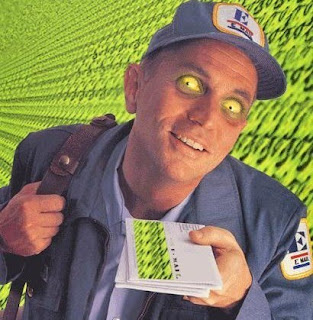
Martin Pasko: Actually, The Postman Never Rings At All

pasko-art-130829-144x225-7257580When I was a little kid, the original <a href=”

The Fly scared the crap out of me. Then, later, when I wrote the Star Trek and Justice League franchises in comics, I felt a morbid and uneasy fascination with the transporter idea, which I’d always thought had a greater potential for disaster than deliverance. But I never did much with it, because my early Vincent Price-induced trauma left me with zero interest in writing about steaming piles of misshapen, dying flesh. So I never thought I’d see the day when I’d write these words:

We need teleportation. Badly. And we need it now.

Why am I bending your digital ear with this?

Well, another day I never thought I’d see is the one when the number of Americans who self-identify as Geeks would outnumber Americans who give a flying rat’s ass about what happens to the US Postal Service.

The great irony of this is that many of the people who stand to lose big-time if the USPS achieves its goal of total self-annihilation are Geeks.

If this painfully slowly-approaching disaster isn’t averted, no amount of muscular adblockers will be able to Improve Your eBay Experience. And there are still some comics publishers who don’t drop-ship everything from Canada by courier service. Moreover, there still exist certain types of vendors who think DHL is an even bigger nightmare than the postal system, and a few pesky creative dinosaurs who still have the temerity to expect payment for entertaining you. And they expect it from Accounting Departments who are already resentful enough as it is about having to generate all those 1099s at year’s end. Which is why their indulgent bosses reward them for never, ever suggesting that Talent can be paid via Direct Deposit, which is obviously evil and irresponsible, in addition to being too much trouble, because that’s how the government that needs to be shrunk in the bathtub now pays The 47% all that social safety net money they don’t deserve and which is obviously a Socialist plot.

All these nice folk will feel like they live in an even more dystopian alternate universe than they already occupy if those little paper things that are redeemable for cash and prizes stop showing up in their cobweb-infested mail boxes.

Yes, I know you know what “going postal” means. But you may not be old enough to remember why, despite the fact that many local P.O.s are named after famous people living or dead, there’s no such thing as a David Berkowitz Post Office. Which is why you may be blissfully unaware that you’re not getting half your mail because your letter carriers’ dogs talk to them and tell them what they should do with it instead of delivering it.

For you, USPS’ headlong rush to make the case for its own irrelevancy to modern life might have a greater significance, so it is my duty to helpfully call it to your attention.

In the interest of appropriate full disclosure, I should add that I’m uniquely qualified to talk about the USPS on a site that’s supposed to be about comics, and not just from having been tortured by them through a few decades as a freelancer (an old girlfriend once got so tired of hearing me bitch about the horrors they visited on me, she nicknamed me BMK, which stood for Bad Mail Karma).

Oh, no. There’s more. You see, I was once involved in creating comic books FOR the USPS, which was a little trip through Pinhead’s Lament Configuration all by itself.

Have I hooked you? Good. Then maybe you’ll come back here for that story next week. I mean, maybe you’ll deign to sample this column again. In spite of everything.

Because in that tale – from the ‘90s, mind you – lies an insight into the monumental and long-customary – and therefore ineluctably irreparable – bureaucratic ineptitude that will inevitably result in USPS’s demise. This, despite a Congress that, while having done nothing else of substance, has managed to reinstate the possibility of its remote mail centers receiving Ricin-laced envelopes on Saturdays.

Hmm. The dogs I live with are barking. That must mean the mailmoron’s here. But that’s impossible. It’s not even dark yet. Must be a new person on this route. Excuse me while I go peer out at him or her suspiciously through the venetian blinds, like one of those crazy old people who’s about to run outside waving a broom to shoo the neighborhood kids out of the driveway. That’ll inspire continued excellent service, I’m sure.

Whoah.

The mailmoron has just delivered six pieces of mail, only four of which are for people who don’t live here. Plus, unlike her predecessor, she actually noticed the large banker’s box under the mailbox. The one with the sign on it reading, in 72-point type, outgoing mail. Which means she actually took the prepaid packages and stamped letters that have been sitting in it since Tuesday. And will do whatever her dog tells her to do with them.

I never thought I’d see the day.

Next week: Neither rain nor snow nor sleet nor gloom of night can possibly make anything worse.

FRIDAY: Martha Thomases

SATURDAY: Marc Alan Fishman


Michael Davis: The Rise Of The Super Nigga

davis-1308131-7967388This year, the San Diego Comic Con celebrated 20 years of my company. Milestone Media. There was standing room only for the 20th Anniversary panel, the Milestone party was off the chain and to top off one of the best times of my life, Derek Dingle, Denys Cowan and I received Inkpot awards!

The biggest and the best pop culture event in the world thought enough of our work to honor us during the convention. That work focuses largely on Milestone’s mission to include more people of color in the media arts.

We’ve been very successful doing so in comics and television and there is more to come.

So, I’m feeling pretty damn good when I get back to my humble abode.

So good in fact I had a brainstorm, and I’m going to share that brainstorm here at ComicMix.

The Rise Of The Super Nigga

Based on a true story until the end.

Michael at 10 years old wanted to be an artist.

A cartoonist, to be exact. That was the good news; the bad news was Michael lived in what is now as was then one of the worst housing projects in New York City.

The years were tough but Michael somehow survived. Two members of his immediate family were murdered, as were two cousins. Michael survived being stabbed twice and having a gun placed to his forehead. The assailant pulled the trigger, the gun jammed.

Michael attended prestigious universities and became a professional artist. Then he co-founded a company that changed the way comic books are published. Then he became President & CEO of three entertainment companies, TV creator, mentor, writer, power broker, deal maker, all around very successful.

How successful? The Gordon Parks Academy named its auditorium after him.

That successful.

One day Michael was thinking: “I’m a very formidable person with far reaching influence. What should I do now that I have all this power?”

All day Michael pondered that thought. Finally he drifted off to sleep…

Crash!!!!!!

Michael awoke with a start. What was that that? Silently he headed to the source of the disturbance. There on his floor was not just the cause of the commotion but the answer this intelligent, successful, influential black man had sort.

Crack.

Somehow a bag of crack was tossed trough his window. Michael picked up the bag held it up and pronounced as loud as he could. “I will become a drug dealer!!”

“I am no longer Michael Davis PhD!” I am now Super Nigga!!!

Yeah, I know, that’s just stupid. Surviving the hood becoming a success then deciding out of the blue to become a drug dealer.

Besides a character named Super Nigga would never see print…unless you changed the name to Tyrone Cash and a hotshot writer named Mark Millar creates it.

Thenit’s all-good.

Tyrone Cash was a brilliant black scientist who gets the power of the Hulk yet retains his intellect. I’ll say that again – retains – his intellect. So what does this brilliant black man do with his new power?

He becomes a drug dealer.

A brilliant black scientist gets the power of the Hulk yet retains his intellect and then decides to become a goddamn drug dealer???

In my opinion that would be the textbook definition of a Super Nigga.

“Oh, no Michael! You don’t want to call out Mark Millar! He’s got to much clout!” That was the response from a concerned fan when I mentioned I was thinking of writing this article.

What the fuck can Mark Millar do to me? The streets are littered with the crushed dreams of motherfuckers who tried to fuck with me. You know why that is? Because I don’t give a fuck what bridge I burn, what’s right is right.

Here’s the kicker, I love this guys work. He’s written some of my favorite comics and Kick Ass is just brilliant, so that makes this even worst. When a talented guy with a HUGE fan base creates some shit like Tyrone Cash it has to be addressed or it becomes OK to do so.

All in all this makes me sad. Sad because Millar’s star is so bright, and rightfully so, sad because if just one black kid thinks Tyrone Cash is cool that that helps no one and if just one white kid thinks Tyrone Cash is accurate that hurts many.

WEDNESDAY MORNING: Mike Gold Gets Real Small

THURSDAY MORNING: Dennis O’Neil and The Seven Basic Plots


Dennis O’Neil: Storytelling and Inconsequential Trivialities

oneil-art-130808-6382461Well, I see that 2 Guns was the weekend box office champ, followed by Wolverine, though the latter has underperformed according to some estimates though we shouldn’t worry because it will almost certainly make a profit when the final reckoning is in and… I didn’t have to go far to learn these facts, and many, many more like them – some of them are in the Monday business section of the New York Times, which is where they belong, and the rest were right in front of me, on the computer screen that is at this moment right in front of me. Lots of inside show biz stuff on the web and maybe that’s not so good.

Stripped of all distracting fiduciary ornamentation, movies and comics and novels and TV shows are about telling stories On the pre-verbal level they’re how infant human beings begin to understand cause and effect, understand how all that color and sound beyond the crib and those warm and comforting holding-things add up to an intelligible world. They assure us and they comfort us: See – it does make sense, you can understand it. As an individual’s biography begins to mimic that of the race, stories morph into other things, some of which do new versions of what the pre-verbal narratives did when the storyteller was just the sweetest little angel! some of which just provide a pretty good evening at the multiplex. They distract us, they entertain us, they provide temporary but welcome respite from current woes.

The business stuff… Not so much. Business these days is about competition and accumulation of wealth – call that greed and I won’t object – and back in the days of our tribal ancestors it was about brute survival. Be tough and ruthless and uglier than the man in the next cave or your genes won’t make it to the next generation.

Evolution obviously selected for both storytelling and acquisitiveness, and so here we are with our share of both. But – I doubt that evolution intended for us to conflate them, They serve separate functions and what I fear is that all that financial information and insider gossip about whose salary is bigger than whose and what kind of contract a given luminary has wangled and other items that I suggest do not even rise to the level of trivia is distracting us from the story! It’s like being backstage at a magic show: if you can see how the tricks are done, they’re not magic anymore.

The other danger is that we’ll become so mired in what are no more than inconsequential trivialities that we’ll bury what should be our real concerns – all those bothersome tidings about war and famine and terrorism and corruption that are no fun at all, but pretty easy to understand. They are, in ironic fact, often part of the stories we enjoy as a way to stop thinking about them.

THURSDAY AFTERNOON: Martin Pasko’s Moving Experience

FRIDAY MORNING: Martha Thomases – Can’t See TV


Martin Pasko: The Age of Michael Jackson Comics

pasko-art-130801-5917889Before I Do This Thang for the week: I’ve been getting messages from readers. Apparently, I do have them. Or, as Bob Hope might have said, “I know you’re out there, because why else would Dolores be propping me up in that direction?”

These messages I’m talking about are all “Why do you use so many links?” Clearly, if you’re asking this, you’re not clicking on them. Hint: Some – not all, or even most, but some – of them don’t lead where you might assume they do. They are instead meant to be weird, “disconnective,” hit-or-miss jokes in and of themselves. So, as the most celebrated member of The Hair Club For Men once put it, “’Nuff said.”

Now, on to That Thang. Meaning I have to stop vamping with jokes about what I didn’t learn in San Diego the weekend before last, and, God help me, actually come up with a third and final part of my highly speculative and putatively uninformed rant to go with the first and second parts. [I say “putatively” because Richard Feder of Fort Lee, New Jersey, writes, “Aren’t the comics selling better than ever? What should I do?” (And, no; no link this time. Get off your fat ass and Google it.)]

If you’re just joining me here for the first time, please feel free – unless your ass really is too fat to allow you to lean over and reach your mouse or trackpad – to check out those previous parts. And maybe click on some on those links you’ve been skipping over. Go ahead. I’ll wait. It’s not like I have anything better to do.

Back now? Good.

One thing Iwasn’t joking about last week: SDCC really didn’t shed much light on whether the Big Two might be incrementally but profoundly changing how they think about creating and marketing comics. Specifically, that they might have to take back total creative control from the freelance talent, to better justify their claim that comics help generate new, original movie and TV properties – titles and characters that aren’t mere spin-offs from the oldest, best-known super hero “brands.”

But I remained in the dark not, as I facetiously suggested, because of the conditions endemic to the con itself, but, rather, because the Big Two’s massive “booths” at least appear to still be doing their dog-and-pony shows in much the samo-samo way as they have been since the beginning of The Gastrotrich Super-Star era and the annual “continuity stunt.” You know – the age of what I like to call Michael Jackson Comics. As in, “We’re going to keep rearranging our face because it gets us publicity even though we don’t entertain anybody anymore. (But we do have a few pet chimps who clap for us when we do it.)”

At first, superficial glance, little seems to have changed this year. There were the same long lines of people waiting for something, but you couldn’t quite be sure what because the crowds were too dense. And there were the same old book signings by the Flavors Of The Week – those comic book “creators” who have been rocketing out of obscurity and vanishing back into it just as fast, ever since Hollywood’s “‘bankable’ star” mentality was first applied to four-color pamphlets by, if memory serves, Jenette Kahn. She was the first Big Two publisher to wonder, for example, whether Superman might not sell better if it were John Byrne’s Superman.

And it did.

For a while.

Thirty years ago.

But this year at SDCC, when I took a closer look at those exhibits, and let my eye follow carefully where that long line was snaking to, it seemed as if more and more of those people were queueing up for a chance to glimpse some “teaser” footage from an upcoming movie or TV show, and the lines to buy signed copies of Flavor of the Week’s Superman or Smokin’ Hot Newcomer’s Spider-Man were shorter. The “brand” – the property – was what was making the loudest ka-ching, ka-ching.

But the people who decide what will be presented in these exhibits seem not to notice, and persist in announcing new comic book titles whose selling point is presumably the name of the creative talent rather than the super hero brand. Meanwhile, superhero feature films continue to succeed without being dependent on major stars in their casts, a phenomenon that is a reflection of a larger, industry-wide paradigm shift.

The early warning signs might be barely noticeable, but I really think they’re there. And it’s getting harder not to wonder whether someday – maybe sooner than even cynical me suspects – Disney and Warners will have convinced themselves that they can endlessly exploit their existing brands, through reboots not unlike those in the old annual face-changing stunts, without any help from their four-color pamphleteers. And if their comic book divisions will have ceased to yield new brands they can add to the product mix as break-out hits, they might start to wonder whether all those Flavors of the Week and their pamphlets are any use to them at all.

LATER TODAY: Emily S. Whitten Returns!

FRIDAY MORNING: Martha Thomases

SATURDAY MORNING: Marc Alan Fishman


REVIEW: Justice League: The Flashpoint Paradox

justiceleaguetheflashpointparadox-finalboxart-e1375282586925-4295223The larger and more sweeping the cosmic event, the more the audience needs a character to act as the anchor. This was a lesson Marv Wolfman learned while writing the first such event, Crisis on Infinite Earths. Years later, when he was afforded the opportunity to novelize it, he focused on The Flash as his focal point. Similarly, Geoff Johns built the entire Flashpoint miniseries around Barry Allen and used it to upend the DC Universe and set the stage for the new 52.

While the miniseries was a beautifully drawn, sprawling mess that made little sense whatsoever, the animated adaptation does a better job honing the story and its spinoffs into a tighter, more focused tale. It still doesn’t make a whole heck of a lot of sense but it’s entertaining to watch. Justice League: The Flashpoint Paradox is now out on Blu-ray from Warner Home Video and it’s a strong entry in the line.

flash06-e1375282676851-7245337

Essentially, the Flash, despite knowing better, goes back in time to prevent his mother’s death, an inexplicable decision exacerbated by his 25th century foe, Eobard Thawne, t

he Reverse Flash. Thawne channels the speed force, which they both access, to create some sort of time distorting “speed boom” that totally alters the DC Universe. As a result, Allen awakes up in a world where Mom is happily alive but not for long as Atlantis and Themyscira are waging a war that threatens to shatter the planet. He also no longer has his powers.

Among the “subtle” alterations is that Kal-El’s rocket misses Kansas and is captured by the U.S. government; Thomas Wayne survives but Bruce is shot by Joe Chill; the wizard Shazam shares his power with multiple kids, and Steve Trevor never arrived on Paradise Island, a.k.a. Themyscira. There are others but it’s a dark, depressing place to live when you have the unrepentant Len Snart running around as the beloved Citizen Cold.

batman-aquaman-e1375282772612-5642017

While focusing on the core JL characters, plus Cyborg for those needing affirmative action, it totally ignores the heroes and champions of bygone eras (except for some version of Sandman), most of whom would gladly come out of retirement to prevent the war from happening. Occult beings such as the Spectre or Dr. Fate certainly would have intervened. And then we have Grifter, who was never a part of the DCU here  so it’s a mess.

Allen convinces the alcoholic Dark Knight to help him regain his speed and then they race to stop global Armageddon, allying themselves with an odd assortment of other metahumans. They also rescue the Kryptonian from custody and he miraculously demonstrates all his powers within hours of exposure to the sun although it took him years in the other reality to develop them and just as long to master them.

wonderwoman-e1375282814188-8433716

But things zip along at such a dizzying pace, you just watch. Director Jay Oliva has a sure hand with the film, as he has in the last handful of outings. He’s saddled, though, with fairly unattractive character designs that once more over emphasize the upper half of the male bodies and give everyone pointy chins. Jim Krieg, another Warner animation vet, does a nice job making the necessary modifications to contain the story in 81 minutes. A few too many characters show up and don’t do anything but it’s nice to see them.

As usual, Andrea Romano brings in an A-list assortment of actors to voice the players led by Justin Chambers as Allen, Kevin McKidd as Thomas Wayne, and C. Thomas Howell as Thawne. The other major players include  Vanessa Marshall (Wonder Woman), Cary Elwes (Aquaman), Michael B. Jordan (Cyborg),  Kevin Conroy (Batman), Dana Delany (Lois Lane), Nathan Fillion (Hal Jordan’) and Tim Daly (Superman).

The miniseries worked as a transition by establishing the DC, Vertigo and WidlStorm universes as three parallel worlds (out of 52 known parallel universes) being brought together into a New DC Universe. The only real hint that the reformed timeline at the film’s end is the modified Flash costume Allen wears. Otherwise, it all seems the same but do watch the film through to the end of the credits for a 10 second hint of the following film, the first to resemble the New 52.

11-e1375283005172-6325360The disc comes with the usual assortment of supplemental features. You get audio commentary from  Producer James Tucker, director Olivia, screenwriter Krieg and Johns as they chat about adapting the comics to film although there’s little new revealed here.

Rather than provided newcomers with a primer as to what this is all about, you get “A Flash in Time: Time Travel in the Flash Universe” (22 minutes) as The Hero’s Journey author Phil Cousineau provides more historic perspective than the others do for the comics that influenced the miniseries. Cousineau takes himself too seriously and the source material underexplained. Then there’s  “My Favorite Villain! The Flash Bad Guys” (19 minutes) as Cousineau, Krieg, Johns and current Flash writer Brian Buccellato discuss some of the colorful foes making up the legendary Flash Rogues’ Gallery. For Blu-ray viewers, there are Flash-centric episodes from

Justice League and Batman: The Brave and the Bold. Finally, there’s a Sneak Peak at Justice League: War (8 minutes) and Flashpoint #1 Digital Comic Excerpt (a mere 8 pages in the hopes you go out and buy the graphic novel).

Michael Davis: The Gold Standard

davis-art-130730-7841477The following article is a lesson for young creators entering the business.

Remember, the comics industry is made up of relationships and the industry is filled with the bodies of young professionals who choose to go with the flow regardless of where that flow takes them or who that flow screws with.

Bad idea.

Be very careful who you hitch your wagon too and don’t throw a good friend under the bus just because it’s what everyone else does.

Thus begins the lesson…

There is a very short list of people I’d take a bullet for. Mike Gold is on that list. Mike and I have known each other for over 20 years. I was around three when I met him.

What?

During the time I’ve known Mike, he has not only been a good friend but also a real confidant and staunch supporter. Look, it’s not easy being my supporter. I’ve been known to bring drama into certain situations and the easy (if not smart) thing to do when that occurs is to step away.

Step away, quickly and with purpose.

Mike has always stood by me even to the point where that decision could have caused real risk to his position at the time.

Mike is like family to me.

Mike does not like the San Diego Comic-Con.

I love the San Diego Comic-Con.

Mike thinks SDCC has very little to do with comics and a bunch of other not nice things.

Mike is entitled to his opinion. I respect but disagree with Mike’s opinion.

Mike and I are still like family.

Thus ended the lesson.

WEDNESDAY MORNING: Mike Gold

WEDNESDAY AFTERNOON: Even MORE Emily S. Whitten!!!


All Pulp Interviews Bad Tiger #3-D. C. Golightly!

For the third interview in the BAD TIGER series, ALL PULP corners Writer/Creator/Marketing Director D. C. Golightly!

ALL PULP: Tell us about yourself, your personal background, and how you got into writing/art/etc.

 DCG: I reside in Pittsburgh, Pennsylvania with my wife and kids. I love comics, cookies, and characters. Follow my freelance rumblings at http://dave-golightly.blogspot.com/. I’ve always been a huge comic fan, and growing up I really got into more adventure pulps as my comic collection grew. Since I wanted to weave a wonderful world myself, I started scribbling little stories. I’ve been lucky enough that some people are willing to pay for those stories. I always wanted to be an artist, but I lack talent. Therefor the pen is the only version of the brush that I can manipulate as a creator.

AP: What is your role at Bad Tiger?

DCG: I write The Skull, a bi-monthly strip, as well as the prose for The Black Kingdom. I’ve recently agreed to take on the role of Minister of Propaganda…or Marketing Director…or whatever you want to call the guy that advertises our junk.

AP:  In our modern society, some would say that there’s nothing new or original anymore. What makes Bad Tiger stand out?

 DCG: It’s a group of like-minded people that have a single goal: create awesome stories. We’re not doing this to get paid; we’re doing this because we love these characters and this genre. There’s a lot of work being put into this venture, and a lot of talent to recognize. This group is populated by people that are not only good enough to make it in the industry, but to an extent already are. We choose to take the time to build this initiative because we believe in it and want to get our stories told.

AP: What are your inspirations, influences for the work you do?

DCG: Jim Butcher is always on his game, and I would buy lunch for Mark Waid any day of the week. Jeffery Deaver can write a character out of any corner.

AP: What do you think appeals to the public about heroic/genre fiction and/or comic strips? Why will people come to Bad Tiger?

DCG: Bad Tiger Studios will quickly become a place fans recognize as a platform for creative talent, free of charge. We’ll toss incredible projects to the wall, see what sticks, and then turn them around for readers. The quality of the material is out of this world and the people interested in this genre will undoubtedly return after they get a sample of what we have to offer. These are the kinds of stories that people want to see, and we’re more than happy to offer them.

AP:  Free response! Say whatever you’d like to about Bad Tiger, yourself, or the experience!

DCG: I’m flattered to be associated with such uniquely creative people. These people are putting in many long hours of work just to provide entertainment, and all they are asking for is a shot to be viewed.

BAD TIGER STUDIO- www.badtigerstudio.com


ALL PULP INTERVIEWS BAD TIGER #2- JUSTIN DITZLER!

badtiger-4231856


ALL PULP continues its series of interviews with BAD TIGER STUDIO! This time, we have co-founder Justin Ditzler in the hot seat!

ALL PULP:  Tell us about yourself, your personal background, and how you got into writing/art/etc.:

JD: I live in Central Pa with my wife and we are expecting our first child in December. I have always been an artist, for as long as I can remember. My family still has drawings of mine from before I can even remember. I’ve always enjoyed working in pencil, black and whites, and inks. When I was in school, all of my best grades came from art class. I entered a few school based competitions over the years and usually place high if not on top. My home town is also the location of the county fair where the school would enter my work and I had quite a nice collection of blue ribbons as a kid. As I grew older, life kept pushing me further and further away from the artwork that I loved so I was forced to find other outlets for my creativity. Through this I discovered I could use a computer to create, so I took to some digital coloring for my drawings and scraps. Over the last decade or so, I’ve been learning about digital art and web design in my free time and squeezing in some drawing where I can. In the past I have created album art and logos for the various musical projects and the occasional tattoo design.
 I am new to the world of comics and pulp, but I’m really liking what I have seen thus far.

AP: What is your role at Bad Tiger?

JD: I am the Co-Founder of Bad Tiger Studio, along with C. William Russette. Also, I am the web-designer/webmaster at www.badtigerstudio.com, the Co-Creator of Operator Zero and the colorist/letterer of Operator Zero. Furthermore, I have designed all of the logos for Bad Tiger Studio and Operator Zero and I am one of the Administrators of the Bad Tiger Studio Facebook Page.

AP: In our modern society, some would say that there’s nothing new or original anymore.  What makes Bad Tiger stand out?

JD: In most cases, I would agree. Originality is something that seems to be very hard to come by these days. To me this is not a surprise. With the invention of the internet and social media it’s becoming harder and harder to come up with a truly original idea. Also, we have to consider the amount of characters and stories that are out there today. Our Genre is not a new one and there are so many Archetypes out there that influences and similarities are very hard to escape.

I think originality is found within the stories of the characters we create. As creators we spend amazing amounts of time figuring out the backgrounds and the stories of our characters. When we write our stories we need to know how our characters will react to the situations and why and what made them react in such a way. So we spend countless hours creating worlds, families, friends, foes and histories just so we can convey the best story and best character to our readers.

At Bad Tiger Studio, our characters and our stories make us stand out. From our writing to our character design and development, to our artwork and finished products, I think we have some great things to offer.

AP:  What are your inspirations, influences for the work you do?

Considering I am quite new to the world of comics and pulp, I think my inspirations and influences are everywhere. I’ll spend hours in the local book store browsing the comics section, picking up book after book just to see the differences in style and technique. Sometimes I learn things and sometimes I get lost in the story.

JD: What do you think appeals to the public about heroic/genre fiction and/or comic strips?  Why will people come to Bad Tiger?

I think hero fiction appeals to everyone’s inner hero. I think that all people have some sort of drive or urge to do the right things on one level or another. The hero fiction genre allows us to indulge our inner hero with the ability to put ourselves in the hero’s shoes, or cape in some cases. These small escapes give us the opportunity to imagine ourselves standing up for what is right and just. Thankfully for us, the creators, once a person is hooked on this feeling and finds our characters relatable, they keep coming back for more. I think as our stories unfold at Bad Tiger Studio, our audience will see just how intricate our stories are and they will keep coming back to find out where the story is headed next.

AP:  Any last words?

JD: Thus far Bad Tiger Studio has been a great experience for me. I work with very talented people and we all seem to share a common interest. We all want to get our characters out there into the hands of the readers and we all want to tell our stories.


Bad Tiger Studio- www.badtigerstudio.comÂ