Tagged: fantasy

The Girl from the Sea by Molly Knox Ostertag

Morgan Kwon knows exactly how her life is going to go. She’s going to get through highschool, being exactly the person she seems to be now, with exactly the same friends, and then she is going to get off Wilneff Island forever, go to some big city, and begin her real life as the person she really is. All she has to do is keep everything packed up in the right boxes until then, and everything will be fine.

Narrator: everything will not be fine

Morgan is at the center of Molly Knox Ostertag’s mid-grade graphic novel The Girl from the Sea , and I think every reader – even those on the young and thoughtless end of that age-band – will sense that Morgan protests too much, that she can’t keep all of the boxes separate. Her parents have already separated when the story starts, so that’s one box broken up…and that, of course, is the point: she’s trying to control the things she thinks she can control, because something so central to her life was just totally uncontrolled.

In the opening pages of Girl from the Sea, Morgan slips on some rocks and nearly drowns. She’s saved by what she thinks is a cute girl, Keltie. And, if we readers are paying attention, we notice one very big box that she’s trying to keep separate and closed: that she likes girls. She thinks that’s got to stay hidden until she gets away, that it can only be a piece of her eventual adult life.

But Keltie is not just a cute girl: she’s something more special, and already loves Morgan. She’s loud and pushy and wants things and can show Morgan different ways of viewing and living her life.

Some of that is a metaphor for coming out. But a lot of it is literal: Keltie is a selkie, transformed from seal to girl, and with a lot of the traditional folkloric issues. (Ostertag plays a bit with reader expectations for some of these, I think, especially Keltie’s skin, but she’s not retelling any specific story or doing the usual folkloric stuff here.)

So: this is a story about whether Morgan will let herself unbend, if she will let herself break through her own boxes and be the person she actually is right now. And what will happen along the way: do her friends and family react the way she fears they will?

Oh, and Keltie has something pretty important she needs to do, too – she’s not in human form for nothing. Oh, sure, she’s crazy about Morgan, too – that definitely is part of it – but she has a mission for her people as well, and that’s not optional.

I liked Girl from the Sea better than Ostertag’s Witch Boy  books – those were fine, but had a slight whiff of formula about them, a sense that they were Teaching Lessons and Being Good Models and all that. Girl from the Sea feels more personal and specific, tied to a specific place Ostertag knows well and centered in a deep but new relationship. I also like the way it implies conflicts that never happen – there are things that are huge in Morgan’s head but don’t really exist in the real world. It’s still very much a book for younger readers, so people even more cynical and world-weary than me might find it too too, but it’s the kind of book I love to see for young readers, the kind that tells them they can be exactly the people they really are and that they have good, loving places in the world that they just need to find or make.

That may not always be true, in the actual real world. But it’s an important story, and it needs to be said as often as possible.

Reposted from The Antick Musings of G.B.H. Hornswoggler, Gent.

Black Hammer/Justice League: Hammer of Justice! by Jeff Lemire, Michael Walsh & Nate Piekos

In the life of every licensed superhero comic, there will come an especially blessed day: Baby’s First Crossover.

This, my dear hearts and gentle people, is that blessed event for the unnamed super-team of Jeff Lemire’s Black Hammer comics. [1] (See here for the previous volume and here for the first volume, if you’re unfamiliar.) Oh, you may quibble that they have already met quite a lot of other superheroes and villains, fighting and teaming up and generating a lot of Licensable Content. But all of those previous encounters were from Lemire’s universe as well; those calls were all coming from inside the house.

For the first time here, someone else deigned to have a play-date with Black Hammer, to let their toys play with the Black Hammer toys, to touch the dolls’ faces together to make them kiss. Those heroes are the current Justice League, the someone is DC Comics, and it is a bit like Barbie and GI Joe in the hands of an hyperactive eight-year-old.

The story is Black Hammer/Justice League: Hammer of Justice!, possibly the laziest possible title for this story. (The exclamation point might have taken a moment of thought; thus the “possibly.”) It’s written by Lemire with art by Michael Walsh and colors by Nate Piekos; I imagine someone on the DC side kibitzed editorially to keep the JL on-brand as well.

Amusingly to me, the Black Hammer gang are still their core ’80s incarnations while the JL is the current (I think) modern incarnations. Sure, separate universes don’t need to line up their timelines exactly, but wouldn’t it be more fun if Lemire had used the contemporaneous bwa-ha-ha era League? Or, possibly even better, the Detroit League? Ah, well.

In any case, the plot is the usual: a Mysterious Someone appears to both teams in their normal milieu (the BH gang grumping on the farm; the JL punching Starro) and swaps their places for making-mischief reasons. In a twist that is never explained, the JL immediately believe they’ve been on the farm for ten years, and mope about that, but the BH gang are aware of actual reality and spend most of their time squabbling with other Justice Leaguers.

The plot from there is…well, there’s that squabbling and moping, which takes up a lot of pages, then the inevitable Reveal of the Mysterious Someone, which is played up big but is one of the few obvious candidates and doesn’t really lead to anything, then, finally, as the play-date is ending, all of the dolls need to go back into their respective boxes separately, so they can stay in mint condition for the collector’s market. Lemire does throw out what may be a hook for another story, but it would need to be another DC Crossover, so let’s hope he gets good grades in school and does all his chores, so maybe there will be another play-date.

At the end of the book, we get what seems to be thirty pages of variant covers for the five issues of this miniseries, and I have nothing coherent to say about that.

I cannot take a single thing about Black Hammer seriously for a second, even while reading it. It is so deeply pastiche that there’s nothing substantial about it. If you are less cynical about superhero comics than I am, you may enjoy this on a more normal level. But it’s well-done – the characters talk like human beings and are drawn in a solid modern style – so it amusing on whatever level you can connect to it on. Black Hammer is not bad; it’s never been bad. It’s just deeply pointless and creepily incestuous.

[1] Black Hammer was a guy; he’s dead now. His daughter later becomes the new Black Hammer, and another woman who looks very much like her becomes another version a hundred years later. And I think there was one before the main guy, but Lemire hasn’t told any stories with the old dead one yet. This is superhero comics; names are just trademarks, and trademarks have to be used or they will be lost.

The team, on the other hand, has no trademark, no identity, since they’re drafting on the Black Hammer name and it’s far too late to create something new now, ten books in.

Reposted from The Antick Musings of G.B.H. Hornswoggler, Gent.

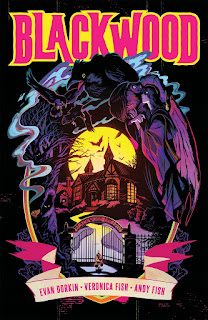
Blackwood by Evan Dorkin, Veronica Fish, and Andy Fish

All the most interesting people have the least-likely careers. (Says the man who started out as a SF editor and somehow ended up doing content marketing for corporate lawyers.) Evan Dorkin was a fiery young cartoonist in the ’80s and 90s when I discovered his work, writing and drawing id-fueled scrawls like Milk & Cheese  and The Eltingville Club . But somehow, along the way, his modern comics career is mostly about writing vaguely Lovecraftian-flavored fantasy/horror adventure stories for other artists to draw.

Like Beasts of Burden  or Calla Cthulhu  – or like this book: Blackwood , written by Dorkin with art by wife-and-husband team Veronica and Andy Fish.

Blackwood College seems to be just another mid-rank private learning institution, though it seems like all of their fields of study are specialized cases of anthropology with various cultural, occult, or religious bends. It’s not that simple, of course: Blackwood has Deep Secrets.

And four brand-new first year students, who have all been recruited to the secret college-within-a-college at Blackwood, are going to find out about those secrets the hard way.

Blackwood collects a four-issue series, so it gets going quickly – with some old guy who just did something magically dangerous and is now dictating his last words while Something happens to him – and keeps at a blistering pace throughout. There’s not a lot of room for the lore of this place to be explained, so the reader (and those four main characters) pick it up in bits and pieces as Dorkin tosses it out.

The last issue hits all of those Deep Secrets, some of which the reader will have guessed and some of which seem to come out of left field. (I wonder if this was originally planned to be longer – maybe six issues? and it got shortened somewhere in the process.) It all runs just a hair too fast and is a hair too generically Creeping Horrors for me, but it is fun and zippy throughout, and the Fishes make good artistic choices: they do grotesquerie well and Veronica’s chapter-break art is particularly atmospheric and spooky.

All in all, I wanted a little more How This World Works and a little less “ahh! the bugs are going to kill us!” but this is largely a Teenagers in Danger movie done as a comic, so what I wanted is somewhat outside the bounds of the genre. This is just fine for what it is, and sets up a world where there could be plenty of other stories – I know there’s at least one more already.

Reposted from The Antick Musings of G.B.H. Hornswoggler, Gent.

Bad Machinery, Vol. 10: The Case of the Severed Alliance by John Allison

When last we left the Mystery Teens of Tackleford, at the end of The Case of the Missing Piece , they had mostly stopped solving mysteries, and two of the core girls, Lottie and Shauna, had just fallen out. That’s what the title refers to for this final collection: not the supernatural menace that threatens Tackleford (which is quite real and sinister), but the break between two of the main characters.

This is the tenth and last Bad Machinery collection, The Case of the Severed Alliance . Creator John Allison has a short afterword where he says his original intention was to have one case for each term of the Mystery Tweens/Teens’ seven years at school, which would have been twenty-one books. He gives a few reasons why he only made half that many stories, but I think he quietly missed the most obvious one: time. Allison is a creator whose stories take place in time. He sometimes drops back into the past – the Bobbins flashback series, for example, or, in an odd way, all of Giant Days – but time always passes in his stories, things change, and his characters grow older. The Bad Machinery stories came out about two a year, not three a year, and I think his characters just grew up, in his head, faster than he expected.

The Bad Machinery books are a creative peak for Allison – he’s had several; most people are more familiar with Giant Days – with a big cast well deployed, a complex and quirky world for them to live in and explore, wonderful dialogue on every page, oddball supernatural menaces that lurk deep in the story and only emerge fully near the end, and long rambly plots full of interesting incidents and unexpected moments that all come together for bang-up finishes. These can’t have been easy stories to plot, write and draw; my sense is that Allison is more of a plotter these days than a pantser, but any multiple-times-a-week comic is going to morph and change as the individual installments come out, so I don’t think anything quite ended up exactly the way he expected.

In any case: this is the “teens get jobs” storyline. All six of the main cast are about 15-16 here. Lotty works at the local newspaper, partially to have a work-study arrangement (called “P&Q” here, which is some British term that I don’t think is ever spelled out) [1] and partially because she is frustrated with her lack of movement in her preferred solving-mysteries-as-a-teenage career. (Yes, that is a thing in the Allisonverse, with glossy magazines and gala awards and all. See Wicked Things .) And Shauna is working for Amy Beckwith-Chilton, one of the old-time Tackleford characters, in her antiques shop, along with a young man named Romesh who Shauna found and who has a mystical ability to detect valuable antiquities among junk.

But the story is mostly about the gentrification of Tackleford: the main street is filling up with posh, expensive shops, rents are skyrocketing, houses prices are ditto, and an “Inland Marina” is being built where the kids used to swim in the local river. We also meet Sewerman General Johnson, the tough man who keeps the drains of Tackleford running, and the massive, possibly sentient, Tackleford Fatberg that he’s been trying to break up. Amy and her competitors in the very Lovejoy-esque antiques trade are chasing after the fabled cursed Pearl of the Quarter, a gem of immense power that disappeared at the death of its previous owner Tommy Binks, the man who made Tackleford the modern success it is.

Oh, and there’s something going on with Tackleford’s sister town, Wendlefield, which is as run-down and hopeless as Tackleford is shiny and expensive.

Shauna and Lottie work opposite ends of this mystery – do they eventually come to find it is the same mystery? Are they forced to work together? Is there a shocking confrontation in a half-constructed industrial scene? Has the mystic Pearl been incorporated into some weapon that threatens the whole town? Is there a fiendish villain who must be stopped? Do all of the Mystery Teens, and their new powers and abilities – I’ve neglected to mention that Mildred has been learning to drive a car! – come into play at the end? Is Tackleford saved?

Reader: yes and yes and yes and yes and yes and yes and sort of.

I would not start here, if you haven’t read Bad Machinery. Severed Alliance is wonderful and funny and exciting and marvelous, but it works much better if you know the characters. So find the first book, The Case of the Team Spirit , and start there. But Bad Machinery is awesome; you should read it if you haven’t already. And if you read it online (it was originally on Allison’s site but now lives on GoComics ), it might be time to get the books and read it again.

[1] Utterly nonamusing anecdote: on a call with some Brits this past week, I realized that what Americans call an “intern” (college-age person working in a business for a limited period of time, usually tied to and providing credit for their school) is called an “apprentice” in the UK. This, I think, is a similar issue.

Reposted from The Antick Musings of G.B.H. Hornswoggler, Gent.

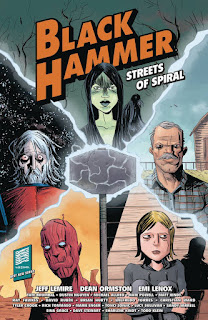
Black Hammer: Streets of Spiral by Jeff Lemire and a cast of thousands

This post may be shorter than my previous diatribes about the wonderful world of Black Hammer, for multiple reasons. One, I’ve said most of the things I could say. Two, this is an odds and sods collection to begin with, so it’s small and random and miscellaneous and will not stand the weight of serious criticism. There may be other reasons as well, but I think those two will do.

In any case, I have written a bunch about the previous Black Hammer books – the most recent was the flashback Black Hammer ’45 , and that one links further back in turn. And, frankly, how much background do you need? This is a pastiche superhero universe, with mixed DC and Marvel influences (Legion of Super-Heroes here, New Gods there), and anyone who knows superhero comics from the second half of the 20th century will find all of it deeply recognizable.

So this is Black Hammer: Streets of Spiral . It was the ninth collection of the series, and the one that gathered all of the loose bits of string to that point: one “Giant-Sized Annual,” in case you thought it wasn’t on-the-nose enough about its obsession with ’70s comics; a one-shot called Cthu-Louise; The World of Black Hammer Encyclopedia, a very “Who’s Who”-style compendium of superhero details; and a short story from the Dark Horse Free Comic Book Day issue for 2019. The Encyclopedia was written by Tate Brombal with series-creator Jeff Lemire; Lemire and Ray Fawkes wrote the short story; Lemire wrote the rest solo. Art is by a large number of people:

  • Nate Powell, Matt Kindt, Dustin Nguyen, Fawkes, Emi Lenox, and Michael Allred for the Annual
  • Lenox with Dave Stewart (who provided colors for nearly all of these pieces) for Cthu-Louise
  • Fourteen different people for the Encyclopedia, including many of the above
  • David Rubin did full-color art for the short story
And what are these individual stories?

The Annual is one of those standard multiple-artists, multiple-heroes “special” stories, which could be assembled piecemeal, showing the whole team dealing with Problem X individually. As was the case with its models, it doesn’t add up to a whole lot in the end. There is a sub-Starro the Conqueror eyeball/squid thing, which appears repeatedly out of the Random Mystical Zone and which has to be punched back out of the normal world. It is, repeatedly – this is a superhero story, after all.

What what does it all mean, ask our heroes in the end?

Well, probably nothing. In a regular superhero universe, it’s either space-filler or a set-up for a crossover. In Black Hammer, it’s just yet another kind of indulgence.

Cthu-Louise is very familiar; the character (and her father, the former supervillain Cthu-Lou) have appeared at least once before, and the plot beats here are very similar. Louise is a teenager with a alien-god squid head, which makes her unpopular, and she wants to fit in. Eventually, she does.

The Encyclopedia is a collection of pages on all of the major characters that have appeared in the various Black Hammer comics to this point, with first appearances and power levels and known family and all that bumf. It is much odder when it’s about a world created by one guy, in one series of stories, over only three or four years.

And the short story is the most forgettable, functioning mostly as a teaser – well, it was in a FCBD comic, and that’s the whole point of the thing – for both past and (I assume) future Black Hammer stories.

If you like Black Hammer, this is a bunch of minor Black Hammer. If you like vaguely ’70s-esque, vaguely Big Two-ish comics, you will like Black Hammer. And god knows there are more of you out there than I want to believe.

Reposted from The Antick Musings of G.B.H. Hornswoggler, Gent.

Enigma: The Definitive Edition by Peter Milligan and Duncan Fegredo

There will probably be spoilers. If you worry about such things on a thirty-year-old obscure Vertigo comic, well, I wonder how you manage to live in the modern world, but go off and read something else on the Internet instead.

I don’t think I read this the first time out. I think I’d remember it. But it also is very much the kind of thing I was reading in 1993: I followed nearly all of Vertigo, and was a fan of Peter Milligan’s writing. So I both don’t know how I missed it and can’t figure out how I could have read it and utterly forgotten it.

I’m talking about Enimga: The Definitive Edition , a spiffy new-ish edition of an eight-issue comics series from those heady early Vertigo days, when it was “superhero comics with adult themes” and not “HBO-style shows in comics form.” Ah, were we ever so young! It was written by Peter Milligan, in the middle of his Shade the Changing Man run, and drawn by Duncan Fegredo with colors by Sherilyn Van Falkenburgh.

And, to be reductive, it’s the story of an sociopath. A mass-murdering sociopath, who either has never been socialized at all or is the usual pulp-fiction mutant who is better than humanity and so entitled to treat us as we treat ants. (Or, perhaps, both.) We think he’s a superhero, throughout most of the story, because he wears a funny costume, because someone very much the same was in an old comic book, and because he seems to be killing villains. But we learn – and, if we’re any good readers at all, we suspected this much earlier – that he made every one of those villains, and so is both directly a murderer and someone who has deliberately created mass-murderers. I don’t think there’s even a word for that. 

We are supposed to be on his side, because He Is Sad, and because he has a sexual relationship with the narrator. I say “has a sexual relationship,” clinically, because I doubt he feels anything like “love” – I’m pretty sure he feels no human emotions of any kind – and the guy he has sex with is in love with him for those same manipulating-humans powers that he used to create mass-murderers.

Yes, I’m talking about Enigma: our title character. This is the story of a young man with fabulous powers and a bizarrely impossible upbringing, whose interactions with the outside world are about 95% murder, but, on the other hand, he’s a tall attractive man with cool clothes. And apparently that is enough to make a mass-murderer into a hero.

I don’t even want to get into whether this was a positive or negative depiction of a gay man. (Wait. Am I kidding? A mass-murderer who literally turns another man gay to love him? I would struggle to find anything positive there, other than “it was 1993, and a gay man existed in comics. Yay!”)

OK. It is stylishly written, and even more stylishly drawn. Fegredo starts out scratchy, maybe even shaky, but he settles down, and the style suits the story very well. It is full of mysteries, and the reader does not realize how horrible Engima is until said reader is near the end of the book.

And our viewpoint character is, thankfully, not a mass-murderer. Michael Smith is instead one of life’s small losers: not very important, not very interesting, not very memorable. But he’s at the scene of a murder by a bizarre villain, and remembers that villain from his old childhood Enigma comics, and that sets off the whole plot, as he starts to think he’s central to all of the craziness. He’s not wrong , but he’s not exactly correct, either.

As I said above, he does find Enigma – the live person now using that name, as well as the crusty old writer who made the comics stories twenty-five years earlier – and fucks the former. He learns that Engima has massive, bizarre powers, but none of us learn why. Perhaps just because it was 1993 and this was a DC comic book; there had to be someone with superpowers in it.

This is a well-crafted, smart, intricate story that seems, at this distance, to be an apology for an appallingly horrible person. Enigma would be a villain in any other comics story, and rightfully so. A pitiable villain, and one that could potentially be redeemed, but, still, the mass-murder thing is hard to overlook.

I’m not sorry I read this, but all of the praise as a “lost classic” seems vastly overwrought to me. It was an attempt to have gay men in comics, yes, and it was not entirely a failure. I do have to say that, of the three gay men here, one is a middle-aged alcoholic failure, one is a mass-murdering sociopath, and the third was turned gay against his will by the sociopath – and that strikes me as not entirely a positive and loving and realistic depiction.

Such is Enigma. Consider yourself entirely spoiled.

Reposted from The Antick Musings of G.B.H. Hornswoggler, Gent.

Steeple, Vol. 2: The Silvery Moon by John Allison

As I type this, my post on the first volume of Steeple was written close to a month ago but has not yet gone live. So I am trying to space things out on this blog, but I may not be spacing them quite far enough for my own systems to work well. (Let’s hope I remember , once that post does go live, to drop in a link here somewhere.)

In any case, this is a sequel to the first Steeple , which was written and drawn by John Allison with colors from Sarah Stern and letters from Jim Campbell. The first collection also appeared first as a five-issue series of floppy comics.

Steeple, Vol. 2: The Silvery Moon , by comparison, appeared originally on-line at Allison’s site , and is an all-Allison joint. (There is a cover by Max Sarin, presumably in an attempt to draw in the Giant Days audience.) This one collects two somewhat discrete stories, and I can even link you to those stories online, on the cheekily-titled steeple.church site: The Silvery Moon and Secret Sentai . I just noticed they were (still) there; I haven’t been as good at keeping up with Allison’s new comics there over the past couple of years as I vaguely searched for a copy of the first Steeple book to read first.

Anyway: this is set in a different corner of the Scarygoround -cum-Giant Days-iverse , down in the Cornish town of Tredregyn, where Rev. David Penrose upholds the glory of the Church of England by battling invading mermen every night (and doing essentially nothing vicaresque besides that) and the Magus Tom Pendennis does what he wilt at the Church of Satan down the lane, and what he wilt is generally sneaky and not always nice, but it tends not to be what one would actually call evil.

It’s more like a football rivalry than a battle for the soul of the town, honestly: the locals line up with their rooting preferences, and it seems like Satan is well in the lead, maybe because he always has the best tunes and dancing.

Our main characters are Billie Baker and Maggie Warren; the trainees in the two churches. Billie came to town for the CoE, but, through some odd events at the end of the first book, the two have switched roles, with the lusty, motorcycle-riding Maggie now assisting Rev. David and energetic and immensely good-hearted Billie now organizing community outreach for Satan.

Allison, as usual, has a decent-sized central cast, who are interestingly quirky. I don’t think these folks have gotten quite as defined as the Giant Days crew or his best Bad Machinery characters (Lottie Grote, for example), but they’ve had fewer pages to do so to date.

In any case: this is two more adventures of Billie and Maggie, one with a werewolf and one with a Japanese guy in a funny costume. They are both Allisonianly quirky and fun, and he’s filling out the details of this corner of his world nicely as he has more pages and time to do so.

I’ve said it many times: Allison is one of the most entertaining, and most distinctive, comics-makers of his generation, and his stories are always fun and always different from what anyone else is doing. How can you not want to read that? 

Reposted from The Antick Musings of G.B.H. Hornswoggler, Gent.

The Golden Age, Book 2 by Roxanne Moreil and Cyril Pedrosa

Endings are harder than beginnings: any story-teller will tell you that. So if I quibble that The Golden Age doesn’t end as well as it begins , I’m largely saying that it’s a story, and that’s what stories do.

Reading the second half , though – the graphic novel or bande dessinee The Golden Age, Book 2 , written by Roxanne Moreil and Cyril Pedrosa, and drawn by Pedrosa with some coloring support from others – there were several times my editor’s pen itched to make notes. I don’t know if these would have made the story better, but if I were involved in the creation, these are the things I would have asked.

First, Book One follows Tilda, the older child of the now-dead king of Antrevers. The beginning of Book Two looks like it might follow her younger brother, who finally gets a name (Edwald) for what I think was the first time at the very end of this book. Edwald does not become our viewpoint at any time here; this is still Tilda’s story. And maybe it had to be. But for a story about political factions and civil war, about opinions on how the world is supposed to be, about noblesse oblige and the democratic impulse, about the battle for the soul of a kingdom, something wider than just Tilda and a handful of advisors as viewpoints would have been useful. As it is, Edwald’s side is basically an evil caricature, with nothing good or positive about them, not even stability or continuity, and that feels like a lack.

Second, both books begin with the same group of peasants, standing in for the whole population of Antrevers, the ones who will be affected by all of these battles and decisions by nobles and kings. It looks like those people may be important to the action of the story, as thematically they are important: The Golden Age is the story of a transition from autocracy to something like democracy, in a very simplified sense. But they really aren’t. The masses are there to fight against each other, while the Important People stand in the center of panels to declaim and fight each other, to do the Important Things. The Golden Age says that it’s about them, but like so many supposedly-democratic works of the fantastic, the strong single person is more interesting, easier to work with narratively, than a mass of “just ordinary people.”

I like parallels; I like books to set things up and then knock them down; I like guns on mantlepieces to be taken down at just the right moment and fired. Golden Age does not quite do those things; it instead is caught up in a vague supernatural element that seems to inherently corrupt all of the autocratic rulers of Antrevers and a possibly prophetic old book of political philosophy (or is it mean to be religion? It’s presented in the manner of a religious text , but its matter is political). Golden Age seems to want to say this mystical book is the Law of the Universe, but the actual operation of the magical things here is deeply obscure: are they set up by a god or gods? were they the embodied power of the ancient kings who stole power from the masses? were they self-generated somehow? are they actually operating against each other, as they seem to be, or is there some deeper balance underneath them?

So, anyway, there’s a magical box and a magical book. The book is supposed to be in the box, but the box seems to be the source of all the bad stuff and the book the source of all the good stuff, so thematically, locking the good stuff inside the bad is a weird metaphor.

I should be clear, after going so deeply into the weeds: this is the subtext, and only occasionally reaches the level of text. The story here is that Tilda’s tired, mostly unpaid, deeply fragile army is besieging Edwald’s castle, and not doing well. Tilda has had a vision of victory, and is utterly uncompromising in that vision, but does not seem to notice ways that the actual world does not line up with her visions. Meanwhile, another army loyal to Edwald is on its way: Tilda’s forces need to win quickly, or will lose forever. And she’s already shattered most of their strength in repeated pointless assaults on a portion of the curtain wall she is sure her forces can break.

So the story is about the siege, and the fight, and who lives and who dies, and how they kill each other. The big ending includes the book and the box, and whatever magics they have. And, as I said, it works pretty well but feels not quite as crisp as it should be to me.

Pedrosa, though, gives us another set of absolutely gorgeous pages, striking in their vibrant colors and stunning in their energy. That makes up for any gaps in the themes: the book powers over any possible quibbles through pure visual power, culminating in a stunning phantasmagorical conclusion. 

Reposted from The Antick Musings of G.B.H. Hornswoggler, Gent.

Trese, Vol. 2: Unreported Murders by Budjette Tan and KaJo Baldismo

I feel like I did this already, but that was a decade ago, so maybe I need to do it again.

Also, and probably more importantly, the last time I talked about this book, it wasn’t actually available at my end of the Pacific at all, which made my praise slightly beside the point for most people. But, luckily, the Trese books are now coming out from Ablaze: the third volume hit in January and the fourth (which is beyond where I saw the first time around) is coming in May. 

But, here we are with Trese 2: Unreported Murders , collecting what were four issues of the floppy-comics series of the same name, originally published in the Philippines sometime in the mid-Aughts. (See also my post from last year on the first book in its Ablaze edition.) Trese is our main character: Alexandra Trese, who runs a bar in Manilla and also is called in by the police on “weird” cases.

This is an urban fantasy, of the common subset that assumes every folkloric or imagined creature is real – they’re all out there somewhere, and they interact with each other and mankind in complicated and often violent ways. Sometimes they need to be dealt with, or just figured out. That’s what Trese does, and what – as we get some hints in these stories – her father did before her.

On a base level, Trese is just good urban fantasy: taut, exciting, full of action and mystery and strangeness. For Filipinos, there’s the added frisson that the fantasy creatures are all part of their folklore – this isn’t yet another story full of the same old boring werewolves and vampires and tedious brain-eating zombies. For non-Filipinos, I think that’s an even better point: these are strange creatures. I don’t know what they are, what they might do, how they connect to the world, what their powers and concerns are. Fantasy all too often falls into the familiar; Trese has no truck with that.

And even more than that, Trese has the secret weapon of KaJo Baldismo’s art. Writer Budjette Tan gives him a lot to work with, true – all of those strange and frightening creatures, all of the odd corners of urban life where they lurk – but Baldismo’s pages, more often with black backgrounds than white, are gloriously detailed and atmospheric, moving from sketchy figures obscured by mist to tight close-ups on detailed faces quickly and confidently. And don’t get me started on the creatures he draws: Baldismo draws the details of horror as well as anyone since Swamp Thing-era Steve Bissette , and has a similar taste for both small things crawling and damp things flying.

As I said, this book collects four stories, four cases. They all have a similar structure: something bad is happening, Trese is called in, and it all gets worse before she fixes it, with the aid of her two bodyguards (not explained here, though they’re clearly something folklorically specific, like all of the other supernatural elements), her connections, and her knowledge. They’re good stories , creepy and specific and dark and ominous and startling. And, these days, they’re easy to find in the USA, so there’s no excuse not to read them.

Reposted from The Antick Musings of G.B.H. Hornswoggler, Gent.

Steeple by John Allison with Sarah Stern and Jim Campbell

I have two theories about John Allison’s best stories, or maybe two versions of the same theory. One goes that his best works are organized around triumvirates – I should perhaps say triumfeminates – such as Bad Machinery  and Giant Days , which allows the three main characters to bounce off each other in complicated ways. This theory goes on to say that the more straightforward, less convoluted Allison works are more likely to have two main characters (q.v., By Night ) who contrast each other in a more obvious way. [1]

The other theory is more straightforward: in every generation of Allison protagonists, there is a female character who embodies chaos, around whom reality itself sometimes bends, who is a force of nature, who both the complications of the narrative and the audience love. Shelly Winters, Charlotte Grote, Esther De Groot – that kind of character. The Allison stories that feature one of those characters are the best ones.

Steeple  is a contrasting-two-people story, and neither of them (yet?) have risen to the level of an Allisonian Chaos Magnet. So I might perhaps say at this point that it’s not quite as zany as his best work, but that might also be said, in a different way, that it’s more accessible and less likely to hare off in random directions for no obvious reasons.

This story is set in the same universe as Tackleford – though, like Giant Days, it touches other parts of that world only very lightly. We are in the small town of Tredregyn, Cornwall  – that’s in the far Southwest of England, for those geographically challenged, about as far you can get from Tackleford’s Yorkshire and still be in the same country. In Tredregyn, there are two churches. And, in each of those churches, there’s a young woman with good intentions.

Just arriving at the local parish – I think it’s CoE , and I think it’s St. something-or-other’s that only gets mentioned once in the book and which I can’t find now – at the beginning of the book is the new parson Billie Baker, to help out the Rev. David Penrose.

On the other side of town, there is a Church of Satan, run by Magus Tom Pendennis and Warlock Brian Fitzpatrick – though I had to look up their full names online; they’re just “Tom & Brian” in this book – where Maggie Warren does what she wilt as the whole of the law when she’s not slinging pints at the local pub. (First lesson: God pays better than Satan. Maggie needs a side job; Billie does not. Who knew?)

Billie and Maggie meet cute when Billie arrives in town, and become friends, even though their lives are deeply opposite to each other.

So that’s one major conflict: they’re friends but they work for (to put it mildly) competing organizations.

The other major conflict is weird supernatural stuff, as it often is in Allison: Tredregyn is in danger from a race of aquatic monsters who want to drag the town and surroundings back beneath the sea whence it came, and apparently they could be successful in this if the local priest doesn’t spend his nights punching said monsters in the cemetery. Penrose keeps asking for strong, burly assistants to aid him in biffing the salty foe, but his superiors keep sending him thin and weedy types. Like Billie, for example.

Now, those sea monsters are said to be sent from the devil, but they don’t seem, at least in this first storyline, to have any connection to the Church of Satan. So it may be that the devil has legions who know naught of each other, or perhaps the sea beasties are actually the spawn of Cthulhu or Belial or some different evil entity. Or perhaps the Church of Satan is the modern, free-living kind of Satanism, and has mostly or entirely sworn off actual evil in the sense of conquering the world and dooming souls to eternal torment and suchlike.

This first volume of Steeple stories – it doesn’t have a “Vol. 1” anywhere on it, though a second volume has since appeared, and a third is coming this summer – collected five comics issues, written and drawn by Allison with colors by Sarah Stern and letters by Jim Campbell. Each issue is basically a standalone story, mostly along the lines of Giant Days, so my assumption is that the hope was to do a few issues, assess, and then do more issues for years and years. That did not actually happen; subsequent Steeple stories have appeared on Allison’s webcomics site , so my guess is that the American comics market continues to Be Difficult.

As I said, both Billie and Maggie are pretty sensible , though they are in one of those weird Allisonian towns. I could wish for a bit more mania and craziness from both of them, to juice the stories up, but these are early days yet. These five adventures are quirky and fun, and the status quo gets upended pretty seriously at the end, which I hope will lead to odder, stranger stories for the next batch. So far , I’m counting this as solid B+ Allison, with signs that it could ascend to the top tier quite easily. And it’s entirely standalone, thus being a good entry point for new readers.

[1] Potential counter-argument: what about things like Bobbins and Scarygoround, which have larger casts around whom the plots circle? How do they fit into this schema? There I pull out a timeline, and argue that the count of Allison’s central characters for a given story tend to diminish over time, and so, therefore, in about 2030 he will publish a comic featuring no central characters!

Reposted from The Antick Musings of G.B.H. Hornswoggler, Gent.