Tagged: fantasy

Mudman, Vol. 1 by Paul Grist

This is nearly everything, but not quite everything. Mudman ran for six issues from Image in 2011-2013, and the first five of those issues were collected in Mudman, Vol. 1 .

It’s clearly a teen superhero comic, another one in the long line spawned by Spider-Man, and slightly more conventional than creator Paul Grist’s previous superhero comic Jack Staff . I knew, going in, that there was just one collection, and assumed the series was dead, but I didn’t realize there was one stray uncollected issue out there, taunting me.

Owen Craig is a teenager at the beginning of a new school term in Burnbridge-on-Sea, a sleepy English village that’s probably in some specific part of the country (on the sea, obviously – I got that part – but I bet Grist has a county and rough location in mind, too). Some not-really-explained thing happens, in an abandoned “Scooby Doo” house out on the sea-side, and Owen gets fabulous mud-based powers!

Spoiler: mud-based powers are not actually all that fabulous.

As with Jack Staff, there’s a lurking sense that Grist can’t quite take all of this superhero stuff essentially seriously. Oh, he has a mysterious cool-looking figure who says cryptic things, has unknown powers, and radiates danger, and he’s toned down the random splash pages that were so fun in Jack Staff. But this is still a comic about a teenage boy – a gawky, bullied, more-than-a-little goofy boy – who gets mud-based superpowers, and it’s really hard to say, “Yeah! Mudman! Splat that bad guy!”

(It reminds me of my joke in college, when a group of friends were fake-creating a superteam. I came up with a guy called String Boy, who could control anything made out of string. Obviously pathetic: that was the point. The big deal was going to be that, several years in and probably as part of a big Crisis hoo-haw, String Boy would discover Cosmic Strings – an actual scientific theory, which I think I only broke as much as comics writers ever do – and bootstrapped himself up to Beyonder-level powers to Show Them All.)

This is not exactly an arc; Grist is following a much older comics model in which every issue is an actual separate story on its own. So we have five loosely connected, and consecutive, tales of Owen as he gets the powers of Mudman and starts to figure out what the hell their deal is. There are bank robbers, and that mysterious (ex-hero? world-class villain?) figure, and Owen’s father, a local police detective. There is the new girl at school he has a crush on and a female figure who appears mostly in visions and may have died decades ago. There’s a whole lot of complications that Grist didn’t really get to do much with, because this ended in six issues, likely because the superhero audience was not as excited by a mud-based superhero as he hoped.

So this is fun, kind of a lower-key Jack Staff, and good for people who like that Paul Grist superhero stuff – I do, and I wish more people did – but it’s also a decade old, not particularly successful when it came out, unfinished, and about a British kid whose power is to hurl balls of mud at people. C’est la vie.

Reposted from The Antick Musings of G.B.H. Hornswoggler, Gent.

Shubeik Lubeik by Deena Mohamed

Anyone who’s traveled in the lands of SF has heard the complaints about worldbuilding: too much research and not enough life, a love of one’s own creations, special pleading and crank ideas. But most of fiction never went that far down the rabbit hole to begin with; most genres could use more worldbuilding, more thought put into how fictional worlds work, more rigor and more demonstrations.

I have no idea if Deena Mohamed ever heard any of those SFnal arguments: she’s Egyptian and works in the comics form, but it’s a big world full of ideas that bounce around, so anything is possible. Her new graphic novel Shubeik Lubeik  is a masterclass in how to do worldbuilding well, immersing the reader in an alternate present that’s a lot like our world in many ways, with the usual One Big Change.

This is a three-part story, and, from the author’s acknowledgements, I think they originally appeared separately when published in Egypt. So call it a trilogy if you have to, but it’s all one thing, and the US publication puts it all under one set of covers, the way it should be. I can’t find a translation credit, and the acknowledgements seem to be in the same “font” as Mohamed’s comics-pages lettering, so I’m guessing this was either originally in English or that Mohamed translated it into English herself. Either way: this is the kind of graphic story that’s the product of one person, from ideas to layout to words to colors to letters.

One quick note: this reads right-to-left on the page, like manga – or, more relevantly, like Arabic in print – rather than left-to-right, as English-language comics generally do. I didn’t see a notice to that effect in the digital copy I read; it should be more obvious in the physical book. And the first few comics pages have just a few panels, stacked vertically, which can obscure the reading direction at first. If you’ve ever read “unflipped” manga, it shouldn’t be any issue, but it’s something to know in order to read Shubeik Lubeik correctly.

“Shubeik Lubeik” are the traditional first words of a djinn: what he says when he’s released from his lamp or bottle or whatever. In English, it would be “your wish is my command,” which means we’re getting shortchanged compared to the graceful rhyme in Arabic. Mohamed tells the story of three wishes here – three powerful, life-changing wishes – in a modern-day Cairo where the last century was subtly different after wishes were discovered, systematized, and industrialized.

There’s some interesting background details there: Mohamed doesn’t dwell on them, but she clearly understands well how colonialism works and has worked out the different ways it would have affected this changed world. Some of that is plot-relevant, especially near the end, but a lot more is just the world our characters live in. Wishes are consumer products, so there’s international commerce and consumer-protection legislation, wish-mining nations and wish-refining nations, standard levels of wishes and international agreements about all of that.

That’s the first thing to know about Shubeik Lubeik: it’s deeper and much more resonant than you might think. It’s not the story of a djinn, or multiple djinni. In this world, a wish is a powerful piece of transformative magic, but not a person. The people who matter here are all human, and what matters to them is what matters to all of us: family and partners, how to fit into the world, friends and working life, history both family and official. The difference is that they can buy wishes – strong ones are very expensive, dangerous ones are cheap – and try to phrase what they want in just the right words so they actually get it.

All three stories start with Shokry, who runs a kiosk on a Cairo street – in an American context, think of it as a concentrated, one-man convenience store or bodega, open to the air and crammed full of stuff to sell to passers-by. Among that stuff is a case with three first-class wishes: he’s had them for a long time and would really like to get them off his hands.

Shokry is a good Muslim, of a tradition that says that using wishes is sinful, no matter why. So the wishes are a burden of conscience to him: he doesn’t want to keep them, after all these years. He doesn’t want to be the cause of bad acts of others. They are valuable, but it’s a value he’s never been able to tap, and he will never use them himself.

All three wishes do get used, one per section. If you know anything about wish-stories, you can guess the paths will not be smooth for the people wishing, and that having a wish is only the beginning. The three stories are all serious, with flashes of humor – the first is the most serious, with a lower-class woman, Aziza, who runs into bad trouble just trying to use her wish.

In between the three sections are more of those worldbuilding details: text features that mimic government bulletins or consumer pamphlets from this world, explaining the history and regulation of wishes, giving warnings about the dangers of third-class wishes or detailing the new Egyptian requirements for all wishes to be registered with the government and their uses approved beforehand. This sometimes prefigures things that will be important in the story later, sometimes adds color and detail to the world, sometimes makes it clear that Great Powers are just as rapacious and destructive in this world as in our own. All of it is depth: this is a living world, full of complex people, and the addition of wishes didn’t change life, but it did make things different in new and inventive ways.

Mohamed has delivered here a major work, full of engaging cartooning and real people and emotionally resonant stories. She immediately leaps as a major comics-maker on the world stage, telling us stories we wouldn’t hear otherwise, from a perspective new and exciting and particular and specific. Shubeik Lubeik is a magnificent achievement and sure to be one of the best graphic novels of the year.

Reposted from The Antick Musings of G.B.H. Hornswoggler, Gent.

Snow, Glass, Apples by Neil Gaiman and Colleen Doran

I’ve mentioned the short story “Snow, Glass, Apples” before – it’s both one of Neil Gaiman’s best, most pointed short pieces and one of the most successful of the Ellen Datlow/Terri Windling-inspired burst of revisionist fairy tales from the early 1990s. (I see that my memory was slightly false – I thought it originally appeared in one of the “Red As Blood” anthologies, but it was a standalone chapbook and then reprinted in the 1995 Datlow/Windling annual.)

As so often with successful things, it’s part of different clusters – all those anthologies of nasty fairy tales, first, and then more recently an odd program that seems to be trying to turn every one of Gaiman’s best stories into individual graphic novels. (See How to Talk to Girls at Parties  and Troll Bridge ; I’m pretty sure there have been several others that I missed.)

So, in 2019, Colleen Doran adapted “Snow, Glass, Apples” (the short story) into the standalone graphic novel Snow, Glass, Apples  – which is what I’ve just read. Like most of the “Neil Gaiman Library” and similar projects (the Coraline  adaptation, the two-volume Graveyard Book  adaptation.) that I’ve seen, it’s a very respectful adaptation, using as many of Gaiman’s original words as possible and just illustrating them rather than attempting to transform the prose story into something new.

Which, somewhat ironically, is the opposite of how Gaiman works when he adapts things – he’s always been deeply transformative – but he’s a Big Deal and his fans want Pure Gaiman, so I assume his editors and publishers know exactly what they’re doing.

Snow, Glass, Apples is thus pretty much exactly the short story, or at least very large chunks of the prose of that story (which is pretty short to begin with), illustrated in a detailed, mostly Art Nouveau style by Doran, on mostly flowing, panel-less pages full of gorgeous, evocative art. If you know the story, this is it, literalized and illustrated by Doran. If you don’t know the story, this is nearly as good a way to discover it. (I’m enough of a purist to insist on that “nearly” – the original precise prose is better.)

Reposted from The Antick Musings of G.B.H. Hornswoggler, Gent.

Colonel Weird: Cosmagog by Jeff Lemire and Tyler Crook

I have to admit: I continue to be amazed at just how much bread Jeff Lemire can spread with so little butter (in Bilbo’s phrase) over the course of his Black Hammer books. There’s a resolute insistence to never ever move beyond the initial setup of the story, even in this twelfth (!) collection.

Colonel Weird: Cosmagog , is, I guess, a single-character side story – looking at the previous book, Skulldigger and Skeleton Boy , I laid out a three-part structure for the books to date, but this one manages to create its own fourth category – but, more importantly, it’s a book in which absolutely nothing at all happens. [1]

Now, plenty of books can have nothing happening. Some can even have nothing happening for over a hundred pages. But doing that in a superhero story is something impressive. Cosmagog is entirely a story of Weird moping about in time and space until he remembers something we the reader always knew – but Lemire hopes we overlooked while reading this book – and then, because of that, he stops moping. 

Oh, we get moments that are new, since even Lemire can’t do without that. So we see Weird at various ages – kid Randy, crew-cut ’50s science hero, hippie ’70s counterculture hero, crazy burnout ’80s hero fighting Antigod, crazy burnout ??? hero as the “current-day” version – doing things, and he bounces among those versions of himself, semi-randomly, until there are enough pages to make this book (and, before that, the four individual issues that comprise it).

But nearly all of the things we see him do are either things we already know, like fighting Antigod or discovering the the Para-Zone. The new moments are either banal – kid Randy buys a soda! he gets bullied! – or implied by what we’ve already seen – hippie ’70s Weird floats in place and dispenses peace and love platitudes to his adoring hippie fans!

We could have seen what the hippie version did – surely he had some goofy villains, right? We could have seen how he burned out to be the wild-haired old man of the Event. We could have even gotten moments of the strong-thewed Weird reveling in his new Para-Powers to fight ’50s aliens. Weird has a lot of holes in his life-story; there’s room for a lot of stories.

But Lemire, in the Black Hammer books, seems to have an allergic reaction to stories: he avoids them whenever possible to instead pivot to showing the same few moments once again.

I’m still vague if Weird has come unstuck in time like Billy Pilgrim or knows everything simultaneously like Dr. Manhattan: sometimes it feels like one, sometimes the other. Maybe it’s a Manhattan-esque cause with a Pilgrim-esque outcome; Weird is much more like the latter than the former, for one thing, no matter what he knows or how he knows it. Either way, he’s a deeply passive character from the get-go: he does very little in the best of times, and is hugely confused by all of it all of the time.

Again, making what is basically a senile old man the hero of a superhero comic is a bold strategy, and I have to appreciate that, even as I have to admit it’s not actually a good idea.

Tyler Crook draws all of that cleanly, all of those familiar remixed moments with all of those varying versions of Weird, in a bright style that makes each Weird distinct – I could swear I can even tell the difference between crazy-fighting-Antigod Weird and crazy-post-Farm Weird, which is a trick. His style is subtly different for each one: science-hero Weird often has Tintin-esque dot eyes, for example. From the credit, he seems to be responsible for the entire visual presentation: art and color and letters; it’s all him. He gets all the kudos for that; his visual storytelling is excellent here.

I don’t know why anyone would want to make this story, other than “Dark Horse is willing to pay me for another four-issue Black Hammer series; maybe I can redo the same thing one more time.” It is utterly unnecessary, and the end is faintly insulting to the reader. (Either you saw it coming, and the book is pointless, or you didn’t, and you feel attacked by such a simple trick.)

But it exists, and even further Black Hammer books exist, and my guess is that they continue to spiral ever tighter and tighter into the same few moments. And, as long as I can keep getting them from libraries, I will keep poking at them, because I find this bizarrely fascinating.

[1] Admittedly, plot has been thinner on the ground in the main Black Hammer series than one would expect, since the very beginning. If you’re interested, the first book was (of course) Secret Origins .

Reposted from The Antick Musings of G.B.H. Hornswoggler, Gent.

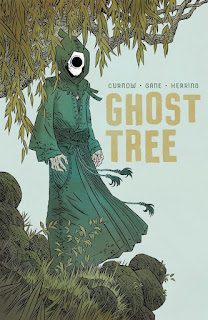
Ghost Tree by Bobby Curnow and Simon Gane

Brandt made a promise to his grandfather, when he was just a kid: come back to visit, ten years after “Oiji-Chan” dies, under a particular tree.

When you’re a kid, you agree to a lot of things like that. Adults say that something is really important, and you say “OK.” Maybe it is important, maybe you actually remember it decades later – maybe a lot of maybes.

Brandt did remember. Probably because it was a good excuse to run away; his marriage with Alice is crumbling, now that he’s in his early thirties, and the anniversary of his grandfather’s death is as good a reason as any to head back to the rural Japanese landscape where he grew up.

Ghost Tree  is about what he finds there. As the title implies, it’s not just a tree – this is a book in which there are real ghosts, and some people can talk to them and interact with them. Brandt’s grandfather is one, but there are a lot more – that tree is a place where they gather, and ghosts, as we all know, are unquiet spirits who have something left unfinished.

Brandt isn’t fazed by the supernatural; maybe he’d suspected, or maybe this is just the kind of thing he always was hoping would erupt into his life. He’s happy to talk to his grandfather, happy to talk to various ghosts and try to help them work out their problems.

But his grandfather isn’t sure, now, if this was a good idea. He now thinks he wasted his own life with ghosts – neglected his wife, Brandt’s grandmother, who is still there in their old house, now quietly taking Brandt to task for the same flaws her late husband had – and he’s worried that Brandt will do exactly the same thing, will give up the world of the living for the simpler world of the dead.

Brandt has other things drawing him to that world: not just his breaking marriage behind him, but the ghost of Arami, his teenage girlfriend, the one who got away, who died not long after he left her and Japan so many years ago. The past is always tempting, especially when it hasn’t changed. Even when it’s a ghost you can’t touch.

There are other elements of this collection of ghosts, other issues and problems and creatures. But that’s the core of it: the question of how much energy and time to give to the past and the dead, and how much to give to the living and the future.

Brandt has to make that decision, in the end. Arami has to make a different kind of decision, because this is a cosmology where ghosts aren’t trapped, aren’t lesser or echoes – just people, later on, in a different way.

Bobby Curnow and Simon Gane (words and art, respectively – colors are by Ian Herring with Becka Kinzie and letters by Chris Mowry) tell this story well, in a mostly quiet mode. Gane gives the world a lushness and depth, and Herrings’s mostly subtle colors add to that depth. Curnow’s dialogue is real and his people realistic, and he doesn’t turn any of his endings facile or obvious. There are a number of excellent moments near the end, in particular: a panel that pays off the “usually one a generation” talk earlier, and a stronger ending to the Brandt-Alice story than I expected.

This is a fine graphic novel: as it says, about “love, loss, and how the past never truly stays dead.”

Reposted from The Antick Musings of G.B.H. Hornswoggler, Gent.

Ralph Azham, Vol. 1: Black Are the Stars by Lewis Trondheim

Ralph Azham does not live in the same world as Dungeon . We’re pretty clear on that; this is not Terra Amata. But it’s the same kind of world: whatever Joann Sfar brings to the mix for Dungeon, that style of fantasy seems to be the way Lewis Trondheim operates. (There are some lesser similarities to his “McConey ” books, too.)

So: we have a central smartass in a big, complicated world, full of anthropomorphic people who plot and scheme, with magic that really works and can do world-changing things but has very specific rules that need to be learned by trial and error. We have authorities who are corrupt or outright evil or just low-key incompetent – this is no surprise, since everyone is out for themselves, pretty much all the time.

Ralph Azham is our central character: another vaguely duck-like hero, like Herbert in Dungeon Zenith. He grew up in an isolated, unnamed mountain village out in the wilds of the kingdom of Astolia, the son of an engineer, Bastien, who moved there to help the locals prepare for a potential attack by the Horde of Vom Syrus. (We don’t know a lot about the Horde or its leader: they’re clearly real, and have been rampaging around the outskirts of this kingdom for decades, but we don’t know who Syrus is or what his goals are. I have a very strong suspicion at the end of this book, though.)

In this world, some children turn blue on the night of a double moon – this is a sign they have a magical power, and are Chosen Ones, or potential Chosen Ones. In Astolia, Couriers take those children off to the capital, but they don’t generally seem to come back.

Ralph is blue. He can tell, infallibly, how many children someone has had. It seems to also include knowing who else was involved in the creation of those children, even if they were never born. And a Trondheim smartass can get himself in a lot of trouble, especially in a small village, knowing who knocked up who, who had a quiet abortion, who had older siblings that are now dead, and so on.

Ralph was taken by a Courier. He came back, a failed Chosen One – so he thinks. Since then, he’s become the village scapegoat and annoyance – he hasn’t helped this at all, to be honest, but he’s not treated well at all. The truth about Chosen Ones, though, is much worse, for a lot of people.

Ralph Azham: Black Are the Stars  collects the first three album-length books of the series. There have been twelve books in French, published between 2011 and 2020, and, as far as I can tell, that’s the complete story: this is not something open-ended like Dungeon. The first book, Why Would You Lie to Someone You Love? , was published in a slightly altered form by Fantagraphics in 2014, but this volume is the first time the rest of the series has been translated into English. Three more English omnibuses are already scheduled, through next March: if all goes well, the whole series will be published within a year. (But the lesson of every Trondheim comic is: things never go well.)

What I’ve just told you covers roughly the first half of the first book. From there, the Horde does come, and violence ensues, as always in a book like this. Obviously, Ralph will leave his village to see the wider world. He will meet other Chosen Ones, and learn what happens to Chosen Ones. There will be magical items with very specific uses that are deployed in inventive and surprising ways. Ralph will learn that he has another, larger power, and two other people from his village – a kid, Raoul, and Claire, who is Ralph’s age – will also turn blue and travel the path of the Chosen One. There will be powerful people who are not who they seem, or who are corrupt and scheming, or both at once. There will be antagonists who are very hard to kill, and ordinary people who are far too quick to die.

The story is about Ralph’s family, maybe. Or about what it means to be a Chosen One. Or the usual overthrowing-the-corrupt story of epic fantasy. Or maybe just surviving in a dangerous world full of people with weapons and magic. This is only a quarter of the way through: it would be premature to say what the whole thing means at this point.

But it’s prime Trondheim: smart fantasy adventure with a sharp edge, pitched only slightly less cruel than Dungeon, accessible to smarter, slightly older kids but with depths only adults will recognize. I’m looking forward to seeing the rest of it.

Reposted from The Antick Musings of G.B.H. Hornswoggler, Gent.

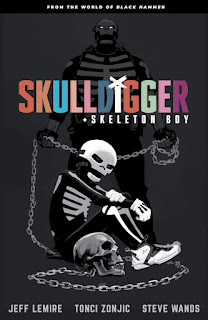
Skulldigger and Skeleton Boy by Jeff Lemire, Tonci Zonjic and Steve Wands

Nigrum Malleoleum est omnis divisa in partes tres.

Some Black Hammer books have numbers in the title: those are the main series. Before the book I’ll be complaining about today, there’s been Secret Origins , The Event , Age of Doom 1 , and Age of Doom 2 .

Some Black Hammer books have the words “Black Hammer” in the title, but no number: Streets of Spiral , the Justice League crossover . These are side stories about the whole team.

(Black Hammer ’45  is deeply confusing in this schema, but it actually fits in the next category. The “Black Hammer” referred to in the title is not the same as the other books, for maximum what-the-fuck-age.)

And some Black Hammer books are about other people in the same world, whose stories may intersect the main gang of mopey superheroes or may not obviously do so. (This is superhero comics: all stories intersect in the Grand Summer Crossover eventually.) Before this book, there was Sherlock Frankenstein , Doctor Andromeda , and The Quantum Age .

Skulldigger and Skeleton Boy , as the title implies, is in the third group. For those who weren’t counting along on their fingers, it’s the eleventh collection. It is written by Jeff Lemire, creator and co-owner of the whole shebang, with stylish gritty art by Tonci Zonjic (often breaking into double-page spreads, which are gorgeous and well-designed but made me wish I wasn’t reading the whole thing on a tablet) and lettering by Steve Wands.

Skulldigger asks the superhero question: “what if the Punisher instead used a metal skull on a chain to kill people, instead of guns? Wouldn’t that be totally awesome?!” It is perhaps the most ’90s idea ever to have been thought up twenty years later, and would have fit comfortably into either DC or Marvel’s mid-90s grim and gritty eras – which, of course, is the point of all of the Black Hammer comics: they’re meant to seem like that stuff you read long ago while at the same time being new stuff you can buy on Wednesdays.

(The argument about how all superhero comics have been doing this more and more consistently for roughly the past forty years is left as an exercise for the reader.)

Now, in any realistic universe, Skulldigger would be shot dead extremely quickly, but so would Batman, so he gets the same dispensation. At the time of the 1996 of this story, he’s been around for maybe a decade, and is seemingly the preeminent crimefighter in Spiral City.

So he’s not-Punisher. There’s also Detective Reyes, who is not-Rene Montoya (literally: tough female detective, lesbian, always fighting with her captain, olive skinned – I do wonder if Lemire does that on purpose or just can’t be bothered to change the details), one of the other viewpoint characters.

The third viewpoint character is Matthew. He’s twelve, and we see his parents get murdered in front of him in the first scene, with a particular overhead view that will make you think they just came out of a Zorro movie. (Black Hammer is many things, but it is never, ever subtle.)

Anyway, the story here is: random thug kills Matthew’s parents. Skulldigger arrives, kills random thug. Matthew becomes non-verbal at witnessing his parents’ murder, doesn’t respond to any questioning by cops including Reyes, is institutionalized. Reyes is obsessed with finding and stopping Skulldigger; her boss literally says “he’s killing the right kind of people, don’t waste time on him.”

Look, do I need to give all of the story beats? Skulldigger gets a sidekick. If you’ve been paying any attention, you know who that is. It’s not a good idea, but he at least seems to be devoted to training the kid so he doesn’t die immediately.

Oh, and meanwhile, an ex-superhero – formerly the Crimson Fist, now civilian Tex Reed – is running for mayor, on a “let’s get back to happy superheroing” platform. (He’s an unpowered guy, maybe a bit more Moon Knight than Batman, and now fiftyish and retired for ten years or so.) The Crimson Fist’s old nemesis Grimjim – who is not anyone in particular from another superhero universe, but is deeply in the Batman Villain template, something of a mash-up of Joker and Ra’s al Ghul conceptually and Killer Croc visually  – has to break out of not-Arkham Asylum to cause trouble.

Tex and Grimjim and Skulldigger have hidden connections, of course. Every superhero story is about the same people tripping over each other over and over again; there’s never anyone new.

It is grim and it is gritty and it is violent: this is supposed to be a 90s-style story, from the dark and decadent age of superheroing. We are meant to deplore that at the same time we revel in it.

Frankly, this is one of the most successful Black Hammer stories to date, in my mind: it tells a specific story, beginning to end, without getting caught up in extraneous crap. It isn’t burdened with the core series’ weird reluctance to move from the initial premise, and has the strengths of the whole series to date: Lemire’s naturalistic dialogue and strong plotting, and great storytelling art.

It’s still a pastiche grim-n-gritty Punisher/Batman comic that has no good reason to exist, mind you. But it’s successful at the things it sets out to do.

One last point: the descriptive copy for this book describes it as a tragedy. It is not. Not in any traditional sense, not in any way. “Tragedy” here seems to mean “a story in which sad things happen,” but that’s most of them. This is not a tragedy, not for Skulldigger or Skeleton Boy or Det. Reyes, or even for Grimjim. And a tragedy has to be a tragedy for the main character.

Reposted from The Antick Musings of G.B.H. Hornswoggler, Gent.

Delicates by Brenna Thummler

I don’t want to say there’s always a sequel…but, these days, it’s the way to bet. Anything that has any degree of success will have a follow-up, telling more of the story or doing as much of the same thing as possible.

So when Brenna Thummler’s first graphic novel, Sheets , was an unexpected success a few years ago, what would her next project be?

Yes, obviously: the direct sequel Delicates , which came out three years later (in 2021). And, though I might sound dismissive, Delicates does all the things a good sequel should: it starts from the end of the first book (rather than rehashing the same story/issues/ideas), adds more details and richness to the world, examines slightly different (but related) concerns, and moves the overall story forward.

Sheets took place, in retrospect, in the fall of Marjorie Glatt’s seventh-grade year. (We didn’t know then exactly how old she was; we did roughly know the time of year.) Delicates jumps forward a bit, to the start of another school year. Summer is ending: Marjorie is about to enter eighth grade.

In the wake of the events of Sheets, Marjorie has a new friend group, mostly because the boy she has a crush on, Colton, is part of it. The rest are all girls, and at the center is Tessi, a mean-girl-type who controls the conversation and is low-key angry most of the time. Tessi has her own issues, mostly with a mother who is trying, in a well-meaning way but not one that has much chance of luck with the terminally sour and image-obsessed Tessi, to engage and lighten up her daughter. But we’re not really on Tessi’s side – we don’t have an antagonist here as we did with Mr. Saubertuck in Sheets, but she’s pretty close.

Wendel the ghost is still Wendel, still basically the same. That’s usually the deal with ghosts, of course. If you want to change, you have to do it before dying.

And there’s a new central character: Eliza, the girl on the cover. She’s the oldest daughter of a favorite teacher at this middle school, has just been held back to repeat eighth grade, and is clearly on the spectrum somewhere. (No specific diagnosis is given in the book: she’s just who she is. But she has obsessions and verbal tics, and I may just be more prone to notice those things.) Her particular obsessions are photography, ghosts, and their overlap: she spends a lot of time trying to photograph ghosts.

She doesn’t know ghosts are real – or, rather, doesn’t know how ghosts actually work in Thummler’s fictional world. She’s pretty sure ghosts are real. I don’t know if she pictures them as Charlie Brown kids-in-sheets, but that’s what they are here.

Delicates is partially a book about fitting in: Eliza is too weird, too specific, to really fit in, Marjorie is weird but can cram herself into a shape Tessi & crew will be friends with, and Wendell only really has Marjorie, so he hates any ways she changes that makes her less friendly to him.

It’s also, like Sheets, a book in which death looms, always off the page and never specifically mentioned, but there all the time. All of Marjorie’s family is still dealing with her mother’s death: her father is engaging more with life now, but seems to be running around trying to do all the things his wife used to do, to keep all the old plates spinning, and to tightly control the few things he feels competent to control. Her kid brother Owen is doing something similar, on the level of a first-grader. And Marjorie, of course, is trying to be a “normal” teenager – have a friends group, be part of the group, maybe have a boyfriend if she can ever figure that out.

By the end, they’ll all have to be themselves instead of the people they’re trying to be. This isn’t exactly a book with a moral, but the story it’s telling aims in that direction: be who you actually are, and let other people do the same. Those are excellent things to remember, and Thummler tells a good story around them.

This is most obviously for people around Marjorie and Eliza’s age – the ones figuring out who they are, alone and with their parents and with their friends and with any potential boy/girlfriends. But, like all good YA, it’s a fine story even for those of us who have been pretty sure who we are for a few decades now, since we sometimes can still tend to forget.

Reposted from The Antick Musings of G.B.H. Hornswoggler, Gent.

The Girl from the Sea by Molly Knox Ostertag

Morgan Kwon knows exactly how her life is going to go. She’s going to get through highschool, being exactly the person she seems to be now, with exactly the same friends, and then she is going to get off Wilneff Island forever, go to some big city, and begin her real life as the person she really is. All she has to do is keep everything packed up in the right boxes until then, and everything will be fine.

Narrator: everything will not be fine

Morgan is at the center of Molly Knox Ostertag’s mid-grade graphic novel The Girl from the Sea , and I think every reader – even those on the young and thoughtless end of that age-band – will sense that Morgan protests too much, that she can’t keep all of the boxes separate. Her parents have already separated when the story starts, so that’s one box broken up…and that, of course, is the point: she’s trying to control the things she thinks she can control, because something so central to her life was just totally uncontrolled.

In the opening pages of Girl from the Sea, Morgan slips on some rocks and nearly drowns. She’s saved by what she thinks is a cute girl, Keltie. And, if we readers are paying attention, we notice one very big box that she’s trying to keep separate and closed: that she likes girls. She thinks that’s got to stay hidden until she gets away, that it can only be a piece of her eventual adult life.

But Keltie is not just a cute girl: she’s something more special, and already loves Morgan. She’s loud and pushy and wants things and can show Morgan different ways of viewing and living her life.

Some of that is a metaphor for coming out. But a lot of it is literal: Keltie is a selkie, transformed from seal to girl, and with a lot of the traditional folkloric issues. (Ostertag plays a bit with reader expectations for some of these, I think, especially Keltie’s skin, but she’s not retelling any specific story or doing the usual folkloric stuff here.)

So: this is a story about whether Morgan will let herself unbend, if she will let herself break through her own boxes and be the person she actually is right now. And what will happen along the way: do her friends and family react the way she fears they will?

Oh, and Keltie has something pretty important she needs to do, too – she’s not in human form for nothing. Oh, sure, she’s crazy about Morgan, too – that definitely is part of it – but she has a mission for her people as well, and that’s not optional.

I liked Girl from the Sea better than Ostertag’s Witch Boy  books – those were fine, but had a slight whiff of formula about them, a sense that they were Teaching Lessons and Being Good Models and all that. Girl from the Sea feels more personal and specific, tied to a specific place Ostertag knows well and centered in a deep but new relationship. I also like the way it implies conflicts that never happen – there are things that are huge in Morgan’s head but don’t really exist in the real world. It’s still very much a book for younger readers, so people even more cynical and world-weary than me might find it too too, but it’s the kind of book I love to see for young readers, the kind that tells them they can be exactly the people they really are and that they have good, loving places in the world that they just need to find or make.

That may not always be true, in the actual real world. But it’s an important story, and it needs to be said as often as possible.

Reposted from The Antick Musings of G.B.H. Hornswoggler, Gent.

Black Hammer/Justice League: Hammer of Justice! by Jeff Lemire, Michael Walsh & Nate Piekos

In the life of every licensed superhero comic, there will come an especially blessed day: Baby’s First Crossover.

This, my dear hearts and gentle people, is that blessed event for the unnamed super-team of Jeff Lemire’s Black Hammer comics. [1] (See here for the previous volume and here for the first volume, if you’re unfamiliar.) Oh, you may quibble that they have already met quite a lot of other superheroes and villains, fighting and teaming up and generating a lot of Licensable Content. But all of those previous encounters were from Lemire’s universe as well; those calls were all coming from inside the house.

For the first time here, someone else deigned to have a play-date with Black Hammer, to let their toys play with the Black Hammer toys, to touch the dolls’ faces together to make them kiss. Those heroes are the current Justice League, the someone is DC Comics, and it is a bit like Barbie and GI Joe in the hands of an hyperactive eight-year-old.

The story is Black Hammer/Justice League: Hammer of Justice!, possibly the laziest possible title for this story. (The exclamation point might have taken a moment of thought; thus the “possibly.”) It’s written by Lemire with art by Michael Walsh and colors by Nate Piekos; I imagine someone on the DC side kibitzed editorially to keep the JL on-brand as well.

Amusingly to me, the Black Hammer gang are still their core ’80s incarnations while the JL is the current (I think) modern incarnations. Sure, separate universes don’t need to line up their timelines exactly, but wouldn’t it be more fun if Lemire had used the contemporaneous bwa-ha-ha era League? Or, possibly even better, the Detroit League? Ah, well.

In any case, the plot is the usual: a Mysterious Someone appears to both teams in their normal milieu (the BH gang grumping on the farm; the JL punching Starro) and swaps their places for making-mischief reasons. In a twist that is never explained, the JL immediately believe they’ve been on the farm for ten years, and mope about that, but the BH gang are aware of actual reality and spend most of their time squabbling with other Justice Leaguers.

The plot from there is…well, there’s that squabbling and moping, which takes up a lot of pages, then the inevitable Reveal of the Mysterious Someone, which is played up big but is one of the few obvious candidates and doesn’t really lead to anything, then, finally, as the play-date is ending, all of the dolls need to go back into their respective boxes separately, so they can stay in mint condition for the collector’s market. Lemire does throw out what may be a hook for another story, but it would need to be another DC Crossover, so let’s hope he gets good grades in school and does all his chores, so maybe there will be another play-date.

At the end of the book, we get what seems to be thirty pages of variant covers for the five issues of this miniseries, and I have nothing coherent to say about that.

I cannot take a single thing about Black Hammer seriously for a second, even while reading it. It is so deeply pastiche that there’s nothing substantial about it. If you are less cynical about superhero comics than I am, you may enjoy this on a more normal level. But it’s well-done – the characters talk like human beings and are drawn in a solid modern style – so it amusing on whatever level you can connect to it on. Black Hammer is not bad; it’s never been bad. It’s just deeply pointless and creepily incestuous.

[1] Black Hammer was a guy; he’s dead now. His daughter later becomes the new Black Hammer, and another woman who looks very much like her becomes another version a hundred years later. And I think there was one before the main guy, but Lemire hasn’t told any stories with the old dead one yet. This is superhero comics; names are just trademarks, and trademarks have to be used or they will be lost.

The team, on the other hand, has no trademark, no identity, since they’re drafting on the Black Hammer name and it’s far too late to create something new now, ten books in.

Reposted from The Antick Musings of G.B.H. Hornswoggler, Gent.