Tagged: fantasy

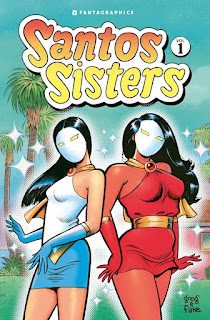
Santos Sisters, Vol. 1 by Greg and Fake

santos20sisters201-2536648

The single-name thing seems to have leapt from Eurocomics and landed on North American shores – well, we’ve always had it in other fields, like music (Cher! Madonna!), but comics-makers are embracing it as well. I may be concerned that our Strategic Name Reserve is in danger of being depleted – there aren’t that many regular forenames, though if we allow variants and standard nouns, we’re in much better shape – but I am still not, despite all my demands, the High Lord of All English Usage, so all I can do is Canute it up here.

I don’t know what arbitration mechanism is available if there’s, say, a Belgian who goes by “Greg” and a North American who does the same – it seems like the kind of thing that could easily happen – but, again, I have not been granted the awesome power I keep asking for, so I guess it’s not my problem.

In any case, Belgians, the name Greg has officially been claimed (by a guy from Chicago, as I understand it), so you snoozed and I suppose you lost. The name Fake has also been claimed (by a guy from Manzanillo, Mexico), but that’s probably less in-demand. And they have teamed up, like Hawk and Animal of the Legion of Doom, over the past few years to make a comic called Santos Sisters.

The first collection of that comic was published a couple of months ago, under the fairly obvious title Santos Sisters, Vol. 1 . From online descriptions – not the book itself – I learn that Fake is the writer and Greg is the artist. The book collects the first five issues of the series, plus a few odds and ends, though not the covers of those five issues, which seems like an odd and unusual choice. The back cover also gives, for what might be the first time: their fabulous superhero origin. (They found medallions on the beach that granted them superpowers from a goddess, Madame Sosostris.)

Santos Sisters is basically a mash-up of vaguely ’90s superhero elements – more early-Image than anything else, big bulky guns and all – with Archie-style storytelling, all in a mildly mocking tone that regularly spells things incorrectly in dialogue, I think deliberately. Alana and Ambar are sisters – we can call their last name Santos, but that’s probably not right – who are probably in their early 20s, since they seem to live in an apartment, but they get up to Archie-ish teen hijinks with boyfriends and dates.

Alana is the serious one, Betty-coded, with lighter skin, smaller breasts and the blue outfit. Ambar is the party girl in red, Veronica-coded and always ready for action of whatever type. They fight crime in the Southern California city of Las Brisas, the kind of place that has a vibrant downtown and a beach and is close enough to ski slopes for a day trip – a location designed for comics stories.

Their stories are short, in that Archie style. Sometimes about battling some supervillain threatening Las Brisas, but as often watching “Boozy Bees” on TV, or squabbling about dating two guys at once, or going camping in the mountains, or aiding Don Quixote (?!) who has randomly arrived in town (??!?). The word “random” is appropos much of the time, as are “quirky” and “slightly silly.” Again, it’s all starting from the premise “what if these Archie-style girls were Image-esque superheroines?”

Their powers are not deeply defined: they have costumes, of course, which manifest when they call on the goddess. They’re probably resistant to harm, since that’s pretty standard, and they do seem to glow when in costume. They definitely fly, and manifest big guns (most of the time) or big swords (once in a while, I suppose for a change of pace) with which to battle their enemies. But it’s not like Alana channels the power of ice and Ambar fire, or one of them turns into an armadillo and the other an ocelot, or their necklaces generate pulsing colorful forcefields in the shape of household objects, or anything like that. They just chase bad guys, squabble among themselves, and shoot their guns to mow down the henchmen. (Major villains get fisticuffs, or talked down, or some other less-lethal activity, so they can return in later stories.)

It’s a fun premise, and hasn’t worn out its welcome yet. It probably will, since it’s not a hugely durable or extensible premise, but a hundred and fifty pages doesn’t get us there. Greg draws it all in that Archie look, and is good at both the heavy-lidded women and the dim-bulb men. Fake’s stories are varied and goofy in interesting ways – there are twenty-two different stories here, and none of them are repetitive or rely on the same ideas. Again, I’m sure that will come: the premise isn’t that deep. But I’d expect probably another book this size of similar stories, then maybe one big all-the-villains-team-up epic, before it hits the wall of ennui.

Reposted from The Antick Musings of G.B.H. Hornswoggler, Gent.

william20of20newbury-1398313

William of Newbury by Michael Avon Oeming

william20of20newbury-1398313

The publisher calls this book “Hellboy meets Redwall,” which hits the major touchpoints, as far as that goes. Yes, fighting supernatural monsters. Yes, medieval times. Yes, anthropomorphic characters. But it’s much more authentically medieval than a reader would expect, in quirky and unusual ways, much more inspired and growing out of actual research than it is a story stuck into that world for vague coolness reasons.

First and most important is that William of Newburgh – “Newbury” is a variation creator Michael Avon Oeming decided to use here – is an actual 12th century monk, and this collection of ghost-fighting stories about a raccoon and his rabbit brother is actually based on the writings of the real person.

Now, Oeming clearly fictionalized some things to turn the historical record The History of English Affairs – an actual book written by the real William covering the period known as The Anarchy when King Stephen and Empress Matilda battled for control of the country (and Normandy) after the unexpected death of Henry I and his heir – into William of Newbury , the collection of the first four comic-book issues of the anthropomorphic William’s adventures. But the bones of the story seem to be much closer to the original than I would have expected.

(For one change, I’m pretty sure the historical human William didn’t have a semi-reformed thief sidekick, Winnie, whom he was teaching to read.)

The four issues tell a continuous story, but each issue is basically one event – each works as an individual issue or story. There’s an encounter with the supernatural each time, plus complications and larger issues.

The supernatural elements are explicitly based in the medieval worldview. The dead do rise, because they are tormented by devils of Satan. The land of faerie exists, and is made up of fiends who want to torment and tempt Christians. 

William, despite the Hellboy comparison and Oeming’s moody Mignola-esque art, is not going to punch any of these creatures. He is going to talk at them, to call on the angels and saints, to use the power of God to force the devils and faeries to leave and the dead to lie still. He has a staff with a cross on it, which he brandishes at the arisen dead – who are nasty and violent and murderous and tossing hellfire at times, too – but what will stop them is not anything violent, but the power of God, possibly channeled or empowered by William’s faith.

(It does work consistently, as we see. Punching would not. This is not a world in which punching evil has any effect.)

The other major theological point, which is an important undertone throughout and becomes central in the fourth issue, is that William and his brother Edward were almost kidnapped by the faeries as children, and that means their souls were stolen and they are doomed to oblivion after death. (Not even hell, as they understand it: their souls are gone, so they will just die.) There’s a hint at the end that this may not be entirely true, and it may be theologically suspect as well – can an immortal soul be stolen? do these pagan spirits have the power to destroy something made by God? – but that, as they say, is probably for the next volume of William of Newbury stories.

William himself is a fascinating, quirky character: devout, scholarly but muscular in his faith, devoted to doing good as he sees it and using his abilities to help those around him. But also scattered and often cheated in everyday things, not necessarily that good at the rough-and-tumble of life – which is understandable for a monk. I think there will be more of these stories, and I hope so: I don’t know how much more of William’s writings Oeming still has to work from, but there’s enough material here for at least another couple of stories of this length.

Reposted from The Antick Musings of G.B.H. Hornswoggler, Gent.

embarrassment20of20wit5ches-2704502

An Embarrassment of Witches by Sophie Goldstein and Jenn Jordan

embarrassment20of20wit5ches-2329460

This is not a sequel to Darwin Carmichael Is Going to Hell . It is, though, the only other project I know of by the team behind that webcomic, and it’s set in a world very similar to Darwin Carmichael‘s. It may even be the same world, though not necessarily so.

Darwin Carmichael ran from 2009 through 2013 and then was collected into a book. Sophie Goldstein drew about 90% of it and co-wrote it all, as far as I can tell, and Jenn Jordan drew a few bits and did the other half of the writing.

An Embarrassment of Witches  was a 2020 original graphic novel. This time out, it looks like Goldstein (the professional comics-maker and teacher) did all of the art, but the book is still vague about their roles, so I continue to assume they write it together, in whatever way. (Probably not Marvel Method. My guess would be some variety of co-plotting, with Goldstein maybe doing page breakdowns and then coming back together for dialogue.)

Darwin was set in a modern NYC where everything in myth was true – there were minotaurs on the subway and stoner angels were important to the plot. In Witches, we only see humans, but it’s a world with industrialized, systematized magic – our milieu is the academic world around magic, focused on two young women and their post-graduate lives.

As required in a story about two people, they’re quite different: Rory is impulsive, unsure, flitting from one idea to the next. Angela is driven, focused, serious. And the story is thus mostly about Rory, since she’s more interesting and active.

They’ve both just graduated. Angela is about to start an internship with Rory’s Type A mother, Dr. Audrey Rosenberg. Rory is heading off to work at a dragon sanctuary in Australia with her boyfriend Holden…who, just before getting on the plane, tells her that he wants to open up their relationship to other people. (We get the sense that this sort of thing happens to Rory all the time – she misreads signals, dives into everything headfirst, and gets hurt all the time by everything before bouncing off into something totally different after a big emotional scene.)

So Rory impulsively doesn’t go to Australia, begs Angela to let her stay in the walk-in closet of their apartment – they’ve sublet her room to a guy named Guy for the summer – sells off most of her stuff, and then falls for Guy and decides to follow him into his new Interdisciplinary Magick program. (Every time Rory does something, you can assume the word “impulsively” is there. The narrative doesn’t say she always does this about a boy, but the two cases we see here both fit that pattern.)

Meanwhile, Angela, in a somewhat more low-key manner, is one of six interns working for Dr. Rosenberg (Rory’s mother, again), who is demanding and exacting and apparently has not one iota of human feeling for her employees or family.

They both crash, of course. Angela because she’s been doing the boiling-frog thing, with pressure building up bit by bit probably since she was five, and she just cracks. Rory because that’s what she always does: throws herself into something but only half-asses it, misunderstands other people and doesn’t say what she wants or needs, and then collapses into an emotional wreck when it inevitably breaks apart. 

They yell at each other, they break their friendship…but only briefly, because it’s that kind of story. They also have familiars – I think everyone in this world does, but the familiars are pretty independent and seem to wander off for weeks at a time – who kibitz on their relationship, squabble with each other, and help to mend everything in the end.

It’s a story I’ve seen many times before – you probably have, too. One part quarter-life crisis, one part best friends assuming too much of their relationship. Goldstein and Jordan tell it well, and their quirky, specific world adds a lot of depth and intertest to what could otherwise be a pretty general and bland story. Rory would be deeply annoying in most stories; she’s the kind of person who goes out of her way to step on every damn rake on the ground, over and over again.

In the end, they both move on to things that we think are good for them – at least, we hope so, and it is the end, so we’ll give them the benefit of the doubt. It’s a solid ending, open and forward-looking. I don’t know if we’ll get another story by Goldstein and Jordan set in a world of industrialized magic, but…if we got two, surely there’s no reason there couldn’t be three?

Reposted from The Antick Musings of G.B.H. Hornswoggler, Gent.

norse20mythology201-1910049

Norse Mythology, Vol. 1 by Neil Gaiman, P. Craig Russell, & various artists

norse20mythology201-1910049

Comics artists of a certain age always want to draw Loki in a helmet with big twisty ram’s horns. I know why, they know why – we all know why. But reminding readers of bombastic comics for kids, hacked out monthly and printed on the cheapest paper available, might not be the mental connection you want to make in your classy hardcover collection of retold myths. I’m just saying.

Norse Mythology, Volume 1  is the latest in the long line of floppies and sturdier-formatted objects intending to, as far as I can tell, create sequential pictures for every last word Neil Gaiman has ever written in his long career. (Look out for Duran Duran by Neil Gaiman: The Graphic Novel!)

As is usual for this project, Gaiman wrote the original thing (in this case, the 2017 book Norse Mythology , a novel-shaped retelling of what bits of Norse mythology survived Christianity, which ain’t much) and is not credited with anything at all related to this book. P. Craig Russell adapted the original thing into comics, and drew some of it – here the first two (of seven) sections. And various other people – Jill Thompson, Mike Mignola, David Rubín, Jerry Ordway, Piotr Kowalski – drew the other bits, sometimes coloring it themselves and sometimes letting others (mostly Lovern Kindzierski) do the colors.

The stories were originally published in twelve floppy issues, with multiple covers because it’s the modern world and we can’t have anything nice anymore, and then those were collected into three hardcovers. I’ll let you figure out which of the two this one was.

(So it’s exactly the same model as The Graveyard Book , for those still confused.)

Using multiple artists works a bit better here than in Graveyard, which was basically one story – this is more miscellaneous to begin with, since the stories are only vaguely in chronological order for the usual mythological reasons. And the styles work well together – they’re individual, but all are working here mostly in an adventure-comics look with quite a lot of Stan-and-Jack in its DNA.

As usual with Russell’s adaptations, it’s very faithful, with lots of captions to use as much of the original prose as possible. As always, I find that is just fine, and probably what the paying audience wants, but it makes the whole thing just slightly plodding and obvious.

But, let me be honest: you get this book because you want more Neil Gaiman stuff, and you want it to be as Neil Gaiman-y as possible. You probably already read the underlying book, and want something as much like “exactly that, but with pictures of Loki in a helmet with big twisty ram’s horns” as possible. This book delivers on that promise.

(Note: I read this book on December 15, and wrote this post on December 21. It is entirely possible that you do not want any more Neil Gaiman stuff ever again in your life. That’s entirely valid, too.)

Reposted from The Antick Musings of G.B.H. Hornswoggler, Gent.

unlikely20story20of20felix20and20macabber-7448447

The Unlikely Story of Felix and Macabber by Juni Ba and Hassan Otsmane-Elhaou

unlikely20story20of20felix20and20macabber-7448447

Knowing what needs to be said in a story, and what can just be implied, is always tricky. We can all think of works that fail in both directions – overexplaining, or leaving things too murky.

I think The Unlikely Story of Felix and Macabber  doesn’t quite explain all of the things it should have – but it’s close, and some readers might find the way it implies its world is just fine. So let me just note that, and note that this is writer Hassan Otsmane-Elhaou’s first graphic novel, and point out that traditionally ties go to the runner.

I have no quibbles about the art by Juni Ba, which is detailed in quirky, grotesque ways that fits this world perfectly. Also, I should say that the lettering is by Otsamane-Elhaou – the sound effects are particularly fun, and he makes the captions and dialogue slightly italic to give the book a distinctive look, too.

I don’t know if this book is specifically for younger readers, but it has a vibe that upper-elementary-school kids will probably enjoy, and the professional-wrestling influences also tend to make the violence stylized and bloodless in ways that are young-reader-friendly.

We’re in a world of monsters – think Monsters, Inc., where everyone is a slightly different kind of creature, and you’ll be close – where strength and fighting ability seem to be prized above all other traits. (Or, at least, this story deals with that side of this world.) A young, small monster named Felix is timid, bullied by a gang of other monsters from his school. They dare him to ring a random doorbell; he does. A craggy old monster answers the door, and seems to want to talk to this random small interloper for reasons that are never clear. He grabs at Felix, who runs away immediately, and loses his backpack to the old guy.

This is all heavily narrated, mostly in ways that tell us things we can already see on-panel rather than adding detail to the world – it’s a very story-book voice, as if telling the story many years later.

Anyway, Felix is bullied at school and browbeaten by his parents and denigrated by his teachers: he’s the usual mousy little guy who needs to learn to stick up for himself. In trying to get his backpack back, he accidentally stows away in the old guy’s car – I suppose I should make it clear that the old guy is Macabber, the other half of the title – as he goes back to the town of his birth.

Macabber is the former World Champion of Monstering, hugely dominant in his era. Monstering is basically pro wrestling, only in a society of monsters where everyone has completely different bodies from each other. He left this town to go off for the big fights, leaving his former best friend behind. He never returned – until now, of course – in however many years it’s been.

The town is a dump now, which everyone living there blames Macabber for. There’s no reason for this I can figure out: it’s a weird mix of “you’re supposed to support the old neighborhood” and “you left us behind.” And everyone is much more likely to resolve interpersonal conflicts by punching rather than talking about things, which may be one reason why we don’t get any clear, or convincing, explanations.

Anyway, the local hooligans – little guys in knight’s armor – find and harass and then recruit Felix, again for murky reasons. Macabber meets his once-best friend, sort-of apologizes for having a successful career elsewhere, and feels guilty. We get a lot of flashbacks to Macabber’s fighting career, which was zippy and action-packed.

That portion of the story doesn’t exactly resolve, but we flash forward suddenly, to see that Felix also goes into Monstering, and is even better at it than Macabber was – we get a few of his fights, too – but we mostly see him at the end of his career, rich and successful and done with it all.

Felix does not seem to have run away from any towns, or beaten up any of his best friends to do so, or run his career in any ways that would make us dislike him. But he has the same sad attitude at the end of his career Macabber did – not sad because it’s over, not sad because he stomped over people to get there, but just generally sad because he’s not sure if he’s a good or bad person, I guess.

I want to say that the lesson Unlikely Story is trying to make – or the lesson it comes closest to making – is that fighting people for a living is a bad idea; that violence is never the answer, little trooper. But it’s so clearly a book about how Monstering is fun and exciting and awesome that doesn’t really seem to fit.

So I’m puzzled by Unlikely Story. It seems to want to give me a Lesson About Life, but its two characters are not parallel in any ways that reinforce the Lesson it seems to want to push. What they have in common, at the end of their careers, is a habit of speaking in vague circumlocutions – this may be more Otsmane-Elhaou’s writing style – and a sense that they are sad because it’s all over and they’re no longer Monstering Champion of the World anymore, which, um, yeah, would be sad, wouldn’t it?

Reposted from The Antick Musings of G.B.H. Hornswoggler, Gent.

usagi20yojimbo20420-20dragon20bellow20conspiracy-7502877

Usagi Yojimbo, Book 4: The Dragon Bellow Conspiracy by Stan Sakai

usagi20yojimbo20420-20dragon20bellow20conspiracy-7502877

The fourth collection of Stan Sakai’s long-running Usagi Yojimbo series collects a long – some would say “epic” – storyline that started in 1989 and ran through six issues of the comic. It’s largely the “gather all of the popular, previously separate, supporting characters” arc, and it has the same largely historical accurate but softened for tween readers tone as the rest of Usagi. [1]

In the interests of clarity, I should note that “Dragon” is a metaphor and “Conspiracy” is overblown: this is one feudal lord, conspiring with only his own lord and minions, planning in secret to launch a rebellion that could, potentially, maybe, topple the Shogun and would definitely knock off a couple of his local rivals and give him much more power and influence. “Dragon Bellow” is an artsy way of saying he’s going to use guns to do that.

Thus Usagi Yojimbo Book 4: The Dragon Bellow Conspiracy . There are basically two intersecting stories, neither one of which initially involves Usagi, our rabbit-samurai hero.

In the main plot, good-guy (super-literally: he is drawn as a baby panda) Lord Noriyuki thinks his neighbor Lord Tamikuro is up to something mischievous. Tamikuro is a supporter of Lord Hikiji, the big bad of the series, who is continually scheming to depose the shogun. (Everyone seems to know this – perhaps except for the shogun.)

So Noriyuki sends a delegation to visit Tamikuro, led by the female samurai Tomoe Ame, who Usagi met and almost had a romance with in a previous story. And of course Tamikuro is scheming, having gathered a large stockpile of guns, and will be attacking Noriyuki any day now. Tomoe attempts to get back to her lord with the big news, but is captured.

Meanwhile, the ronin Gen (a big, mostly honorable rhino) is chasing the blind swords-pig Ino for the bounty on the latter’s head. Both of them had been occasional allies of Usagi in the past, and they’re heading through this same territory right now.

Usagi gets pulled into the story as he’s also traveling through this region on foot: he sees Tamikuro’s forces riding off with a captured Tomoe and tries to follow. But a rabbit on foot is no match for multiple…cats?…on horseback, so he’s quickly left behind. He did hear her call out something about warning Noriyuki, and is torn between saving the damsel from unknown peril or warning the lord “hey, your samurai damsel is in some kind of peril.” While pondering, he wanders into what had been a secret ninja village – they’re like carpenter ants, there’s one behind every hillside in this region – to find all the inhabitants had been slaughtered.

Quick background note, to explain what readers learned in bwa-ha-ha style gloating dialogue among the villains: this particular group of ninjas is opposed to Hijiki, for whatever reason, and has been spying on Tamikuro, trying to figure out his plans. So Tamikuro had his men slaughter their village.

Anyway, Usagi is an honorable rabbit, so he drags all of the dead bodies into one hut, in hopes some kin will eventually bury them. He is witnessed leaving the village, with not a little blood on him, by Shingen, a leader of those ninja, who has the reasonable misapprehension that Usagi was responsible. So he starts following Usagi to take his vengeance.

After more than a little swordfighting and yelling at each other, the good guys not in Tamikuro’s prison – to sum up: Usagi, Shingen, Gen, and Ino – meet, work out their differences at least temporarily, and band together to assault Tamikuro Fortress with a force of those handy ninja.

There are battles, there are deaths, there is a conspiracy foiled. But, in the middle-grade friendly standard for the series, no recurring characters are harmed in the melee. As usual, I’m finding Usagi Yojimbo to be well-constructed, beautifully drawn, and compellingly told – but inherently a watered-down story for young readers. It definitely has a niche, but I’m finding that niche increasingly restrictive as the story goes on.

[1] See my posts on books one , two , and three for more details on the series, if you’re interested.

Reposted from The Antick Musings of G.B.H. Hornswoggler, Gent.

fly20by20night-6018171

Fly By Night by Tara O’Connor

fly20by20night-3422939

Do you ever find yourself complaining about the genre premises of a work? It’s not helpful, I can tell you. And it can waste a bunch of mental energy while reading until you realize that’s what you’re doing.

For example, in a graphic novel mostly aimed at teen readers, with a mostly teen cast and a thriller/mystery plot, the reader needs to remember that the characters have to solve the dangerous problem themselves. Sure, they might be in the New Jersey Pine Barrens, a preserve of ecological interest to at least a national if not international audience. And they might also be right in between two massive media markets full of reporters who would be happy to make a lot of noise about this particular issue. But adults sweeping in – even if the teens strategize and find those adults – is not what this kind of story is about. So I really shouldn’t have spent so much time thinking about the ways these characters could have done any of that.

My foibles aside, Tara O’Connor’s Fly By Night  is a thrill ride with heart, a few good fakeouts, and an ending that goes big when it has to. I grabbed it randomly from the YA GN shelves at my library – it’s set in New Jersey, where I live, and that sealed the deal – but I’ve never read any of O’Connor’s work before.

Dee Ramirez’s twin sister Beth has disappeared mysteriously, in the small Pine Barrens town where they both spent their childhood. After their parents divorced about six years ago – in middle school; the girls are high school seniors now – Dee went with her father to live in a new town, Westbury (and eventually with a new wife) while Beth stayed with their mother. O’Connor is a bit shaky on some details, both here and later – how exactly did Beth go missing? have the girls really not been in touch at all for six years? what actually is the name of this town? – but it works, psychologically. 

(I also initially thought that Dee was the older sister, and her talk about graduating meant she was nearly done with college – the twin thing isn’t mentioned until a number of pages in. Fly By Night trips over its own feet a few times like that.)

Anyway, Dee is back in her childhood home, with her ex-cop (or maybe still currently cop, somewhere else?) dad and something-or-other mom, as they squabble with each other over everything. (They got divorced for a reason. Mom is a bit passive, but Dad comes across as a minor-league asshole a lot of the time.) Dee is going to snoop around at school to find out what happened to Beth, even as a police investigation continues. She meets back up with her old friend Tobi, and spends some time with Beth’s boyfriend Lucas, who has a gigantic “Suspect Me!” sign on him but she still goes out into the Barrens with him alone.

At the same time, there’s a big evil company – Redline Oil, recently taken over by your standard evil businessman, Marshall Monroe – intending to run a big pipeline through the Pine Barrens. It’s not clear where this pipeline is going or why – I gather there is actually a similar pipeline proposal in the real world, so maybe it’s a big natural gas feeder from Philly to Atlantic City or something, but O’Connor just focuses on Big Evil Scary Polluting Horrible Thing – and the local students, led by teacher Mrs. Ruby, are predictably organized against it. Monroe more-or-less admits that he’s buying his way into this project, and we assume it must have some expected profit for him, but it’s mostly “I’m rich and powerful, and I want to do this, so I will buy it, and the rest of you can go pound sand.”

(Frankly, everyone seems to be against it, because it is cartoonishly evil. We have a couple of scenes of board meetings, and even the random adults don’t seem to want any of this.)

The where-is-Beth plot and the stop-the-pipeline plot are never as connected as they feel like they should be. They intersect, sort-of, out in the Barrens, but they diverge in the end. Oh, and I probably should have mentioned this before, but the Jersey Devil is real – this is a supernatural story. There is a big confrontation in the woods at the end, which for dramatic purposes happens right in the middle of the prom – this is the kind of town so far away from anything that they have the prom in the high school gym, which I didn’t think was a thing in NJ anymore – and there are dramatic revelations about the evil CEO and a big fight.

At this point, modern media actually becomes relevant, after I spent three hundred pages having the argument at the top of this post in my head. But there is a moderately happy ending.

Fly By Night looks gorgeous, has strong naturalistic dialogue, interesting and distinctive character designs, a strong sense of place, and a lot of ideas whirling around inside it. I didn’t think it quite pulled all of those elements together as well as it should have, but it does a decent job, and it’s a solid environmental thriller for teens, especially those with any connection to Jersey.

Reposted from The Antick Musings of G.B.H. Hornswoggler, Gent.

Scott Pilgrim and the Infinite Sadness by Bryan Lee O’Malley

This is the one where things become both more and less complicated. On balance, probably less overall, by the end, which is unusual for the mid-point of a series.

For any Gen Z readers coming to Scott Pilgrim for the first time (or, I guess, older people who managed to miss it): this is a six-book graphic novel series by Bryan Lee O’Malley, in a manga-inspired format and video game-inspired world, about a twenty-something slacker from Toronto and his friends, mostly about how he meets a new girlfriend and has to defeat her seven evil exes, but also partly about his band and some related stuff. The six books all came out in the back half of the Aughts, so I guess they’re core Millennial culture, if you want to generation-type them, but Scott himself is such a stereotypical slacker that this Gen X guy found him and his world instantly recognizable.

Scott Pilgrim and the Infinite Sadness  is the third book; the first two were Precious Little Life  and Vs. the World . Current editions have color by Nathan Fairbairn; original publication was in black and white.

This one is the all-exes-all-the-time volume: Scott’s new girlfriend Ramona Flowers (the quirky, cool American with a mysterious past) had a previous boyfriend, Todd Ingram, who is the bassist in the hot new band The Clash at Demonhead. And Scott’s ex-girlfriend, Envy Adams, is the leader of that band. So there’s bad blood all around with TCaD – even more so because Envy’s band is more slick, successful, and success-oriented.

TCaD is in Toronto; they’re playing some shows, and Scott’s band Sex Bob-omb is opening for them. Which is just as awkward – for Scott in particular – as it sounds.

So there’s a lot of scenes here of Scott uncomfortable around Envy – she basically kicked him and Steven Stills out of the band the three of them founded, back in high school, and Scott is not known for being comfortable with conflict and ambition and stress in the first place. And there’s a fair bit of flashback, to show those older relationships – Ramona with Todd, Scott with Envy, and even Envy with Todd, since they’re together now. (Well, relatively together – Todd is a cheater there as well as on a level that will affect his fighting abilities later in the book.)

On the positive side, Scott’s most recent ex, the teenager Knives Chau, is less obsessed with him here and more with Envy. She’s maybe growing up a bit, and, as of this point, seems to be over Scott and settling into a new relationship with Young Neil.

And, of course, there are some fights. Scott is at first utterly incapable of fighting Todd – who has superpowers because he’s a vegan, in one of the best-known and most amusing minor plot points of the series – and there are other small and large battles throughout, including the quick bit where Knives gets the highlights punched out of her hair.

The whole Scott Pilgrim saga has a wonderful control of tone and an infectious joy in its own fictional structures – there’s a lovely sequence early in this book that runs through nearly the whole cast, during the first tense meeting with Envy and her band, with captions to say what everyone wants at that moment. There’s a lot of similar moments, where O’Malley is playing with the comics form and with his video-game references, both to make jokes and to quirkily underline serious moments. (When Scott tries to run to access a “save point,” we can feel his flop sweat and panic.)

In some ways, this book is the core of the whole series – sure, it’s not all resolved here, and you can see O’Malley setting some of the hooks for the back half – but this is where the Scott-Envy-Ramona-Todd broken quadrangle happens, and that’s one of the major foci of the whole story.

But, of course, even after getting past Todd here, Scott knows: there are four evil exes yet to fight.

Reposted from The Antick Musings of G.B.H. Hornswoggler, Gent.

Fall Through by Nate Powell

This book is already dancing about architecture. So I worry that anything I might say would compound that – painting a picture of dancing about architecture. But here I am, and here I go.

Fall Through  is Nate Powell’s new graphic novel this year: it has what I think of as his trademark atmospheric, black-background, swirling pages and vaguely creepy, unexplained and deeply embedded fantasy elements. I found myself resisting it more than some of his earlier books: as always, I can only say how I reacted, and note that it’s as likely to have been me as the book.

This is the story of a punk band, Diamond Mine. They formed in 1994, recorded a 7″, did a bunch of touring, had a following. They lived together in a house, all seemingly in their early twenties. They were part of a wider punk scene across the Midwest and South, with clusters of more-or-less angry, more-or-less young people in every mid-sized town or larger, putting on mostly illegal shows in fields or backyards or wherever and running away when the cops came to break it up. None of that paid – if you actually made gas money, you were way ahead.

Punk, you know?

Jody was one of the four members of the band. She played bass and sang, at least some of the time. She wasn’t the leader and songwriter: that was Diana. She wasn’t the flashy guitarist: that was Napoleon. She wasn’t the quiet, solid-as-a-rock drummer: that was Steff. But she’s our viewpoint character.

Fall Through takes place mostly in 1994. But we also see Jody, seeming the same age, or just a few years younger, in 1978, back in what Gen X me thinks of as the actual age of punk. (Punk was a movement. It happened, and ended, like every other movement. Even early ’80s hardcore was something else. Everything later was revivals and different things, just like “rockabilly” now isn’t what it meant in the ’50s.)

How did Jody get from being 18ish in 1978 to being 23ish in 1994? Well, that’s the story here.

Most of the book is about a tour. It’s the summer of 1994, and the four members of Diamond Mine are in a van, going from town to town to play shows with local acts – again, mostly not legally, and the only way they get paid is if they sell some merch.  Like any tour, it seems to be endless, days stretching on and on, each one like the last. Like it never began and will never end, just a single day, over and over again.

And that may be true. Diana wrote a song – “Fall Through” – and when Diamond Mine plays it the right way, at the climax of a show, they seem to change worlds or times or something. The flap copy calls it “transported to alternate worlds in which they’ve never existed but their band’s legend has.” I don’t know about that: it all seems to still be 1994, and they have tour dates day after day, which implies their band exists and is known.

Really, it feels like a reset. Maybe different worlds, but not that different from each other. Certainly not the wild swings in time and space the description implies. All still that same tour, the same van, rambling through mid-America during the summer of 1994. More punk shows: one every night, potentially forever. Like August keeps resetting – this time St. Louis, the next time Louisville.

Diana seems to be doing this on purpose. Once there’s a frightening figure – coming out of a surrounding cornfield, like a horror movie, during their set – that she clearly triggers the song, the spell to get away from. And it’s taken a while, but the rest of the band knows something is wrong.

There are confrontations, but it’s all in vague language – “moving forward,” “sticking together,” that kind of thing. I expect punks to be louder, more demanding – to swear a lot more, for one thing. (I guess these are well-behaved, Southern, second generation punks.)

So the book never explains what’s happening or why. They talk around it a few times, but that’s all. There’s never even a “this band is going to break up” fight or possibility or option: it’s as if they’re all locked into this, no matter what they want or choose.

The situation does get resolved in the end, and we do circle back to 1978…but the ways and hows of it frustrated me. It’s all thematically appropriate, but not dramatically. The plot doesn’t go anywhere, the actions of the characters aren’t really important to the ending. It’s a book about an endless punk tour, about community and scene, rather than being a story about these things that happened to these people.

We never learn why this happened. We never learn how this song works. We never learn who that mysterious figure was, if he was actually chasing them, or anything. In the end, it all doesn’t matter, all those explanations are beside the point Powell wants to make. But I was here to find out all those things, and I don’t have any particular nostalgia for “wasn’t it awesome to be young and in a punk band?”

So I found this book incredibly frustrating: it avoided all of the things I wanted to know and focused entirely on things I found vague and trite. It’s lovely and thoughtful: Powell draws as well as ever and his people are real and precise. They just all waffle on about the least interesting things, and then go on to play another show as if none of that happened, which makes very little sense to me.

Your mileage may vary. If you’ve ever been in a band, particularly. And Powell is one of our best, so I won’t ignore the fact that I might have missed something major. But the Fall Through I read was not the book I was hoping for.

Reposted from The Antick Musings of G.B.H. Hornswoggler, Gent.

Black Hammer: Visions, Vol. 1 by Jeff Lemire’s friends

My standard complaint about the Black Hammer comics is that they’re mostly static, locked into an initial premise that wasn’t all that exciting to begin with. I suppose that’s in distinction to “real” superhero comics, which rely on the façade of change – someone is always dying, someone’s costume is always changing, someone is always making a heel-face turn, and worlds are inevitably always living and dying so that nothing will ever be the same – but it’s not self-reflective enough to count as irony.

But some kinds of stories aren’t supposed to change anything – the whole point is that they don’t, and can’t, change the things we already know. Jam comics by entirely different creators tend to fall into that bucket: they’re sometimes “real” and sometimes not, but even if they’re canonical, they don’t push the canon in any direction.

Black Hammer: Visions, Vol. 1  is a book like that – it collects four of the eight issues of the title series, each one of which was a separate adventure, by an entirely different team, set in the Black Hammer-verse. It’s all sidebar, all “I want to do this story” by people who will do only one Black Hammer story and this is it. So it’s self-indulgent in a somewhat different, more inclusive way than the main series.

Since the four issues here are entirely separate – and half of them have no credits within the stories themselves, making me wonder what comics editors do with their time if they can’t handle the most basic parts of their jobs – I’ll treat them each in turn.

Issue 1 has a story, “Transfer Student,” written by comedian Patton Oswalt and drawn by Dean Kotz, which is supposedly about Golden Gail but really is a light retelling of Dan Clowes’s Ghost World – I’m 99% sure Oswalt knew it was a comic first, and not just a movie – in the context of the pocket universe. This is pleasant and well-told and has decent emotional depth, but… We the readers know that the Enid character can never get out of this town: there’s nowhere else to go. She can’t go to college, find new friends, and have a different world to fit into. She is stuck in small-town hell, in the background of someone else’s depressive superhero story.

Oddly, the narrative doesn’t seem to know this. And that knowledge makes the reading of this story a substantially different experience than I think Oswalt wanted: this is a dark, depressing story with bone-deep irony, saying one thing and meaning the exact opposite.

The second issue sees Geoff Johns and Scott Kolins bring us “The Cabin of Horrors!”, a Madame Dragonfly-hosted horror tale. It features what could have been the sensational character find of 1996, Kid Dragonfly, and a nasty serial killer getting his comeuppance. This one feels the most like an actual random issue that could have been part of a larger comics line at the time – well, more like a Secret Origins retelling, cleaning things up maybe a decade later, but still in the same vein.

It’s a perfectly acceptable horror/superhero comics story, entirely professional and hitting all of its marks.

In the third installment, Chip Zdarsky writes and Johnnie Christmas draws “Uncle Slam,” the obligatory “I’m too old for this shit” story. The person too old for the shit is of course Abraham Slam; that’s been his main character note for the entire series. Here, he’s sixtyish, retired, running a gym and dating a woman who I think is meant to be a little younger than him but looks childlike (much smaller, very thin, drawn with a young face). But of course a new, more violent hero “takes his name” and he Has To Stand Up for Punching Evil the Right Way (Without So Much Death), which goes about as well as it ever does. He does not die, since he’s a superhero-comics protagonist, but other people do, and he loses a lot. The ending tried to move away from And It Is Sad, and would have been OK if this were a standalone story, but we know Abe gets back into the costume like five more times after this point, so it’s mostly pointless.

And in the last of these stories, Mariko Tamaki (of all people!) tells a story with Diego Olortegui art that I don’t think has a title. It’s a fun bit of metafiction, with our core heroes seen in multiple universes, as the viewers of and characters in and actors behind a popular TV show, with different relationships and interactions on each level. It is amusing, a fun exercise in moving the chess pieces around in unexpected but pleasant ways, but it doesn’t really turn into a specific story – it’s just a sequence of riffs on these characters and their interactions.

On the other hand, that’s the most successful and interesting thing in the book, so I can overlook the not-going-anywhere aspects.

So: all in all, it’s amusing and is pretty much what you would expect – random quirky takes on these characters and situations by other people, who each get to have one good idea for this setting and then go back to their real careers.

Reposted from The Antick Musings of G.B.H. Hornswoggler, Gent.