Tagged: You Know: For Kids

0

Young Shadow & the Watchdogs by Ben Sears

I’m still not sure if Ben Sears intends his comics to be all-ages (or, more specifically, most-ages, for tweens and up), or if it’s a by-product of the stories that he tells. Either way, I’d say his books are OK for tweens, mostly, if that’s something you care about.

Young Shadow & the Watchdogs  is Sears’ new book this year; it follows 2021’s Young Shadow  and can be considered a sequel to that book. I say “can be considered,” because it doesn’t reference the plot of the first book in any way, and Spiral Scratch isn’t in this book – so maybe it’s a prequel, instead. Or just another book in the same world, with no clear time sequence.

In the first book, Young Shadow was an urban vigilante, of the kind renowned in comics since the 1930s, though he was somewhat more lefty – mostly beating up polluters and corrupt cops – than the typical Big Two character. And he’s still doing some of that here: the story starts with Shadow and a group of kids – a distributed group of sidekicks, I suppose, or something like the Shadow’s organization, or a anarcho-syndicalist collective, if we think he’s leaning more heavily into the lefty thing – follow a truck with two bearded guys, stop them from dumping large barrels of something toxic in a place they shouldn’t, and turn them those bearded guys to the authorities of Soil & Water.

So we think “Young Shadow & the Watchdogs” is this vigilante group, probably. The title at first made me think it was a band, but sadly it’s definitely not that. But it’s not exactly a superteam, either: The Watchdogs are actually a baseball team, and Shadow is their coach. There’s only eight of them other than Shadow, which means, including him, they only just barely have enough players to field a team, and can never change pitchers – but it’s comics, and I suppose Sears wants to avoid having a too-large cast.

Anyway, the Shadows have a game coming up, with the requisite snooty rich kids – the term of art used in the book is “prep school jerks” – in two days. So the day after the vigilante action, they’re going to have a big practice to make sure they’re ready.

Parenthetically, these seem to be school-age kids – maybe middle school, maybe late elementary – but no one even mentions school. They’re out late at night stopping polluters who threaten them with guns, and parents don’t seem to bat an eye. And they spend the whole next day playing baseball. I assume that Bolt City has public schools and that these kids are enrolled, but the book itself provides no evidence to support that.

The reader thinks that the book will be about that big game with the snooty rich kids, and this old Meatballs fan was up for that. Or, possibly, that the polluters would come back and interfere with the game: some kind of intersection of the vigilante plot and the baseball plot. Neither of those two things are true.

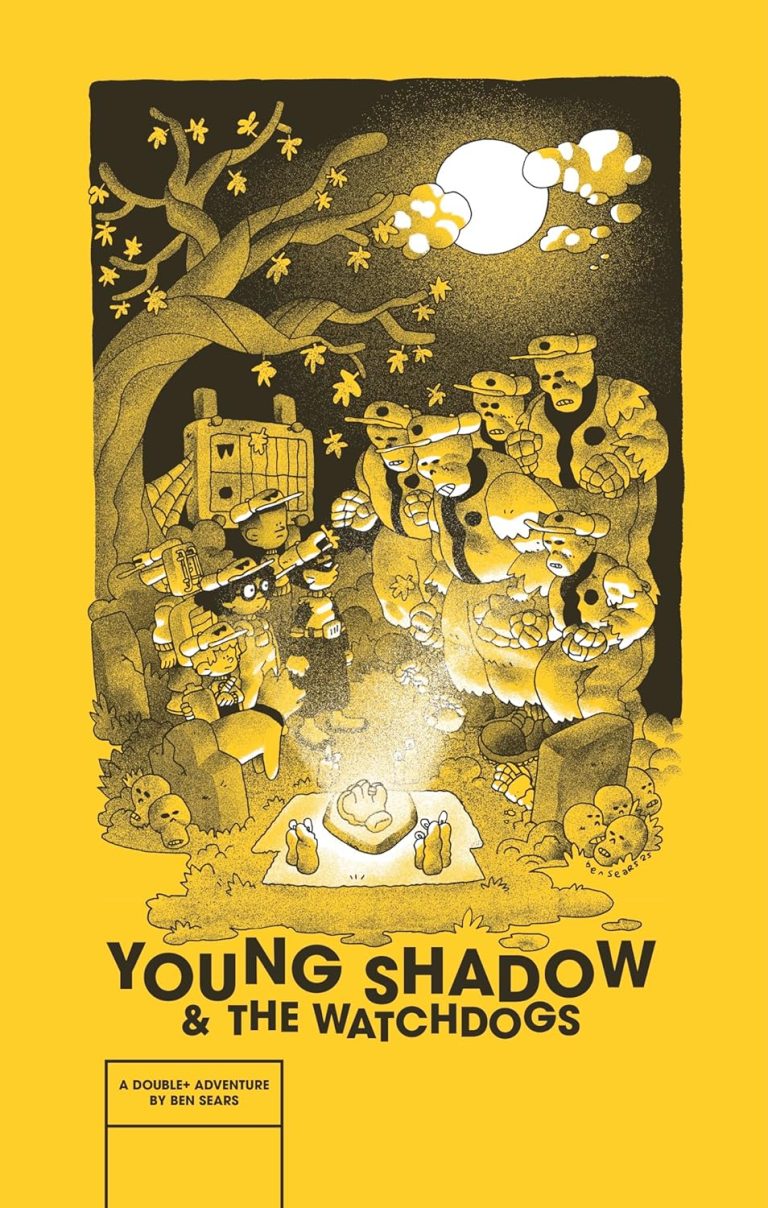
Instead, Watchdogs takes a turn into the supernatural – signposted by a cold-open sequence about a nasty pro baseball player, in some earlier time and place – and the Watchdogs instead play a very different baseball game, against an unexpected opposing team. I don’t want to be coy about it; you can see them on the cover: the Watchdogs need to battle a team of skeletons because of the usual haunted-artifact-makes-them reasons. If they lose, they all die.

To immediately defuse all tension, they do not get eaten by the eels at this time. Sears works in a combination of the traditions of the superhero comic and the It-was-Old-Man-Jenkins! kid-friendly mystery, both of which require that the hero win in the end and everything be put right with the world. So they play fair, they play well, and they win in the end. The haunted artifact is returned to its proper custodian, and even the grumpy old  supernatural baseball player has a change of heart, maybe, we think.

Sears tells all of this in a fun cartoony line, softly rounded and full of amusing visual interest in every panel. He tells it all straight, but his art subtly tells the reader not to worry; nothing too scary will happen from these skeletons and other monsters. That’s another reason I think his books are OK for younger readers: they fit well in that tradition, and tell stories in ways that audience will both enjoy and be familiar with.

I’d still like to see a proper sequel to Young Shadow, to see what happens next and what’s the deal with Bolt City, but this was an amusing diversion from that plot, with an appealing cast and a lot of pages with great bits on them.

Reposted from The Antick Musings of G.B.H. Hornswoggler, Gent.

Laser Moose and Rabbit Boy: Time Trout by Doug Savage

First up: I know I missed one. In between the original Laser Moose and Rabbit Boy  and this book, there was Laser Moose and Rabbit Boy: Disco Fever, which is unavailable from any library near me, digitally or physically. (In fact, none of the nearby libraries seem to have any of the Laser Moose books in dead-tree form, which shocks and annoys me.) I may have to read it in a bookstore at some point, assuming I remember.

But I’m pretty sure there weren’t any shocking revelations or major change in Disco Fever: this is a middle-grade graphic novel series about a moose who shoots lasers out of his eyes and his best friend the slightly more reasonable rabbit, and that’s going to be the whole point. Oh, and they fight crime. Well, maybe not crime as such, since they’re out in the woods – but they help nice people and foil miscreants, so basically the same thing.

OK, so maybe Laser Moose gets a little wild with his eye-lasers, and cuts off the deer Frank’s leg once in a while. These kinds of things will happen when you’re defending the forest. And, anyway, Doc the raccoon can sew Frank’s leg back on. Again.

Laser Moose and Rabbit Boy: Time Trout is just what the title implies: another adventure of Laser Moose and Rabbit Boy, in which they meet and help out a time-traveling fish. A time-traveler from the polluted far future came back to their bucolic wilderness and dropped his time gizmo, which the fish immediately ate. (Because “I thought it might be a grasshopper. I tend to eat anything in the river, just in case it’s a tasty grasshopper. You don’t want to find out that it was a grasshopper later, when it’s already gone,” which makes just as much sense as anyone’s motivation in this series.) 

This makes the fish travel semi-randomly in time: a big purple vortex appears repeatedly to pull him off when he thinks about past events and then again to return him to the present day. Our heroes – plus the evil Aquabear from the first book – get caught up in the shenanigans, with the usual time-travel complications, including changing the past and seeing how current-day things actually got that way. Oh, and dinosaurs. Time-travel stories are required to have dinosaurs.

In the end, Moose and Rabbit put (nearly) everyone back in their proper times, get the time gizmo back to the traveler, and watch the fish follow the traveler off to the future in search of adventure.

It is aimed at middle-graders, which may be a detriment for some readers. I love the goofy tone, and the plot’s zippiness, and creator Doug Savage’s clean cartoony lines, all of which make it a lot of fun and solidly land it in that genre. Graphic novels for pre-teens can often be substantially less serious than those for older readers, and I appreciate that a lot. Savage is particularly good at that kind of thing.

Reposted from The Antick Musings of G.B.H. Hornswoggler, Gent.

ArkhaManiacs by Art Baltazar & Franco

Art Baltazar and Franco have been making a very particular kind of comics for twenty years or so – kid-friendly versions of popular superhero and superhero-adjacent properties, bright and happy and light-hearted, colorful and zippy, full of rubber-hose cartooning and vibrant colors, with usually a cluster of short related stories with minimal plots but a lot of (mostly goofy) character work.

It’s been a durable model, and it’s worked quite well, from what I’ve seen. I think they started with Tiny Titans, which ran for a long time and seemed to be a major success from my chair. The only comic of theirs I’ve covered on this blog was Itty Bitty Hellboy  a decade ago; I got their books for my kids when my kids were young, but my kids are in their mid-twenties now. So I haven’t read a Baltazar/Franco [1] book in quite some time, but I had a lot of fond memories.

ArkhaManiacs  is exactly the same kind of thing they do so well: it collects a short series from 2020 about a kid Bruce Wayne in a somewhat sunnier, happier Gotham City and his encounters with the inhabitants of the Arkham Apartments.

And…it just struck me as a bit odd, subtly off in ways that made me uneasy. Centrally, the problem is that it’s reminiscent of, or seems to reference, the classic creepy Grant Morrison/Dave McKean Arkham Asylum . In both cases, Bruce comes to this mysterious place, is led around by the Joker, meets a whole bunch of weird people, and is told repeatedly he needs to lighten up.

I don’t think Baltazar and Franco meant to make this rhyme with Arkham Asylum. But it does. So the subtext is that a whole bunch of colorful characters – whom we, the adult reader, knows as insane murderers – are urging a kid Bruce, pre-trauma, that he needs to become more like them by using his imagination.

In a kid context, we can just take it all as straightforward, as it’s presented: these colorful characters are harmless. They’re not inhabitants of an asylum, just goofy people living in an apartment building, and they have a lot of fun, and do clearly have great imaginations. And Bruce is a bit of a serious, quiet kid, who could use some loosening up – which is what happens here. In the book itself, it’s all sunny and kid-friendly, Killer Croc and Bane and Harley Quinn and the Penguin all just having fun and playing pretend around a pool.

But…that inevitably makes me think of this Morrison moment, which I don’t want to be reminded of during a book for kids set before Bruce’s parents are murdered:

You may be able to read ArkhaManiacs and not think about Arkham Asylum. Your kids, if you have any, will almost certainly be able to, and that’s probably even more important. But if you know Arkham Asylum, this book will hit more uncomfortably than you expect.

[1] Franco’s last name is Aureliani, which isn’t hidden, but he uses the single name professionally, like Ms. Sarkisian 

Reposted from The Antick Musings of G.B.H. Hornswoggler, Gent.

Usagi Yojimbo, Book 8: Shades of Death by Stan Sakai

This one was a professional transition – it collects the first six issues (plus stories from issues seven and eight) of the second series of Usagi Yojimbo , from Mirage – but, within the story, there’s no indication of that. Creator Stan Sakai didn’t reboot the series, drop into long explanatory flashback stories for the relaunch, or even make much of an apparent effort to attract any new readers. Well, it was 1993, when “long-running” was a selling point for a comic, unlike today.

As it was, the Mirage series only lasted sixteen issues, and they didn’t manage to publish any collections – this eighth book, and all of the subsequent book-format Usagi materials (I think; there’s been a lot of them and I might be missing some odd item) came out from Dark Horse, which started the third Usagi series in 1996 and published 165 issues over the next twenty years.

That’s the background of Usagi Yojimbo Book 8: Shades of Death , which was originally published in 1997. The current edition, which I read digitally, is from 2010; it doesn’t say what was different but my guess is that it was mostly trade dress – there’s no sign that Sakai changed any of the stories fifteen years later.

Shades includes seven stories, all of which stand alone and don’t directly connect to each other. (When your main character is a wandering adventurer who’s solo most of the time, you can just make stories as you feel like it, and they line up just fine.) Two of them, “Shades of Green” and “Shi,” are long three-parters, sixty-some pages each. Two more – the wordless “The Lizards’ Tale” and the flashback “Battlefield” – are about the length of a single issue, in the low twenty-page range. The last three, “Jizo,” “Usagi’s Garden,” and “Autumn,” are eight-pagers that presumably were backup stories.

Three of those stories feature Usagi as a young rabbit – a kit, I suppose – learning Important Life Lessons from his sensei, Katsuichi. Usagi has never been officially a book for young readers, but it’s always been young-reader-adjacent, with any sex kept implied and the violence stylized enough to pass, and these three pieces show that side of the series strongly: as always, Usagi Yojimbo was a comic told in a register suitable for tweens.

The jump to Mirage also meant another crossover with the Teenage Mutant Ninja Turtles; Usagi had met one of them (Leo, maybe?) a few times before, but now all four of the TMNT are summoned to this cod-Edo-Japan world by the traditional old guy (who, unsubtly, Sakai draws to look just like their leader, Splinter) to battle side-by-side with Usagi and defeat the evil ninja, in the first story of the book, “Shades of Green.”

There are other evil ninja in other stories, too: that’s how cod-Edo-Japan stories work: noble samurai battle fiendish ninja, and of course prevail in the end. This isn’t “the end” – Sakai had another four thousand-plus story pages still to come (and I’m not sure that he isn’t still adding more on, even now) – but you know what I mean.

Usagi stories are dependable and fairly predictable, but, luckily, the American comics audience for the past eighty years has craved monthly doses of exactly the same thing, only with slightly different covers so they know to buy it again. So Usagi has been successful commercially, and it’s pretty successful artistically – as long as you like this sort of thing and are comfortable with the moral lessons inherent in any stories about violence experts.

Reposted from The Antick Musings of G.B.H. Hornswoggler, Gent.

Yeah! by Peter Bagge and Gilbert Hernandez

I never want to discourage creators from stretching, from trying new things and talking to new audiences. But, sometimes, it just doesn’t really click.

In the late ’90s, Peter Bagge had been making sarcastic comics about grumpy twenty-something slackers in Hate for more than a decade; his work was really closely associated with not just a particular adult audience, but a very specific tone and style. It’s no surprise that he wanted to do something different.

What he did was surprising, though: he wrote the all-ages, Comics Code-approved girl-band comic Yeah! for DC Comics, collaborating with Gilbert Hernandez. (Hernandez’s career has taken a lot of odd turns, and he’s worked with a number of writers over the years, so this was not quite as much of a departure for him – I’ve always gotten the sense that Hernandez just has the desire or need to generate a lot of work, to keep himself engaged and happy, and the more different the better.)

Bagge’s introduction in this 2011 collection of Yeah! – notably from Fantagraphics, longtime publisher of both Bagge and Hernandez, not DC, which is a big signpost to the fortunes of the series for those who can read tea-leaves – notes that he had an eight-year-old daughter at the time, and had gotten happily into “girl culture,” which reignited his love of pop music. There always are reasons and explanations for specific projects; they always make sense to the creators at the time, and enough sense to the publishers that they make it out into the market. The question, always, is how that market responds.

Yeah! was not a success in the market. It ran nine issues, and was only collected a decade later by a different publisher. (And here I should also note that the collection is in black-and-white, but I think the original comics were in color, since characters make comments about the colors of things pretty regularly, and 1999 was awfully late for a book for tween girls without color.)

And the comics are…OK, I suppose. Bagge is a wordy writer, and this reads not too differently from his better-known work, to the point that the regular Bagge reader starts wondering if these characters are actually being honest and straightforward, or if Bagge has just unlocked a previously inaccessible level of sarcasm. There’s one backup strip at the end that Bagge draws himself, and it’s really hard not to read it like a Hate story – Bagge clearly intends for it to be taken straight, but regular readers will assume spleen and bile in his phrases.

Yeah! is the name of the band: Honey, Woo-Woo and Krazy, three best friends not quite out of their teens, a few years into a music career. They are struggling on Earth but the biggest act in the galaxy, beloved by millions across dozens of alien worlds. (But this was a contemporary Earth that hadn’t had a first contact yet, so there’s no commerce with those alien worlds, so the vast loot Yeah! brings in is useless. They don’t seem to even bank it on an alien world so it’s available for tours or such, like the old Soviet Union; they just give it away or ignore it.) They also have an old, nutty guy as their manager: Crusty; his inventions got them out into the galaxy but his general incompetence can’t get them any good gigs on Earth.

The nine issues are each basically standalone, with goofy adventures either on Earth or in space – including the inevitable flashbacks to reveal Who They Are and How They Got Here – as Yeah! chases fame and fortune here (with little success) and gets involved in odd alien things out there. On Earth, they have a rival, Miss Hellraiser, and a band of boys, The Snobs, who always beat them in battle-of-the-bands situations and one of whom has a crush on Woo-Woo. In space, the characters are all one-offs – there’s the driver of their space limo who shows up a couple of times without actually getting a personality or anything to do. The stories are all wordy, and all full of the cultural assumptions and ideas of a guy Bagge’s age (early 40s around this time), including a bunch of hippie jokes.

This is all fine: it’s amusing and entertaining, and the gestalt of Bagge’s writing and Hernandez’s art works well together. It is too wordy, in that old-fashioned comics style, full of long captions and long dialogue balloons that say a lot of the same things over and over again. And it all comes across as something like a generation-later version of Bob Hope: goofy, sui generis comics that are meant to appeal to a younger audience but are full of the ideas and plot devices of old people.

Yeah! is basically forgotten, for good and sufficient reasons. It might not quite deserve that, but most things get forgotten twenty-five years later. If you really loved Josie and the Pussycats (the movie, the concept or the comics) and wish there was something else sorta like that, you might be in luck.

Reposted from The Antick Musings of G.B.H. Hornswoggler, Gent.

Laser Moose and Rabbit Boy by Doug Savage

When a creator you like turns to creating works for younger readers, you have two choices: follow him along, and check out the new stuff, trying to have an open mind, or to avoid the new stuff and grump about how creators should keep doing the things you discovered them for, grumble grumble.

OR – and this is what I seem to do most of the time – you could not even notice the creator has material in a different genre for about a decade, and then stumble on it randomly when the “new thing” has a fifth book published, and wonder where the time has gone, alas, where are the green fields of our youth?

Doug Savage is a funny, inventive cartoonist. I discovered him with the Savage Chickens project, which I think was either his first big thing or his breakout. Adults don’t buy books of funny drawings very consistently these days – this is sad, because in my youth, the small funny book of cartoons by the cash-register was a dependable publishing category, with big successes every year, but the Internet ruined that like it has ruined so many things – but, and here’s the trick, kids still do. So a lot of funny, inventive cartoonists have found that, if they can tune their sensibility to middle-schoolers or grade-schoolers, they could have a really awesome career making fun things, visiting a very appreciative (though often massively rambunctious) audience, and enjoying a mostly supportive community of peers.

I don’t know if any of that went into Savage’s decision to make Laser Moose and Rabbit Boy  in 2016 – many cartoonists fall into making books for younger readers because they have younger readers roaming around their houses – I’m talking about their own children, usually, not semi-feral bands of tweens – and there can be other reasons as well. But Savage made a graphic novel for middle-schoolers, got it published by Andrews McMeel, which also handled his “Savage Chickens” books, and has gone on to do four more books about these characters in the decade since then.

This first book has three mostly separate stories, all set in this same forest and focused on the main characters. They’re superheroes, I guess. They fight evil, or try to, or intend to. Laser Moose is a moose who can shoot lasers out of his eyeballs for unspecified reasons, and who takes his responsibilities as a laser-shooting moose very, very seriously, probably too much so. Rabbit Boy is his sidekick, a sunny and positive rabbit with no visible superpowers but a somewhat more grounded view of reality that is desperately needed to keep Laser Moose from just cutting everything within sight in half.

In this book, they “battle” aliens who don’t seem to really be invading at all. They discover a hideous Aquabear, transformed into a monstrous chimera by toxic waste, and, after some setbacks, return the monster to the human facility that created him, making him the humans’ problem. And they foil a new plot by Laser Moose’s arch-enemy, Cyborgupine – yes, a cyborg porcupine – who has created a fiendish minion, Mechasquirrel.

It’s all fun and zippy, in an appealing kid-friendly cartooning style, mostly thin lines and flat colors. It’s the kind of style that looks like an evolved version of the drawings those kids themselves are making – accessible, immediate, quickly readable. And Savage is as funny here with delusional moose and sunny bunnies as he was with wage-slave chickens. You don’t need to be ten to enjoy Laser Moose and Rabbit Boy, though, if you can access your inner ten-year-old at will, that definitely helps.

Reposted from The Antick Musings of G.B.H. Hornswoggler, Gent.

Who Is AC? by Hope Larson & Tintin Pantoja

version-1-0-0-22

If this were a TV show, it would be a pilot that didn’t get picked up: it obviously aimed to start a series, and, a decade later, it didn’t. There are a lot of plot points, themes, and ideas that aren’t completely explained or fleshed out here – but of course there would be, if it were going to be a series. Those are hooks for later stories, for further details to come later, room for the story to grow.

But, for whatever reason, it didn’t. Who Is AC?  is a decade-old standalone now; I suppose it’s just possible that writer Hope Larson and artist Tintin Pantoja could get back together and tell us what happened next, but this was a Sailor Moon-inspired, manga-styled graphic novel about superheroes and social media aimed at tweens. That audience is now in college; the phones they used in 2013 are four generations out of date; and the ways all of us interact online has shifted and altered. Any follow-up would either be a period piece or a full reboot.

But, if you can ignore the fact that the main character gets her superpowers from a candybar phone, the likes of which were I think solidly out of date even in 2013, AC is a fast-moving, if somewhat superficial, adventure story about one girl who gets superpowers and discovers there are Trolls lurking out in the world.

Lin just moved with her family to the small college town of Barnhurst – location deliberately left unspecified, but  notably small and far away from everything. On the flight over, her phone rang while in airplane mode, and something happened that transformed her. She can use that phone contact, in a way the book doesn’t over-explain, to turn into a costumed superheroine with what looks like a big spear and some vaguely computer-esque powers.

Trace is a young man, about the same age, who lives in Barnhurst. He works in a copy shop, where he meets Lin making her zine. He’s got a crush on Mel, who works next door at the get-your-photos-taken-in-old-timey-garb shop (which is sustainable as a business in a small college town? Barnhurst must get substantially more tourist traffic than it seems to). Mel is a bit self-centered, the stereotypical pretty girl, but seems like a basically nice, normal person, not an airhead or a spoiled brat. The two have a date, which does not go well, largely because Trace is even more self-centered and full of unwarranted assumptions about every last thing in the world than we expected. (He’s also about sixteen or so, which means it comes across as young and unformed and needing some life experience rather than completely horrible. But he is clearly reminiscent of That Internet Guy, who was a loathed type even in 2013.)

The same night as that date, Lin witnesses a hold-up at the copy shop. She transforms into her alter ego, saves the day, and captures the crook (who is a sad-sack guy trying to get money to pay for dental work). But she also transforms again on the way home, to see how it works, and causes an accident for an already-mad Trace and his bike.

Trace posts an angry rant online about the superheroine after he learns about the holdup, calling her Anonymous Coward. (Presumably, if there had been a series, AC would have stood for other things – but that’s the source of the name here.) At about the same time, a shadowy figure in a repurposed Pizza Hut somewhere nearby – clearly the Big Villain of the series, but not completely identified in this book – tempts Mel into becoming what I suppose I have to call an Evil Minion.

Mel and Trace are going to meet someone isolated the next night, where Mel will presumably use the power of the Negative Internet to change Trace into another Evil Minion like herself. But Lin shows up, and there is a battle with lots of 1s and 0s in it, and the hold of the Troll (I guess we can call the big villain that – he’s called a troll in the book, which implies he may not be alone) is broken.

Lin’s secret identity is still, we think, safe, though her costume doesn’t cover her face all that much. Mel and Trace are back to being friends, we think, and maybe, if there were a Book Two, might move on to more. But AC doesn’t have a real superhero name, the origin of her powers and the Troll are still mysterious, and it’s not clear what the significance of the plot of the book was.

So: very much an introductory first volume, mostly set up and mysteries. All things that will now never be cleared up; this is all we have. Pantoja gives it an energetic, mildly manga style, and Larson, as always, is good with the big personalities of young people. It’s not quite a complete story, but it’s fine as long as you think of it as a pilot episode getting burned off one random night in the summer.

Reposted from The Antick Musings of G.B.H. Hornswoggler, Gent.

Usagi Yojimbo, Book 7: Gen’s Story by Stan Sakai

This one collects seven more issues of the early Usagi Yojimbo comic, plus a story from Critters, though the dates in the book are a little confusing. The book itself claims a first edition in September 1991, but says the stories included are copyright no earlier than 1992. Now, Stan Sakai is a fantastic creator, but I do think he’s bound by linear time, so issues 32-38 of Usagi, which were published from February 1992 through March of 1993, could not be collected in late 1991. Given that it has a 1996 Sergio Aragones introduction, and the second edition is said to be December 1997…I’m wondering if that first edition is a typo or just a mistake inserted onto the copyright page so long ago everyone has forgotten about it.

This book is also the end of the initial Fantagraphics run of Usagi. A second edition started up – checks notes – what looks like the very same month from Mirage . That one only lasted sixteen issues, but then Dark Horse picked it up and ran for another twenty-plus years for over a hundred and fifty issues.

So I’ll look to see if the beginning of the eighth volume seems to be more of an attempt to onboard new readers; this seventh volume, Gen’s Story , is much like the books immediately preceding it. There’s one long story that gives the book its title, this time featuring the return of the irascible rhino bounty hunter Gen, and featuring some historical backstory for him, alongside a cluster of shorter, relatively standalone stories.

We meet a female thief, Kitsune, who may be a love interest for Usagi, and then she returns in a later story. We’ve got a ghost story, in which Usagi is able to lay the spirit of a general he served under. We’ve got two shorter stories, one mostly humorous about young Usagi with his sensei and one where he’s narrating an encounter with an evil witch-like character to Noriyuki, the young panda lord who has showed up in this series a few times. And there’s “The Last Ino Story,” in which Gen and Usagi find that blind swordspig and nurse him back to health, learning what’s happened to him after their last meeting. (With about a hundred and eighty issues of later Usagi, I’m vaguely dubious anything of this era is “the last” anything, but it’s possible he never shows up again.)

As always, Usagi is upstanding and righteous, closely following the code of bushido and not particularly suffering because of it – this is a lightly moralistic series for younger readers, so the character with the rigid moral framework will be correct in every situation and events will arrange themselves so that he succeeds in his endeavors. Gen in particular exists to show an alternative to Usagi – not quite villainous, but clearly Not Right, like a young man bandying a girl’s name in a Wodehouse novel. The fact that this entire social setup was exploitative and corrupt, enabling a vicious caste of violence experts who were able to terrorize peasants basically at will…well, that’s just the way of the samurai, isn’t it?

Reposted from The Antick Musings of G.B.H. Hornswoggler, Gent.

version-1-0-0-13

What If We Were… by Axelle Lenoir

version-1-0-0-13

I have to start, as usual, with my biggest criticism, and get it out of the way. I’m sorry to slam Axelle Lenoir and her publishing team so hard, but it has to be said.

What If We Were…  only has a three-period ellipsis in its title. This is wrong. When an ellipsis ends a sentence, it needs to have four periods. I am incredibly disappointed at this major, unforgivable mistake.

This book collects what I think were forty or fifty individual strips – the main story seems to be in two-page entries, but there’s also interstitial material that might have been attached to the stories, added for this book, or maybe the alternate version in every other issue – that appeared in Quebec’s teen-focused magazine Curium  in French. From the copyright page, I think a version of this collection then appeared in book form in Quebecois French, from Front Froid, and then this edition came out in 2020, from Top Shelf, translated by Pablo Strauss and Aleshia Jensen. It is the first of two books collecting this strip; I have no idea if that’s the whole run or not.

Marie and Natalie are teens, best friends who have played the title game since they were little kids. One of them has a premise – what if the two of them were Vikings, or superheroines, or world-famous scientists, or whatever – and they both riff on the idea. The strip is about their friendship, using the game as a regular (but not required) element to show how they relate to each other and what they care about. Oh, and Natalie has a crush on another girl they go to school with – first unnamed, then called “Jane Doe”…which somehow turns into her actual name over the course of the strip.

Jane does become the third major character during these strips, first having that very teenager-y  circumlocutious conversation with Marie to ask if Natalie 1) likes girls and 2) likes her. Since Natalie does and definitely does, Jane starts circling the outer orbit of the strip about a third of the way into this book, gradually getting more and more central until the two of them actually have a date.

This is very much a story about teenagers, originally for teenagers. It has that nervous, insecure-in-its-own-skin energy of the teen, the sense that all of the world is new and overwhelming and awesome but also deeply scary. Marie and Natalie are interesting, quirky, real people with foibles and distinct personalities – Jane is a bit more of a plot token, especially early on, but she does get somewhat more depth once she’s in the strip more.

What If We Were… is fun and zippy – it’s clearly a collection of a loose serial, and equally clearly a work for teens (especially French-speaking teen girls in Canada, which may be a bit too far away from some readers’ experience), and definitely not as ambitious and impressive as Lenoir’s big graphic novel Secret Passages . But Lenoir has an infectious energy in her drawing and her dialogue is always specific and grounded – this is a story about these people and what they care and think about.

Reposted from The Antick Musings of G.B.H. Hornswoggler, Gent.

Hockey Girl Loves Drama Boy by Faith Erin Hicks

hockey20girl20loves20drama20boy-6723269

Sometimes working titles survive everything the book-production process can throw at them. The new project comes in with a title everyone assumes will be replaced, eventually, by something better, but then the whole team gets used to it, every new option is shot down for various reasons, and the placeholder title seems OK by comparison.

Maybe not just OK – it’s the way everyone is thinking about the book.

And, eventually, the cover has to be designed and the placeholder title is put in type, and, gosh! it looks just fine there, so whaddayaknow: that’s the actual title.

I don’t know that happened with Faith Erin Hicks’ 2023 graphic novel Hockey Girl Loves Drama Boy . But it’s the style of title that makes me very suspicious.

This is a teen romance drama, heavier on the teen drama than the romance, which is mostly light and casual. Our central character, as implied in the title, is Alix, the star player on her teen hockey team on Vancouver Island.

Alix is a loner and not good at social interactions. She also seems to be about six feet tall and pretty muscular; we think that has a lot to do with it. (She’s big even on her hockey team.) But probably more pertinently, she’s been bullied by her team captain Lindsay, for what seems like years – and the other players quietly let it happen, so Lindsay doesn’t focus on them.

(The unwritten story here is how horrible their coach is: she sees and allows this behavior from the team captain because, apparently, the team wins consistently. I don’t know about legal requirements in Canada, but, where I live, the coach would be a mandated reporter and could – wait, I mean should – lose her job for turning a blind eye to such toxic behavior.)

Anyway, after one game at the very beginning of this book, Lindsay goes off on a tirade against Alix – how she’s no good at anything except hockey, will never have a boyfriend, is the worst person ever, that kind of thing – and Alix just hauls off and socks her.

Now, I have never been a teenage girl. But in my years as a teenage boy, when similar things happened, – and they happened quite a lot – both participants would be disciplined, for slightly different reasons, and told nothing like that could ever happen again.

But in Canada, in the year 2023, among young women, in this book at least, it’s all Alix’s fault, and the coach pulls her into an office to ask seriously why this happened and “where this violence came from.” Um, one – hockey, and two – sustained endemic bullying from an authority figure! This is not actually difficult for a coach who has any idea what she is doing…which this one clearly does not.

This is our plot. Alix, who had one completely understandable and long-overdue moment of rage, needs to learn to control her anger. And her coach, having no professional skills in this as in everything else in her purview, leaves Alix to figure out something on her own as a seventeen-year-old, instead of referring her to a counselor or booking her into the league anger-management group or anything else serious and constructive that a coach with actual resources would have done.

Alix instead goes to school the next day, where she sees a classmate, Ezra, facing down his own bully, Greg – who, in the overdetermined world of high-school drama, is also Lindsay’s boyfriend, though this plot point doesn’t really become important – through words. So she, in her clumsy-galoot way, asks Ezra to teach her not to hit people when they bully her, which, again, she apparently has only done once in her life in the first place.

Ezra, one of the Drama People who are eternally at war with the Jocks, as told in legends and ’80s movies since time immemorial, agrees to this random weird request from a gigantic girl he’s never really interacted with. And they start hanging out, since Ezra doesn’t have an anger-management course or specific lessons he can just tell her to begin with.

Ezra’s friends run the gamut of mildly supportive to strongly opposed: how dare he spend any time with someone who is regularly in physical vicinity to bullies like Lindsay and Greg?

Oh! And also, everyone at school thinks Ezra is gay, since he’s only dated boys in highschool. (He’s actually one of these modern “I don’t want to put labels on it” kind of person who is not “bisexsual” even though he admits he’s attracted to both boys and girls – and, we the readers think, any other kind of person he meets, probably.)

Alix starts developing a crush on Ezra, thinking it’s impossible. Ezra is the kind of bisexual totally unique unlabel-able teenage sex-god-thing who wants everyone to live and/or love him. They are both dramatic in their own ways, because they are teenagers and it comes with the territory.

There’s also an undercurrent of “what do you want to do with your life, and do your parents approve?” Both Alix and Ezra have been raised by single mothers with dramatic backstories – Alix’s mom is a “Canadian-famous” sculptor who went strongly against her own parents’ wishes to go into the arts and whose husband ran away sometime after Alix’s birth to play hockey in the States and apparently has had no contact since; Ezra’s mom was abused by his father until ten-year-old Ezra stood up to him with a knife and drove him out of the house.

Consequently, Alix’s mom is strongly anti-hockey, and doesn’t see the flashing, direct, incredibly obvious parallels between her parents’ “it would be crazy for my teen daughter to work so hard on this thing with a very low chance of career success!” arguments and hers. And Ezra is cold to his mother’s boyfriend, a perfectly nice guy who seems to have been around for a while and plans to stick around permanently.

Like I said: more drama than romance. Alix and Ezra do eventually work out the “he’d be more than happy to kiss her, too” thing, and they do kiss and hold hands. But the plot-driven Dramatic Stuff takes up most of the book.

I found it a bit overstuffed: there’s too many bits of drama, which proliferate as the book goes on, and there’s not quite enough space to let it all breathe naturally. A number of things are suspiciously convenient – such as Alix’s father’s location and the ease of contacting him – when they need to be, and adult reactions also seem to be carefully calibrated to keep the drama running on the right track to the ending Hicks wants.

So my sense is that Hockey Girl Loves Drama Boy wanted to be bigger than it was – maybe two books, one mostly Hockey Girl to start and a concluding volume mostly Drama Boy. It all works as it is – Hicks is an old hand at this, and tells stories well – but there’s more material here than quite fits comfortably into the package.

Reposted from The Antick Musings of G.B.H. Hornswoggler, Gent.