
Tagged: You Know: For Kids

When Stars Are Scattered by Victoria Jamieson and Omar Mohamed

, so I’m calling it now: the Usual Suspects will be protesting this book , too, since it makes their little Kaydens and Buddies either “get lib’rul ideas” or whine that their teachers are being mean to them, depending on how stupid and/or indoctrinated any individual Kayden or Buddy is.

That may seem to have nothing to do with the book, but it’s not. Culture wars have no boundaries: they range through all of culture. Culture is what we live in. And the white supremacists are waging a very clear cultural war, with loud “will not replace us” messaging on national TV, aimed at people exactly like the co-author of this book.

When Stars Are Scattered is a book every Kayden and Buddy should read. As young as possible: maybe when they’re about seven, like Omar is at the beginning of this book. They should think about how they would live if they were refugees in a foreign country, with one parent dead and the other possibly lost forever. They should think about other kids: in their classes, in other parts of America, around the world. They should wonder what those kids are going through.

(To quote a song I’ve been listening to a lot lately, “<a href=”

you think you’re at your limit, just remember what some folks survive.”)

This is a true story, more or less. From the afterwords by Omar Mohamed (who lived it, and shaped it into a story) and Victoria Jamieson (who turned the story into a script and the script into drawn pages), I think some characters are composites or somewhat fictional. But Omar is real. His brother Hassan, who can only say the word “Hooyo,” is real. The refugee camp Dadaab in Kenya, where hundreds of thousands have lived for up to three decades now, is real. And the civil war in Somalia, which is still going on, is real.

Omar was about four and his brother just a baby when they left Somalia. What happened that day isn’t revealed until late in this graphic novel, but I will tell you it opens three years later, with the two boys taking every chance they can get to look at new arrivals, hoping they will see their mother.

Scattered is mostly about life in the camp , and how Omar grows up there. It’s a grinding life: not enough food, very little to do, no clear possible escape. The dream of every refugee is to get out – some, like Omar, dream of going back to their lives before the war, but we get the sense that’s mostly children. Adults know that can never happen. The other dream is to get out: to be allowed to settle in some faraway country, Canada or America or somewhere in Europe. Only a few can get one of those slots: it’s a long process, full of paperwork and interviews, and there’s an element of competition to it.

And is your family situation worse than the others around you? Have you suffered more than them? Are you more worthy of being resettled somewhere overseas because of what you’ve been through?

And what does it do to a person and a society to have to think like that, to tell your story through that lens to UN interviewers?

Omar makes it through that world. This is a book for children; it has a happy ending. Omar is telling us this story, because he did make it out to America, and made the life he wanted. More than that, his adult life is devoted to helping other refugees, both the ones who made it to America and the ones back in Dadaab. It’s a good life, a life worth celebrating and spotlighting. I’m glad he and Jamieson were able to tell his story so cleanly and clearly, to an audience that needs to hear it.

And so, again, I want to see When Stars Are Scattered in every elementary school across the country. Especially the ones without people named “Omar,” or people who look like Omar Mohamed. That’s the way compassion and honesty wins the cultural wars: through true stories of different people, presented to an audience young enough to learn lessons of compassion and honesty.

[1] In case you don’t know, actual CRT is a graduate-level discipline, originated in law schools and also taught at the graduate level, to graduate students, in graduate schools of other kinds. It aims to untangle racial biases in things like historical criminal sentences.

It is in no way identical to “teaching white kids that kids of other races are also real people who you need to respect.” The latter should be base-level standard, but it’s what “conservative” parents are actually protesting, as seen in a telling quote from Connecticut, also this week: “helping kids of color to feel they belong has a negative effect on white, Christian, or conservative kids .”

antickmusingsdyil2auoc8za-7868739 antickmusingsd63t7ie-lg7y-5518639 antickmusingsdqj6idk7rits-3617157

Reposted from The Antick Musings of G.B.H. Hornswoggler, Gent.

Minecraft: Wither Without You Vols. 1 & 2 by Kristen Gudsnuk

I don’t have tags for either video games or sharecropping, since I don’t read enough books in either category to make those useful, but this book would have both of those tags, if they existed. I’m also not 100% sure the “for kids” applies: the CIP data on the copyright page says these books are “Ages 8+,” but so are a lot of other things. The Minecraft graphic novels are at least not not for kids, if that makes sense.

Most people will be reading this book, and the burst of other Minecraft graphic novels that Dark Horse has been publishing under an arrangement with Mojang over the past couple of years, because they like the video game Minecraft: maybe the building/crafting elements, maybe the grinding/fighting mobs elements, maybe something social about being on a server with friends. But I only played Minecraft a very little bit myself, way back near the beginning, so I’m one of the few people here because I’m following Kristen Gudsnuk’s career.

(Sidebar 1: said career consisting, as far as I’ve seen, of the awesome Henchgirl  graphic novel, mostly for adults, and two books in the Making Friends  series for middle-grader readers. Those also contain awesomeness, but said awesomeness is more finely tailored to an audience of tween girls. A third Making Friends book has just been published; I haven’t seen it yet. I recommend adults start with Henchgirl: as previously mentioned, it is awesome, and I will keep saying so until everyone admits it.)

(Sidebar 2: I think I liked what I played of Minecraft. It’s just that I think I want to play building/crafting sims – I spent decades thinking I really really wanted to play Sim City or Sim Universe or whatever, but never got around to any of them, and did buy The Sims but left it moldering in my Steam folder after setting up two separate households in one evening – but, on the evidence, I actually want to do some crafting/building in my RPGs, as evidenced by nearly 3k hours in Fallout 4 to date. So nothing against Minecraft, and I may get back to it someday. But I bet it’s totally different than my vague memory.)

I say that to orient you the reader: the Minecraft stuff here is vaguely familiar to me, and I have definitely played other video games. But I may misunderstand some pretty basic stuff, and I apologize ahead of time if I do.

Anyway, Kristen Gudsnuk, of previous awesome comics fame, is in the middle of a trilogy of short graphic novels set in the world of Minecraft, the popular video game. I recently read the first two: as far as I can see, the third is not yet scheduled to be published, but my guess is that it should hit in mid-2022. The series is called Minecraft: Wither Without You, and Volume One  was published in April of 2020 and Volume Two  followed this May.

So this is an incomplete story, obviously. It’s set-up and middle, but the ending is not available yet. But each of the two books to date has an arc of its own – as all trilogies should – so I think I can say coherent things about the two of them.

We’re in a fantasy world that will be very familiar to Minecraft players and deeply weird to anyone else: the world is made of blocky elements than can be mined for materials used to build other things, and monsters run around randomly. Some of the people are rounded, but most of the villagers (whisper NPCs whisper) are blocky just like their world and creatures. Adventurers fight monsters to save villages, but even more so to get experience orbs and rare materials and probably some valuables the monsters have themselves.

Cahira and Orion are twin teenage monster hunters, traveling with their mentor/teacher Senan the Thorough to learn the ways of monster hunting and get epic loot along the way. In the first book, a Wither – a big nasty flying monster – attacks them when they trigger a trap in some monster-filled castle they’re exploring. It swallows Senan, and the twins chase it across the landscape, thinking they can save their mentor from its belly if they can do it quickly enough.

They are correct, though they need the help of Atria, a teen girl they meet along the way: she’s been cursed to attract monsters, and ends up both luring the Wither to them and figuring out what the Wither really wants.

The second book begins with our four heroes seeing that same Wither fly over, which it should definitely not be doing given the end of book one. (Trying to be at leas slightly vague here.) They’re on their way to Whitestone City to resupply after their epic battle , and they decide to also consult the great sorcerer Lucasta while they’re in town.

Unfortunately, Lucasta is also Senan’s great rival, so there’s some tension there. She also farms monsters, and is most interested in setting Atria up in a room with some monster death-traps to harvest their stuff – which is not the most pleasant thing for Atria. And there’s a self-proclaimed great monster hunter, Elvicks, in Whitestone, and his arrogance and attempted thievery leads to a zombie infestation , as it sometimes does.

So most of the back end of book two is devoted to getting rid of the zombies and working out the other problems. But they all end the book newly geared up and ready to go out and stop that Wither…which I presume they will do in the final book.

These are both fun and zippy in Gudsnuk’s usual style: her people have big emotions and reactions, which is excellent for slightly goofy melodrama where the reader knows it will all end well eventually. You probably do need to be a fan of Minecraft or Gudsnuk to want to read them, unless you’ve got a thing for books-based-on-video games. (And maybe you do: I don’t judge.) But both of these books are very good at what they set out to do, and what they set out to do is be vaguely positive but silly entertainment.

antickmusingsdyil2auoc8za-4996415 antickmusingsd63t7ie-lg7y-2107828 antickmusingsdqj6idk7rits-6730665

Reposted from The Antick Musings of G.B.H. Hornswoggler, Gent.

The Midwinter Witch by Molly Knox Ostertag

I could pretend that I did it on purpose: that I skipped The Hidden Witch because this book is newer, maybe as some kind of comment on how commercial fiction, especially for younger readers, is so trope-ridden and bend-over-backward accessible that any reader can jump in anywhere and figure out everything important.

I could. But I shouldn’t: it’s not true. So I won’t.

I did read The Witch Boy , the first book in this series of graphic novels by Molly Knox Ostertag (who also, apropos of nothing, is the artist of the great Strong Female Protagonist  series). But I missed the second one, and maybe got The Midwinter Witch  from the library thinking it was the second one. (I had them in the wrong order in my list there, so that’s my excuse.) Whatever: I read book one three years ago, and now I read book three.

There are secret families of magical people – large, extended clans spread across the world, several families, each with slightly different traditions and skills and abilities. As far as we’ve seen, they’re almost entirely good, nurturing people, though, like anyone else, they can be close-minded and unwilling to want change. [1]

Aster is a boy, and in his family, boys are typically shifters – they transform into animals – and girls are witches, casting spells. In Witch Boy, Aster was able to show that typically does not mean must always be, and was able to start training publicly as a witch.

I think Hidden introduced Ariel, a girl about the same age – maybe ten? I’m not clear how old these kids are, but they feel early-middle-schoolish, just prior to the pairing up and worrying-about-sex years – who has witchy abilities, but was adopted, so her heritage was somewhat unknown. Ariel is now part of the same cluster of kids that learn magic (and maybe other things? there may be a Hogwarts-education issue in this world as well) in a homeschooling environment, along with Aster.

This book is about the runup to the big Midwinter Festival, in which Aster’s family (Vanisen) gathers together for a combination family reunion and competition. The shifters (just the kids, as far as I can see) compete in one contest, the witches in another. And the drama in this book is about whether Aster and Ariel will compete.

Aster wants to compete: wants to be seen as what he is. Ariel is reticent: she’s good at magic, but not good at family, and this is all really new to her. Aster’s mother Holly wants Aster to take a pass this year (for what seem to be mostly not-making-waves reasons) and Ariel to compete (since that would help cement her place in the larger family).

Meanwhile, Ariel is having dreams of a powerful older witch who claims to be a living real relative of hers, and trying to drag her into a very different, much nastier kind of magic.

Who! Will! Win!

This is a YA graphic novel series, so obviously it all turns out fine in the end, with all of the good people hugging and being friendly, and everyone winning to at least some degree. I tend to prefer stories with slightly harder choices, but this is fun and positive and affirming: I expect it, and the whole series, are big confidence-builders for all sorts of kids who are odd in one way or another, particularly those whose oddities run up against the gender norms in their families.

[1] This has been a series for pre-sex kids so far, so how people pair up isn’t as clear. I’m hoping there are pan-family gatherings at least partially for teens to meet and match with each other, or else each family is going to get really unpleasant genetically.

antickmusingsdyil2auoc8za-2672398 antickmusingsd63t7ie-lg7y-8227067 antickmusingsdqj6idk7rits-8678401

Reposted from The Antick Musings of G.B.H. Hornswoggler, Gent.

Young Shadow by Ben Sears

Sometimes a creator’s different instincts and plans don’t always play nice with each other. For example, a costumed-hero story has certain standard tropes: the hero can always leave the bad guys tied up with a nice note for the authorities and the reader knows that means justice has and will be done.

But if the same creator wants to do a story about corrupt cops in what seems to be a deeply corrupt city, tying up those cops will not have the same expected result: it just means their compatriots will untie them, maybe make fun of them, maybe get angry on their behalf. Frankly, it would just annoy Certain People even more: that’s an event for the middle of the story, not the end.

So I’m not as happy with Ben Sears’s new graphic novel Young Shadow  as I was with the last book of his I read, House of the Black Spot . Black Spot had villains who could be dealt with by mostly offstage Forces of Justice, and heroes whose modus operandi was a bit more complex and nuanced than the costumed-hero standard of “run around the city at night , asking people if there’s any trouble, and then get into fights with people whose look you don’t like.” That’s very close to Young Shadow’s exact words: he’s the hero, so the book says he’s right to do so, but his actions are exactly those of a bully or criminal gang: find someone doing something you object to (in this case, “rebel against your rich parents by drinking in the park and not bathing”), use violence on him.

If I were being reductionist, I’d say Young Shadow is “the Jason Todd Robin in an ACAB world.” We don’t know what Young Shadow’s real name is, or his history: we meet him on patrol, in Bolt City. He’s in tactical gear, with a domino mask, and he’s good at violence but signposted to be on the side of righteousness – the first time we see him fight, it’s to help a maltreated dog. Sears’s rounded, clean art style isn’t great at communicating this, though: Shadow says the dog is malnourished and dehydrated, but Sears draws him exactly the same then as later in the story, or like any other dog, just with his eyes closed most of the time.

Shadow doesn’t appear to have any real home. Maybe a bolt hole or three where he sleeps, or stashes gear, or keeps whatever other stuff he has. It’s not a “this guy is homeless” situation; it’s just not important. What he does is patrol as Young Shadow. What he does is protect the city. Anything else he does is not even secondary.

Shadow has a network of friends, or maybe informants. They’re the people of this neighborhood, or maybe multiple Bolt City neighborhoods. A number seem to be the owners of small businesses: a “lantern shop,” places that look a lot like bodegas, an animal shelter. They would tell Shadow about miscreants in their areas, we think – but, in this book, they don’t talk about nuts dressed up like wombats planning elaborate wombat-themed crimes, but instead about the night shift of the Bolt City Police Department. Those cops are acting suspicious, searching for things in a more furtive way than usual for cops. It’s not super-clear if there are elements of the BCPD, or any aspect of Bolt City governance, that is generally trusted by the populace. My guess is no. There is definitely some generalized “never talk to the cops about anything” advice, as with similar communities in the real world.

We do get some scenes from outside Shadow’s point of view, to learn that there are Sinister Forces, and that they encompass both the young malcontents Shadow beat up in the early pages and those crooked cops. (Well, maybe not crooked: they’re not soliciting bribes. We don’t even see them beat up or harass anyone. It’s just that Young Shadow is set in a world with people who totally mistrust cops for reasons which are too fundamental to even be mentioned.) There is an Evil Corporation, as there must be, and both a villain with a face and a higher-up Faceless Villain. Their goals are pretty penny-ante for an Evil Corporation: get back a big cache of crowd-control weapons and tools, get some more pollution done quickly before the law changes.

Shadow spends a lot of time wandering around looking for these people. I’m not sure if Sears is trying to make the point that this is not a useful tactic, or that Shadow is good at the violence stuff, but not so much at the finding-appropriate-avenues-for-violence stuff. I thought he did make those points, deliberately or not. Eventually, another vigilante appears: Spiral Scratch. (At first in a closed helmet, which I was sure meant it would be a character we’d seen before. But nope.) The flap copy calls SS the sidekick of Shadow, but the opposite is closer to the truth: Scratch is more organized and planful, and Shadow wouldn’t get much done alone.

In the end, our two forces of righteous violence find the thing the Forces of Evil are searching for, and dispose of it with the aid of an order of robot nuns. (I do enjoy the odd bits of Sears’s worldbuilding.) And they tie up some of the henchmen, which, as I mentioned way up top, will probably not lead to anything like punishment for them.

So I’m left wondering if there’s going to be a sequel: it feels like this story isn’t really over, that our vigilante heroes haven’t actually solved any underlying problem by punching a few people. And I also think I like Sears when his characters are detecting and talking rather than punching. But I like that in general, so that’s no surprise. People who like more punching in their comics may have a different opinion, and God knows they’re very common – if you’re one of them, give Young Shadow a look.

antickmusingsdyil2auoc8za-6335485 antickmusingsd63t7ie-lg7y-7355968 antickmusingsdqj6idk7rits-6817122

Reposted from The Antick Musings of G.B.H. Hornswoggler, Gent.

The Unbeatable Squirrel Girl, Vol. 9: Squirrels Fall Like Dominoes by North, Charm, & Renzi

The ninth volume collecting The Unbeatable Squirrel Girl collects five issues from early 2018 and came out in late 2018, with yet another lightly modified “funny” song lyric for a title: Squirrels Fall Like Dominoes .

As usual, I got to it three years late, after the series ended. (See my post on Vol. 8  for similar tardiness, and links back to even earlier tardiness.)

This time out, regular series writer Ryan North and colorist Rico Renzi are joined by a new artist: Derek Charm, replacing Erica Henderson. Henderson had drawn the first thirty-one issues of the series, the short previous series, and an original Graphic Novel, which were probably as many Squirrel Girl pages as all previous artists put together. (She defined the look and style of SG for this era, at the very least, and seemed to work very closely with North on stories & plots, too.) So this was kind of a big deal, especially since the SG audience was proverbially heavily pre-teen and female , which as an audience is often not happy with change.

Charm is a cartoonier artist than Henderson, which is a nice change-up. SG is a bit cartoony story-wise (if that makes any sense), so it’s appropriate and gives a different energy to the pages. I’m sure some people hated it; some people hate everything. But it works for me.

As always, we have an epic four-part story and a single-issue story in this volume. The epic story has possibly the lamest villain in SG history, on purpose, but is mostly a Kraven the Hunter story about redemption and what it means to be a good person. (Well, it aims at that, but it’s about a comics character whose characterization is dependent on the needs of random stories and editors over the course of multiple decades, so I don’t actually buy any of it.) Also: the Power of Friendship!

The single-issue piece is mostly-silent, an exercise in North writing something the youngest end of the SG audience can entirely read themselves. It’s fine, too.

Squirrel Girl is, as always, relentlessly positive, so the fact that the trade paperbacks are pretty slim is appropriate: a bigger dose of this would be too much. I also have to admit that my eternal favorite character is the mildly nihilistic Brain Drain, not the perky Doreen or any of the others. This is still very good at what it does, and what it does is still a good thing to have in the world: the transition to Charm gave it a different look, but the essentials stayed exactly the same.

antickmusingsdyil2auoc8za-8299889 antickmusingsd63t7ie-lg7y-6018702 antickmusingsdqj6idk7rits-5839995

Reposted from The Antick Musings of G.B.H. Hornswoggler, Gent.

The Complete Peanuts, 1955-1956 by Charles M. Schulz

This is, as far as I can tell, the last of the books collecting Charles M. Schulz’s Peanuts comic strips that I’ve never written anything about here. I read the hardcover soon after it came out in 2005, just before this blog existed, but did mention the 1957-58 volume early the next year . (I believe all of my other Peanuts posts can be found through a post on the first book from 2016 and from a 2017 post on the final odds-and-sods volume that collected the odd bits of string from the whole history of the strip.)

So I have thrown around a lot of words about Peanuts over the past decade and a half. And not just me: Schulz is one of the towering masters of the form, so plenty of other people have been pontificating about his work (mostly positively, I think; is there anyone who hates Schulz?). There’s no dearth of discussion of the ol’ round-headed kid, is what I’m saying. You don’t actually need me here to say anything about this book.

But I am here, and I did just read The Complete Peanuts, 1955-1956 . And it’s…just fine, actually.

This is a middle period: any strip that runs for a really long time will have at least one of those, where it was one thing, and will someday become something slightly different, but right now is just running its gag every day, trying some small tweaks as it goes and starting to speciate. In the mid to late ’50s, Peanuts was as general as it was ever going to be: the kids basically were kids, doing kid things in a kid world, and occasionally even seemed to be specific ages (just old enough for school, generally).

So the initial shock had worn off. Charlie Brown had settled down into a sad sack rather than a trickster, but all of the ritualized humiliations were still gathering. This book sees him lose kites to trees, but not gloating trees. Lucy pulls away a football maybe once. The whole baseball team loses, but it’s not all on his head yet. He was the central kid in a world of kids, in that imagined green and glorious ’50s suburbia full of other kids just like himself. Franklin was still a good decade off; even Peppermint Pattie wouldn’t appear for a while – these are all the white kids in the relatively nice neighborhood, for all Original Pattie teases Charlie Brown about the relative poverty of his barber father.

The kids tease each other in kid ways and do goofy kid things. Sometimes surrealistically, as comics can: Linus can blow square balloons. But mostly naturalistically. Pig Pen gets more page-time here, and is still as one-note as he was in the previous book.

On the other side, Snoopy is getting odder, more specific and less realistic. He doesn’t have thought balloons yet, but he clearly doesn’t think like a dog anymore. Not only does he think he’s people – lots of dogs think that – but he can convincingly act like people, more and more.

Peanuts would become magnificent in a few years. But strip comics rarely become magnificent immediately. (Counterexample: “‘ja think I’m a cowboy?”) Schulz was, at this point, writing a Zeitgeist strip, about the consensus best possible life in the best possible nation in the best possible moment in history, for an audience that loved to hear that. He was good at that, but he was better than that – you can see how he got better in later volumes of this series.

antickmusingsdyil2auoc8za-8286897 antickmusingsd63t7ie-lg7y-4407429 antickmusingsdqj6idk7rits-9369380

Reposted from The Antick Musings of G.B.H. Hornswoggler, Gent.

Making Friends: Back to the Drawing Board by Kristen Gudsnuk

Hey! Remember when I said that I thought Kristen Gudsnuk’s middle-grade graphic novel Making Friends  was a lot of fun, but that I missed the random background goofiness in the world that Gudsnuk brought to her previous book (for adults, as much as any book about superheroes is) Henchgirl ? Sure you do!

Well, Gudsnuk had a sequel to Making Friends a couple of years ago – I just found out about it recently, since I guess I don’t spend as much time keeping track of comics for middle-graders as I should – and I’m happy to report that Making Friends: Back to the Drawing Board  shoves the Weird Stuff meter way over into the red zone before it’s done, in a very integrated and fun way. So I do hope to keep using Gudsnukian as an adjective and looking forward to the day when everyone does.

Making Friends followed seventh-grade motormouth Dany – seriously, she’s one of those people (I was intermittently one of them at a slightly later age) who cannot shut up to save their lives even though she knows she’s saying things the wrong way – as she adjusted to life in middle school, where her old friends had a completely different schedule. She thought her life would be perfect if she just had one really good best friend, so, when a magic sketchbook fell into her life from her deceased Great-Aunt Elma, she made herself the perfect friend, Madison Fontaine.

(See my post on the first book for more on where it went from there.)

It’s now a little later in the school year: there’s still a gaping hole in the gym ceiling from , and Dany has been using her reality-warping powers in lots of ways, none of which could ever backfire on her…as far as she’s ever foreseen. But Madison is now even better friends with Cara McCoy , another cheerleader, and Cara is not Dany’s biggest fan. Cara isn’t a “mean girl,” though she does get mean in the ways middle-schoolers do. Honestly, it’s pretty clear than Dany can be annoying regularly, and is exhausting nearly all the time.

So Dany thinks: I just need to use the notebook again, to make things better. I’m too busy and too lazy to get everything done – what if there were two of me? So she uses the notebook to create “Cloney,” a version of herself with a ponytail who lives in a “Pikkiball.” And it actually seems to go OK at first: the two Danys get along with each other, Cloney is happy to take original Dany’s place at school, and nobody is an evil twin or from the dimension of death.

But there’s other stuff going on in the background. Dany’s parents have mysteriously won the lottery. Her mother has lost a lot of weight suddenly. Some other relatives, we see later, have had equally surprising life changes. All soon after Great-Aunt Elma passed and her stuff was bequeathed to her family – interesting!

Gudsnuk doesn’t underline that; the reader has to pick up on it. Or maybe it’s that Dany doesn’t pay much attention to it, since she’s self-absorbed in the ways only a twelve-year-old can be, and the book is from her point of view.

But Back to the Drawing Board is a book where things get even nuttier than in the first book. It builds slowly at first, but the back half of this one is full of all kinds of weird magical powers and events: it is (he said approvingly) deeply Gudsnukian and lots of fun. There is an even bigger magical conflict at the end of this book, and, this time, it’s not all Dany’s fault – though she and her friends do need to be the ones to make everything right.

Gudsnuck has a slightly looser line here than in the previous book, as if she’s drawing at white-hot speed and trying to get to all of the good stuff in her head. I found it a bit too loose here and there, but it works almost all the time. And her people are energetic to a fault: she’s particularly good at a cartoony open-mouth pose when they run into yet something else bizarre and unexpected.

Obviously, the core audience for this book is middle-school girls. But I’m about as far from that demo as you can get, and I’m looking forward to Book Three later this summer, so take that as a recommendation. If you’re an adult, I’d still start Gudsnuk with Henchgirl, but, if you like that, you’ll get a hoot out of these books, too.

antickmusingsdyil2auoc8za-9984018 antickmusingsd63t7ie-lg7y-5419815 antickmusingsdqj6idk7rits-2925368

Reposted from The Antick Musings of G.B.H. Hornswoggler, Gent.

All Together Now by Hope Larson

There’s something deeply pure about a middle-book about middle-schoolers. The characters are in a point of their lives where they’re growing and changing – not still the people they were as kids, and not even the teenagers they will be in another year or two, much less the actual adults they will eventually become – and the story is similarly middle, starting from another book it hopes we’ve already read and handing off at the end to a book the author may not have even planned out yet.

It’s very thematically appropriate, is what I’m saying.

That’s how I think about All Together Now , Hope Larson’s new graphic novel for 2020 and a sequel to 2018’s All Summer Long . It picks up soon after the end of the previous book: Bina is still thirteen, it’s still the same year, and she still wants to write and play music. But the entanglements and problems are different, because it’s not summer anymore – All Together Now begins in September and runs through nearly the end of the year. So Bina is back in school, has formed a band with her new friend Darcy, and hardly sees her neighbor and one-time best friend Austin, who has a punishing travel-soccer schedule.

So the Bina-Darcy band needs a drummer, and gets one, which changes everything, and keeps changing things. And Austin eventually circles back, with a different opinion of Bina than he had before.

Things change. They can change really quickly when you’re thirteen.

Together is the same kind of book as Summer: episodic, quiet rather than flashy, introspective rather than dramatic. It’s about how Bina feels about what’s happening as much as it’s about the things that happen…and, to be honest, Bina isn’t really sure how she feels about the band-drama and the next-door-neighbor drama a lot of the time.

Books about people this age often have the young people bemoaning the changes, and wanting things to stay the way they were, forever – Bina had a bit of that, in Summer. She’s still not thrilled with all of the changes now, but I think she’s happier, or maybe just resigned, about the changes. Maybe she’s starting to see the places the changes could take her, and those are thrilling and frightening, like all adult life is. That’s a good sign for her: life is change , and the earlier people realize that, the better off they will be.

All Together Now is another fine, deep, naturalistic graphic novel by Hope Larson, following a long string like Chiggers and Mercury . I’m not as plugged into that world, so I hope the reason I don’t hear about her work as much is because I’m not part of that conversation, and not because she’s little-known. This book, in particular, should be in every middle-school library in the country: it has a lot to say to other actual and aspirational thirteen-year-olds.

antickmusingsdyil2auoc8za-1817299 antickmusingsd63t7ie-lg7y-4088738 antickmusingsdqj6idk7rits-6596503

Reposted from The Antick Musings of G.B.H. Hornswoggler, Gent.

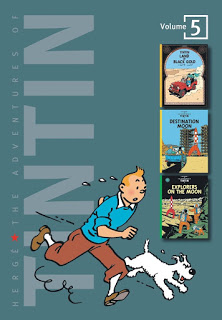
The Adventures of Tintin, Vol 5 by Herge

I am still not your Tintin expert – I’m in the middle of my first reading of this series, seventy years or so after it was published and a good forty years after I was in the target demographic – but I did just read The Adventures of Tintin, Vol. 5 , the first major post-war chunk of the adventures of the Belgian boy reporter (ha!), so I can, I hope, tell you a few things.

I’ve previously gotten through the earlier omnibuses: one , and two , and three , and four . I have not yet found the first two, semi-forgotten books Tintin in the Land of the Soviets and Tintin in the Congo, which are generally considered to be racist and/or dull and/or not up to Herge’s later level; I may get to them eventually, though the library copies I originally expected to read seem to have been quietly removed from circulation since I first thought about reading Tintin.

This volume starts off with Land of Black Gold, the story interrupted by WWII – Herge started it in 1939, was interrupted in 1940 by a small Nazi invasion of Belgium, and did six other books before getting back to this in 1948. [1] I didn’t know that until I read it on Wikipedia a few minutes ago, so major props to Herge and/or his estate for smoothing that transition out. Then it dives into what I see is the last two-book story in Tintin’s history: Destination Moon and Explorers on the Moon, in which a pre-teen Belgian boy, his sea-captain buddy, and their absent-minded professor accomplice become the world’s first astronauts in a program run by a random Eastern European country, because comics, that’s why.

Black Gold does feel pre-war, with some vaguely escalating tensions in the background – mostly seen commercially, in oil prices – but the focus of the plot, as I think was always the case with Tintin, is on individual evil people rather than The Land of the Evil People or SMERSH or anything like that. Oh, the evil people are organized , and come from somewhere, but it’s not the named, re-used Land of the Evil People, it’s just a place where these particular Evil People came from. This one is also deeply colonialist, obviously – how could it be otherwise?

And then Professor Calculus has been recruited by Syldavia to run their space program, because a small Balkan monarchy of course has a space program in 1948. (Admittedly, everyone wanted a space program in 1948, at least on the V2 level, and fictioneers are not obliged to let reality impinge too heavily on their worlds.) A rival country – unnamed but probably Borduria, unless I missed something – attempts skullduggery both before the launch (in Destination) and during the trip to the moon (in Explorers), but, as always in Tintin, is foiled by the forces of good and right and spiky-haired Belgianness.

This series is still the same kind of thing: everything I said about the earlier books still applies. They are very wordy for adventure stories, which makes this small-format omnibus a less than ideal presentation. These pages should be large, to be savored and to let the word balloons be somewhat less overwhelming. The comic relief is deeply slapstick, entirely silly, and mostly successful. The plots aren’t complex, per se, but they are complicated, full of additional wrinkles and problems as Herge rumbles through his stories and makes sure he has sixty-some pages of stuff for Tintin to overcome each time.

I expect I’ll finish up the series, and maybe even find the old suppressed books if I can, because I am a completest. But if you didn’t grow up with these, they’re just OK. Solid adventure fiction for boys, yes. Deathless classics of any kind, no.

[1] It’s all much more complicated than that, and I say “books” when I mean “serialized stories in a series of different magazines, which were then collected into books not always in the same sequence and then re-edited and revised multiple times over the next few decades, including but not limited to during different rounds of translation into English.” But they’re books now.

antickmusingsdyil2auoc8za-6659816 antickmusingsd63t7ie-lg7y-4363041 antickmusingsdqj6idk7rits-3178667

Reposted from The Antick Musings of G.B.H. Hornswoggler, Gent.

The Unbeatable Squirrel Girl, Vol. 8: My Best Friend’s Squirrel by North, Henderson, & Renzi

I’m trying to figure out how far behind I am on Unbeatable Squirrel Girl, and it is surprisingly difficult, since this is a Marvel comic. The series ended in late 2019 with issue 58, but the trade paperbacks are still dribbling out, since they’re all slim. I believe Marvel has only managed to emit Vol. 12, which probably collects issues 47-51, meaning there’s one or two more books yet to come.

But none of this is simple, and places like Wikipedia and the Grand Comics Database and the Marvel Database fail to list those trades at all. But, I am behind, though the series has now ended, so I won’t get any further behind from this point.

Anyway, I’m here to talk about The Unbeatable Squirrel Girl, Vol. 8: My Best Friend’s Squirrel , written by Ryan North, drawn by Erica Henderson, colored by Rico Renzi. It collects issues 27-31 of the second series (let’s not get into that) and Not Brand Ecch #14, which appears to be a 2018 one-shot continuing the numbering of the 1967-69 series, which is exactly what you want to do for a story about a girl who likes squirrels and computer science and whose core audience are six-year-old girls. (Marvel, once again: there’s nothing they can’t make more complicated and difficult for no good reason.)

It follows the previous collections one and two and three and four and the OGN and five and six and seven ; see my posts on those if you’re feeling particularly bored today.

Squirrel Girl is still Doreen Green, second-year computer-science student at Empire State University, and her super-powers are (most obviously) being super-strong and talking to squirrels and (most usefully) actually being a thoughtful, friendly person who can talk out problems, unlike every other human being ever extant in the Marvel Universe. And this volume, as usual, collects a big four-issue plotline in which she defeats a Major Threat (less Major this time, since she’s already run through all of the big Marvel supervillain names) and then a single issue in which odder things happen.

The four-issue story sees Doreen’s best friend, Nancy, and her sidekick, Tippy-Toe, whisked away to a world on the other side of the galaxy where a race of intelligent squirrels (well, squirrels on Earth seem intelligent enough when Doreen talks to them, so maybe I mean civilized?) are under threat from a shakedown from Galactus’s herald the Silver Surfer. The SS says he and his similarly-shiny buddies – all of whom are stereotypically “surfer” types – will leave this planet along if they give all their valuables to the SS and compatriots.

Long-time readers of Marvel comics may well be confused, since the actual SS is more prone to zooming around on a surfboard, emoting at great length in bad pseudo-poetic prose about how sad his life is and how anguished he is and how he desperately needs to find a nice snackable but uninhabited planet or else his master will slaughter billions yet again, oh the misery. They may suspect this is an impostor, and they would be correct.

Eventually, Doreen makes her way to the squirrel planet, along with some allies, and there is a series of confrontations, which all end peacefully, because this is Unbeatable Squirrel Girl. (Doreen does fight the actual SS on sight, which I think is the first time that very hoary superhero trope actually happened in this comic.)

The one-off story is a kind of timeslip tale: an accident with a villain’s weapon strands Doreen and Nancy in hypertime, living much faster than everyone else in New York City. So, over the course of one weekend, they live the entire rest of their lives, leaving written messages for their friends , saving everyone in the city from everything for three whole days, and working on a time machine to save themselves before they die of old age. And maybe doing something else, which is hinted at but not spelled out in this book larger for pre-teens.

Squirrel Girl by North and Henderson was dependably fun and positive and kid-friendly and just about every appreciative adjective I could think of: it was nice down to its core, creating a world that was equally nice, which has never been common in Marveldom. I think these were the last Henderson-drawn issues, so, if I continue, I’ll get to see if whoever came next was able to maintain that sweetness.

antickmusingsdyil2auoc8za-5657182 antickmusingsd63t7ie-lg7y-4101171 antickmusingsdqj6idk7rits-1256100

Reposted from The Antick Musings of G.B.H. Hornswoggler, Gent.