Tagged: You Know: For Kids

Maybe an Artist by Liz Montague

I say this a lot, but audiences are important. If you’re putting something out into the world, and don’t have a sense of who would care about it, it might be because no one will.

But “people like me” is a valid answer. “People like me at age 10” is an even better one. People get quirkier and more specific every year they live; every eighty-year-old is an entirely different microsegment. But kids are still early in that journey; they’re weird and particular but still care about a lot of the same things.

And a good “this is the kind of weird kid I was” book is always welcome. Maybe an Artist  is that kind of book, from cartoonist Liz Montague. It is about her childhood, and it is aimed at people who are children now – or who will be children when they read it; there’s no reason it won’t still be read in thirty years, by the kids of the kids reading it now.

Montague has had cartoons published in The New Yorker, had a strip called “Liz at Large” in Washington City Paper, and did other pretty high-profile cartooning gigs (a Google doodle! illos for the Obama Foundation!), even though she is, if I’m counting correctly, only about twenty-seven.

She gets into that quickly at the end, but Maybe an Artist is about how she got there – it’s the story of how drawing and art were important to her as a child, starting at the age of five in 2001. It’s really tightly focused on Montague, and deeply in her head most of the time. The external stuff of her life is included, some of the time, but it’s all about Montague, and, in the end, all about the pull of creating art and cartoons.

It won, eventually. We know that, because we have the book. But it wasn’t the path Montague or her family thought she was on – she was supposed to get an athletic scholarship to a good school, study something that would lead to a “good” career, and move forward. (And she did a lot of that: Maybe an Artist might be helpful for a lot of driven kids, or kids with demanding parents, to show how you can mostly follow the path laid out for you and still get to exactly the place you want to be.)

Here’s an example: the back cover mentions that the book includes how she “overcame extreme dyslexia through art,” but the book itself never uses the word “dyslexia.” Montague shows her problems with letters, and how she used art to work through it, but this is not a book about problems, or about diagnoses – it’s not that kind of YA graphic novel at all.

Montague has a cartoony, immediate style throughout, and keeps her young self front and center in the book – most of the panels are about Young Liz in one way or another, and Montague gives her younger self a lot of great facial expressions. She also lays out the book in a light, breezy way, with panels most of the time, filling up most of the page a lot of the time, but spilling out or vignetted regularly as well, to give more energy and life to her story.

This is much more a a purely YA book than I usually read; the audience is very much young maybe-artists. But Montague’s voice is true and straightforward and helpful; she gives a great account of the struggles and turmoils of her younger self. So there are joys, even for those who are very much past the maybes of their younger lives.

Reposted from The Antick Musings of G.B.H. Hornswoggler, Gent.

Danger and Other Unknown Risks by Ryan North and Erica Henderson

I have no idea why this very specific and distinctive book has such a generic-sounding title. I could make up stories of epic battles behind the scenes, with different factions jockeying for utterly different titles (How Daisy Saved the World! My Y2K Story – Really! The Second-Worst Journey in the World! What I Did on My Summer Vacation World-Saving Trip! My Story, by Marguerite de Pruitt!), and only able to agree, after months of internecine warfare, on this one. But that would be entirely fictional, if amusing.

What we have is Danger and Other Unknown Risks , a title which could apply to practically any adventure story ever told. This one is written by Ryan North and drawn by Erica Henderson, the team that did the Squirrel Girl  comic for several years to vast acclaim and strong sales and the adoration of a huge number of fans, more of them small and/or female than was typical for a Marvel comic.

The cynical side of me assumes that they did Danger so they could have something similar that they would own; the sunnier side of me assumes that they liked working together so much that they just had to do it again. Either way, this is very much the same kind of story: spunky, young, optimistic heroine in quirky adventures across a world that needs to be saved. Marguerite, though, does not have the plot armor Doreen Green did, does not have any superpowers – she has one spell, which has different effects in every realm and borderline useless everywhere – and, even though she is a well-trained Chosen One, her failure is very much possible.

Our world has been transformed. Y2K happened – several hundred years ago, we think, while being a bit vague on how many hundreds – but was instead a magical transformation. The world is now radically balkanized, with obvious borders between different magical zones where physical laws can work entirely differently. (Our heroine, Marguerite, tosses a toad across borders as a testing mechanism, which implies some places don’t support biological life at all…but we don’t see any of those potentially fatal realms in this book.)

Marguerite has been sent by her uncle Bernard – this is the kind of “uncle” like Donald and Mickey and Scrooge, where the actual parents, if there ever were any, are never even mentioned – on this world-saving mission, along with her companion, the talking dog Daisy. The two need to find three specific artifacts and bring them back to Bernard, who will use them in a massive spell that will Save the World. The world needs saving, Bernard says, because the magical realms are diverging more and more every day, and that will eventually Destroy the World if it is not Saved.

Readers of books for younger people may guess that Not All Is As It Seems. Marguerite and Daisy discover Shocking Revelations and The Real Truth and have to Change Their Mission. But they’re always going to Save the World. Along the way, they steal those three artifacts of the Before Times, run away from and/or confront various nasty or otherwise opposed forces, meet some friends and helpers, and, as always with North/Henderson stories, model positive friendship at all times.

Reader, they do Save The World. How could they do otherwise? And if you’ve been looking for something to scratch that phantom Squirrel Girl itch, this is exactly the thing for it.

Reposted from The Antick Musings of G.B.H. Hornswoggler, Gent.

Snug Harbor Stories by Will Henry

I used to read a lot of strip-comics collections: I assembled a full set of Doonesbury back in the day, kept up with Dilbert until the writing on the wall was too obvious to ignore [1], and had multiple books from probably a dozen other currently-running strips over the years. But, somehow, the past decade or so has made that seem old-fashioned. Maybe because of so many re-runs (Get Fuzzy, for example, which I still read in the paper but can never tell if it’s actually new, because it generally isn’t) and legacy strips (too many to mention, not that I ever cared for most of them in even their earlier forms), maybe because of just the weight of time.

Will Henry’s Wallace the Brave is probably the first newspaper strip where I’ve read two collections in…ten years? More or less? So I may end up grumping about some aspects of the strip, because what I apparently do best is grump, but let me underline that first: I like this a lot more than just about anything else I’ve seen in a newspaper for a bunch of years.

Snug Harbor Stories  is the second collection of the strip, after the self-titled first book . It was published in 2019, soon after the strip started running in newspapers. (If I’m reading the Wikipedia entry correctly, it had an extended try-out on GoComics starting in 2015, the first book hit in 2017, and it was actively syndicated into papers starting in 2018.)

And this is a strip comic, so this book is the same kind of thing as the first book, only more of it. I feel like the strip these days is really focused on the kids and from their point of view – so, for example, the teacher and parents are seen from a metaphorical kid-height rather than being viewpoints – but some of these earlier strips are more obviously coming from an adult perspective. I enjoyed that difference, but great strips develop focus and stick to it, so the overall change is both expected and admirable.

I also thought there were even more inventive layouts in this book than the first one, which could be Henry getting comfortable with what’s possible within the physical constraints of the strip. My mostly-uninformed idea would be that inventiveness is easier digitally – as when the strip was only on GoComics in the early days – than in print, but maybe newspapers are not quite as hidebound and backwards-thinking as I assume.

I still like Spud as a character a lot better than Wallace, though I don’t think I’m supposed to. Wallace can just be too much of a muchness, constructed to be the eternally wide-eyed optimist dreamer, like a Tom Sawyer with all cynicism and sneakiness surgically extracted. Spud is quirky and weird and particular, like normal people. But one of the things that makes a great comics strip is characters you argue about, even in your own head – strips are formed over time, through lots of moments and jokes and recurring ideas. So even my saying, “I like Wallace the Brave the strip better than I like Wallace the character” is a good sign for the strip as a whole.

Anyway, this is about a bunch of six-year-olds, and, like all comics, they’re smarter and more articulate and have more physical freedom of action than any six-year-olds have ever had in the real world. Calvin and Hobbes is the most obvious predecessor: the two strips have a similar sense of infinite possibility and joy in the outdoors and exploration. But Wallace is more about community and friendship – Wallace himself is central, but he’s not the whole strip. He’s the catalyst or the glue, but the strip is as much about his friends and family as about him specifically.

And Henry is an inventive, somewhat loose artist with great sound-effects, a willingness to draw weird stuff (people, places, layouts – all of it) and a complete and total lack of fussiness at all times. It’s a lovely, always organic-looking strip full of energy and life

I still think the best way to discover a strip is day-by-day rather than in clumps; the good ones stick in your mind even in small doses like that. But, when you’re ready for a larger dose, Snug Harbor Stories (and the book before and, so far, two books after) are there.

[1] From the evidence of my bookshelves, I think this was 15-20 years ago, which is even longer than I thought. I also should note that I wrote this post in early January, before the recent unpleasantness. But Dilbert‘s creator has been a wealth of unpleasantness for quite some time now.

Reposted from The Antick Musings of G.B.H. Hornswoggler, Gent.

Nayra and the Djinn by Iasmin Omar Ata

My problem is that I’m always comparing books with other books, or just wanting things out of them that they never promised. This is, of course, a Me Problem, and I try to tamp it down when it hits.

I have a major case today, but I’m going to try to be fair to Nayra and the Djinn , a fine new graphic novel by Iasmin Omar Ata with lovely colors, a positive story, and a message that will resonate with a whole lot of readers younger than I am. Nayra is officially published today; you should be able to find it in all the usual ways and places you find books.

You see, I recently read another book about wishes, Djinni-adjacent, connected to Egyptian culture and Islam – Deena Mohamed’s Shubeik Lubeik  – and anything I say about Ata’s YA book could well be me wanting it to be more like Mohamed’s book for adults. That’s a bad impulse! I want to make that clear. Each book, each story should be precise and particular – even things I might think of as flaws [1] can be important and specific to that book.

I’m saying all this to stop myself from doing it. Let’s see if I succeed.

Nayra Mansour is a younger child in a high-pressure Arab-American immigrant family. She also has only one close friend at school, Rami, and is being bullied – in the mostly psychological, nasty-names way that young women are most likely to attack each other. She’s feeling overwhelmed and increasingly unhappy, especially since it’s Ramadan.

She’s fasting all day, since that’s important to her, but that makes her hungry and cranky and tired – and also gives her bullies more things to use to attack her. It’s a vicious circle that only gets tighter, especially when her parents refuse to listen to her complaints – admittedly, she mostly does the nonspecific teenager-y “you don’t understand me!” yell rather than trying to explain in depth, and they are equally loud and stereotypically tigerish immigrant shouty parents – and just point to her high-achieving, seemingly perfect older siblings.

In case I buried the lede above: this is very much a YA book. Nayra continually fumes and runs away and has titanic, massive emotional swings. I don’t know exactly how old she is, but she is about as sixteen as it is possible to be. Readers who are many decades past their own equivalent life-stage may find they have less patience for that kind of drama, and may wish that Nayra was somewhat more constructive in her problem-solving.

But, instead, she meets a djinn, which the cover and title gives away. Marjan has their own issues and has fled the djinn world for reasons that won’t be explained for a while, but that stays secondary to Nayra’s problems. (Again: YA story. Big, overwhelming, all-encompassing drama.)

Nayra’s new friendship with the djinn supplants her previous friendship with Rami – parenthetically, I kept getting the vibe that the relationship was hugely more important to Rami than it was to Nayra, and wasn’t sure if that was supposed to be a romantic thing, but the relentless focus on Nayra and her emotions leaves that unclear – but having Marjan in her corner generally does make things better for Nayra, as the month of Ramadan rolls on.

On the other hand, Nayra has also secretly applied to transfer to another school, to get away from the bullying. Her parents don’t know this, and would probably not be in favor: they don’t seem to be in favor of anything other than “shut up and be a perfect student.” And the bullying troubles are getting worse. And her schoolwork is taking a hit – from spending time with Marjan, from the bullying, from stress and anxiousness, from spending too much time reading about Arab folklore online, and from the physical stress of Ramadan.

So everything blows up, as it must in a YA story. It does end mostly happily, though Nayra still doesn’t explain things to other people in the ways I hoped she would. Still, she’s young: she has a long time to learn that skill, which will be hugely valuable. I hope she does.

As I said up top, Ata has a colorful art style that pops particularly well when showing the djinn world. The publisher compares their style to Stephen Universe, which I’ve never seen – it looks like plain ‘ol manga-inspired western comics to me, all big eyes and huge gestures, but I am One of the Olds. Nayra is a positive, energetic, very teen-aimed book where problems are resolved non-violently and people do eventually learn to understand each other’s differences, which are all good things. I found it a little too teenager for my personal taste, but I did stop being a teenager in 1989, so that’s only to be expected.

[1] I’m not the authority on flaws. Other people have different opinions.

Reposted from The Antick Musings of G.B.H. Hornswoggler, Gent.

Wallace the Brave by Will Henry

Books aren’t just catapulted out into the world willy-nilly, no matter what some people might think. There’s always a complex calculation on the publisher’s side, to figure out who the audience is and how best to get to those people. The books that don’t have any clear audience, or obvious way to reach them, are the ones that tend to be rejected.

Newspaper cartoons, on the other hand, tend to be thought of as “for everyone,” at least by your less thoughtful kind of editor. And who else is left in the newspaper industry after thirty years of cutting? Admittedly, newspaper strips tend to skew to the older side, like everything else in a dead-tree newspaper, but that can mean that the more thoughtful editors – I’ve been told they still exist, perhaps like the Sasquatch, eternally rumored and never witnessed – try to counter-program, picking features and investigative series and even strip cartoons that appeal to different, even younger audiences.

But I didn’t think Will Henry’s “Wallace the Brave” strip was particularly one to appeal to current-day kids. It’s set in the modern world, as far as I can tell, and it features a central cast of kids, but the tone feels like nostalgia, like an imagined version of what growing up used to be like, before helicopter parents and cellphones and Internet, set in a rinky-dink New England fishing town that might as well be cut off from the rest of the world. It’s a very constructed world, is what I mean: a vision of what never was, but that older generations always talk about as if they lived through it.

But the first collection of that strip, called Wallace the Brave , as is traditional, includes a bunch of activities for kids at the back, so my guess is that someone actually thinks this will primarily appeal to actual kids, and not just adults who want to believe their youth was carefree and wonderful. Those someones may even be right, though I wouldn’t want to try to attract elementary-school kids to a dead-tree newspaper feature these days.

Anyway, this first Wallace book came out in 2017 and collects what looks like roughly the first four to six months of strips. It has 166 pages of comics, and pages are mostly a single daily, so that’s how I do the math. Henry, or his editor, has laid this out more like a graphic novel, with longer strips and sequences – I think mostly Sundays, but potentially week-long continuities, or maybe even new material for the book? – a few panels to each page, making the whole book flow more than the average strip collection.

Oh, don’t get me wrong: the  majority of pages here have what seems to be one daily strip. But Henry sticks to four-panels for a daily less than most, so some dailies are turned sideways to get one long panel in, some have three or five or seven panels arranged in two or three tiers on the page, and some places, as I said, it’s clearly a longer sequence stretching across multiple pages.

The strips are about a kid named Wallace – that’s him at the right on the cover. He’s the traditional pushy dreamer for stories like this, the guy who wants to do everything and experience it all, impatient with rules and limitations and always ready to do “real” things. The two overlapping circles of the cast are his family (fisherman father; stay-at-home mother; younger brother Sterling, who is not quite as feral as he later becomes in these early strips) and his friends at school (neurotic best friend Spud, overwhelming new girl Amelia, teacher Mrs. Macintosh).

Wallace the Brave is not a direct descendant of Peanuts, but Henry’s kids are smarter, more thoughtful, and better-spoken than their real-world counterparts in the same ways Schulz’s were; they’re neither realistic six-year-olds nor the doll-like joke-engines of strips like Family Circus. And what they do is in the vein of early Peanuts, or Calvin & Hobbes – more-or-less what real kids do, only more so. Sometimes more so because that’s what makes it funny, sometimes more so because that’s the “perfect childhood” mythology here. Sometimes both.

Henry has a great illustrative line, detailed and energetic – it reminds me of a lot of the great strip cartoonists of a century ago, back when they had more space for extra detail and complication.

This is a fun strip, which I started reading maybe a year ago, maybe a bit less. You can search out the books if you want – I think there are three more after this one, so far – but the best way to read a daily is daily, so either look for it in your paper (assuming you have one) or check it out on GoComics , and slot into its daily routines.

Reposted from The Antick Musings of G.B.H. Hornswoggler, Gent.

Adventuregame Comics, Vol. 1: Leviathan by Jason Shiga

Just over a decade ago, Jason Shiga made a big, complex story engine in book format, called Meanwhile… , telling a choose-your-own-adventure-style story with clusters of comics panels connected by “pipes” and numbers, driven by the reader’s choices. It was twisty, it was complex, it was inventive, it was brilliant, it was a hell of a lot of fun. It rewarded an obsessive re-reading, to get to every page, every path, and was equally amusing and thought-provoking.

As far as I can tell, there’s been nothing else like it since – not from Shiga, not from anyone else. But this fall, what looks to be the first in a series with somewhat smaller (presumably easier-to-achieve) goals appeared, to show that Shiga is back with his pipes and story choices.

That’s Adventuregame Comics, Vol. 1: Leviathan . This one is a small-format book, which cuts down the amount of real estate devoted to the story, and it’s a more straightforward D&Dish adventure: “you” are an adventurer in a tavern in a fantasy land, and “you” get hired by an old sea captain to retrieve a fabled artifact that is at the center of your land, Cloud Harbor.

The story is much simpler than Meanwhile: there’s a “good” ending and a “bad” ending, but all of the other mishaps that could potentially lead to other bad endings tend to dump “you” on an island for exiles and miscreants, and, if you paid attention, you know how to get back from that island to the mainland.

In terms of story structure, if the average choose-your-adventure book is a branching bush – a few choices lead to a lot of different, mostly unpleasant endings – then Leviathan is a latticework, with multiple paths through and around it but almost always another connection that loops back to places you’ve been before.

So, while reading this book, you may find certain sequences of pages come up multiple times, especially navigating around this small world. In that way, it’s a lot like an computer adventure game: even the way Shiga draws the world-view pages echoes classic games like Zelda and early Pokemon titles. The cover reading line does say “Part comic! Part maze! Part game!” and that is roughly true, though the maze elements are pretty simple.

Shiga has always been a rationalist, both at the base level of his stories and in how he works out permutations of his premises. I don’t want to give away the details of Leviathan, but that’s still the case here, even if a fantasy world seems to be an odd choice for such a science-focused creator.

In the end, this is fun and entertaining, with a lot of small details that are important when looping back around and a mostly-serious tone. It’s not as ambitious as Meanwhile, and doesn’t hit the heights of that previous book, but it’s a good, inventive story-machine mostly for younger readers. And the promise of more books like this is also intriguing: will they also be set in Cloud Harbor, or somewhere nearby, or will they be entirely separate stories? With Shiga, I would always bet on the side of complexity and connection, but we’ll have to see.

Reposted from The Antick Musings of G.B.H. Hornswoggler, Gent.

Delicates by Brenna Thummler

I don’t want to say there’s always a sequel…but, these days, it’s the way to bet. Anything that has any degree of success will have a follow-up, telling more of the story or doing as much of the same thing as possible.

So when Brenna Thummler’s first graphic novel, Sheets , was an unexpected success a few years ago, what would her next project be?

Yes, obviously: the direct sequel Delicates , which came out three years later (in 2021). And, though I might sound dismissive, Delicates does all the things a good sequel should: it starts from the end of the first book (rather than rehashing the same story/issues/ideas), adds more details and richness to the world, examines slightly different (but related) concerns, and moves the overall story forward.

Sheets took place, in retrospect, in the fall of Marjorie Glatt’s seventh-grade year. (We didn’t know then exactly how old she was; we did roughly know the time of year.) Delicates jumps forward a bit, to the start of another school year. Summer is ending: Marjorie is about to enter eighth grade.

In the wake of the events of Sheets, Marjorie has a new friend group, mostly because the boy she has a crush on, Colton, is part of it. The rest are all girls, and at the center is Tessi, a mean-girl-type who controls the conversation and is low-key angry most of the time. Tessi has her own issues, mostly with a mother who is trying, in a well-meaning way but not one that has much chance of luck with the terminally sour and image-obsessed Tessi, to engage and lighten up her daughter. But we’re not really on Tessi’s side – we don’t have an antagonist here as we did with Mr. Saubertuck in Sheets, but she’s pretty close.

Wendel the ghost is still Wendel, still basically the same. That’s usually the deal with ghosts, of course. If you want to change, you have to do it before dying.

And there’s a new central character: Eliza, the girl on the cover. She’s the oldest daughter of a favorite teacher at this middle school, has just been held back to repeat eighth grade, and is clearly on the spectrum somewhere. (No specific diagnosis is given in the book: she’s just who she is. But she has obsessions and verbal tics, and I may just be more prone to notice those things.) Her particular obsessions are photography, ghosts, and their overlap: she spends a lot of time trying to photograph ghosts.

She doesn’t know ghosts are real – or, rather, doesn’t know how ghosts actually work in Thummler’s fictional world. She’s pretty sure ghosts are real. I don’t know if she pictures them as Charlie Brown kids-in-sheets, but that’s what they are here.

Delicates is partially a book about fitting in: Eliza is too weird, too specific, to really fit in, Marjorie is weird but can cram herself into a shape Tessi & crew will be friends with, and Wendell only really has Marjorie, so he hates any ways she changes that makes her less friendly to him.

It’s also, like Sheets, a book in which death looms, always off the page and never specifically mentioned, but there all the time. All of Marjorie’s family is still dealing with her mother’s death: her father is engaging more with life now, but seems to be running around trying to do all the things his wife used to do, to keep all the old plates spinning, and to tightly control the few things he feels competent to control. Her kid brother Owen is doing something similar, on the level of a first-grader. And Marjorie, of course, is trying to be a “normal” teenager – have a friends group, be part of the group, maybe have a boyfriend if she can ever figure that out.

By the end, they’ll all have to be themselves instead of the people they’re trying to be. This isn’t exactly a book with a moral, but the story it’s telling aims in that direction: be who you actually are, and let other people do the same. Those are excellent things to remember, and Thummler tells a good story around them.

This is most obviously for people around Marjorie and Eliza’s age – the ones figuring out who they are, alone and with their parents and with their friends and with any potential boy/girlfriends. But, like all good YA, it’s a fine story even for those of us who have been pretty sure who we are for a few decades now, since we sometimes can still tend to forget.

Reposted from The Antick Musings of G.B.H. Hornswoggler, Gent.

The Girl from the Sea by Molly Knox Ostertag

Morgan Kwon knows exactly how her life is going to go. She’s going to get through highschool, being exactly the person she seems to be now, with exactly the same friends, and then she is going to get off Wilneff Island forever, go to some big city, and begin her real life as the person she really is. All she has to do is keep everything packed up in the right boxes until then, and everything will be fine.

Narrator: everything will not be fine

Morgan is at the center of Molly Knox Ostertag’s mid-grade graphic novel The Girl from the Sea , and I think every reader – even those on the young and thoughtless end of that age-band – will sense that Morgan protests too much, that she can’t keep all of the boxes separate. Her parents have already separated when the story starts, so that’s one box broken up…and that, of course, is the point: she’s trying to control the things she thinks she can control, because something so central to her life was just totally uncontrolled.

In the opening pages of Girl from the Sea, Morgan slips on some rocks and nearly drowns. She’s saved by what she thinks is a cute girl, Keltie. And, if we readers are paying attention, we notice one very big box that she’s trying to keep separate and closed: that she likes girls. She thinks that’s got to stay hidden until she gets away, that it can only be a piece of her eventual adult life.

But Keltie is not just a cute girl: she’s something more special, and already loves Morgan. She’s loud and pushy and wants things and can show Morgan different ways of viewing and living her life.

Some of that is a metaphor for coming out. But a lot of it is literal: Keltie is a selkie, transformed from seal to girl, and with a lot of the traditional folkloric issues. (Ostertag plays a bit with reader expectations for some of these, I think, especially Keltie’s skin, but she’s not retelling any specific story or doing the usual folkloric stuff here.)

So: this is a story about whether Morgan will let herself unbend, if she will let herself break through her own boxes and be the person she actually is right now. And what will happen along the way: do her friends and family react the way she fears they will?

Oh, and Keltie has something pretty important she needs to do, too – she’s not in human form for nothing. Oh, sure, she’s crazy about Morgan, too – that definitely is part of it – but she has a mission for her people as well, and that’s not optional.

I liked Girl from the Sea better than Ostertag’s Witch Boy  books – those were fine, but had a slight whiff of formula about them, a sense that they were Teaching Lessons and Being Good Models and all that. Girl from the Sea feels more personal and specific, tied to a specific place Ostertag knows well and centered in a deep but new relationship. I also like the way it implies conflicts that never happen – there are things that are huge in Morgan’s head but don’t really exist in the real world. It’s still very much a book for younger readers, so people even more cynical and world-weary than me might find it too too, but it’s the kind of book I love to see for young readers, the kind that tells them they can be exactly the people they really are and that they have good, loving places in the world that they just need to find or make.

That may not always be true, in the actual real world. But it’s an important story, and it needs to be said as often as possible.

Reposted from The Antick Musings of G.B.H. Hornswoggler, Gent.

The Thud by Mikael Ross

Americans are more likely to take this book’s cover wrongly. There’s a young man, tying something around his neck, and a title that could be a vivid, short, violence-tinged name.

Americans are likely to jump into some kind of superhero explanation , either real in the world of the story or imagined by the protagonist – to assume, first of all, that this young man is “The Thud,” and the story is about his adventures, in whatever mode.

The Thud  is not a person. The Thud is an event. It’s a moment, one that led this young man – his name is Noel – to stand outside that hospital, clutching that blanket.

I’ve had Thuds in my life: moments where everything changes. If you’re old enough, you have, too. The point of a Thud is that it’s unexpected, and that it’s usually not happy. Something breaks, something shatters, something is gone forever.

Noel Flohr lives in Berlin with his mother as The Thud opens. He’s twentyish, but clearly has some kind of developmental disability: he’s loud, and not good at social interaction, and seems to be obsessed with a few things. We don’t know his diagnosis. But we know he needs help, that he needs support to make it through life. And his mother is that help and support: it’s just the two of them against the world, and that’s fine with them.

Thud.

One night, Noel heard a noise. He finds his mother lying on the floor, a pool of blood by her head. He knows enough to call the emergency services. He saves her life, probably.

But she’s had a stroke. She’s in a medically induced coma. It is no longer the two of them against the world.

Noel is put in the care of a guardian, who he thinks of as “the man with the ‘stache.” He’s sent to live in a group home in the village of Neuerkerode, which seems to be largely populated by the developmentally disabled and their minders.

The bulk of the story happens from that point: how Noel settles into Neuerkerode, the people he meets there, his new way of living. It’s told in episodes, moments in Noel’s new life. There’s Valentin, another young man in the same home, who becomes something like his new best friend. There’s a woman he is attracted to, and another woman who may be attracted to him. All of them are disabled in some way, all of them have some kind of trouble interfacing with the “normal” world, something that led to them living in Neuerkerode.

So I have a warning for readers of The Thud. We often expect a story to have a certain shape, to be about people who grow and change, who encounter new things and become better people, who fall in love and build lives with others.

Noel, and most of the other characters in The Thud, aren’t capable of that kind of easy growth, certainly not in any short period of time. They are not going to “get better.” They are not going to “learn to be normal.” They are not going to “get over it.” This is who they are; these are the lives they have to lead.

What they can do – what they do do – is to live those lives, as best they can, within the guardrails those neurotypical guardians make for them. (And some readers may find there’s a lot of  leeway in what the inhabitants of Neuerkerode are allowed!) They may act out, they may be inappropriate, they may try to do things for reasons that seem weird or wrong from a neurotypical point of view. But they’re living their lives, as best they can.

That’s what The Thud is about: how Noel lives when the way he lives is completely upended. It’s based on true stories: Neuerkerode is a real place, though I think Noel is completely fictional. Mikael Ross visited it several times while working on this graphic novel: this isn’t an “official” publication of that institution, but it’s close. 

The Thud is meant for younger readers: people a few years younger than Noel, probably in their teens. Maybe neurotypical, maybe not. Maybe German, maybe American, maybe from other places. I suspect a lot of those younger readers will get more out of The Thud than their parents will; I’ve already seen a few wrong-headed reviews by American adults , too focused on their own guardrails and expectations.

If you’re not too rigid in your own guardrails, you should read it. If there’s someone not neurotypical in your life – yourself, a child, a friend, a spouse, whoever – you should read it. If you wonder what would happen to your life after a Thud…read it.

Reposted from The Antick Musings of G.B.H. Hornswoggler, Gent.

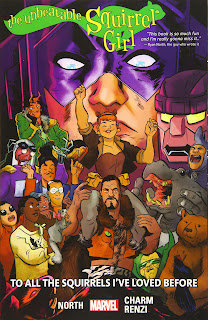
The Unbeatable Squirrel Girl, Vol. 12: To All the Squirrels I’ve Loved Before by North, Charm, & Renzi

So I have no idea if the Unbeatable Squirrel Girl series ended at #50 for actual economic reasons (slowing sales), for fake economic reasons (Marvel wanted to concentrate only on comics that can have ten different covers), or for real creative reasons (Ryan North ran out of ways to tell the same “Doreen Green faces Big Marvel Villain, and gets BMV to talk about feelings rather than punching”). It may have even been a reason I’m not considering – perhaps the combined forces of global squirrels realized this comic was too close to reality for their liking , and they’ve used their squirrely wiles to suppress it.

But, for whatever reason, Unbeatable Squirrel Girl – at that point the longest-running Marvel comic (hey! that’s another possibility: it annoyed someone in the Marvel hierarchy that such an off-brand, for-female-and-young-people comic was so prominent!) – ended with issue #50, in January of last year.

The very last storyline was collected in this, the last collection: The Unbeatable Squirrel Girl, Vol. 12: To All the Squirrels I’ve Loved Before . As with the previous few books, the creative team was writer Ryan North, artist Derek Charm, and color artist Rico Renzi, with a quick guest appearance from original series artist Erica Henderson.

In that book, Squirrel Girl’s greatest foe gathers up all of her nearly-greatest foes and executes a carefully-orchestrated plan to first unmask Doreen Green (she who is Squirrel Girl) and then kill her.

Spoiler: it doesn’t work. Squirrel Girl is not murdered in the last issue of her comic. This may seem to be a silly thing to mention , but in modern-day superhero comics, the opposite is actually somewhat more likely.

Anyway, there’s a big fight – no, really, really big – involving nearly every character who has appeared in all fifty-eight issues of Squirrel Girl, but, in the end, niceness wins, with only a minor case (lampshaded in the actual book) of deus ex machina. This book is mostly fight scene: in that way, it’s more like the rest of the superhero millieu than most of the previous Squirrel Girl stories

And Doreen nearly comes out of the closet near the end, in a way that gives plausible deniability to North but which only the very youngest and most sheltered of the Squirrel Girl audience will miss. And I can wish that was clearer or louder, but maybe this is as good as it could get.

I’ve written far too much about this series – witness my archives – so I think I’ll leave it there. This was a nice comic that went almost entirely against the grain of modern superhero comics, in ways that were all good and positive. It was sometimes a bit too Girl Power! for me , but I am not a girl, and my opinion is not that important.

antickmusingsdyil2auoc8za-8698850 antickmusingsd63t7ie-lg7y-6797095 antickmusingsio6bqooxpldabhqqrw4yl1k4cex4hpknuu-7346521 antickmusingsio6bqooxpldabhqqrw4yl1kf7zbnmyn0lo-3008501 antickmusingsio6bqooxpldabhqqrw4yl1kv_sglipbpwu-8603108 antickmusingsdqj6idk7rits-8114670 antickmusingsio6bqooxpldabhqqrw4yl1kgin9vfwoqvq-4185762

Reposted from The Antick Musings of G.B.H. Hornswoggler, Gent.